MCQ
$X$ compound reacts with $\text{Na}$ to give $\mathrm{CH}_3 \mathrm{CH}_2 \mathrm{CH}_2 \mathrm{CH}_3$​. The compound $X$ is :
  • A
    $ \mathrm{CH}_3 \mathrm{CH}_2 \mathrm{OH} $
  • $ \mathrm{CH}_3 \mathrm{CH}_2-\mathrm{Cl} $
  • C
    $ \mathrm{CH}_3-\mathrm{CH}_3 $
  • D
    $ \mathrm{CH}_3-\mathrm{CH}_2-\mathrm{CH}_2-\mathrm{CH}_2-\mathrm{OH}$
Answer

Correct option: B.
$ \mathrm{CH}_3 \mathrm{CH}_2-\mathrm{Cl} $
$\mathrm{CH}_3 \mathrm{CH}_2 \mathrm{Cl}+2 \mathrm{Na}+\mathrm{ClCH}_2 \mathrm{CH}_3 \rightarrow \mathrm{CH}_3-\mathrm{CH}_2-\mathrm{CH}_2 \mathrm{CH}_3+2 \mathrm{NaCl}$
This is Wurtz reaction.

Need a full question paper?

Generate a complete, print-ready paper with questions like this in minutes — across 16+ boards, with answer keys.

Start Generating Free

Similar questions

The solubility product of silver sulphide is $3.2 \times {10^{ - 11}}.$ Its solubility at the experimental temperature is 
From the ground state electronic configuration of the elements given below, pick up the  one with highest value of second ionization energy
If a solution of $10^{-6}\, M\, HCl$ is diluted $100$ times, the $pH$ of solution is
Match the conditions and the temperature for the 'fusion' process of $H_2O(s)$ at $1\, atm$ pressure

Condition Temperature
$(1)$ Spontaneous $(p)$ $273\,K$
$(2)$ At equilibrium $(q)$ $260\, K$
$(3)$ Non-spontaneous $(r)$ $280\, K$


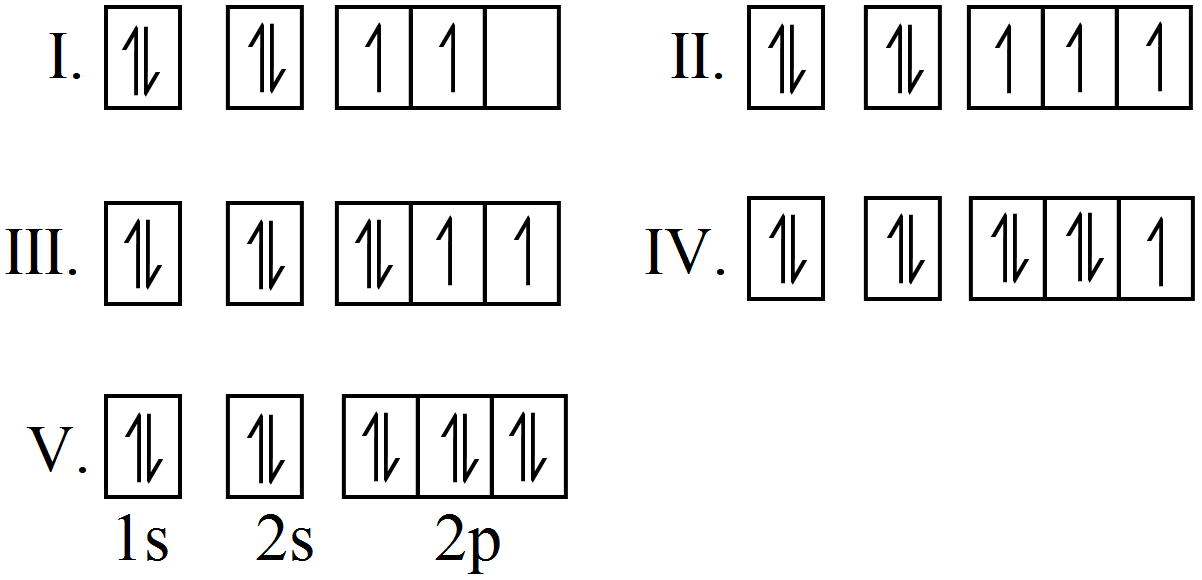
Electronic configuration of five elements $\ce{I, II, III, IV, V}$ is mentioned below. In the above configuration element $\ce{I, II, III, IV}$ and $\ce{V}$ represent as :
In which of the following molecule electron density on oxygen atom is not correctly mentioned ?
Vapour pressure of $\ce{CCl_4}$ at $25^\circ C$ is $\ce{143 mm Hg. 0.5gm} $ of a non $-$ volatile solute $($mol. wt. $65)$ is dissolved in $100\ ml$ of $\ce{CCl_4}$​. Find the vapour pressure of the solution : $($Density of $\ce{CCl_4 = 1.58gm/cm^3)}$
The $IUPAC$ name of $\begin{matrix}
   \,\,\,\,\,\,\,\,\,\,\,\,\,\,\,\,\,\,\,\,\,\,\,\,\,\,\,\,\,\,\,\,\,\,\,\,\,\,\,\,O  \\
   \,\,\,\,\,\,\,\,\,\,\,\,\,\,\,\,\,\,\,\,\,\,\,\,\,\,\,\,\,\,\,\,\,\,\,\,\,\,\,||  \\
   C{{H}_{3}}-CH-C{{H}_{2}}-C-Br  \\
   |\,\,\,\,\,\,\,\,\,\,\,\,\,\,\,\,\,\,\,\,\,\,\,\,\,\,\,\,  \\
   C{{H}_{3}}\,\,\,\,\,\,\,\,\,\,\,\,\,\,\,\,\,\,\,\,\,\,\,\,  \\
\end{matrix}$ is
$p{K_a}$ value of the strongest acid among the following is
At $25^{\circ} C$ and 1 atm pressure, the enthalpies of combustion are as given below:

Substance $H _{2}$ $C ($ graphite $)$ $C _{2} H _{6}( g )$
$\frac{\Delta_{ C } H ^{\Theta}}{ kJmol ^{-1}}$ $-286.0$ $-394.0$ $-1560.0$

The enthalpy of formation of ethane is ........ .