MCQ
$X$ different wavelengths may be observed in the spectrum from a hydrogen sample if the atoms are exited to states with principal quantum number ${n}=6$ ? The value of ${X}$ is ..... .
  • A
    $11$
  • $15$
  • C
    $10$
  • D
    $8$

Answer

Correct option: B.
$15$
b
No. of different wavelengths $=\frac{{n}({n}-1)}{2}$

$=\frac{6 \times(6-1)}{2}=\frac{6 \times 5}{2}=15$

Need a full question paper?

Generate a complete, print-ready paper with questions like this in minutes — across 16+ boards, with answer keys.
Start Generating Free

Similar questions

An electron and a proton are in a uniform electric field, the ratio of their accelerations will be
Which of the following particle will describe the smallest circle when projected with the same  velocity perpendicular to the magnetic field ?
Particle $A$ of mass $m_{A}=\frac{m}{2}$ moving along the $x-$axis with velocity $v_{0}$ collides elastically with another particle $B$ at rest having mass $m _{ B }=\frac{ m }{3}$ If both particles move along the $x-$axis after the collision, the change $\Delta \lambda$ in $de-$Broglie wavelength of particle $A,$ in terms of its $de-$Broglie wavelength $\left(\lambda_{0}\right)$ before collision is
The electric charge in uniform motion produces
The electrical resistance of depletion layer is large because
When is the angle of dip at a place equal to $45^{\circ}$ ?
Average energy stored in a pure inductance L when a current i flows through it, is
Can a metal be used as a medium for dielectric
The work which is required to be done to make an arrangement of four particles each having a charge $+q$ such that the particles lie at the four corners of a square of side $a$ is .......
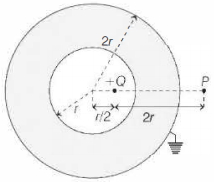
Consider an initially neutral hollow conducting spherical shell with inner radius $r$ and outer radius $2 r$. A point charge $+Q$ is now placed inside the shell at a distance $r / 2$ from the centre. The shell is then grounded by connecting the outer surface to the earth. $P$ is an external point at a distance $2 r$ from the point charge $+Q$ on the line passing through the centre and the point charge $+Q$ as shown in the figure. The magnitude of the force on a test charge $+q$ placed at $P$ will be