MCQ
$Xe{F_4}$ on partial hydrolysis produces
  • A
    $Xe{F_2}$
  • $XeO{F_2}$
  • C
    $XeO{F_4}$
  • D
    $Xe{O_3}$

Answer

Correct option: B.
$XeO{F_2}$
b
(b) Partial hydrolysis; $Xe{F_4} + {H_2}O \to $$XeO{F_2} + 2HF$

Complete hydrolysis;

$2Xe{F_4} + 3{H_2}O\, \to $$Xe + Xe{O_3} + {F_2} + 6HF$

Need a full question paper?

Generate a complete, print-ready paper with questions like this in minutes — across 16+ boards, with answer keys.

Start Generating Free

Similar questions

The condition for a stable wave is
For the reversible reaction in equilibrium

${N_2}(g)\, + \,{O_2}(g)\,\underset{{{k_2}}}{\overset{{{k_1}}}{\longleftrightarrow}}\,2NO(g)$

$C_0=Ce^{-2.1 \times 10^{-3}t}$ for the forward reaction and $C'_0=C'e^{-4.2 \times 10^{-4}t}$ for the backward reaction, hence $K_c$ for the above equilibrium is :-
Elements of atomic number $6$ is placed in
Which of the following does not reduce fehling's solution ?
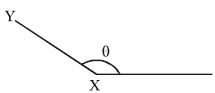
Which bond angle $\theta $ would result in the maximum dipole moment for triatomic molecule $XY_2$ shown below
$9.3 \mathrm{~g}$ of aniline is subjected to reaction with excess of acetic anhydride to prepare acetanilide. The mass of acetanilide produced if the reaction is _________$100 \%$ completed is $\times 10^{-1} \mathrm{~g}$. (Given molar mass in $\mathrm{g} \mathrm{mol}^{-1} \mathrm{~N}: 14, \mathrm{O}: 16, \mathrm{C}$ : $12, \mathrm{H}: 1)$
Match List I with List II 
List I (Compound)List II(pK $K _{ a }$ value)
A.EthanolI.10.0
B.PhenolII.15.9
C.m-NitrophenolIII.7.1
D.p-NitrophenolIV.8.3
Choose the correct answer from the options given below :-
(image) $\xrightarrow{{\begin{array}{*{20}{c}}
  {AlC{l_3} + C{H_3} - C - Cl} \\ 
  {\,\,\,\,\,\,\,\,\,\,\,\,\,\,\,\,\,\,\,\,\,\,||\,\,\,} \\ 
  {\,\,\,\,\,\,\,\,\,\,\,\,\,\,\,\,\,\,\,\,\,\,O\,\,\,} 
\end{array}}}$ major product
Consider the following complexes.

$\left[\mathrm{CoCl}\left(\mathrm{NH}_3\right)_5\right]^{2+}, \quad\left[\mathrm{Co}(\mathrm{CN})_6\right]^{3-} \text {, }$

$(A)$                                        $(B)$

$\left[\mathrm{Co}\left(\mathrm{NH}_3\right)_5\left(\mathrm{H}_2 \mathrm{O}\right)\right]^{3+}, \quad\left[\mathrm{Cu}\left(\mathrm{H}_2 \mathrm{O}\right)_4\right]^{2+}$

$(C)$                                       $(D)$

The correct order of $A$, $B$, $C$ and $D$ in terms of wavenumber of light absorbed is :

Which of the following solid salt on heating with solid $K_2Cr_2O_7$ and conc. $H_2SO_4$ orange red vapours are evolved which tum aquous $NaOH$ solution yellow ?