MCQ
Yellow light is refracted through a prism producing minimum deviation. If $i_1$ and $i_2$ denote the angle of incidence and emergence for the prism, then ..........
  • $i_1=i_2$
  • B
    $i_1 > i_2$
  • C
    $i_1 < i_2$
  • D
    $i_1+i_2=90$

Answer

Correct option: A.
$i_1=i_2$
a
(a)

At angle of minimum deviation angle of emergence of prism is same as angle of incidence.

Need a full question paper?

Generate a complete, print-ready paper with questions like this in minutes — across 16+ boards, with answer keys.
Start Generating Free

Similar questions

The ultimate individual unit of magnetism in any magnet is called
A diode, a resistor and a 50Hz AC source are connected in series. The number of current pulses per second through the resistor is:
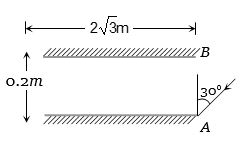
Two plane mirrors. $A$ and $B$ are aligned parallel to each other, as shown in the figure. A light ray is incident at an angle of $30^\circ $ at a point just inside one end of $A.$ The plane of incidence coincides with the plane of the figure. The maximum number of times the ray undergoes reflections (including the first one) before it emerges out is
The angle of minimum deviation measured with a prism is $30^{\circ}$ and the angle of prism is $60^{\circ}$. The refractive index of prism material is
A thin wire of length $2\,m$ is placed perpendicular to the $x-y$ plane. It is moved with velocity $\overrightarrow v  = \left( {2\hat i + 3\hat j + \hat k} \right)\,m/s$ through a region of magnetic induction $\overrightarrow B  = \left( {\hat i + 2\hat j} \right)\,wb/{m^2} .$ The potential difference induced between the ends of the wire is......$volts$
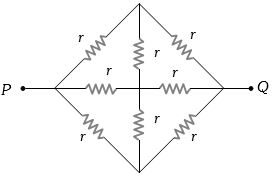
The equivalent resistance between the points $P$ and $Q$ in the network given here is equal to  ................ $\Omega$ (given $r = \frac{3}{2}\Omega $)
A plot of the number of neutrons $(N)$ against the number of protons ( $P$ )of stable nuclei exhibits upward deviation from linearity for atomic number, $Z>20$. For an unstable nucleus having $N / P$ ratio less than $1$ , the possible mode($s$) of decay is(are)

($A$) $\beta^{-}$-decay ( $\beta$ emission)

($B$) orbital or $K$-electron sasture

($C$) neutron emission

($D$) $\beta^{+}$-decay (positron emission)
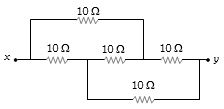
The equivalent resistance between $x$ and $y$ in the circuit shown is ............. $\Omega$
The speed of an electron having a wavelength of ${10^{ - 10}}m$ is ................. $ \times {10^6}\,m/s$
Two identical parallel plate capacitors are connected in series to a battery of $100\,V$. A dielectric slab of dielectric constant $4.0$ is inserted between the plates of second capacitor. The potential difference across the capacitors will now be respectively