Question
You are facing a circular wire carrying an electric current. The current is clockwise as seen by you. Is the field at the centre coming towards you or going away from you?

Answer

According to the right-hand thumb rule, if we curl the fingers of our right hand in the direction of the current flowing, then the thumb will point in the direction of the magnetic field developed due to it and vice versa. Therefore, in this case, the field at the centre is going away from us.

Need a full question paper?

Generate a complete, print-ready paper with questions like this in minutes — across 16+ boards, with answer keys.
Start Generating Free

Similar questions

The light emitted in the transition n = 3 to n = 2 in hydrogen is called $\text{H}_\alpha$ light. Find the maximum work function a metal can have so that $\text{H}_\alpha$ light can emit photoelectrons from it.
Write formula for Bohr's frequency.
A magnetic field of $100 \mathrm{G}\left(1 \mathrm{G}=10^{-4} \mathrm{~T}\right)$ is required which is uniform in a region of linear dimension about 10 cm and area of cross-section about $10^{-3} \mathrm{~m}^2$. The maximum current-carrying capacity of a given coil of wire is 15 A and the number of turns per unit length that can be wound round a core is at most 1000 turns $\mathrm{m}^{-1}$. Suggest some appropriate design particulars of a solenoid for the required purpose. Assume the core is not ferromagnetic.
Light falls from glass $(\mu=1.5)$ to air. Find the angle of incidence for which the angle of deviation is 90°.
State the principle of working of a cyclotron. Write two uses of this machine.
12J of work has to be done against an existing electric field to take a charge of 0.01C from A to B. How much is the potential difference $V_B- V_A$?
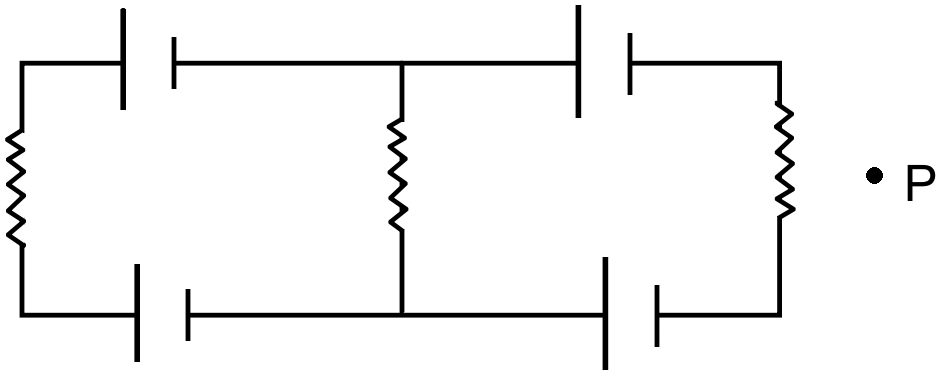
Each of the batteries shown in figure has an emf equal to 5V. Show that the magnetic field B at the point P is zero for any set of values of the resistances.
The force between two point charges kept at a distance r apart in air is F. If the same charges are kept in water at the same distance, how does the force between them change?
Apply the first law of thermodynamics to a resistor carrying a current i. Identify which of the quantities $\Delta\text{Q},\ \Delta\text{U}$ and $\Delta\text{W}$ are zero, which are positive and which are negative.