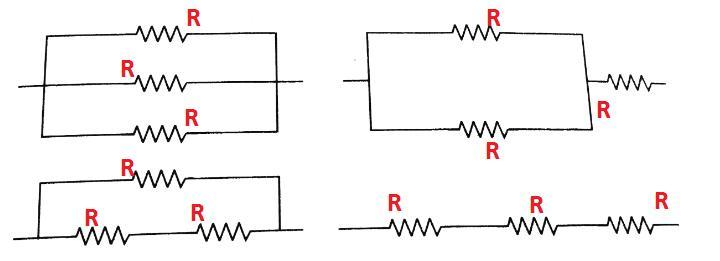
MCQ
Your are given three equal resistances. In how many combinations can they be arranged?
- AThree
- BFour
- CFive
- DTwo
Generate a complete, print-ready paper with questions like this in minutes — across 16+ boards, with answer keys.
Kinetic energy of emitted cathode rays is dependent on
|
(a) Only voltage |
|
(b) Only work function |
|
(c) Both (a) and (b) |
|
(d) It does not depend upon any physical quantity |
The part of a transistor which is heavily doped to produce a large number of majority carriers, is
|
(a) Base |
(b) Emitter |
(c) Collector |
(d) None of these |
Specific rotation of sugar solution is 0.01 SI units. 200  of impure sugar solution is taken in a polarimeter tube of length 0.25m and an optical rotation of 0.4rad is observed. The percentage of purity of sugar is the sample is
|
(a) 80% |
(b) 89% |
(c) 11% |
(d) 20% |
A thin prism  with angle 6° and made from glass of refractive index 1.54 is combined with another thin prism P2 of refractive index 1.72 to produce dispersion without deviation. The angle of prism
  will be
|
(a) 5° 24’ |
(b) 4° 30’ |
(c) 6° |
(d) 8° |
The magnetic flux linked with a coil, in webers, is given by the equations ∅ =  Then the magnitude of induced e.m.f. at t = 2 second will be
|
(a) 2 volt |
(b) 4 volt |
(c) 8 volt |
(d) 16 volt |
Number of spectral lines in hydrogen atom is
|
(a) 3 |
(b) 6 |
(c) 15 |
(d) Infinite |
The continuous X-rays spectrum produced by an X-ray machine at constant voltage has
| (a) A maximum wavelength | (b) A minimum wavelength |
|
(c) A single wavelength |
(d) A minimum frequency |