Question
Zener diode works on:

Answer

  1. Reverse bias
Explanation:
We know that zener diode works on the reverse bias. When the reverse bias is equal to the break-down voltage, the voltage across the zener remains almost constant and the current increases rapidly.

Need a full question paper?

Generate a complete, print-ready paper with questions like this in minutes — across 16+ boards, with answer keys.
Start Generating Free

Similar questions

When does a magnetic dipole possess maximum potential energy inside a magnetic field?
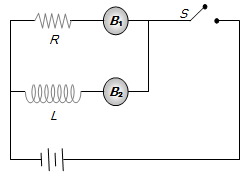
The adjoining figure shows two bulbs $B_1$ and $B_2$ resistor $R$ and an inductor $L$. When the switch $S$ is turned off
the anode is kept at positive potential with respect to the cathode:
The wavelength of $K_\alpha\ X-$rays produced by an $X-$ray tube is $0.76 \mathring A .$ The atomic number of the anode material of the tube is
One bar magnet is kept in the direction of north-south such that its north pole is towards north.The direction of points of zero magnetic field is towards which side of the centre of the magnet:
A thermoelectric refrigerator works on(a) Joule effect(b) Seeback effect(c) Peltier effect(d) Thermonic emission
       
In a transformer, the number of turns in primary coil and secondary coil are 5 and 4 respectively. If 240 V is applied on the primary coil, then the ratio of current in primary and secondary coil is
Assertion  :   A loosely round helix made of stiff wire is suspended vertically with the lower end just touching a dish of mercury. When a current is passed through the wire, the helical wire executes oscillatory motion with the lower end jumping out of and inside of mercury.
Reason     : When electric current is passed through helix, a magnetic field is produced both inside and outside the helix.(a) If both assertion and reason are true and the reason is the correct explanation of the assertion.(b) If both assertion and reason are true but reason is not the correct explanation of the assertion.(c) If assertion is true but reason is false.(d) If the assertion and reason both are false.


When objects at different distances are seen by the eye, which of the following remain constant?
The velocity of light emitted by a source $S$ observed by an observer $O,$ who is at rest with respect to $S$ is $c.$ If the observer moves towards $S$ with velocity $v,$ the velocity of light as observed will be