MCQ
Zero dipole moment is present in
  • A
    $N{H_3}$
  • B
    ${H_2}O$
  • C
    $cis\, 1, \,2-dichloroethene$
  • $trans\, 1,\, 2-dichloroethene$

Answer

Correct option: D.
$trans\, 1,\, 2-dichloroethene$
d

Need a full question paper?

Generate a complete, print-ready paper with questions like this in minutes — across 16+ boards, with answer keys.

Start Generating Free

Similar questions

The presence of the chlorine atom on benzene ring makes the second substituent enter at a position
For the spontaniety of reaction, which statement is always true?
The hydrogen bond is strongest in
Determine the empirical formula of Kelvar, used in making bullet proof vests, is $70.6\%\,C, 4.2\%\,H, 11.8\%\, N$ and $13.4\%\, O$
Among the following basic oxide is .....
Given

$(i)$ $\begin{gathered}
  HCN\left( {aq} \right) + {H_2}O\left( l \right) \rightleftharpoons {H_3}{O^ + }\left( {aq} \right) + C{N^ - }\left( {aq} \right) \hfill \\
  {K_a} = 6.2 \times {10^{ - 10}} \hfill \\ 
\end{gathered} $

$(ii)$ $\begin{gathered}
  C{N^ - }\left( {aq} \right) + {H_2}O\left( l \right) \rightleftharpoons HCN\left( {aq} \right) + O{H^ - }\left( {aq} \right) \hfill \\
  {K_b} = 1.6 \times {10^{ - 5}} \hfill \\ 
\end{gathered} $

These equilibria show the following order of the relative base strength

Study the structures given below carefully and choose the type of isomerism they represent.
$ \ \ \ \ \ \ \ \ \ \ \ \ \text{CH}_3 \\ \ \ \ \ \ \ \ \ \ \ \ \ \ \ |\\\ \text{CH}_3-\text{C}-\text{CH}_3 \ \ \ \ \ \ \ \ \ \ \ \ \ \ \ \ \ \ \ \ \ \ \ \ \ \ \ \ \\ \ \ \ \ \ \ \ \ \ \ \ \ \ \ |\\ \ \ \ \ \ \ \ \ \ \ \ \ \ \text{CH}_3$
$ \ \ \ \ \ \ \ \ \ \ \ \ \text{CH}_3 \\ \ \ \ \ \ \ \ \ \ \ \ \ \ \ |\\\ \text{CH}_3-\text{CH}- \text{CH}_2-\text{CH}_3$
Match list $I$ with list $II$ and select the correct answer
List $-I$ (Molecule / Species) List $-II$
$(P)$ $NO_2$ (Unpaired electron in) $(1)$ Vacant $p-$ orbital involved in hybridization
$(Q)$ $B_2H_6$ $(2)$ $sp^2-$ orbital
$(R)$ $ClO_3$ (Unpaired electron in) $(3)$ $sp^3-$orbital
$(S)$ $CH_3^+$ $(4)$ $120^o$ Bond angle
Which of the following compound is formed in borax bead test?
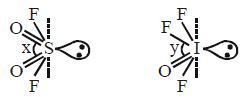
Compare $x$ and $y$ bond angles for the above given molecules