Questions

3 Marks Question

🎯

Test yourself on this topic

15 questions · timed · auto-graded

Question 33 Marks
Can you recall meiosis and indicate at what stage a recombinant DNA is made?
Answer
As we know that in meiosis the number of chromosomes reduces to half. In the first meiosis, there is an exchange of one or more segments between the homologous chromosomes of each pair, i.e. crossing over.
Homologous chromosome pairs are formed in zygotene, the substage of the first prophase of the first meiosis. This is called Synapsis. In the pachytene substage, round microscopic nodules start appearing at one or more places in the synaptonemal complex, these are called recombination nodules.
The mutual exchange of one or more segments between adjacent chromatids of homologous chromosomes is called transposition. Due to this, homologous recombinant DNA is formed. Recombination knobs are formed at the places where pieces of chromatids break and rejoin for transduction.
View full question & answer
Question 43 Marks
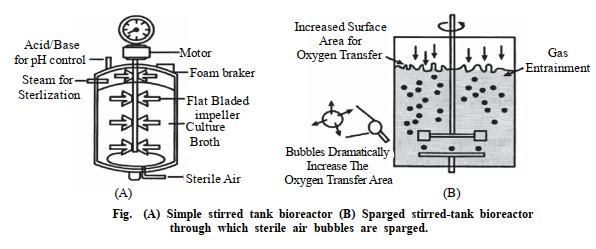
Besides better aeration and mixing properties, what other advantages do stirred tank bioreactors have over shake flasks.
Answer
The ultimate objective of all recombinant technologies is to produce the desired protein. For this, expression of recombinant DNA is required. Foreign genes are expressed under suitable conditions. After cloning the desired gene and optimizing the conditions that induce the expression of the target protein, they are produced on a large scale.
Bioreactor is used to produce products in large quantities. The bioreactor provides optimal conditions for the desired production. Optimum conditions include temperature, pH, substrate, salts, vitamins, oxygen etc. Stirring tank bioreactor is equipped with agitator system, $O_2$ supply system, foam control system, temperature systempH control system and sampling ports from which a small amount of culture can be taken out from time to time.
Image
View full question & answer
Question 53 Marks
What would be the molar concentration of human DNA in a human cell? Consult your teacher.
Answer
Molar Concentration: The concentration of a substance is the measure of its amount per unit volume. It is usually expressed in terms of molarity. The molarity of a substance is the number of its molecules present in one liter of volume. The concentration of molecules can be calculated from the following formula:
Molar concentration $=\frac{\text { Number of molecules }}{\text { Molecular weight }}$
DNA molecules are complex biological macromolecules. Their molecular weight ranges from 10 ^ 6 to 10 ^ 9 Dalton. The average molecular mass of the nucleotides of DNA in our body is 130.86. Therefore, the molecular mass of human DNA molecule $6 \times 10^9$ nucleotides (as per Human Genome Project) $130.86=784.56 \times 10^9 g / mol$
View full question & answer
Question 63 Marks
From what you have learnt, can you tell whether enzymes are bigger or DNA is bigger in molecular size? How did you know?
Answer
Enzymes are proteins. Protein molecules are macromolecules with extremely complex structures. They are made from amino acids. About 300 types of amino acids are found in nature, but out of these only 20 amino acids are found in animal and plant cells. Amino acids form chains and are connected to each other by peptide bonds. The sequence of amino acids in the polypeptide chain of each protein molecule is of a specific type. The molecular weight of proteins is very high. There are different types of proteins made from different amino acids. About 50,000 types of proteins are found in our body.
Biological macromolecules of DNA have complex structure. These are biological macromolecules larger than proteins (enzymes). Their molecular weight ranges from 10 ^ 6 to 10 ^ 9 Dalton. The DNA molecule is made up of polynucleotide chains. Low molecular weight m-RNA, t-RNA and r-RNA are formed from DNA. RNA plays an important role in protein synthesis. For RNA synthesis, DNA molecules get replicated at different places and form small complementary chains ie. a small molecule of ribonucleotide acid. These are called primers. The synthesis of RNA primers is catalyzed by the enzyme RNA polymerase. RNA molecules are used in protein synthesis. This makes it clear that RNA molecules are larger molecules than proteins (enzymes). Therefore, on the basis of molecular size, DNA is larger than enzymes.
View full question & answer
Question 73 Marks
find out how to distinguish between: Plasmid DNA and chromosomal DNA
Answer
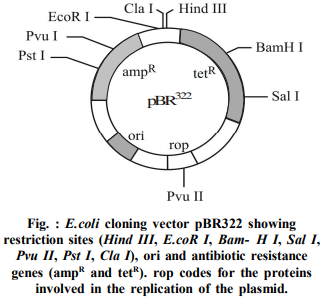
Plasmid DNA and Chromosomal DNA: Plasmids are extra-chromosomal structures which keep multiplying automatically inside bacteria. Their DNA is made up of two strands and is usually circular. Apart from other genes, genes involved in replicating the plasmid are also found on them. Plasmids used in recombinant DNA technology also contain antibiotic resistance genes, which make identification of recombinant DNA molecules possible.
The DNA present in chromosomes is chromosomal DNA. It also has two strands but is not spherical and is located in the nucleus of the cell. It does not contain genes for antibiotic resistance. This DNA is longer and contains more nucleotides than plasmid.
View full question & answer
Question 83 Marks
Explain : PCR
Answer
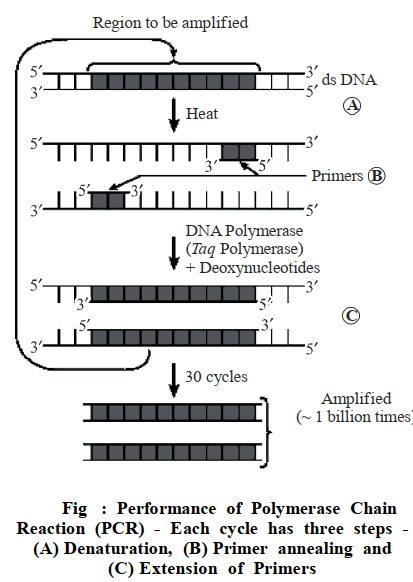
PCR: PCR means Polymerase Chain Reaction = PCR. This is a technique of gene amplification. In fact, it is like a photocopying machine. With the help of a small piece of DNA, millions of copies can be made in a short time. In this reaction, multiple copies of the useful gene are synthesized by the in vitro method using two sets of primers (chemically synthesized small oligonucleotides that are complementary to the DNA region) and the DNA polymerase enzyme. This enzyme, using genomic DNA as a template, extends the primers using the nucleotides obtained from the reaction. If the DNA replication process is repeated many times, then the DNA fragment can be amplified approximately one billion times (one billion), that is, one billion copies are formed. This continuous amplification is done by thermostable DNA polymerase (isolated from the bacterium, Thermus aquaticus). It always remains active even during denaturation of double-stranded DNA induced by high temperature. If desired, the amplified fragment can be ligated to the vector and used for further cloning.
Image
View full question & answer
Question 93 Marks
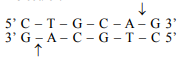
(i) EcoRI has played a very important role in recombinant DNA technology.
(a) Explain the naming convention of Eco RI.
(b) Write the name of the recognition site and cleavage site of this restriction enzyme.
(ii) What is the longitudinal extension of DNA produced by these restriction enzymes called? Describe their role in the formation of r-DNA.
View full question & answer
Question 103 Marks
What is a bioreactor? Explain its functioning.
Answer
The main objective of almost all recombinant technologies is to produce the desired protein. For this, after cloning the desired gene and optimizing the conditions that induce the expression of the target protein, it is possible to produce them on a large scale. Cells harboring beneficial genes can be cultured in the laboratory on a small scale. The desired protein can be extracted from the culture and purified using various methods of separation. Cells can be multiplied in a continuous culture system, in which used medium is drained from one side and fresh medium is added from the other side so that the cells remain in their most functionally active log (exponential) phase. This culture method is useful for producing more biomass and producing more of the desired protein.
Bioreactors are used to produce these products in large quantities. Bioreactors are like vessels in which raw materials are converted into biologically specific products, individual enzymes etc. using microorganisms, plants, animals and human cells. The bioreactor provides optimum conditions to obtain the desired product. Temperature, pH, substrate, salts, vitamins, oxygen etc. are the optimum conditions for growth. Generally stirring type bioreactor is used the most.
Stirred tank bioreactors are cylindrical. Its curved base helps in mixing of the contents inside the bioreactor. The bioreactor has the availability of oxygen and a stirrer facility for mixing the mixture. Alternatively, air is sent into the bioreactor in the form of bubbles. The bioreactor is equipped with an agitator system, oxygen supply system, froth control system, pH control system, temperature control system and sampling ports from which a small amount of the culture can be taken out from time to time.
View full question & answer
Question 113 Marks
(a) Describe the role of selectable marker in r-DNA technology.
(b) Write the name of one such selectable marker considered useful for E. coli.
(c) Write one reason why it is considered an advantageous selectable marker
Answer
(a) In r-DNA technology, selectable markers are used to identify transformants and select successful transformants and they are helpful in eliminating nontransformants. These provide survival benefits to cells with exogenous DNA.
(b) The name of one such selectable marker considered useful for E. coli is—tetracycline, which is a gene that codes for resistance to antibiotics.
(c) It is called a beneficial selectable marker because it helps in identifying and selecting the transformant.
View full question & answer
Question 123 Marks
What is recombinant DNA? Describe the micro injection and gene gun methods of introducing foreign DNA into host cells.
Answer
Taking a fragment of DNA from one organism and hybridizing it with the DNA of another organism is called recombinant DNA. In this technique, recombinant DNA is obtained by introducing the DNA of one species into the DNA of another species.
Microinjection : In this, DNA is injected under pressure into protoplasts or pollen grains or directly into the developing inflorescence.
Gene Gun : 1-3 micro mm diameter particles of gold or tungsten coated with DNA are fired into the target cells at high velocity by the bullet. Due to this, they penetrate the cell wall and enter inside the cell.
View full question & answer
Question 133 Marks
Compare polymerase chain reaction and gene cloning.
Answer
S.No.Polymerase Chain Reaction = PCRGene Cloning
1It requires very little DNA, even one copy of the gene is sufficient.It requires more DNA.
2This is an inexpensive method because it does not require expensive restriction enzymes, ligases and vector DNA.All these are required in this, hence it is an expensive method.
3It requires less time (4-5 hours), labor and efficiency.It requires more time (2-4 days), labor and efficiency
4It requires less time (4-5 hours), labor and efficiency.It has limited applications.
5This is a completely automatic methodIt is not automatic.
View full question & answer
Question 143 Marks
What is genetic engineering? Explain the technique of Recombinant DNA production.
Answer
The technique in which recombinant DNA is obtained by introducing the DNA of one species into the DNA of another species is called genetic engineering.
In genetic engineering, recombinant DNA is created using gene cloning and gene transfer. The first recombinant DNA was created by adding an antibiotic-resistant transcription gene to the plasmid of Salmonella typhimarium. Stanley Cohen and Herbert Boyer’s work was accomplished in 1972 by cutting a piece of DNA from a plasmid, which contained the gene responsible for providing antibiotic resistance. The discovery of 'restriction enzymes' called molecular scissors made it possible to cut DNA at specific places. The cut DNA portion is combined with the plasmid DNA. This plasmid acts as a DNA vector which transfers the DNA attached to it. The work of connecting the antibiotic resistance gene with the vector is done by the enzyme DNA ligase, which works on the cut part of the DNA molecule and joins its ends. By this combination, new circular self-replicating DNA is formed in vitro, which is called recombinant DNA. When this DNA is transferred into Escherichia coli, it makes multiple copies by using the DNA polymerase enzyme of the new host. 
View full question & answer
Question 153 Marks
Write a note on the vector relationship for gene cloning in plants and animals.
Answer
After gaining knowledge from bacteria and viruses, gene cloning was done in plants and animals also. Some types of bacteria and viruses were studied which are pathogens in plants and animals. For example, Agrobacterium tumifaciens is a pathogenic pathogen of many dicotyledonous plants. It transforms normal plant cells into tumors by transferring a segment of DNA called 'TDNA' and these tumor cells produce chemicals necessary for the pathogen. In the same way, retroviruses in animal cells transform normal cells into cancer cells. By understanding the art of gene transfer by pathogens in their eukaryote host, they can use this knowledge to transform these tools of pathogens into useful vectors for delivering genes of interest to humans. The Ti plasmid of Agrobacterium tumifaciens has now been adapted as a cloning vector that is not pathogenic to plants, but is used to transfer genes of interest to many plants. In the same  way, retrovirus is made harmless and used to modify desired genes in animal cells. In this way, when a gene or segment of DNA is attached to the appropriate vector, it is transferred to the bacterial, plant or animal host (where it continues to multiply).
View full question & answer
3 Marks Question - BIOLOGY STD 12 Science Questions - Vidyadip