Question 14 Marks
Read the following and answer any four questions from (i) to (v) given below: Kangaroo rat seldom drinks water. It has thick coat to minimise evaporative desiccation. TI1e animal seldom comes out of its comparatively humid and cool burrow during the day time. 90% of its water requirement is met from metabolic water (water produced by respiratory breakdown of fats) while 10% is obtained from its food. Loss of water is minimised by producing nearly solid urine and faeces. As the animal faces acute water scarcity, it develops two types of adaptations : reducing water loss and ability to tolerate desert conditions.
- Kangaroo rat is a:
- Partial regulators
- Partial conformer
- Regulator
- Conformer
- Metabolic water refers to:
- Water required for metabolic activities.
- Water present in intercellular fluid.
- Water produced during oxidation of fat or carbohydrate.
- Water taken in, to promote metabolism.
- Desert animals minimise water loss by:
- Producing highly concentrated urine.
- Promoting maximum reabsorption of water in kidney tubules.
- Possessing one of the longest loop of Henle in kidney tubules.
- All of these.
- Assertion: Kangaroo rat can tolerate and thrive in wide temperature range and is known as stenothermal.
Reason: Kangaroo rats go into hibernation during winter to escape cold weather.
- Both assertion and reason are true and reason is the correct explanation of assertion.
- Both assertion and reason are true but reason is not the correct explanation of assertion.
- Assertion is true but reason is false.
- Both assertion and reason are false.
- The adaptations in an organism are meant for:
- Optimum primary production.
- Optimum life span.
- Optimum mobility.
- Optimum survival and reproduction.
Answer
View full question & answer→- (c) Regulator
Explanation:
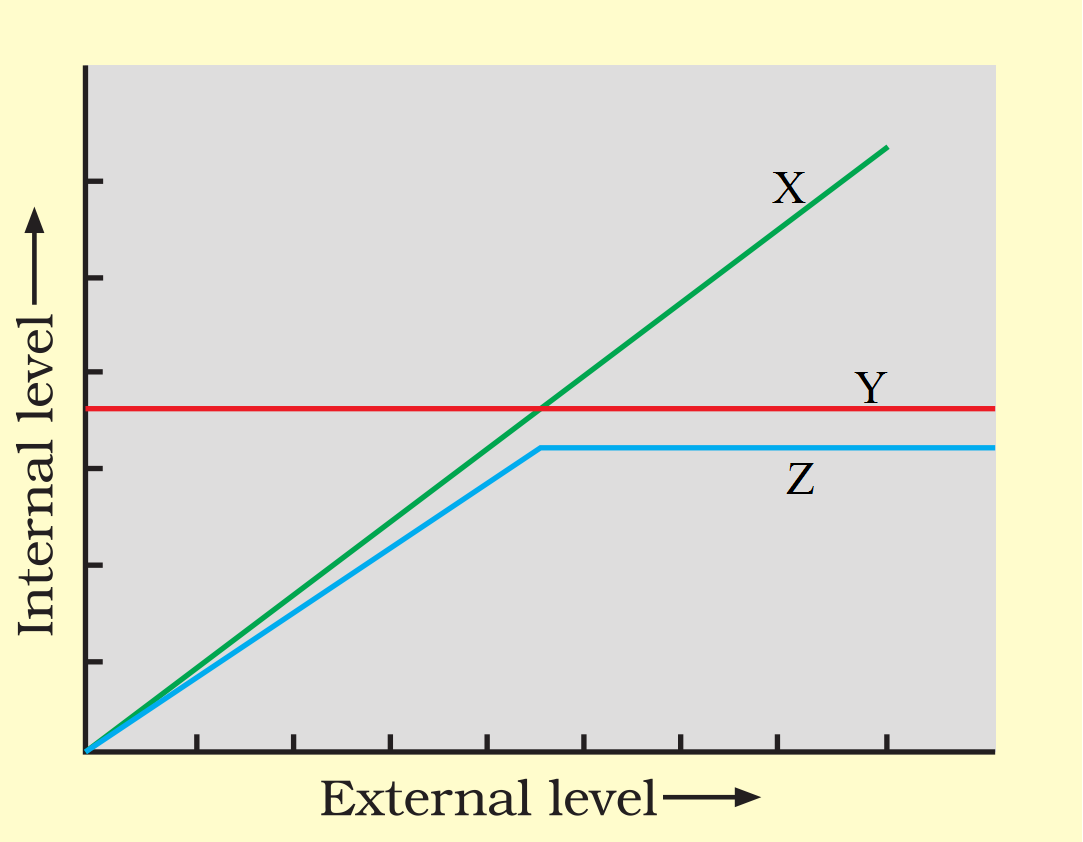
Kangaroo rat is a regulator that performs homeostasis through thermoregulation osmoregulation by physiological adjustments and behavioural changes.
- (c) Water produced during oxidation of fat or carbohydrate.
- (d) All of these.
- (d) Both assertion and reason are false.
Explanation:
Organisms that can tolerate and thrive in wide temperature range are known as eurythermal. Kangaroo rats do not go into hibernation rather, they stay in cool moist burrows during summer days..
- (d) Optimum survival and reproduction.
Explanation:
Adaptation is an attribute of an organism (morphological, physiological and behavioural) that enables it to survive and reproduce in its habitat. Adaptations lead to the formation of some specialised and peculiar features which have evolved over a long period of time through natural selection.