Questions · Page 4 of 4

M.C.Q [1M]

MCQ 1511 Mark
In an A.C. circuit, the current flowing in inductance is $\text{I}=5\sin\Big(\frac{100-\text{t}-\pi}{2}\Big)$ ampers and the potential difference is $\text{V}=200\sin(100\text{t})$ volts. The power consumption is equal to.
  • A
    1000 watt
  • B
    40 watt
  • C
    20 watt
  • D
    Zero
Answer
  1. Zero

Explanation:

Power, $\text{P}=\text{I}_\text{rms}\times\text{V}_\text{rms}\times\cos\phi$

In the given problem, the phase difference between voltage and current is $\frac{\text{P}}{2}$ Hence

$\text{P}=\text{I}_\text{rms}\times\text{V}_\text{rms}\times\cos\big(\frac{\pi}{2}\big)=0$
View full question & answer
MCQ 1521 Mark
The power loss in an AC circuit is Erms​ Irms​, when in the circuit there is only.
  • A
    C
  • B
    L
  • C
    R
  • D
    L, C, and R
Answer
  1. R

Explanation:

Inductors and capacitors bring a phase difference between the voltage and current in the circuit, hence changing the p.f. When only a resistance is present, Poer factor = 1.
The power loss in an AC circuit = Erms ​Irms ​Power factor.

View full question & answer
MCQ 1531 Mark
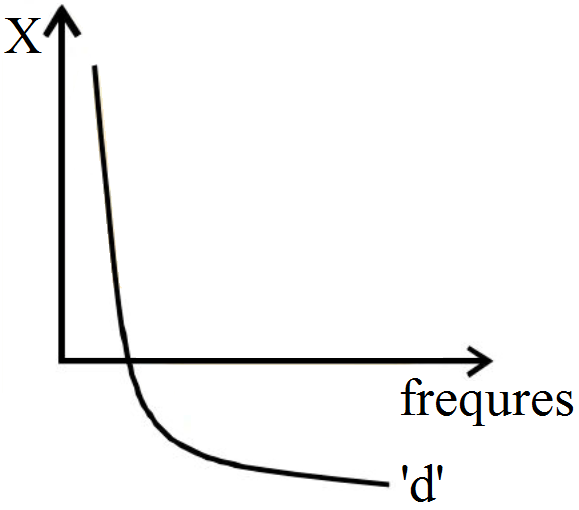
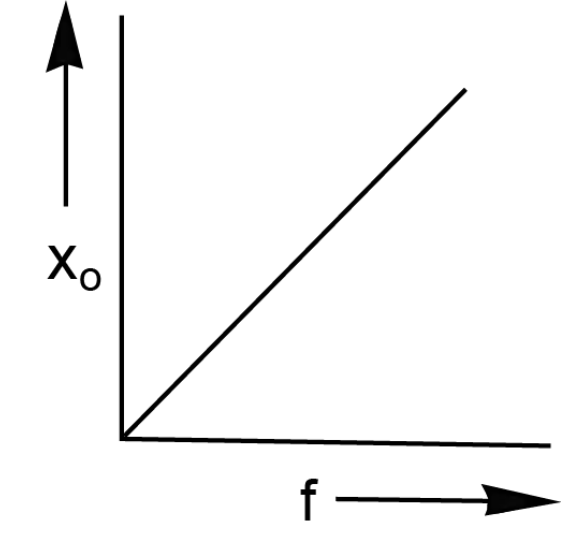
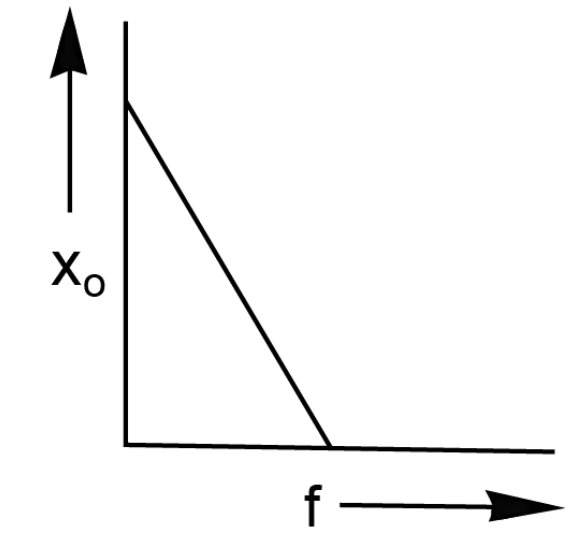
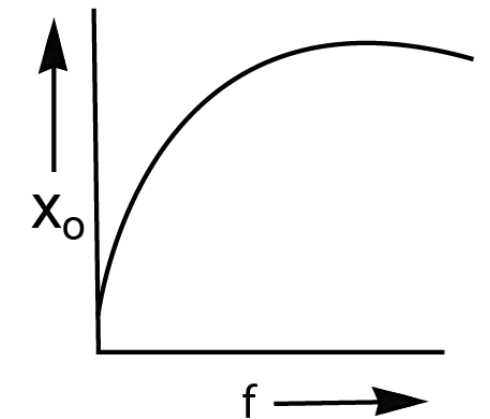
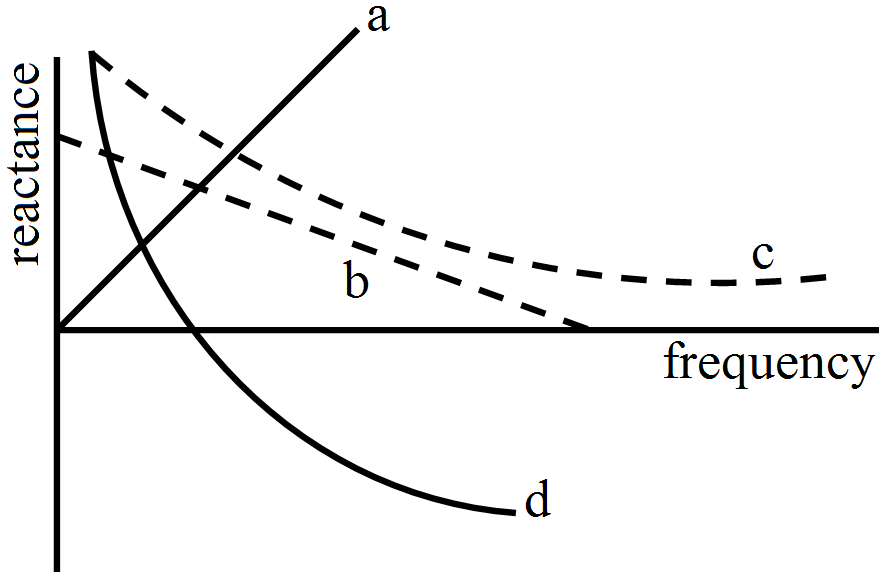
Which of the following plots may represent the reactance of a series LC combination?

  • A
    A
  • B
    B
  • C
    C
  • D
    D
Answer
  1. (d)

Explanation:

$\text{X}=\text{X}_\text{L}-\text{X}_\text{C}$

$=\omega\text{L}-\frac{1}{\omega\text{C}}$

$=2\pi\text{fL}-\frac{1}{2\pi\text{fC}}$

View full question & answer
MCQ 1541 Mark
An AC voltmeter in an L - C - R circuit reads 30volt across resistance, 80 volt across inductance and 40 volt across capacitance. The value of applied voltage will be.
  • A
    50 Volt
  • B
    25 Volt
  • C
    150 Volt
  • D
    70 Volt
Answer
  1. 50 Volt

Explanation:

$\text{V}=\sqrt{\text{V}^2_\text{R}+(\text{V}_\text{L}-\text{V}_\text{C})^2}$

$\text{V}=\sqrt{30^2+(80-40)^2}$

$\text{V}=50\text{ Volt}$

View full question & answer
MCQ 1551 Mark
The resonant frequency of an L - C circuit is.
  • A
    $\frac{1}{2\pi\sqrt{\text{LC}}}$
  • B
    $\frac{1}{2\pi}\sqrt\frac{\text{L}}{\text{C}}$
  • C
    $\frac{1}{4\pi}\sqrt\frac{\text{L}}{\text{C}}$
  • D
    $\frac{1}{2\pi}\sqrt\frac{\text{C}}{\text{L}}$
Answer
  1. $\frac{1}{2\pi\sqrt{\text{LC}}}$

Explanation:

Resonance frequency f of an L - C circuit can be written as

Resonance frequency $\text{f}=\frac{1}{2\pi\sqrt{\text{LC}}}$ where L = inductance and C is capacitance.

View full question & answer
MCQ 1561 Mark
The capacitor offers zero resistance to.
  • A
    D.C. only
  • B
    A.C. & D.C.
  • C
    A.C. only
  • D
    neither A.C. nor D.C.
Answer
  1. A.C. only

Explanation:

Capacitive reactance is given as $\text{X}_\text{C}=\frac{1}{\omega\text{C}}$

From this relation we can see that the value of capacitive reactance and therefore its overall impedance (in Ohms) decreases to zero as the frequency increases acting like a short

circuit. Likewise, as the frequency approaches zero or DC, the capacitors reactance increases to infinity, acting like an open circuit which is why capacitors block DC.

View full question & answer
MCQ 1571 Mark
A 6kHz sinusoidal voltage is applied to a series RC circuit. The frequency of the voltage across the resistor is.
  • A
    0Hz
  • B
    12kHz
  • C
    6kHz
  • D
    18kHz
Answer
  1. 6kHz

Explanation:

Frequency of applied voltage and voltage or current accross any component are same. As we know,

$\text{I}=\frac{\text{V}}{\text{Z}}$ and Z has nothing to do with frequency 

$\Rightarrow $$ \text{IandV}$$$ have same frequency. 

And also according to KVL V = V1 ​+ V2​ + V3​

⟹ voltage and current across any component have same frequency i.e 6kHz.

View full question & answer
MCQ 1581 Mark
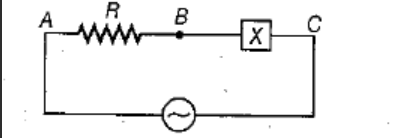
In the given circuit R in pure resistance and X is unknown circuit element. An AC voltage source is applied across A and C. If VAB​ = VAC​, then X is.
Image
  • A
    Pure resistance
  • B
    Pure inductance
  • C
    Combination of inductance and capacitance at resonance
  • D
    None of the above
Answer
  1. Combination of inductance and capacitance at resonance

Explanation:

Since the voltage across the resistive element is same as the voltage applied, the voltage drop across BC is zero. This is possible only when the ohmic value of the element connected across BC is zero. So, X should be combination of inductance and capacitance at resonance.

View full question & answer
MCQ 1591 Mark
The natural frequency of an LC - circuit is 1,25,000 cycles per second. Then the capacitor C is replaced by another capacitor with a dielectric medium of dielectric constant k. In this case, the frequency decreases by 25kHz. The value of k is:
  • A
    3.0
  • B
    2.1
  • C
    1.56
  • D
    1.7
Answer
  1. 1.56
View full question & answer
MCQ 1601 Mark
An inductive coil has resistance of $100\Omega$ When an ac signal of frequency 1000 Hz is fed to the coil, the applied voltage leads the current by 45. What is the inductance of the coil?
  • A
    2mH
  • B
    3.3mH
  • C
    16mH
  • D
    $\sqrt{5}\text{mH}$
Answer
  1. 16mH

Explanation:

$\tan(45)=1\frac{\text{L}\omega}{\text{R}}$

$\text{L}=\frac{\text{R}}{\omega}=\frac{\text{R}}{(2\pi1000)}=.016\text{H}$

View full question & answer
MCQ 1611 Mark
If the frequency of an A.C is made 4 times of its initial value, the inductive reactance will.
  • A
    be 4 times
  • B
    be 2 times
  • C
    be half
  • D
    remain the same
Answer
  1. be 4 times

Explanation:

inductive reactance $=2\pi\text{fL}$

therefore when f is made 4 times, inductive reactance also becomes 4 times

View full question & answer
MCQ 1621 Mark
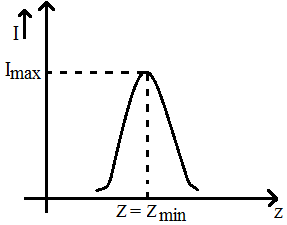
As the frequency of an ac circuit increases, the current first increases and then decreases. What combination of circuit elements is most likely to comprise the circuit?
  • A
    Inductor and capacitor.
  • B
    Resistor and inductor.
  • C
    Resistor and capacitor.
  • D
    Resistor, inductor and capacitor.
Answer
  1. Inductor and capacitor.
  1. Resistor, inductor and capacitor.

Solution:

Compare the given circuit by predicting the variation in their reactances with frequency. So, that then we can decide the elements.

Reactance of an inductor of inductance L is $\text{X}_\text{L}=2\pi\text{vL}$, where v is the frequency of the AC circuit.

Xc = Reactance of the capacitive circuit

$=\frac{1}{2\pi\text{fC}}$

With an increase in frequency in (f) of an AC circuit, R remains constant, inductive reactance (XL) increases and capacitive reactance (XC) decreases. For an L-C-R circuit,

Z- Impedance of the circuit,

$=\sqrt{\text{R}^2+(\text{X}_\text{L}-\text{X}_\text{C})^2}$

$=\sqrt{\text{R}^2+\bigg(2\pi\text{vL}-\frac{1}{2\pi\text{vC}}\bigg)^2}$

As frequency (v) increases, Z decreases and at certain value of the frequency known as resonant frequency (v0), impedance Z is minimum that is Zmin = R current varies inversely with impedance and at Zmin current is maximum.

View full question & answer
MCQ 1631 Mark
In a pure capacitive A.C circuit current and voltage differ in phase by.
  • A
  • B
    45°
  • C
    90°
  • D
    180°
Answer
  1. 90°

Explanation:

$\text{i}=\text{i}_\text{o}\sin(\omega\text{t}+\frac{\pi}{2})$

current leads voltage by $\frac{\pi}{2}$ i.e., current and voltage differ in phase by 90°

View full question & answer
MCQ 1641 Mark
In a series LCR circuit the voltage across resistance, capacitance and inductance is 10V each. If the capacitance is short circuited, the voltage across the inductance will be.
  • A
    $10\text{V}$
  • B
    $\big(\frac{10}{\sqrt{2\text{V}}}\big)$
  • C
    $\big(\frac{10}{\sqrt{3\text{V}}}\big)$
  • D
    $30\text{V}$
Answer
  1. $\big(\frac{10}{\sqrt{2\text{V}}}\big)$
View full question & answer
MCQ 1651 Mark
In an LCR series a.c. circuit, the voltage across each of the components. L, C and R is 50V. The voltage across the LC combination will be:
  • A
    50V
  • B
    $50\sqrt{2}\text{v}$
  • C
    100V
  • D
    0V (zero)
Answer
  1. 0V (zero)

Explanation:

In a series LCR circuit, the voltage across the inductor (L) and the capacitor (C) are in opposite phase. 

So the voltage across LC combination will be (50 - 50) = 0V

View full question & answer
MCQ 1661 Mark
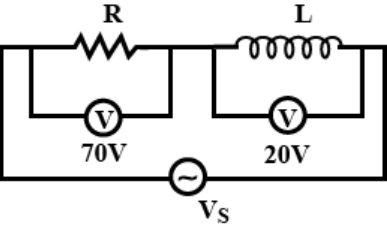
The adjoining figure shows an AC circuit with resistance R, inductance L and source voltage Vs. Then.
Image
  • A
    the source voltage Vs​ = 72.8V.
  • B
    the phase angle between current and source voltage is $\tan-\frac{7}{2}$
  • C
    Both (a) and (b) are correct.
  • D
    Both (a) and (b) are wrong.
Answer
  1. the source voltage Vs​ = 72.8V.
View full question & answer
MCQ 1671 Mark
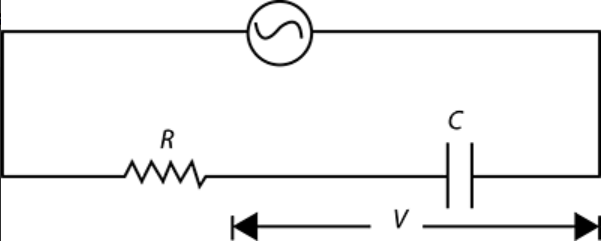
A resistance R and a capacitor C are joined to a source of AC of constant e.m.f and variable frequency. The potential difference across C is V. If the frequency of AC is gradually increased, V will
Image
  • A
    increase
  • B
    decrease
  • C
    remain constant
  • D
    first increase and then decrease
Answer
  1. decrease

Explanation:

In complex plane $\text{V}=\frac{\text{V}_\text{AC}}{1+\text{jRC}\omega}$

Therefore as $\omega$(frequency) increases, V decreases.

View full question & answer
MCQ 1681 Mark
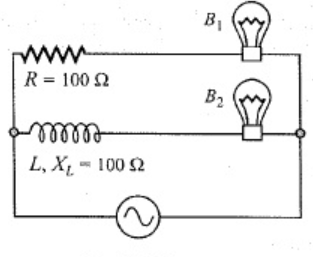
In the figure two identical bulbs, each with filament resistance $100\Omega$ are connected to a resistor $\text{R}=100\Omega$ and an inductor $(\text{X}_\text{L}=100\Omega)$ as shown in the Figure. Then, which bulb glows more.
Image
  • A
    B1
  • B
    B2
  • C
    both glow equally
  • D
    cannot be predicted
Answer
  1. B2

Explanation:

Impedance in branch containing bulb1

$\text{Z}_1=200\Omega$

impedance in branch containing bulb2

$\text{Z}_2\sqrt{\text{R}^2+\text{X}_\text{L}}^2$

$\text{Z}_2=\sqrt{100^2+100^2}$

$\text{Z}_2=100\sqrt{2}$

Since,

$\text{Z}_1>\text{Z}_2$

B2​ will glow more than B1​.

View full question & answer
MCQ 1691 Mark
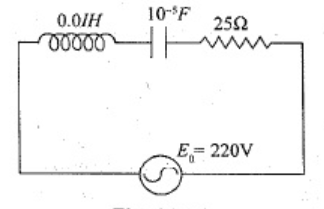
In the following circuit the values of L, C, R and E0​ are 0.01 H, 10-5F, $25\Omega$ and 220volt respectively. The value of current flowing in the circuit at f = 0 and $\text{f}=\infty$ will respectively be.
Image
  • A
    8 A and 0 A
  • B
    0 A and 0 A
  • C
    8 A and 8 A
  • D
    0 A and 8 A
Answer
  1. 0 A and 0 A

Explanation:

$\text{I}=\frac{220}{25+\text{j}\Big(0.1\times2\pi\text{f }-\frac{1}{10^{-5}2\pi\text{f}}\Big)}$

$\text{I}=0\text{ at }\text{f}=0$

$\text{I}=0\text{ at }\text{f}=\infty$

View full question & answer
MCQ 1701 Mark
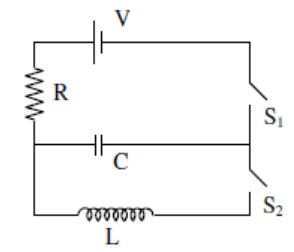
In an LCR circuit as shown below both switches are open initially. Now switch S1​ is closed, S2​ kept open. (q is charge on the capacitor and $\tau=\text{RC}$ is capacitive time constant). Which of the following statement is correct?
Image
  • A
    $\text{At t}=\tau,\text{q}=\frac{\text{CV}}{2}$
  • B
    $\text{At t}=2\tau,\text{q}={\text{CV}}(1-\text{e}^{-2})$
  • C
    $\text{At t}=\frac{\text{T}}{2},\text{q}={\text{CV}}(1-\text{e}^{-1})$
  • D
    Work done by the battery is half of the energy dissipated in the resistor.
Answer
  1. $\text{At t}=2\tau,\text{q}={\text{CV}}(1-\text{e}^{-2})$

Explanation:

Charge on the capacitor at any time `t' is

$\text{q}=\text{CV}(1-\text{e}\frac{-\text{t}}{\tau})$

$\text{at }\text{t}=2\tau$

$\text{q}=\text{CV}(1-\text{e}^{-2})$

View full question & answer
MCQ 1711 Mark
In an AC circuit, the impedance is 3​ times the reactance, then the phase angle is.
  • A
    60°
  • B
    30°
  • C
    zero
  • D
    none of these
Answer
  1. none of these

Explanation:

$\sin\phi=\frac{\text{X}}{\text{Z}}=\frac{1}{\sqrt{3}}$

$\therefore\phi=\sin^{-1}\Big(\frac{1}{\sqrt{3}}\Big)$

View full question & answer
MCQ 1721 Mark
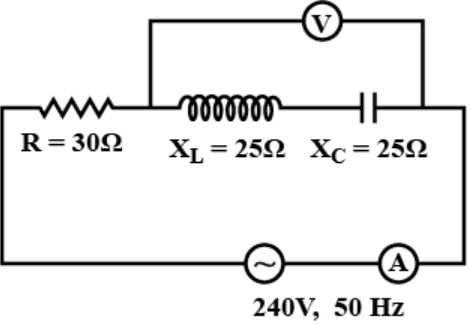
In the circuit shown in the figure, (neglecting source resistance) the voltmeter and ammeter readings will respectively be.
Image
  • A
    0 V, 8 A
  • B
    150 V, 8 A
  • C
    150 V, 3 A
  • D
    0 V, 3 A
Answer
  1. 0 V, 8 A

Explanation:

Voltmeter reading is zero since voltage in both Capacitor and inductor is same in magnitude but opposite in sign because current in series is same and both have same reactance.

So, $\text{i}=\frac{\text{V}}{\text{R}}$

$=\frac{240}{30}$

$=8\text{A}$

View full question & answer
MCQ 1731 Mark
Voltage across each elements of a series LCR circuit are given by VL​ = 60V, VC ​= 20V, VR ​= 30V Find out source voltage.
  • A
    50V
  • B
    100V
  • C
    150V
  • D
    200V
Answer
  1. 50V

Explanation:

$\text{V}=\sqrt{\text{V}_\text{R}^2+(\text{V}_\text{L}-\text{V}_\text{C})^2}=\sqrt{30^2+(60-20)^2}=50\text{V}$

View full question & answer
MCQ 1741 Mark
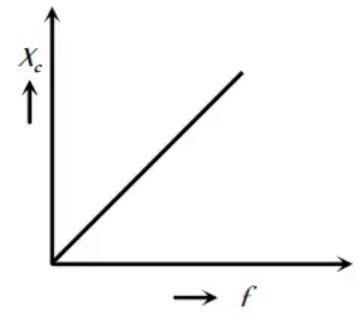
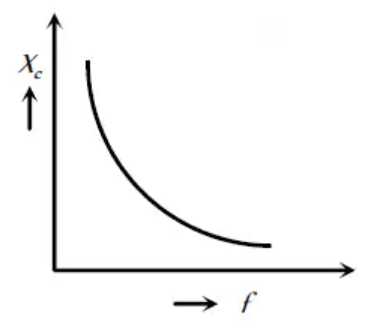
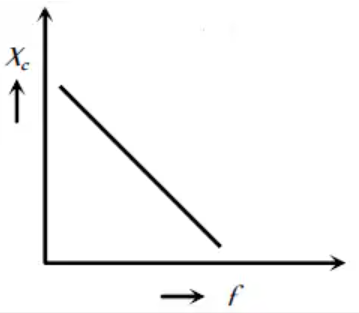
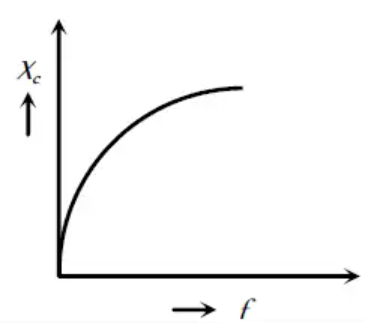
Which one of the following graphs in following figure represents variation of reactance ′Xc′​ of a capacitor with frequency 'f' of an ac supply?
  • A

    Image
  • B

    Image
  • C

    Image
  • D

    Image
Answer
  1. Image

Explanation:

Capacitor reactance is given by: $\text{X}_\text{c}=\frac{1}{2\pi\text{fC}}$ 

C is the capacitance. 

Xc​ & f are inversely proportional.

View full question & answer
MCQ 1751 Mark
The correct curve representing the variation of capacitive reactance Xc​ with frequency f is.
  • A

    Image
  • B

    Image
  • C

    Image
  • D

    Image
Answer
C. Image

Explanation:

$\text{X}_\text{C}=\frac{1}{\text{C}2\pi\text{f}}$

XC​ and f are inversely proportional.

View full question & answer
MCQ 1761 Mark
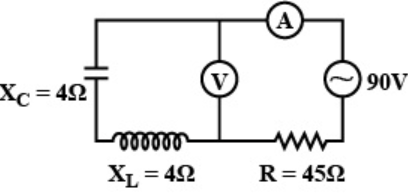
The reading of voltmeter and ammeter in the following figure will respectively be:
Image
  • A
    0 and 2A
  • B
    2A and 0V
  • C
    2V and 2A
  • D
    0V and 0A
Answer
  1. 0 and 2A

Explanation:

In the problem $\text{XC}=4\Omega$ and $\text{XL}=4\Omega$

So, V across XC​ and XL​ will be same and in opposite direction, So net voltage will be zero. Since voltmeter is connected parallel to Capacitor and inductor so, it will read 0 volts.

Current $=\frac{\text{V}}{\text{impedance}}$

Z = R as XL ​= XC​

Current $=\frac{90}{45}=2\text{A}$

View full question & answer
MCQ 1771 Mark
A coil has an inductance of 0.7 H and is joined in series with a resistance of $220\Omega$ When an alternating emf of 220V at 50 cps is applied to it, then the wattless component of the current in the circuit is $(\text{take }0.7\pi=2.2)$
  • A
    5 A
  • B
    0.5 A
  • C
    0.7 A
  • D
    7 A
Answer
  1. 0.5 A

Explanation:

Wattless current $=\text{I}_\text{max}\sin(\tan^{-1}[\frac{\text{L}\omega}{\text{R}}])=\frac{220}{\sqrt{\text{R}^2+\text{L}^2\omega^2}}\sin(\tan^{-1}[\frac{\text{L}\omega}{\text{R}})=0.5\text{A}$

View full question & answer