Show that moment of inertia of a solid body of any shape changes with temperature as $\text{I}=\text{I}_0(1+2\alpha\theta),$ where $\text{I}_0$ is the moment of inertia at 0°C and a is the coefficient of linear expansion of the solid.
View full solution →Question types
Heat and Temperature question types
48 questions across 5 question groups — pick any mix to generate a Physics paper with step-by-step answer keys.
48
Questions
5
Question groups
5
Question types
01
1 Marks Question
2 Q→02Short Answer Type Questions [2M]
17 Q→033 Marks Question
12 Q→044 Marks Questions
2 Q→05Long Answer Type Questions [5M]
15 Q→Sample Questions
Heat and Temperature questions
One sample from each question group in this chapter. Select any group above to see the full set with answer keys.
A steel wire of cross-sectional area 0.5mm2 is held between two fixed supports. If the wire is just taut at 20°C, determine the tension when the temperature falls to 0°C. Coefficient of linear expansion of steel is 1.2 × 10⁻⁵ °C-1 and its Young's modulus is 2.0 × 10¹¹N m-2.
If two bodies are in thermal equilibrium in one frame, will they be in thermal equilibrium in all frames?
A steel rod is clamped at its two ends and rests on a fixed horizontal base. The rod is unstrained at 20°C. Find the longitudinal strain developed in the rod if the temperature rises to 50°C. Coefficient of linear expansion of steel = 1.2 × 10⁻⁵ °C-1.
A spherical shell is heated. The volume change according to the equation $\text{V}_\theta=\text{V}_\theta(1+\gamma\theta)$. Does the volume refer to the volume enclosed by the shell or the volume of the material making up the shell?
View full solution →A steel rod of length 1m rests on a smooth horizontal base. If it is heated from 0°C to 100°C, what is the longitudinal strain developed?
A gas thermometer measures the temperature from the variation of pressure of a sample of gas. If the pressure measured at the melting point of lead is 2.20 times the pressure measured at the triple point of water, find the melting point of lead.
The length of a brass rod is found to be smaller less on a hot summer day than on a cold winter day as measured by the same aluminium scale. Do we conclude that brass shrinks on heating?
If mercury and glass had equal coefficient of volume expansion, could we make a mercury thermometer in a glass tube?
The density of water at 0°C is 0.998g cm-3 and at 4°C is 1000g cm-3.Calculate the average coefficient of volume expansion of water in the temperature range 0 to 4°C.
Find the ratio of the lengths of an iron rod and an aluminium rod for which the difference in the lengths is independent of temperature. Coefficients of linear expansion of iron and aluminium are 12 × 10-6 °C-1 and 23 × 10-6 °C-1 respectively.
Does the temperature of a body depend on the frame from which it is observed?
Why do marine animals live deep inside a lake when the surface of the lake freezes?
If an automobile engine is overheated, it is cooled by putting water on it. It is advised that the water should be put slowly with engine running. Explain the reason.
A glass window is to be fit in an aluminium frame. The temperature on the working day is 40°C and the glass window measures exactly 20cm × 30cm. What should be the size of the aluminium frame so that there is no stress on the glass in winter even if the temperature drops to 0°C ? Coefficients of linear expansion for glass and aluminium are 9.0 × 10⁻⁶ °C-1 and 24 × 10-6 °C-1 respectively.
Two metre scales, one of steel and the other of aluminium, agree at 20°C. Calculate the ratio aluminium-centimetre/ steel-centimetre at:
View full solution →- 0°C,
- 40°C
- 100C. $\alpha$ for steel = 1.1 × 10⁻⁵ °C-1 and for aluminium= 2.3 × 10⁻⁵ °C-1.
A metre scale is made up of steel and measures correct length at 16°C. What will be the percentage error if this scale is used:
- On a summer day when the temperature is 46°C.
- On a winter day when the temperature is 6°C? Coefficient of linear expansion of steel = 11 × 10-6°C-1.
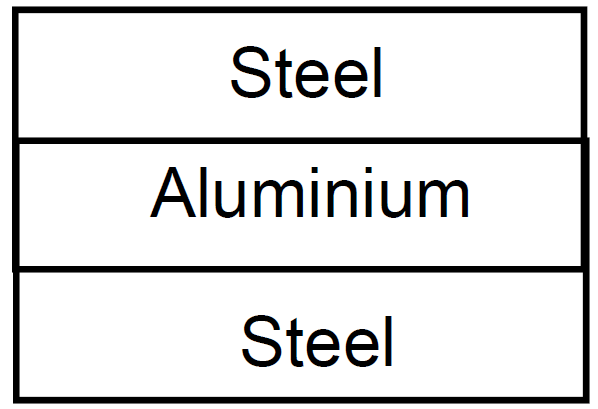
Two steel rods and an aluminium rod of equal length l0 and equal cross section are joined rigidly at their ends as shown in the figure below. All the rods are in a state of zero tension at 0°C. Find the length of the system when the temperature is raised to $\theta$. Coefficient of linear expanaion of aluminium and steel are $\alpha_\text{a}$ and $\alpha_\text{s}$respectively. Young's modulus of aluminium is Ya and of steel is Ys.
View full solution →A pendulum clock gives correct time at 20°C at a place where g = 9.800m s-2. The pendulum consists of a light steel rod connected to a heavy ball. It is taken to a different place where g = 9.788m s-2. At what temperature will it give correct time ? Coefficient of linear expansion of steel = 12 × 10-6 °C-1.
Generate a Heat and Temperature paper free
Pick question groups from the list above, set marks and difficulty, and export a branded PDF with step-by-step answer keys. First 3 chapters free — no signup.