Questions

M.C.Q (1 Marks)

🎯

Test yourself on this topic

18 questions · timed · auto-graded

MCQ 11 Mark
Consider the following table:
Class interval $10-14$ $14-18$ $18-22$ $22-26$ $26-30$
Frequency $5$ $11$ $16$ $25$ $19$
The mode of the above data is
  • A
    $25$
  • B
    $23.5$
  • $24.4$
  • D
    $24$
Answer
Correct option: C.
$24.4$
Maximum frequency $= 25$
Hence, modal class is $22 - 26$
Now, Mode $=x_k+h\left\{\frac{\left(f_k-f_{k-1}\right)}{\left(2 f_k-f_{k-1}-f_{k+1}\right)}\right\}$
$=22+4\left\{\frac{(25-16)}{(2(25)-16-19)}\right\}$
$=22+4 \times \frac{9}{15}$
$= 22 + 2.4$
$= 24.4$
View full question & answer
MCQ 21 Mark
A cylindrical vessel of radius $4 \ cm$ contains water. A solid sphere of radius $3 \ cm$ is lowered into the water until it is completely immersed. The water level in the vessel will rise by
  • $\frac{9}{4} \ cm$
  • B
    $\frac{9}{2} \ cm$
  • C
    $\frac{2}{9} \ cm$
  • D
    $\frac{4}{9} \ cm$
Answer
Correct option: A.
$\frac{9}{4} \ cm$
Radius of sphere $\left(r_1\right)=3 \ cm$
$\therefore$ Volume $=\frac{4}{3} \pi r^3$
$=\frac{4}{3} \pi(3)^3 \ cm^3$
$=36 \pi \ cm^3$
$\therefore$ Volume of water in the cylinder $=36 \pi \ cm^3$
Radius of cylindrical vessel $\left(r_2\right)=4 \ cm$
Let $h$ be its height, then
$\pi r_2^2 h=36 \pi$
$\Rightarrow \pi(4)^2 h=36 \pi$
$\Rightarrow 16 \pi h=36 \pi$
$\Rightarrow h=\frac{36 \pi}{16 \pi}=\frac{9}{4} \ cm$
View full question & answer
MCQ 31 Mark
Consider the following frequency distribution:
Class0-56-1112-1718-2324-29
Frequency131015811
The upper limit of the median class is
  • A
    18.5
  • 17.5
  • C
    18
  • D
    17
Answer
Correct option: B.
17.5
(B) 17.5
Explanation: Given, classes are not continuous, so we make continuous by subtracting 0.5 from lower limit and adding 0.5 to upper limit of each class.
ClassFrequencyCumulative frequency
-0.5-5.51313
5.5-11.51023
11.5-17.51538
17.5-23.5846
23.5-29.51157
Here, $\frac{N}{2}=\frac{57}{2}=28.5$, which lies in the interval 11.5 - 17.5.
Hence, the upper limit is 17.5 .
View full question & answer
MCQ 41 Mark
In a single throw of a die, the probability of getting a multiple of $3$ is
  • A
    $\frac{1}{6}$
  • B
    $\frac{2}{3}$
  • C
    $\frac{1}{2}$
  • $\frac{1}{3}$
Answer
Correct option: D.
$\frac{1}{3}$
A die is thrown, the possible number of events $(n) = 6$
Now multiple of $3$ are $3, 6$ which are $2$
$\therefore m =2$
$\therefore \text { Probability }=\frac{m}{n}=\frac{2}{6}=\frac{1}{3}$
View full question & answer
MCQ 51 Mark
Pankaj has a motorcycle with wheels of diameter 91 cm. There are 22 spokes in the wheel. Find the length of arc between two adjoining spokes.
  • A
    13 cm
  • B
    26 cm
  • C
    15 cm
  • D
    18 cm
Answer
13 cm
Explanation: Radius of wheel $=\frac{91}{2} cm$
Angle between two adjoining spokes, $\theta=\frac{360^{\circ}}{22}$
$\therefore$ Length of arc $=\frac{\theta}{360^{\circ}} \times 2 \pi r$
$=\frac{360^{\circ}}{360^{\circ} \times 22} \times 2 \times \frac{22}{7} \times \frac{91}{2}=13 cm$
View full question & answer
MCQ 61 Mark
A circular disc of radius $6 \ cm$ is divided into three sectors with central angles $90^{\circ}, 120^{\circ}$ and $150^{\circ}$. The ratio of the areas of the three sectors is
  • A
    $4 : 5 : 6$
  • $3 : 4 : 5$
  • C
    $1 : 5 : 6$
  • D
    $2 : 3 : 4$
Answer
Correct option: B.
$3 : 4 : 5$
Area of sector Having central angle $90$ degree $:$ Area of sector Having central angle $120$ degree $:$ Area of sector Having central angle $150$ degree
$=\frac{90}{360} \times \pi \times 6^2: \frac{120}{360} \times \pi \times 6^2: \frac{150}{360} \times \pi \times 6^2$
$=\frac{1}{4}: \frac{1}{3}: \frac{5}{12}$
$=3: 4: 5$
View full question & answer
MCQ 71 Mark
$9 \sec ^2 A-9 \tan ^2 A=$
  • $9$
  • B
    $1$
  • C
    $0$
  • D
    $99$
Answer
Correct option: A.
$9$
$\text { Explanation: Given: } 9 \sec ^2 A-9 \tan ^2 A$
$=9\left(\sec ^2 A-\tan ^2 A\right)$
$=9 \times 1=9 \ldots\left[\because \sec ^2 \theta-\tan ^2 \theta=1\right]$
View full question & answer
MCQ 81 Mark
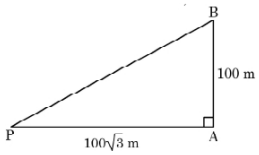
The angle subtended by a vertical pole of height $100\ m$ at a point on the ground $100 \sqrt{3}$ m from the base is, has measure of
Image
  • A
    $45^{\circ}$
  • B
    $90^{\circ}$
  • C
    $60^{\circ}$
  • $30^{\circ}$
Answer
Correct option: D.
$30^{\circ}$
$30^{\circ}$
$\text { Explanation: } \tan \theta=\frac{100}{100 \sqrt{3}}$
$\tan \theta=\frac{1}{\sqrt{3}}$
$\theta=30^{\circ}$
View full question & answer
MCQ 91 Mark
If $X \sin ^3 \theta+ Y \cos ^3 \theta=\sin \theta \cos \theta$ and $X \sin \theta= Y \cos \theta$, then $........$
  • A
    $X^4+Y^4=1$
  • $X ^2+ Y ^2=1$
  • C
    $X ^2- Y ^2=1$
  • D
    $X^3+Y^3=1$
Answer
Correct option: B.
$X ^2+ Y ^2=1$
We have, $X \sin ^3 \theta+ Y \cos ^3 \theta=\sin \theta \cos \theta \ldots (i)$
$X \sin \theta= Y \cos \theta \ldots (ii)$
Using $(ii)$ in $(i),$ we get
$\Rightarrow Y \cos \theta \sin ^2 \theta+y \cos ^3 \theta=\sin \theta \cos \theta$
$\Rightarrow Y \sin ^2 \theta+Y \cos ^2 \theta=\sin \theta$
$\Rightarrow Y=\sin \theta$
Now, $X \sin \theta=\sin \theta \times \cos \theta$
$\Rightarrow X =\cos \theta$
$\therefore X ^2+ Y ^2=1$
View full question & answer
MCQ 101 Mark
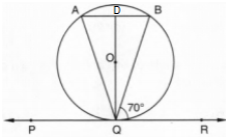
In Figure, if $\text{PQR}$ is the tangent to a circle at Qwhose centre is $O, AB$ is a chord parallel to $PR$ and $\angle BQR =70^{\circ},$ then $\angle AQB$ is equal to
Image
  • $40^{\circ}$
  • B
    $20^{\circ}$
  • C
    $35^{\circ}$
  • D
    $45^{\circ}$
Answer
Correct option: A.
$40^{\circ}$
Image
Given $, AB \| PR$
$\angle ABQ =\angle BQR =70^{\circ} \ [$alternate angles$]$
Also $QD$ is perpendicular to $AB$ and $QD$ bisects $AB$.
In $\triangle ODA$ and $\triangle ODB$
$AD = BD$
$QD = QD\ [$common side$]$
$\therefore \triangle ADQ \cong \triangle BDQ \ldots[$ by $\text{SAS}$ similarity criterion$]$
Then, $\angle Q A D=\angle Q B D \ldots (i) \ [ c , p , c , t ]$
Also , $\angle ABQ =\angle BQR \ [$alternate interior angle$]$
$\angle A B Q=70^{\circ} \ldots\left[B Q R=70^{\circ}\right]$
Hence, $\angle QAB =70^{\circ} \ [$from Eq. $(i)]$
Now, in $\triangle ABQ$
$\angle A+\angle B+\angle Q=180^{\circ}$
$\Rightarrow \angle Q=180^{\circ}-\left(70^{\circ}+70^{\circ}\right)=40^{\circ}$
View full question & answer
MCQ 111 Mark
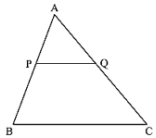
In $\triangle ABC , PQ \| BC$. If $PB =6 cm, AP =4 cm, AQ =8 cm$, find the length of AC .
Image
  • A
    12 cm
  • B
    14 cm
  • 20 cm
  • D
    6 cm
Answer
Correct option: C.
20 cm
(C) 20 cm
Explanation: In $\triangle ABC , PQ \| BC$
$\therefore \frac{ AP }{ PB }=\frac{ AQ }{ QC }$ (By proportionality theorem)
$\Rightarrow \frac{4}{6}=\frac{8}{Q C}$
$\Rightarrow QC =\frac{8 \times 6}{4}=12 cm$
Now, AC = AQ + QC
= 8 + 12
= 20 cm
View full question & answer
MCQ 121 Mark
$\triangle PQR \sim \triangle XYZ$ and the perimeters of $\triangle PQR$ and $\triangle XYZ$ are 30 cm and 18 cm respectively. If $QR =9 cm$, then, YZ is equal to
  • A
    4.5 cm.
  • 5.4 cm.
  • C
    12.5 cm.
  • D
    9.5 cm.
Answer
Correct option: B.
5.4 cm.
(B) 5.4 cm.
Explanation: Given: $\triangle PQR \sim \triangle XYZ$
$\therefore \frac{\text { Perimeter of } \triangle PQR }{\text { Perimeter of } \triangle XYZ }=\frac{ QR }{ YZ }$
$\Rightarrow \frac{30}{18}=\frac{9}{ YZ }$
$\Rightarrow YZ =5.4 cm$

View full question & answer
MCQ 131 Mark
The distance of the point (4, 7) from the y-axis is
  • A
    11
  • 4
  • C
    $\sqrt{65}$
  • D
    7
Answer
Correct option: B.
4
(B) 4
Explanation: The distance of the point (4, 7) from y-a x is = 4
View full question & answer
MCQ 141 Mark
One of the two students, while solving a quadratic equation in x, copied the constant term incorrectly and got the roots 3 and 2. The other copied the constant term and coefficient of $x^2$ correctly as -6 and 1 respectively. The correct roots are ________.
  • 6, -1
  • B
    3, -2
  • C
    (-3, 2)
  • D
    (-6, -1)
Answer
Correct option: A.
6, -1
(A) 6, -1
Explanation: Let the equation be $x^2+a x+b=0$
Its roots are 3 and 2
Sum of roots, 5 = -a
and product of roots, 6 = b
$\therefore$ Equation is $x^2-5 x+6=0$
Now constant term is wrong and it is given that correct constant term is -6.
$\therefore x ^2-5 x -6=0$ is the correct equation.
Its roots are -1 and 6.
View full question & answer
MCQ 151 Mark
If am = bl and $bn \neq cm$, then the system of equations
$a x+b y=c$
$Ix + my = n$
  • A
    Has a unique solution.
  • B
    Has infinitely many solutions.
  • Has no solution.
  • D
    May or may not have a solution.
Answer
Correct option: C.
Has no solution.
(C) Has no solution.
Explanation: We have, ax + by - c and lx + my = n
Now, $\frac{a}{l}=\frac{b}{m} \neq \frac{c}{n}$ (given)
$\therefore$ The given system of equations has no solution.
View full question & answer
MCQ 161 Mark
Two numbers whose sum is 12 and the absolute value of whose difference is 4 are the roots of the equation ________.
  • A
    $2 x^2-24 x+43=0$
  • B
    $2 x^2-6 x+7=0$
  • $x^2-12 x+32=0$
  • D
    $x^2-12 x+30=0$
Answer
Correct option: C.
$x^2-12 x+32=0$
(C) $x^2-12 x+32=0$
Explanation: Let the two roots be a and b, then
a + b = 12 ...(i)
and a - b = 4 ...(ii)
$\Rightarrow a =8$ and $b =4$ (from (i) and (ii))
$\therefore$ Required equation is $x^2-12 x+32=0$
View full question & answer
MCQ 171 Mark
If $a=2^3 \times 3, b=2 \times 3 \times 5, c=3^n \times 5$ and LCM $( a , b , c )=2^3 \times 3^2 \times 5$, then $n =$
  • A
    $1$
  • B
    $4$
  • C
    $3$
  • $2$
Answer
Correct option: D.
$2$
$\text{LCM} (a, b, c) =2^3 \times 3^2 \times 5 \ldots (I)$
we have to find the value of $n$
Also we have
$a=2^3 \times 3$
$b=2 \times 3 \times 5$
$c=3^n \times 5$
We know that the while evaluating $\text{LCM,}$ we take greater exponent of the prime numbers in the factorisation of the number.
Therefore, by applying this rule and taking $n \geq 1$ we get the $\text{LCM}$ as
$\operatorname{LCM}( a , b , c )=2^3 \times 3^n \times 5 \ldots ..(II)$
On comparing $(I)$ and $(II)$ sides, we get:
$2^3 \times 3^2 \times 5=2^3 \times 3^n \times 5$
$n=2$
View full question & answer
MCQ 181 Mark
The LCM and HCF of two rational numbers are equal, then the numbers must be
  • equal
  • B
    prime
  • C
    co-prime
  • D
    composite
Answer
Correct option: A.
equal
(A) equal
Explanation: If we assume that a and b are equal and consider a = b = k
Then,
HCF (a, b)= k
LCM (a, b) = k
View full question & answer
M.C.Q (1 Marks) - Maths STD 10 Questions - Vidyadip