MCQ 511 Mark
The area of the triangle formed by the lines $x = 3, y = 4$ and $x = y$ is :
- A
$2$ sq. unit
- ✓
$\frac{1}{2}$ sq. unit
- C
$1$sq. unit
- D
AnswerCorrect option: B. $\frac{1}{2}$ sq. unit
Given $x = 3, y = 4$ and $x = y$
We have plotting points as $(3, 4), (3, 3), (4, 4)$ when $x = y$
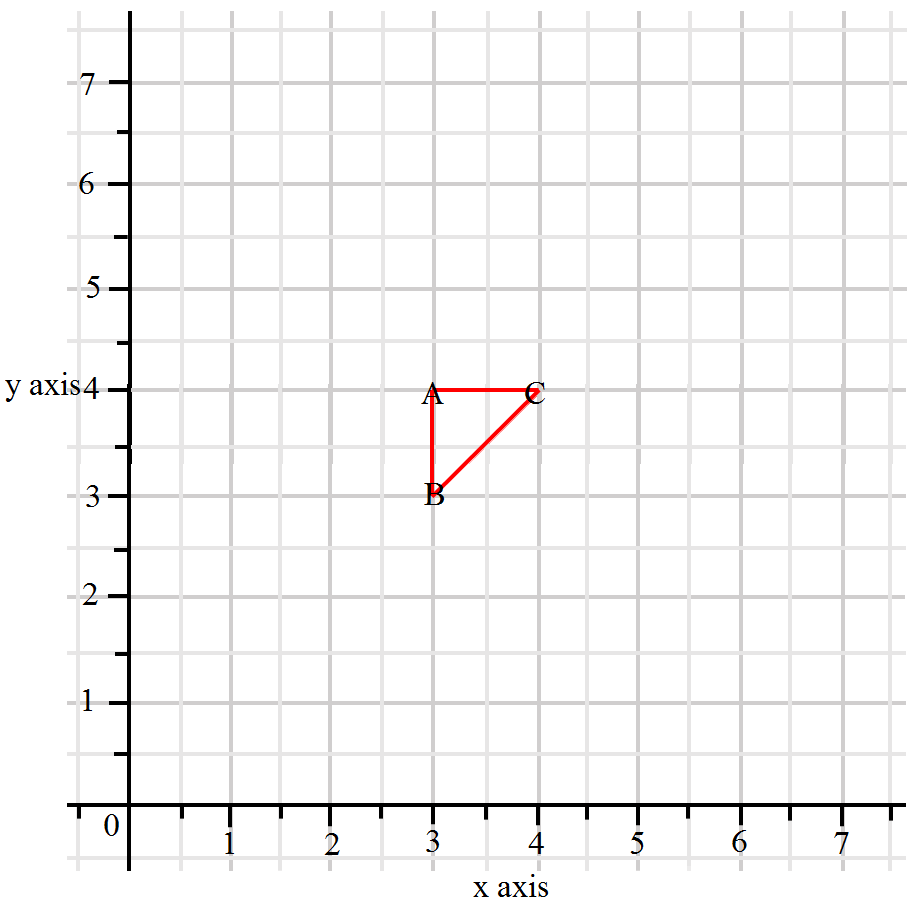
$\therefore\triangle\text{ABC}=\frac{1}{2}(\text{Base}\times{\text{Height)}}\frac{1}{2}(\text{AB}\times\text{AB})$
$=\frac{1}{2}(1\times1)=\frac{1}{2}$
Area of triangle $\text{ABC}$ is $\frac{1}{2}\text{Sq. units}$ View full question & answer→MCQ 521 Mark
If $x = a, y = b$ is the solution of the equations $x - y = 2$ and $x + y = 4,$ then the values of $a$ and $b$ are, respectively :
- ✓
$3$ and $1$
- B
$-1$ and $-3$
- C
$5$ and $3$
- D
$3$ and $5$
AnswerCorrect option: A. $3$ and $1$
Given equations are :
$x - y = 2$ and
$x + y = 4$
Adding them, we get
$2x = 6$
$x = 3$
Subtracting them, we get
$2y = 2$
$y = 1$
So $, a = 3$ and $b = 1$ is the solution of the equations.
View full question & answer→MCQ 531 Mark
The graphs of the equations $5x - 15y = 8$ and $3\text{x}-9\text{y}=\frac{24}{5}$ are two lines which are :
- ✓
- B
- C
Intersecting exactly at one point.
- D
Perpendicular to each other.
Answer$5x - 15y = 8$ and $3\text{x}-9\text{y}=\frac{24}{5}$
$5x - 15y - 8 = 0$ and $15x - 45y - 24 = 0$
$\frac{\text{a}_1}{\text{a}_2}=\frac{5}{15}=\frac{1}{3}$
$\frac{\text{b}_1}{\text{b}_2}=\frac{-15}{-45}=\frac{1}{3}$
$\frac{\text{c}_1}{\text{c}_2}=\frac{-8}{-24}=\frac{1}{3}$
Clearly, $\frac{\text{a}_1}{\text{a}_2}=\frac{\text{b}_1}{\text{b}_2}=\frac{\text{b}_1}{\text{b}_2}.$
We know that,
If in a system of linear equations $a_1 x+b_1 y+c_1=0,$
$ a_2 x+b_2 y+c_2=0$
We have $\frac{\text{a}_1}{\text{a}_2}=\frac{\text{b}_1}{\text{b}_2}=\frac{\text{b}_1}{\text{b}_2}.$
then the system has a unique solution.
So, the pair of lines are coincident.
View full question & answer→MCQ 541 Mark
The lines representing the pair of equations $9x + 3y + 12 = 0$ and $18x + 6y + 24 = 0$ :
- A
- B
Intersected at two points
- C
- ✓
AnswerGiven : $a_1=9, a_2=18, b_1=3, b_2=6, c_1=12$, and $c_2=24$
$=a_1=9, a_2=18, b_1=3, b_2=6, c_1=12$, and $c_2=24$
$=$ Here, $\frac{\text{a}_{1}}{\text{a}_{2}} = \frac{9}{18} = \frac{1}{2}, \frac{\text{b}_{1}}{\text{b}_{2}} =\frac{3}{6} = \frac{1}{2},\frac{\text{c}_{1}}{\text{c}_{2}} = \frac{12}{24} = \frac{1}{2}$
$\because\frac{\text{a}_{1}}{\text{a}_{2}} = \frac{\text{b}_{1}}{\text{b}_{2}} = \frac{\text{c}_{1}}{\text{c}_{2}} $
$\therefore$ The lines are coincident.
View full question & answer→MCQ 551 Mark
$5$ years hence, the age of a man shall be $3$ times the age of his son. while $5$ years earlier the age of the man was $7$ times the age of his son. The present age of the man is :
- A
$45$ years.
- B
$50$ years.
- C
$47$ years.
- ✓
$40$ years.
AnswerCorrect option: D. $40$ years.
Let the present age of the man be $x$ years, and his son's age be $y$ years.
According to the first condition,
$x + 5 = 3(y + 5)$
$\Rightarrow x + 5 = 3y + 15$
$\Rightarrow x - 3y = 10 ...(i)$
According to the second condition,
$x - 5 = 7(y - 5)$
$\Rightarrow x - 5 = 7y - 35$
$\Rightarrow x - 7y = -30 ...(ii)$
Subtracting $(ii)$ from $(i)$, we get
$4y = 40$
$\Rightarrow y = 10$
Substituting $y = 10$ in $(i),$ we get
$\Rightarrow x = 40.$
So, the present age of the man is $40$ years.
View full question & answer→MCQ 561 Mark
The pair of equations $2x + 3y = 5$ and $4x + 6y = 15$ has :
- A
- B
- C
Infinitely many solutions.
- ✓
Answer$2x + 3y = 5$ and $4x + 6y = 15$
$\Rightarrow 2x + 3y - 5 = 0$ and $4x + 6y - 15 = 0$
$\frac{\text{a}_1}{\text{a}_2}=\frac{2}{4}=\frac{1}{2}$
$\frac{\text{b}_1}{\text{b}_2}=\frac{3}{6}=\frac{1}{2}$
$\frac{\text{c}_1}{\text{c}_2}=\frac{-5}{-15}=\frac{1}{3}$
Clearly, $\frac{\text{a}_1}{\text{a}_2}=\frac{\text{b}_1}{\text{b}_2}\neq\frac{\text{c}_1}{\text{c}_2}$
We know that,
The system of linear equations $a_1 x+b_1 y+c_1=0 $ and $ a_2 x+b_2 y+c_2=0$ has no solution if $\frac{\text{a}_1}{\text{a}_2}=\frac{\text{b}_1}{\text{b}_2}\neq\frac{\text{c}_1}{\text{c}_2}.$
So, the pair of equations has no solution.
View full question & answer→MCQ 571 Mark
$4$ chairs and $3$ tables cost $Rs. 2100$ and $5$ chairs and $2$ tables costs $Rs. 1750$ The cost of a chair is :
- A
$Rs. 500$
- ✓
$Rs. 150$
- C
$Rs. 350$
- D
$Rs. 250$
AnswerCorrect option: B. $Rs. 150$
Let the cost of one chair be $Rs. x$ and the cost of $1$ table be $Rs. y$
According to question,
$4x + 3y = 2100 ... (i)$
$5x + 2y = 1750 ... (ii)$
Solving by elimination method,
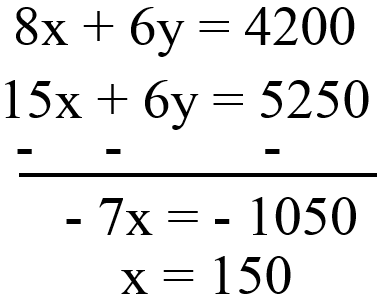
The cost of a chair is $Rs. 150$ View full question & answer→MCQ 581 Mark
If $29x + 37y = 103$ and $37x + 29y = 95$ then :
- A
$x = 1, y = 2$
- ✓
$x = 2, y = 1$
- C
$x = 3, y = 2$
- D
$x = 2, y = 3$
AnswerCorrect option: B. $x = 2, y = 1$
$29x + 37y = 103 ...(i)$
$37x + 29y = 95 ...(ii)$
Adding $(i)$ and $(ii),$ we get
$66x + 66y = 198$
$\Rightarrow x + y = 3 ...(iii)$
Subtract $(i)$ from $(ii),$ we get
$8x - 8y = 8$
$\Rightarrow x - y = 1 ....(iv)$
Adding $(iii)$ and $(iv),$
we get $2x = 4$
$\Rightarrow x = 2$
Substituting $x = 2$ in $(iii),$
we get $y = 1$.
View full question & answer→MCQ 591 Mark
The pairs of equations $x + 2y - 5 = 0$ and $-4x - 8y + 20 = 0$ have :
- A
- B
- ✓
Infinitely many solutions
- D
AnswerCorrect option: C. Infinitely many solutions
$\frac{\text{a}_{1}}{\text{a}_{2}} = \frac{1}{-4}$
$\frac{\text{a}_{1}}{\text{a}_{2}} = \frac{2}{-8} = \frac{1}{-4}$
$\frac{\text{c}_{1}}{\text{c}_{2}} = \frac{-5}{20} = -\frac{1}{4}$
This shows :
$\frac{\text{a}_{1}}{\text{a}_{2}}=\frac{\text{b}_{1}}{\text{b}_{2}}=\frac{\text{c}_{1}}{\text{c}_{2}}$
The pair of equations has infinitely many solutions.
View full question & answer→MCQ 601 Mark
Aruna has only $₹\ 1$ and $₹ \ 2$ coins with her. If the total number of coins that she has is $50$ and the amount of money with her is $₹ \ 75,$ then the number of $₹ \ 1$ and $₹ \ 2$ coins are, respectively :
- A
$35$ and $15.$
- B
$35$ and $20.$
- C
$15$ and $35$.
- ✓
$25$ and $25$.
AnswerCorrect option: D. $25$ and $25$.
Let number of $₹\ 1$ coins $= x$
and number of $₹ \ 2 $ coins $= y$
Now, by given condition $x + y = 50 ..…(i)$
Also $, x \times 1 + y \times 2 = 75$
$\Rightarrow x + 2y = 75 …...(ii)$
On subtracting eq. $(i)$ from eq. $(ii),$ we get
$(x + 2y) - (x + y) = 75 - 50$
$\Rightarrow y = 25$
When $y = 25,$ then $x = 25$
View full question & answer→MCQ 611 Mark
If $x = -y$ and $y > 0,$ which of the following is wrong ?
AnswerCorrect option: C. $\frac{1}{\text{x}}-\frac{1}{\text{y}}={0}$
Given that $x = -y,$ and $y > 0$
$\frac{1}{\text{x}}-\frac{1}{\text{y}} = 0$
$\Rightarrow\frac{1}{-\text{y}}-\frac{1}{\text{y}} = 0$
$\Rightarrow\frac{-2}{\text{y}}\neq0$
since $y > 0,$ also $\frac{1}{\text{y}} > 0,$ but $\frac{-2}{\text{y}} < 0$
It is not satisfied.
View full question & answer→MCQ 621 Mark
Every linear equation in two variables has :
- A
- B
- ✓
An infinite number of solutions
- D
AnswerCorrect option: C. An infinite number of solutions
A linear equation in two variables is of the form, $ax + by + c = 0,$
where geometrically it does represent a straight line and every point on this graph is a solution for a given linear equation.
As a line consists of an infinite number of points.
A linear equation has an infinite number of solutions.
View full question & answer→MCQ 631 Mark
The graphs of the equations $2x + 3y - 2 = 0$ and $x - 2y - 8 = 0$ are two lines which are :
- A
- B
- ✓
Intersecting exactly at one point.
- D
Perpendicular to each other.
AnswerCorrect option: C. Intersecting exactly at one point.
$2x + 3y + 9 = 0$ and $x - 2y + 8 = 0$
$\frac{\text{a}_1}{\text{a}_2}=\frac{2}{1}=2$
$\frac{\text{b}_1}{\text{b}_2}=\frac{3}{-12}$
$\frac{\text{c}_1}{\text{c}_2}=\frac{9}{-8}$
Clearly, $\frac{\text{a}_1}{\text{a}_2}\neq\frac{\text{b}_1}{\text{b}_2}.$
We know that,
If in a system of linear equations $a_1 x+b_1 y+c_1=0,$
$ a_2 x+b_2 y+c_2=0$
We have $\frac{\text{a}_1}{\text{a}_2}\neq\frac{\text{b}_1}{\text{b}_2}$ then the system has a unique solution.
So, the pair of lines are intersecting exactly at one point.
View full question & answer→MCQ 641 Mark
A system of linear equations is said to be inconsistent if it has :
AnswerA system of linear equations is said to be inconsistent if it has no solution means two lines are running parallel and not cutting each other at any point.
View full question & answer→MCQ 651 Mark
In a $\triangle\text{ABC},\ \angle\text{C}=3\angle\text{B}=2(\angle\text{A}+\angle\text{B}),$ then $\angle\text{B}=?$
- A
$20^\circ$
- ✓
$40^\circ$
- C
$60^\circ$
- D
$80^\circ$
AnswerCorrect option: B. $40^\circ$
Give that in a $\triangle\text{ABC},$
$\angle\text{C}=3\angle\text{B}=2(\angle\text{A}+\angle\text{B})$
$\Rightarrow\angle\text{C}=3\angle\text{B}$ and $\angle\text{C}=2(\angle\text{A}+\angle\text{B})$
Consider, $\angle\text{C}=2(\angle\text{A}+\angle\text{B})$
$\Rightarrow3\angle\text{B}=2(\angle\text{A}+\angle\text{B})$
$\Rightarrow\angle\text{B}=2\angle\text{A}$
By the Angle Sum Property
$\angle\text{A}+\angle\text{B}+\angle\text{C}=180^\circ$
$\Rightarrow\angle\text{A}+2\angle\text{A}+2(\angle\text{A}+2\angle\text{A})=180^\circ$
$\Rightarrow\angle\text{A}+2\angle\text{A}+2\angle\text{A}+4\angle\text{A}=180^\circ$
$\Rightarrow9\angle\text{A}=180^\circ$
$\Rightarrow\angle\text{A}=20^\circ$
So, $\angle\text{B}=2\angle\text{A}$
$\Rightarrow\angle\text{B}=40^\circ$
View full question & answer→MCQ 661 Mark
The pair of linear equations $3x + 2y = 5$ and $2x - 3y = 7$ are :
AnswerGiven : $ a_1=3, a_2=2, b_1=2, b_2=-3, c_1=5$, and $c_2=7$
Here : $\frac{\text{a}_{1}}{\text{a}_{2}} = \frac{3}{2}, \frac{\text{b}_{1}}{\text{b}_{2}} = \frac{2}{-3}$
$\therefore\frac{\text{a}_{1}}{\text{a}_{2}}\neq\frac{\text{b}_{1}}{\text{b}_{2}}$
$\therefore$ the pair of given liner equations is consistent.
View full question & answer→MCQ 671 Mark
Choose the correct answer from the given four options : The value of $c$ for which the pair of equations $cx - y = 2$ and $6x - 2y = 3$ will have infinitely many solutions is :
AnswerCorrect option: C. $-12.$
Condition for infinitely many solutions,
$\frac{\text{a}_1}{\text{a}_2}=\frac{\text{b}_1}{\text{b}_2}=\frac{\text{c}_1}{\text{c}_2}$
The given lines are $cx - y = 2 $ and $6x - 2y = 3$
Here, $a_1=c, b_1=-1, c_1=-2$
and $a_2=6, b_2=-2, c_2=-3$
From Eq. $(i), \frac{\text{c}}{6}=\frac{-1}{-2}=\frac{-2}{-3}$
Here, $\frac{\text{c}}{6}=\frac{1}{3}$ and $\frac{\text{c}}{6}=\frac{2}{3}$
$\Rightarrow\ \text{c}=3$ and $\text{c}=4$
Since $, c$ has different values.
Hence, for no value of $c$ the pair of equations will have infinitely many solutions.
View full question & answer→MCQ 681 Mark
A system of two linear equations in two variables is dependent consistent, if their graphs :
- A
Do not intersect at any point
- ✓
- C
Cut the $x-$ axis
- D
Intersect only at a point
AnswerA system of two linear equations in two variables is dependent consistent, if their graphs coincide with each other
i.e. they superimpose each other and all points in one line are also a solution for the other line.
View full question & answer→MCQ 691 Mark
The solution of $3x - 5y = -16$ and $2x + 5y = 31$ :
- ✓
$x = 3, y = 5$
- B
$x = -3, y = 5$
- C
$x = 3, y = -5$
- D
$x = -3, y = -5$
AnswerCorrect option: A. $x = 3, y = 5$
Given : $3x - 5y = -16 ... (i)$
And $2x + 5y = 31 ... (ii)$
Adding eq. $(i)$ and $(ii),$ we get
$5x = 15$
$\Rightarrow x = 3$
Putting the value of $x$ in eq. $(ii),$ we get
$2(3) + 5y = 31$
$\Rightarrow 5y = 31 - 6$
$\Rightarrow y = 5$
View full question & answer→MCQ 701 Mark
The value of $k$ for which the system of equations has a unique solution, is : $ kx - y = 2, 6x - 2y = 3$
- A
$= 3$
- ✓
$\neq 3$
- C
$\neq 0$
- D
$= 0$
AnswerCorrect option: B. $\neq 3$
The given system of equation are
$kx - y = 2$
$6x - 2y = 3$
$\frac{\text{a}_1}{\text{a}_2}\neq\frac{\text{b}_1}{\text{b}_2}$ for unique solution
Here $a_1=k, a_2=6, b_1=-1, b_2=-2$
$\frac{\text{k}}{6}\neq\frac{-1}{-2}$
By cross multiply we get
$2\text{k}\neq6$
$\text{k}\neq\frac{6}{2}$
$\text{k}\neq3$
Hence, the correct choice is $b$.
View full question & answer→MCQ 711 Mark
The larger of the two supplementary angles exceeds the smaller by $18^\circ$. The smaller angle is :
- A
$180^\circ$
- ✓
$81^\circ$
- C
$100^\circ$
- D
$99^\circ$
AnswerCorrect option: B. $81^\circ$
Let larger of the two supplementary angles be $x$ and smaller be $y$
According to question $, x + y = 180^\circ ... (i)$
And $x = y + 18^\circ $
$\Rightarrow x - y = 18^\circ ... (ii)$
Subtracting eq. $(ii)$ from eq. $(i),$
we get $2y = 162^\circ $
$\Rightarrow y = 81^\circ $
Therefore, the smaller angle is $81^\circ $
Putting the value of $y$ in equation $1$
$x + 81^\circ = 180^\circ $
$x = 180^\circ - 81^\circ $
$x = 99^\circ ,$ which is a larger angle.
View full question & answer→MCQ 721 Mark
The value of $'k\ '$ so that the system of equations $3x - y - 5 = 0$ and $Gx - 2y - k = 0$ have infinitely many solutions is :
- A
$k = -10$
- ✓
$k = 10$
- C
$k = -8$
- D
$k = 8$
AnswerCorrect option: B. $k = 10$
Given : $a_1=3, a_2=6, b_1=-1, b_2=-2, c_1=-5$ and $c_2=-k$
If there is infinitely many solutions then $\frac{\text{a}_{1}}{\text{a}_{2}}= \frac{\text{b}_{1}}{\text{b}_{2}}=\frac{\text{c}_{1}}{\text{c}_{2}}$
$=\frac{3}{6}= \frac{-1}{-2}=\frac{-5}{\text{-k}}$
Taking $\frac{-1}{-2}=\frac{-5}{\text{-k}}$
$\Rightarrow \text{k}=5\times2$
$\Rightarrow\text{k}=10$
View full question & answer→MCQ 731 Mark
The system of linear equations $a_1 x+b_1 y+c_1=0$ and $a_2 x+b_2 y+c_2=0$ has a unique solution if :
- A
$\frac{\text{a}_{1}}{\text{a}_{2}}=\frac{\text{b}_{1}}{\text{b}_{2}}=\frac{\text{c}_{1}}{\text{c}_{2}}$
- B
$\frac{\text{a}_{1}}{\text{a}_{2}}=\frac{\text{b}_{1}}{\text{b}_{2}}\neq\frac{\text{c}_{1}}{\text{c}_{2}}$
- ✓
$\frac{\text{a}_{1}}{\text{a}_{2}}\neq\frac{\text{b}_{1}}{\text{b}_{2}}$
- D
AnswerCorrect option: C. $\frac{\text{a}_{1}}{\text{a}_{2}}\neq\frac{\text{b}_{1}}{\text{b}_{2}}$
The systeam of linear equations $a_1 x+b_1 y+c_1=0$ and $a_2 x+b_2 y+c_2=0$ has a unique solution if $\frac{\text{a}_{1}}{\text{a}_{2}}\neq\frac{\text{b}_{1}}{\text{b}_{2}}$
View full question & answer→MCQ 741 Mark
If $2^{\text{x+y}}=2^{\text{x}-\text{y}}=\sqrt8$ then the value of $y$ is :
- A
$\frac{1}{2}$
- B
$\frac{3}{2}$
- ✓
$0$
- D
Answer$\Rightarrow2\text{x} +\text{y}=2\text{x}-\text{y}=\sqrt{8}$
$\Rightarrow2\text{x}+\text{y}=\sqrt{8}\ ...(\text{i})$
$\Rightarrow2\text{x}-\text{y}=\sqrt{8}\ ...(\text{ii})$
Adding $(i)$ and $(ii),$ we get
$4\text{x}=2\sqrt8$
$\Rightarrow\text{x}=\frac{\sqrt8}{2}$
Substituting $\text{x}=\frac{\sqrt8}{2}$ in $(i),$
we get $y = 0.$
View full question & answer→MCQ 751 Mark
The pair of linear equations $5x - 3y = 11$ and $-10x + 6y = -22$ are :
AnswerGiven : $a_1=5, a_2=-10, b_1=-3, b_2=6, c_1=11$ and $c_2=-22$
$=a_1=5, a_2=-10, b_1=-3, b_2=6, c_1=11$, and $c_2=-22$
$=$ Here, $\frac{\text{a}_{1}}{\text{a}_{2}} = \frac{5}{-10} = -\frac{1}{2},=\frac{\text{b}_{1}}{\text{b}_{2}} = \frac{-3}{6} = -\frac{1}{2},=\frac{\text{c}_{1}}{\text{c}_{2}} = \frac{11}{-22} = -\frac{1}{2},$
$\because\frac{\text{a}_{1}}{\text{a}_{2}}= \frac{\text{b}_{1}}{\text{b}_{2}}= \frac{\text{c}_{1}}{\text{c}_{2}}$
$\therefore$ The pair of given linear equations is coincident.
View full question & answer→MCQ 761 Mark
If $2x + 3y = 12$ and $3x - 2y = 5$ then :
- A
$x = 2, y = 3$
- B
$x = 2, y = -3$
- ✓
$x = 3, y = 2$
- D
$x = 3, y = -2$
AnswerCorrect option: C. $x = 3, y = 2$
$2x + 3y = 12 ....(i)$
$3x - 2y = 5 ...(ii)$
Multiplying equation $(i)$ and $(ii)$ by $2$ and $3$ respectively.
$4x + 6y = 24 ...(iii)$
$9x - 6y = 15 ....(iv)$
Adding equations $(iii$) and $(iv),$
we get $13x = 39$
$\Rightarrow x = 3$
Substituting $x = 3$ in $(ii),$
we get $y = 2$.
View full question & answer→MCQ 771 Mark
If $\frac{3}{\text{x+y}}+\frac{2}{\text{x}-\text{y}}=2$ and $\frac{9}{\text{x+y}}-\frac{4}{\text{x}-\text{y}}=1$ then :
- A
$\text{x}=\frac{1}{2},\ \text{y}=\frac{3}{2}$
- ✓
$\text{x}=\frac{5}{2},\ \text{y}=\frac{1}{2}$
- C
$\text{x}=\frac{3}{2},\ \text{y}=\frac{1}{2}$
- D
$\text{x}=\frac{1}{2},\ \text{y}=\frac{5}{2}$
AnswerCorrect option: B. $\text{x}=\frac{5}{2},\ \text{y}=\frac{1}{2}$
$\frac{3}{\text{x+y}}+\frac{2}{\text{x}-\text{y}}=2$
$\frac{9}{\text{x+y}}-\frac{4}{\text{x}-\text{y}}=1$
Put $\frac{1}{\text{x+y}}=\text{u}$ and $\frac{1}{\text{x}-\text{y}}=\text{v}$
So, we get
$3u + 2v = 2 ...(i)$
$9u - 4v = 1 ...(ii)$
Multiply $(i)$ by $2$ and add it to $(ii)$.
$\Rightarrow 6u + 4v = 4$
$\Rightarrow 15u = 5$
$\Rightarrow\text{u}=\frac{1}{3}$
Substituting $\text{u}=\frac{1}{3}$ in $(i),$ we get $\text{v}=\frac{1}{2}.$
$\Rightarrow\frac{1}{\text{x+y}}=\frac{1}{3}$ and $\frac{1}{\text{x}-\text{y}}=\frac{1}{2}$
$\Rightarrow x + y = 3 ...(iii)$
$\Rightarrow x - y = 2 ...(iv)$
Adding $(iii)$ and $(iv),$ we get
$2\text{x}=5$
$\Rightarrow\text{x}=\frac{5}{2}$
Substituting $\text{x}=\frac{5}{2}$ in $(iii),$ we get $\text{y}=\frac{1}{2}.$
View full question & answer→MCQ 781 Mark
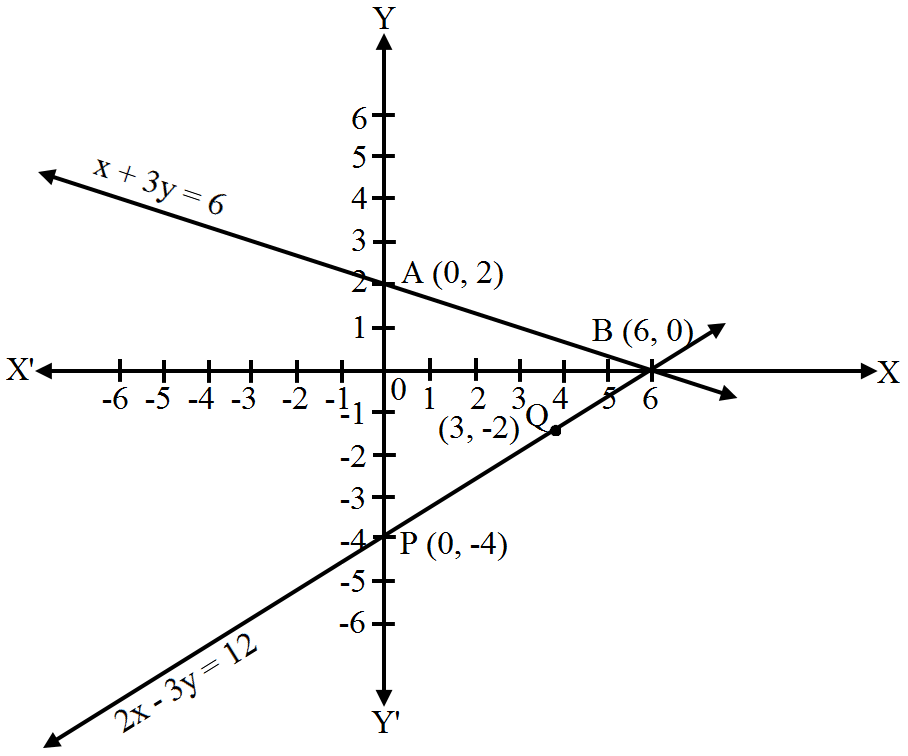
The lines representing the pair of equations $x + 3y = 6$ and $2x - 3y = 12$ intersect at :
- A
$(0, 6)$
- B
$(1, 6)$
- ✓
$(6, 0)$
- D
$(6, 1)$
AnswerCorrect option: C. $(6, 0)$
Here are the two solutions of each of the given equations. $x + 3y = 6$
$2x - 3y = 12$
| $X$ |
$0$ |
$3$ |
| $y$ |
$-4$ |
$-2$ |
View full question & answer→MCQ 791 Mark
Choose the correct answer from the given four options : Graphically, the pair of equations $6x \ – 3y + 10 = 0, 2x \ – y + 9 = 0$ represents two lines which are :
- A
Intersecting at exactly one point.
- B
Intersecting at exactly two points.
- C
- ✓
AnswerThe given equations are
$6x - 3y + 10 = 0$
$\Rightarrow\ 2\text{x}-\text{y}+\frac{10}{3}=0 \ [$dividing by $3] .....(i)$
and $2x - y + 9 = 0 .....(ii)$
Now, table for $2\text{x}-\text{y}+\frac{10}{3}=0$
| $x$ |
$0$ |
$-\frac{9}{2}$
|
|
$\text{y}=2\text{x}+\frac{10}{3}$
|
$\frac{10}{3}$
|
$0$
|
|
Points
|
$A$ |
$B$ |
and teble of $2x - y + 9 = 0,$
| $x$ |
$0$ |
$-\frac{9}{2}$
|
|
$y = 2x + 9$
|
$9$ |
$0$ |
|
Points
|
$C$ |
$D$ |
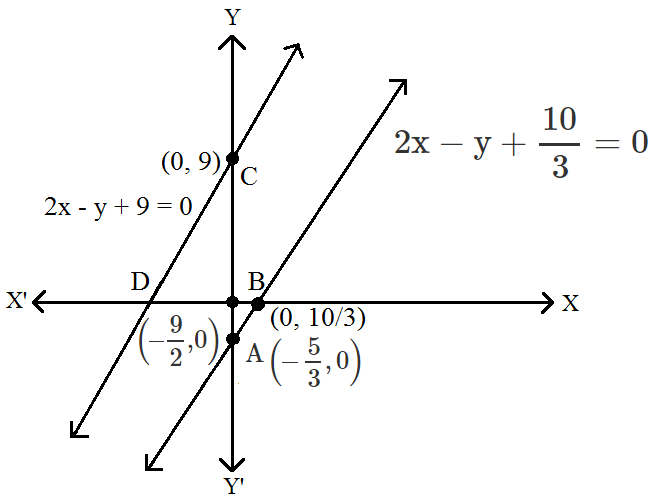
Hence, the pair of equations represents two parallel lines. View full question & answer→MCQ 801 Mark
The value of $k$ so that the system of equations $3x - 4y - 7 = 0$ and $6x - ky - 5 = 0$ have a unique solution is :
- A
$\text{k} \neq -4$
- B
$\text{k} \neq -8$
- ✓
$\text{k} \neq 8$
- D
$\text{k} \neq 4$
AnswerCorrect option: C. $\text{k} \neq 8$
Given : $a_1=3, a_2=6, b_1=-4, b_2=-k, c_1=-7$, and $c_2=-5$
if there is a unique solutions,
then $\frac{\text{a}_{1}}{\text{a}_{2}}\neq\frac{\text{b}_{1}}{\text{b}_{2}}$
$\Rightarrow \frac{3}{6}\neq\frac{-4}{\text{-k}}$
$\Rightarrow-3\text{k}\neq-4\times{6}$
$\Rightarrow \text{k}\neq{8}$
View full question & answer→MCQ 811 Mark
In a cyclic quadrilateral $\text{ABCD},$ it is being given that $\angle\text{A}=(\text{x+y}+10)^\circ,$
$\angle\text{B}=(\text{y}+20)^\circ, \angle\text{C}=(\text{x+y}-30)^\circ$ and $\angle\text{D}=(\text{x+y}).$ then, $\angle\text{B}=?$
- A
$70^\circ$
- ✓
$80^\circ$
- C
$100^\circ$
- D
$110^\circ$
AnswerCorrect option: B. $80^\circ$
Given that in cydic quadrilateral $\text{ABCD},$
$\angle\text{A}=(\text{x}+\text{y}+10)^\circ, \angle\text{B}=(\text{y+20})^\circ,$
$\angle\text{C}=(\text{x}+\text{y}+30)^\circ$ and $\angle\text{D}=(\text{x}+\text{y})^\circ$
We know that,
Opposite angles of a quadrilateral sum upto $180^\circ .$
$\Rightarrow\angle\text{B}+\angle\text{D}=180^\circ$
$\Rightarrow(\text{y}+20)^\circ+(\text{x+y})^\circ=180^\circ$
$\Rightarrow\text{x}+2\text{y}=160\ .....(\text{i})$
Similarly, $\angle\text{A}+\angle\text{C}=180^\circ$
$\Rightarrow(\text{x+y}+10)^\circ+(\text{x+y}-30)^\circ=180^\circ$
$\Rightarrow2\text{x}+2\text{y}=200$
$\Rightarrow\text{x+y}=100\ ...(\text{ii})$
Subtracting $(ii)$ from $(i),$ we get
$\text{y}=60$
$\angle\text{B}=(60+20)^\circ=80^\circ$
View full question & answer→MCQ 821 Mark
For what value of $k,$ do the equations $kx - 2y = 3$ and $3x + y = 5$ represent two lines intersecting at a unique point ?
AnswerCorrect option: B. all real values except $-6$
For a unique intersecting point we have $\frac{\text{a}_{1}}{\text{a}_{2}}\neq\frac{\text{b}_{1}}{\text{b}_{2}}$
$\therefore\frac{\text{k}}{3}\neq \frac{-2}{1}$
$\text{k}\neq-6$
View full question & answer→MCQ 831 Mark
If $\frac{2\text{x}+\text{y}+2}{5}=\frac{3\text{x}-\text{y}+1}{3}=\frac{3\text{x}+2\text{y}+1}{6}$ then :
- ✓
$x = 1, y =1$
- B
$x = -1, y = -1$
- C
$x = 1, y = 2$
- D
$x = 2, y = 1$
AnswerCorrect option: A. $x = 1, y =1$
$\frac{2\text{x}+\text{y}+2}{5}=\frac{3\text{x}-\text{y}+1}{3}=\frac{3\text{x}+2\text{y}+1}{6}$
$\Rightarrow\frac{2\text{x}+\text{y}+2}{5}=\frac{3\text{x}-\text{y}+1}{3}$ and $\frac{3\text{x}-\text{y}+1}{3}=\frac{3\text{x}+2\text{y}+1}{6}$
On solving we can obtain two equations in $x$ and $y$.
Multiplying each of the equation by the $\text{LCM}$ of the denominators, we get
$\Rightarrow 3(2x + y + 2) = 5(3x - y + 1)$ and $2(3x - y + 1) = 3x + 2y + 1$
$\Rightarrow 6x + 3y + 6 = 15x - 5y + 5$ and $6x - 2y + 2 = 3x + 2y + 1$
$\Rightarrow 9x - 8y = 1 ...(i)$
$\Rightarrow 3x - 4y = -1 ...(ii)$
Multiply $(ii)$ by $3,$ and subtract from $(i).$
$\Rightarrow 9x - 8y = 1$ and $9x - 12y = -3$
$\Rightarrow 4y = 4$
$\Rightarrow y = 1$
Substituting $y = 1$ in $(i),$ we get $x = 1$.
View full question & answer→MCQ 841 Mark
If a pair linear equations is inconsistent then their graph lines will be :
- ✓
- B
- C
- D
Intersecting or coincident.
AnswerA system of equations $a_1 x+b_1 y+c_1=0,$
$ a_2 x+b_2 y+c_2=0$ is said to be inconsistent if it has no solution.
If a pair of linear equation are parallel,
It has no solutions.
If a pair of linear equation are coincident,
If has infinite number of solutions.
If a pair of linear equations are intersecting,
It has a unique solution.
So, the pair of linear will be parallel.
View full question & answer→MCQ 851 Mark
The value of $k$ for which the system, of equations has infinite number of solutions, is : $2x + 3y = 5 , 4x + ky = 10$
AnswerThe given equation are
$2x + 3y = 5 ....(i)$
$4x + ky = 10 ......(ii)$
For infinite solution,
$\frac{\text{a}_1}{\text{a}_2}=\frac{\text{b}_1}{\text{b}_2}=\frac{\text{c}_1}{\text{c}_2}$
$\Rightarrow\frac{2}{4}=\frac{3}{\text{k}}=\frac{5}{10}$
$\Rightarrow\frac{2}{4}=\frac{3}{\text{k}}$
$\Rightarrow\frac{1}{2}=\frac{3}{\text{k}}$
$\Rightarrow\text{k}=6$
Thus $, k = 6$
View full question & answer→MCQ 861 Mark
The area of the triangle formed by the lines $y = x, x = 6$ and $y = 0$ is :
- A
$36$ sq. units
- ✓
$18$ sq. units
- C
$9$ sq. units
- D
$27$ sq. units
AnswerCorrect option: B. $18$ sq. units
Given $x = 6, y = 0$ and $x = y$
We have poltting points as $(6, 0) (0, 0) (6, 6)$ when $x = y$
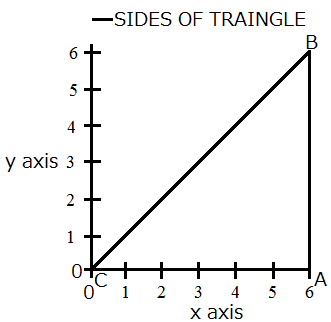
Therefore, area of $\triangle\text{ABC}=\frac{1}{2}\times\text{base}\times\text{height}$
$=\frac{1}{2}(\text{CA}\times\text{AB})$
$=\frac{1}{2}(6\times6)$
$=\frac{1}{2}\times36=18$
Area of triangle $\text{ABC}$ is $18$ square units.
Hence the correct choice is $b$. View full question & answer→MCQ 871 Mark
For what value k, do the equations $3x - y + 8 = 0$ and $6x - ky + 16 = 0$ represent :
- A
$\frac{1}{2}$
- B
$-\frac{1}{2}$
- ✓
$2$
- D
$-2$
AnswerLet $3x - y + 8 = 0 ...…(i)$
and $6x - (-ky) + 16 = 0 .....(ii)$
Here, $a_1=3, b_1=-1, c_1=8$
and $a_2=6, b_2=-k, c_2=16$
The given lines are coincident
$\therefore\frac{\text{a}_1}{\text{a}_2}=\frac{\text{b}_1}{\text{b}_2}=\frac{\text{c}_1}{\text{c}_2}$
$\therefore\frac{3}{6}=\frac{-1}{-\text{k}}=\frac{8}{16}$
$\therefore\frac{3}{6}=\frac{-1}{-\text{k}}$
$\therefore-\text{k}=-1\times\frac{6}{3}$
$\Rightarrow\text{k}=2$
View full question & answer→MCQ 881 Mark
If the system of equations is inconsistent, then $k = 3x + y = 1(2k - 1)x + (k - 1)y = 2k + 13x + y = 12k - 1x + k - 1 = 2k + 1.$
AnswerThe given equation are,
$3x + y = 1 .....(i)$
$(2k - 1)x + (k - 1)y = 2k + 1 ....(ii)$
For inconsistencey,
$\frac{\text{a}_1}{\text{a}_2}=\frac{\text{b}_1}{\text{b}_2}\neq\frac{\text{c}_1}{\text{c}_2}$
$\Rightarrow\frac{3}{2\text{k}-1}=\frac{1}{\text{k}-1}\neq\frac{-1}{-2(\text{k}+1)}$
$\Rightarrow\frac{3}{2\text{k}-1}=\frac{1}{\text{k}-1}$
$\Rightarrow 3(k - 1) = 2k - 1$
$\Rightarrow 3k - 3 = 2k - 1$
$\Rightarrow 3k - 2k = 3 - 1$
$\Rightarrow k = 2$
View full question & answer→MCQ 891 Mark
The system $x - 2y = 3 $ and $3x + ky = 1$ has a unique solution only when :
- A
$\text{k}=-6,$
- ✓
$\text{k}\neq-6$
- C
$\text{k}=0$
- D
$\text{k}\neq0$
AnswerCorrect option: B. $\text{k}\neq-6$
$x - 2y = 3$ and $3x + ky = 1$
We know that, the system of linear equations $a_1 x+b_1 x+c_1=0, $
$a_2 x+b_2 y+c_2=0$ has a unique solution if $\frac{\text{a}_1}{\text{a}_2}\neq\frac{\text{b}_1}{\text{b}_2}.$
So, $\frac{1}{3}\neq\frac{-2}{\text{k}}$
$\Rightarrow\text{k}\neq-6.$
View full question & answer→MCQ 901 Mark
The difference between two numbers is $26$ and one number is three times the other. The numbers are :
- A
$36$ and $10$
- B
$36$ and $12$
- C
$30$ and $10$
- ✓
$39$ and $13$
AnswerCorrect option: D. $39$ and $13$
Let the two numbers be $x$ and $y$
According to question $, x - y = 26$ and $x = 3y$
Putting the value of $x$ in $x - y = 26,$
we get $, 3y - y = 26$
$\Rightarrow y = 13$ And $x = 3 \times 13 = 39$
$\therefore$ the two numbers are $13$ and $39$.
View full question & answer→MCQ 911 Mark
The pair of equations $2x + y = 5, 3x + 2y = 8$ has :
- ✓
- B
- C
- D
Infinitely many solutions.
AnswerThe given system of equations can be written can be follows :
$2x + y - 5 = 0$ and $3x + 2y - 8 = 0$
The given equations are of the following form :
$ax + by + c = 0 $ and $ax + by + c = 0$
Here, $a = 2, b = 1, c = -5$ and $a = 3, b = 2$ and $c = -8$
$\therefore\frac{\text{a}_1}{\text{a}_2}=\frac{2}{3},\ \frac{\text{b}_1}{\text{b}_2}=\frac{1}{2}$ and $\frac{\text{c}_1}{\text{c}_2}=\frac{-5}{-8}=\frac{5}{8}$
$\therefore\frac{\text{a}_1}{\text{a}_2}\neq\frac{\text{b}_1}{\text{b}_2}$
The given system has a unique solution.
Hence, the lines intersect at one point.
View full question & answer→MCQ 921 Mark
The value of $'k\ ’$ so that the system of linear equations $kx - y - 2 = 0$ and $6x - 2y - 3 = 0$ have no solution is :
- ✓
$k = 3$
- B
$k = 4$
- C
$k = -4$
- D
$k = -3$
AnswerCorrect option: A. $k = 3$
Given : $a_1=k, a_2=6, b_1=-1, b_2=-2, c_1=-2$, and $c_2=-3$
if there no solution, then $\frac{\text{a}_{1}}{\text{a}_{2}} = \frac{\text{b}_{1}}{\text{b}_{2}}\neq\frac{\text{c}_{1}}{\text{c}_{2}}$
$\Rightarrow\frac{\text{k}}{6} = \frac{-1}{-2}\neq\frac{-2}{-3}$
$\Rightarrow \text{k}=\frac{6}{2}$
$\Rightarrow\text{k} = {3}$
View full question & answer→MCQ 931 Mark
The angles of cyclic quadrilaterals $\text{ABCD}$ are : $A = (6x + 10), B = (5x)^\circ , C = (x + y)^\circ$ and $D = (3y - 10)^\circ$ . The value of $x$ and $y$ is :
- A
$x = 20^\circ$ and $y = 10^\circ$
- ✓
$x = 20^\circ$ and $y = 30^\circ$
- C
$x = 44^\circ$ and $y = 15^\circ$
- D
$x = 15^\circ$ and $y = 15^\circ$
AnswerCorrect option: B. $x = 20^\circ$ and $y = 30^\circ$
We know, in cyclic quadrilaterals, the sum of the opposite angles are $180^\circ .$
$A + C = 180^\circ $
$6x + 10 + x + y = 180 $
$\Rightarrow 7x + y = 170^\circ $
And $B + D = 180^\circ $
$5x + 3y - 10 = 180 $
$\Rightarrow 5x + 3y = 190^\circ $
By solving the above two equations we get;
$x = 20^\circ $ and $y = 30^\circ .$
View full question & answer→MCQ 941 Mark
The system $kx - y = 2$ and $6x - 2y = 3$ has a unique solution only when :
- A
$\text{k}=-6,$
- B
$\text{k}\neq-6$
- C
$\text{k}=0$
- ✓
$\text{k}\neq3$
AnswerCorrect option: D. $\text{k}\neq3$
$kx - y = 2$ and $6x - 2y = 3$
We know that,
the system of linear equations $a_1 x+b_1 x+c_1=0,$
$a_2 x+b_2 y+c_2=0$ has a unique solution if $\frac{\text{a}_1}{\text{a}_2}\neq\frac{\text{b}_1}{\text{b}_2}.$
So $, \frac{\text{k}}{6}\neq\frac{-1}{-2}$
$\Rightarrow\text{k}\neq3.$
View full question & answer→MCQ 951 Mark
Choose the correct answer from the given four options : A pair of linear equations which has a unique solution $x = 2, y = -3$ is :
- A
$x + y = -1, 2x - 3y = -5.$
- ✓
$2x + 5y = -11, 4x + 10y = -22.$
- C
$2x - y = 1, 3x + 2y = 0.$
- D
$x - 4y -14 = 0, 5x - y - 13 = 0.$
AnswerCorrect option: B. $2x + 5y = -11, 4x + 10y = -22.$
If $x = 2, y = -3$ is a unique solution of any pair of equation,
then these values must satisfy that pair of equations.
From option $(b), \text{LHS} = 2x + 5y = 2(2) + 5(-3) = 4 -15 = -11 = \text{RHS}$
and $\text{LHS} = 4x + 10y = 4(2) + 10(-3) = 8 - 30 = -22 = \text{RHS}.$
View full question & answer→MCQ 961 Mark
A system of two linear equations in two variables is inconsistent if their graphs :
- ✓
Do not intersect at any point
- B
- C
Cut the $x-$ axis
- D
Intersect only at a point
AnswerCorrect option: A. Do not intersect at any point
A system of two linear equations in two variables is inconsistent if their graphs do not intersect at any point.
In this case, a pair of lines represented by the system are parallel to each other.
so they do not intersect each other at any point.
The system is an inconsistent system of linear equations and the equations are independent.
View full question & answer→MCQ 971 Mark
The pairs of equations $9x + 3y + 12 = 0$ and $18x + 6y + 26 = 0$ have :
- A
- B
- C
Infinitely many solutions
- ✓
AnswerGiven, $9x + 3y + 12 = 0$ and $18x + 6y + 26 = 0$
$\frac{\text{a}_{1}}{\text{a}_{2}} = \frac{9}{18} = \frac{1}{2}$
$\frac{\text{b}_{1}}{\text{b}_{2}} = \frac{3}{6} = \frac{1}{2}$
$\frac{\text{c}_{1}}{\text{c}_{2}} = \frac{12}{26} = \frac{6}{13}$
Since $\frac{\text{a}_{1}}{\text{a}_{2}} = \frac{\text{b}_{1}}{\text{b}_{2}}\neq\frac{\text{c}_{1}}{\text{c}_{2}}$
So, the pairs of equations are parallel and the lines never intersect each other at any point,
There is no possible solution.
View full question & answer→MCQ 981 Mark
The area of the triangle formed by the line $\frac{\text{x}}{\text{a}}+\frac{\text{y}}{\text{b}}=1$ with the coordinate axes is :
- A
$\text{ab}$
- B
$2\text{ab}$
- ✓
$\frac{1}{2}\text{ab}$
- D
$\frac{1}{4}\text{ab}$
AnswerCorrect option: C. $\frac{1}{2}\text{ab}$
Given
$\frac{\text{x}}{\text{a}}+\frac{\text{y}}{\text{b}}=1\ .....(\text{i})$
Eq. $(i)$ cut $x-$ axis and $y-$ axis at $a$ and $b$ respectively.
Area of $\triangle=\frac{1}{2}\times\text{base}\times\text{height}$
$=\frac{1}{2}\times\text{a}\times\text{b}$
$=\frac{1}{2}\text{ab}$
View full question & answer→MCQ 991 Mark
The value of a so that the point $(3, a)$ lies on the represented by $2x - 3y = 5$ is :
- A
$\frac{-1}{3}$
- ✓
$\frac{1}{3}$
- C
$1$
- D
$-1$
AnswerCorrect option: B. $\frac{1}{3}$
$\Rightarrow2\text{x} - 3\text{y} = 5$
$\Rightarrow2\times3-3\times\text{a} = 5$
$\Rightarrow{6}-3,\text{ a} = {5}$
$\Rightarrow\text{a}=\frac{1}{3}$
View full question & answer→MCQ 1001 Mark
If the system of equations $kx - 5y = 2, 6x + 2y = 7$ has no solution, then $k =$
- A
$-10.$
- B
$-5.$
- C
$-6.$
- ✓
$-15.$
AnswerCorrect option: D. $-15.$
The given equation are,
$kx - 5y = 2$
$6x + 2y = 7$
If $\frac{\text{a}_1}{\text{a}_2}=\frac{\text{b}_1}{\text{b}_2}\neq\frac{\text{c}_1}{\text{c}_2}$
Here $a_1=k, a_2=6, b_1=-5, b_2=2$
$\frac{\text{k}}{6}=\frac{-5}{2}$
$2\text{k}=-30$
$\text{k}=-15$
Hence, the correct choice is $d.$
View full question & answer→