MCQ 1511 Mark
In $\triangle\text{ABC}$ and $\text{ DEF},\angle\text{B}= \angle\text{E},\angle\text{F}=\angle\text{C}$ and $\text{AB} =3\text{DE}$ Then, the two traingles are :
- A
Congruent but not similar
- ✓
Similar but not congruent
- C
Neither congruent nor similar
- D
Congruent as well as similar
AnswerCorrect option: B. Similar but not congruent
in $\triangle\text{ABC}$ and $\triangle\text{DEF}$,
$\angle\text{B}= \angle\text{E},\angle\text{F}=\angle\text{C}$ and $\text{AB}=3 \text{DE}$
By $\text{AA}$ similarity criterion,
$\triangle\text{ABC}\sim\triangle\text{DEF}$
$\text{AB}=3\text{DE}$
$=\frac{\text{AB}}{\text{DE}}=3$
$=\frac{\text{AB}}{\text{DE}}=\frac{\text{BC}}{\text{EF}}=\frac{\text{AC}}{\text{DF}}=3$
For triangles to be congruent, the ratio of sides must be $1$
Therefore, triangles are similar but not congruent.
View full question & answer→MCQ 1521 Mark
Choose the correct answer from the given four options : If in two triangles $\text{DEF}$ and $\text{PQR},$ $\angle\text{D}=\angle\text{Q}$ and $\angle\text{R}=\angle\text{E},$ then which of the following is not true?
- A
$\frac{\text{EF}}{\text{PR}}=\frac{\text{DF}}{\text{PQ}}$
- ✓
$\frac{\text{DF}}{\text{PQ}}=\frac{\text{EF}}{\text{RP}}$
- C
$\frac{\text{DF}}{\text{QR}}=\frac{\text{DF}}{\text{PQ}}$
- D
$\frac{\text{EF}}{\text{RP}}=\frac{\text{DF}}{\text{RQ}}$
AnswerCorrect option: B. $\frac{\text{DF}}{\text{PQ}}=\frac{\text{EF}}{\text{RP}}$
Give, $\triangle\text{DEF},\angle\text{D}=\angle\text{Q},\angle\text{R}=\angle\text{E}$
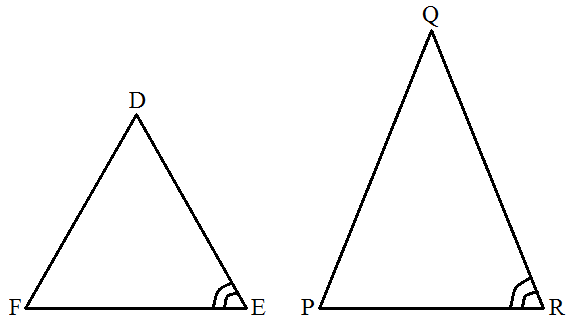
$\therefore\triangle\text{DEF}\sim\triangle\text{QRP} \ [$by $\text{AAA}$ similarity criterion$]$
$\Rightarrow\angle\text{F}=\angle\text{P} \ [$Corresponding angles of similar triangles$]$
$\therefore\frac{\text{DF}}{\text{PQ}}=\frac{\text{EF}}{\text{RP}}$ Hence proved. View full question & answer→MCQ 1531 Mark
In $\triangle\text{ABC}$ it is given that $\frac{\text{AB}}{\text{AC}}=\frac{\text{BD}}{\text{DC}}.$ If $\angle\text{B}=70^\circ$ and $\angle\text{C}=50^\circ$ then $\angle\text{BAD}=?$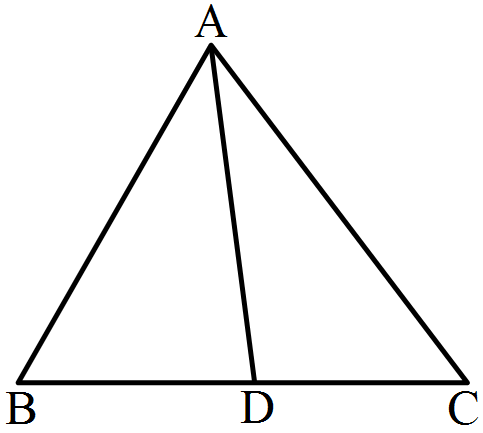
- ✓
$30^\circ$
- B
$40^\circ$
- C
$45^\circ$
- D
$50^\circ$
AnswerCorrect option: A. $30^\circ$
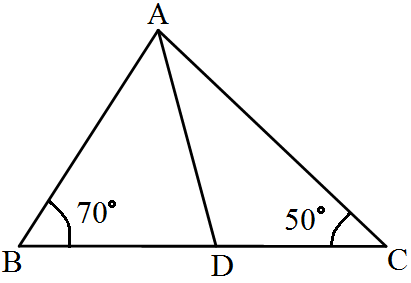
in $\triangle\text{ABC}$ it is given that $\frac{\text{AB}}{\text{AC}}=\frac{\text{BD}}{\text{DC}}.$
$\Rightarrow AD$ bisects $\angle\text{BAC}$
In $\triangle\text{ABC},$
$\angle\text{BAC}+\angle\text{ABC}+\angle\text{ACB}=180^\circ$
$\Rightarrow\angle\text{BAC}+70^\circ+50^\circ=180^\circ$
$\Rightarrow\angle\text{BAC}=60^\circ$
$\Rightarrow\angle\text{BAD}=\angle\text{DAC}=30^\circ$ View full question & answer→MCQ 1541 Mark
The line segments joining the midpoint of the sides of a triangle form four triangles, each of which is :
- A
Congruent to the original triangle.
- ✓
Similar to the original triangle.
- C
- D
AnswerCorrect option: B. Similar to the original triangle.
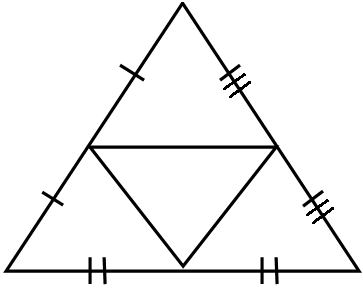
The line segments joining the midpoint of the side of a triangle form four triangles, each of which is similar to the original triangle.
View full question & answer→MCQ 1551 Mark
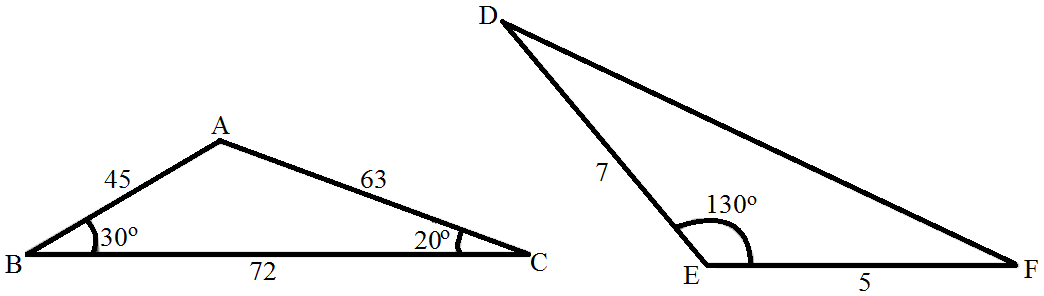
In the given figure the measure of $\angle\text{D}$ and $\angle\text{F}$ are respectively :
- A
$50^\circ , 40^\circ$
- ✓
$20^\circ , 30^\circ$
- C
$40^\circ , 50^\circ$
- D
$30^\circ , 20^\circ$
AnswerCorrect option: B. $20^\circ , 30^\circ$
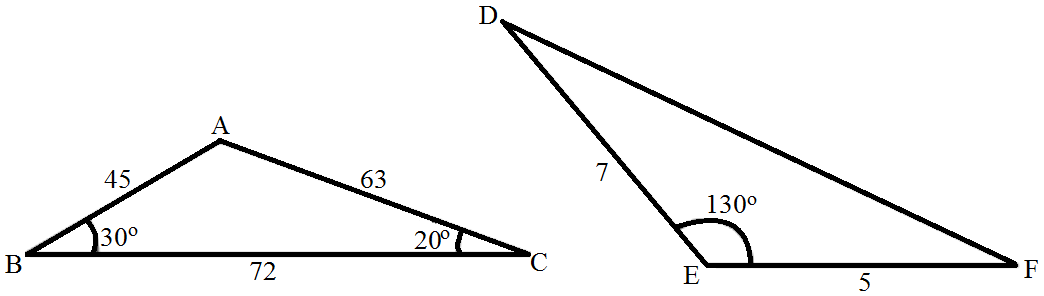
$\triangle\text{ABC}$ and $\triangle\text{DEF,}$
$\frac{\text{AB}}{\text{AC}}=\frac{\text{EF}}{\text{ED}}$
$\angle\text{A}=\angle\text{E}=130^\circ$
$\triangle\text{ABC}\sim\triangle\text{EFD} \ (\text{SAS}$ Similarity$)$
$\therefore\angle\text{F}=\angle\text{B}=30^\circ$
$\angle\text{D}=\angle\text{C}=20^\circ$
Hence the correct answer is $B$. View full question & answer→MCQ 1561 Mark
If $\text{ABC}$ is a right triangle right $-$ angled at $B$ and $M, N$ are the mid $-$ points of $AB$ and $BC$ respectively, then $4\left(\mathrm{AN}^2+\mathrm{CM}^2\right) =$
- A
$4\text{AC}^2$
- ✓
$5\text{AC}^2$
- C
$\frac{5}{4}\text{AC}^2$
- D
$6\text{AC}^2$
AnswerCorrect option: B. $5\text{AC}^2$
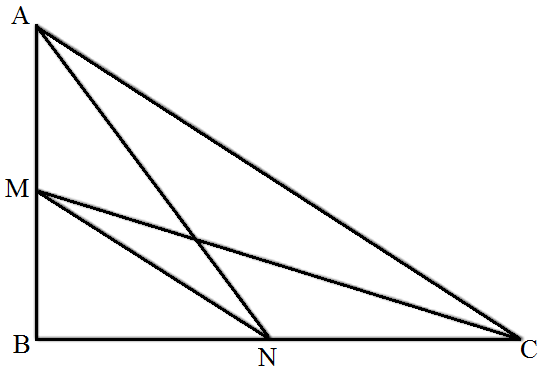
$M$ is the mid $-$ point of $AB$.
$\therefore\text{BM}=\frac{\text{AB}}{2}$
$N$ is the mid $-$ point of $BC.$
$\therefore\text{BN}=\frac{\text{BC}}{2}$
Now,
$\text{AN}^2+\text{CM}^2=\bigg(\text{AB}^2+\Big(\frac{1}{2}\text{BC}\Big)^2\bigg)+\bigg(\Big(\frac{1}{2}\text{AB}\Big)^2+\text{BC}^2\bigg)$
$=\text{AB}^2+\frac{1}{4}\text{BC}^2+\frac{1}{4}\text{AB}^2+\text{BC}^2$
$=\frac{5}{4}\Big(\text{AB}^2+\text{BC}^2\Big)$
$\Rightarrow4\Big(\text{AN}^2+\text{CM}^2\Big)=5\text{AC}^2$
Hence option $B$ is correct. View full question & answer→MCQ 1571 Mark
$\triangle\text{ABC}$ is an isosceles triangle in which $\angle\text{C}=90^\circ$ If $AC = 6\ cm,$ then $AB =$
- ✓
$6\sqrt{2}\text{ cm}.$
- B
$6\text{ cm}.$
- C
$2\sqrt{6}\text{ cm}.$
- D
$4\sqrt{2}\text{ cm}.$
AnswerCorrect option: A. $6\sqrt{2}\text{ cm}.$
$\triangle\text{ABC}$ is an isosceles with $\angle\text{C}=90^\circ$
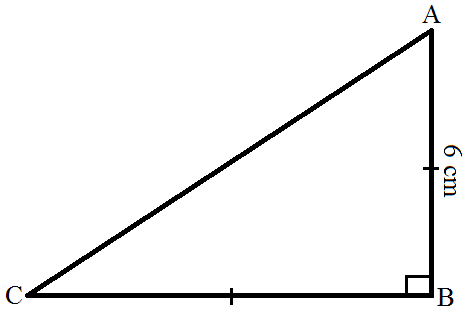
$AC = BC$
$AC = 6\ cm$
$AB^2= AC^2+ BC^2\ ($Pythagoras Theorem$)$
$(6)^2+ (6)^2= 36 + 36 = 72 (AC = BC)$
$\text{AB}=\sqrt{72}=\sqrt{(36\times2}=6\sqrt{2}\text{ cm}.$ View full question & answer→MCQ 1581 Mark
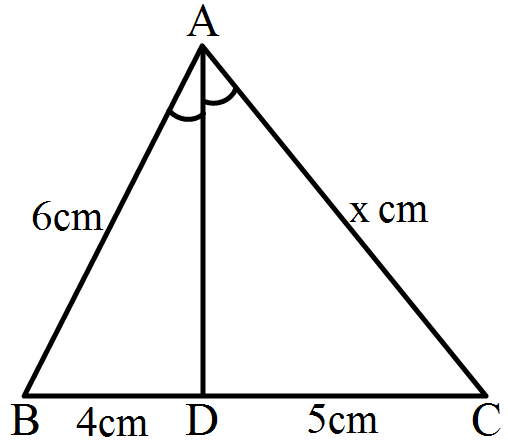
In a $\triangle\text{ABC}$ it is given that $AD$ is the internal bisector of $\angle\text{A}.$ If $BD = 4\ cm, DC = 5\ cm$ and $AB = 6\ cm,$ then $AC =?$
- A
$4.5\ cm$
- B
$8\ cm$
- C
$9\ cm$
- ✓
$7.5\ cm$
AnswerCorrect option: D. $7.5\ cm$
since $AD$ is the bisector of $\angle\text{A},$
by the angle bisector theorem,
$\frac{\text{AB}}{\text{AC}}=\frac{\text{BD}}{\text{DC}}$
$\Rightarrow\frac{6}{\text{x}}=\frac{4}{5}$
$\Rightarrow\text{x}=7.5\text{ cm}$
So $, AC = 7.5\ cm.$
View full question & answer→MCQ 1591 Mark
In the given figure, $DE \| BC$. If $DE = 5\ cm, BC = 8\ cm$ and $AD = 3.5\ cm$ then $AB =?$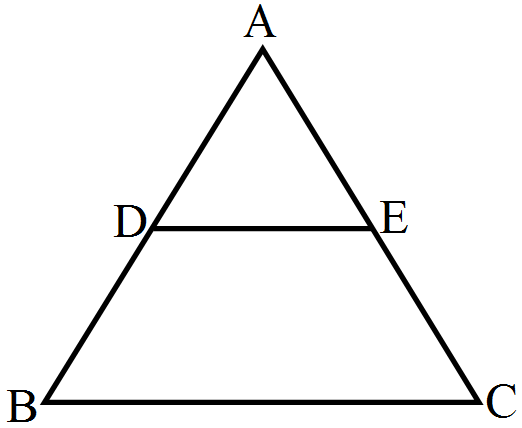
- ✓
$5.6\ cm$
- B
$4.8\ cm$
- C
$5.2\ cm$
- D
$6.4\ cm$
AnswerCorrect option: A. $5.6\ cm$
$\therefore\text{DE }\|\text{ BC}$
$\therefore \frac{\text{AD}}{\text{AB}}=\frac{\text{AE}}{\text{AC}}=\frac{\text{DE}}{\text{BC}} \ ($Thales' theorem$)$
$\Rightarrow\frac{3.5}{\text{AB}}=\frac{5}{\text{8}}$
$\Rightarrow\text{AB}=\frac{3.5\times8}{\text{5}}=5.6\text{ cm}$
View full question & answer→MCQ 1601 Mark
In $\triangle\text{ABC}$ and $\triangle\text{DEF},$ it is given that $\angle\text{B}=\angle\text{E},\angle\text{F}=\angle\text{C}$ and $\text{AB}=3\text{DE},$ then the two triangles are :
- A
Congruent but not similar
- ✓
Similar but not congruent
- C
Neither congruent not similar
- D
Similar as well as congruent
AnswerCorrect option: B. Similar but not congruent
In $\triangle\text{ABC}$ and $\triangle\text{DEF},$
It is given that $\angle\text{B}=\angle\text{E},\angle\text{F}=\angle\text{C},$ and hence $\angle\text{A}=\angle\text{D}$
So, the two triangles are similar.
Since $AB = 3DE$
$\Rightarrow\text{AB}\not=\text{DE}$
So, the triangles are not congruent.
Thus, the two triangles are similar, but not cogruent.
View full question & answer→MCQ 1611 Mark
In $\triangle\text{ABC},$ a line $XY$ parallel to $BC$ cuts $AB$ at $X$ and $AC$ at $Y$. If $BY$ bisects $\angle\text{XYC},$ then :
AnswerCorrect option: A. $\text{BC} = \text{CY}$
Given : $XY\| BC$ and $BY$ is bisector of $\angle\text{XYC}.$
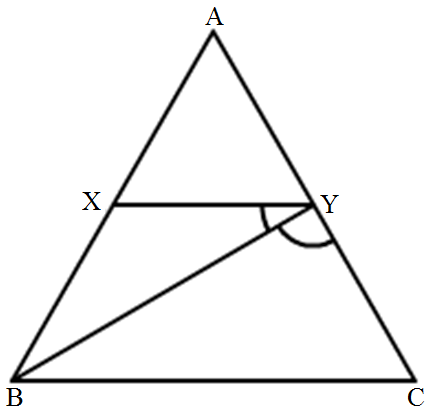
Since $XY \| BC$
So, $\angle\text{YBC}=\angle\text{BYC} \ ($Alternate angles$)$
Now, in triangle $\text{BYC}$ two angles are equal.
Therefore, the two corresponding sides will be equal.
Hence $, BC = CY$
Hence option $(a)$ is correct. View full question & answer→MCQ 1621 Mark
If perimeter of a triangle is $100\ cm$ and the length of two sides are $30\ cm$ and $40\ cm,$ the length of third side will be :
- ✓
$30\ cm$
- B
$40\ cm$
- C
$50\ cm$
- D
$60\ cm$
AnswerCorrect option: A. $30\ cm$
Perimeter of triangle $=$ sum of all its sides
$P = 30 + 40 + x$
$100 = 70 + x$
$x = 30\ cm$
View full question & answer→MCQ 1631 Mark
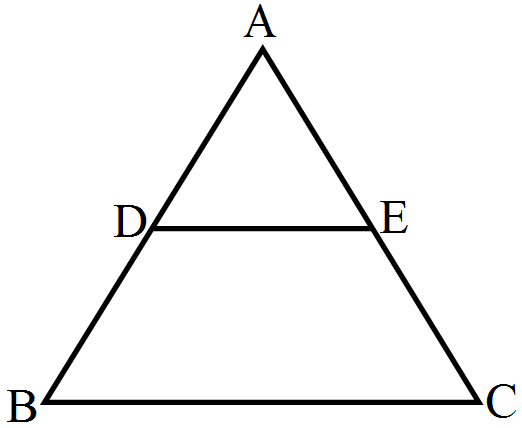
In an equilateral $\triangle\text{ABC},\text{D}$ is the midpoint of $AB$ and $E$ is the midpoint of $AC$. Then $,\text{ar}(\triangle\text{ABC}):\text{ar}(\triangle\text{ADE})=?$
- A
$2 : 1$
- ✓
$4 : 1$
- C
$1 : 2$
- D
$1 : 4$
AnswerCorrect option: B. $4 : 1$
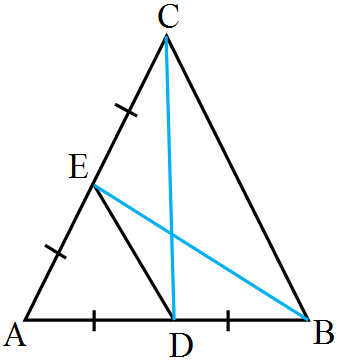
Since $D$ and $E$ are the mid $-$ point of $AB$ and $AC$ respectively.
$\frac{\text{AB}}{\text{AD}}=\frac{\text{AC}}{\text{AE}}=\frac{2}{1}$ and $\angle\text{CAD}=\angle\text{EAD}$
$....($common angle$)$
$\Rightarrow\triangle\text{ABC}\sim\triangle\text{ADE} ....\ (\text{SAS}$ criterion for Similarity$)$
$\Rightarrow\frac{\text{ar}(\triangle\text{ABC})}{\text{ar}(\triangle\text{ADE})}=\frac{\text{AB}^2}{\text{AD}^2}=\frac{2^2}{1^2}=\frac{4}{1}$
So, the ratio is $4 : 1.$ View full question & answer→MCQ 1641 Mark
Choose the correct answer from the given four options: Its is given that $\triangle\text{ABC}\sim\triangle\text{PQR},$ with $\frac{\text{BC}}{\text{QR}}=\frac{1}{3}.$ Then $,\frac{\text{ar}(\text{PQR})}{\text{ar}(\text{BCA})}$ is equal to :
- ✓
$9$
- B
$3$
- C
$\frac{1}{3}$
- D
$\frac{1}{9}$
AnswerGiven, $\triangle\text{ABC}\sim\triangle\text{PQR},$ and $\frac{\text{BC}}{\text{QR}}=\frac{1}{3}.$
We know that the ratio of the areas of two similar triangles is equal to squal of the ratio of their corresponding sides.
$\therefore\frac{\text{ar}(\text{PQR})}{\text{ar}(\text{BCA})}=\frac{(\text{QR})^2}{(\text{BC})^2}$
$\Big(\frac{\text{QR}}{\text{BC}}\Big)^2=\Big(\frac{3}{1}\Big)^2=\frac{9}{1}=9$
View full question & answer→MCQ 1651 Mark
In $\triangle A B C$ and $\triangle P Q R, \angle B=\angle Q$ and $\frac{A B}{P Q}=\frac{B C}{Q R}$.
If $\frac{\operatorname{ar}(\triangle A B C)}{\operatorname{ar}(\triangle P Q R)}=\frac{16}{9}$ and $B C=8 \ cm$, then find $Q R$.
- A
$9 \ cm$
- B
$8 \ cm$
- C
$5 \ cm$
- ✓
$6 \ cm$
AnswerCorrect option: D. $6 \ cm$
In $\triangle A B C$ and $\triangle P Q R$
$\angle B=\angle Q \ ($Given$)$
$\frac{A B}{P Q}=\frac{B C}{Q R} \ ($Given$)$
$\therefore \triangle A B C \sim \triangle P Q R \ ($By $\text{SAS}$ similarity criterion$)$
$\therefore \frac{\operatorname{ar}(\triangle A B C)}{\operatorname{ar}(\triangle P Q R)}=\frac{B C^2}{Q R^2}$
$\Rightarrow \frac{16}{9}=\frac{8^2}{Q R^2} $
$\Rightarrow Q R^2=\frac{64 \times 9}{16}$
$\Rightarrow Q R^2=36$
$ \Rightarrow Q R=6 \ cm$
View full question & answer→MCQ 1661 Mark
If $\triangle A B C \sim \triangle D E F, B C=4 \ cm , E F=5 \ cm$ and area of $\triangle A B C=64 \ cm ^2$, find the area of $\triangle D E F$.
- ✓
$100 \ cm ^2$
- B
$75 \ cm ^2$
- C
$50 \ cm ^2$
- D
$125 \ cm ^2$
AnswerCorrect option: A. $100 \ cm ^2$
In $\triangle A B C, B C=4 \ cm$ and in $\triangle D E F, E F=5 \ cm$
Now, $\triangle A B C \sim \triangle D E F $
$\Rightarrow \frac{\operatorname{ar}(\triangle A B C)}{\operatorname{ar}(\triangle D E F)}=\frac{B C^2}{E F^2}=\frac{16}{25}$
$\Rightarrow \frac{64}{\operatorname{ar}(\triangle D E F)}=\frac{16}{25}$
$\Rightarrow \operatorname{ar}(\triangle D E F)=64 \times \frac{25}{16}=100 \ cm ^2$
View full question & answer→MCQ 1671 Mark
In $\triangle \ce{LMN, PQ \| M N}$ such that $\text{LP}=2 \ cm$ and $\text{PM}=6 \ cm$. Also $\text{MN}=20 \ cm$. Find $\text{PQ} ($in $\ cm).$
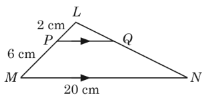
AnswerIn $\triangle \text{LPQ}$ and $\triangle \text{LMN,} \angle L$ is common and
$\angle \text{LPQ}=\angle \text{LMN} ($ Corresponding angles $).$
$\therefore \triangle \text{LPQ} \sim \triangle \text{LMN} ($ By $\text{AA}$ similarity criterion $)$
$\therefore \frac{L P}{L M}=\frac{P Q}{M N}$
$\Rightarrow \frac{2}{(2+6)}=\frac{P Q}{20}$
$\Rightarrow P Q=\frac{2}{8} \times 20$
$\Rightarrow P Q=5 \ cm$
View full question & answer→MCQ 1681 Mark
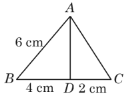
In the figure, $A D$ is the bisector of $\angle A$. If $B D=4 \ cm , D C=2 \ cm$ and $A B=6 \ cm,$ determine $A C$.
- A
$2 \ cm$
- B
$5 \ cm$
- ✓
$3 \ cm$
- D
$8 \ cm$
AnswerCorrect option: C. $3 \ cm$
In $\triangle A B C, A D$ is the bisector of $\angle A$.
$\therefore \frac{B D}{D C}=\frac{A B}{A C} $
$\Rightarrow \frac{4}{2}=\frac{6}{A C}$
$\Rightarrow 4 A C=12 $
$\Rightarrow A C=3 \ cm$
View full question & answer→MCQ 1691 Mark
What values of $x$ will make $D E \| A B$ in the figure?
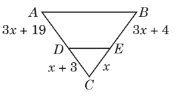
Answer$D E \| A B$ if $\frac{C D}{D A}=\frac{C E}{E B}$
$($By converse of Thales theorem$)$
$\therefore \frac{x+3}{3 x+19}=\frac{x}{3 x+4}$
$\Rightarrow \quad(x+3)(3 x+4)=x(3 x+19)$
$\Rightarrow 3 x^2+4 x+9 x+12$
$=3 x^2+19 x$
$\Rightarrow 12=6 x $
$\Rightarrow x=2$
Hence, $x=2$ will make $D E \| A B$.
View full question & answer→MCQ 1701 Mark
In the adjoining figure, $D E \| B C$. If $A D= 3.4 \ cm , A B=8.5 \ cm$ and $A C=13.5 \ cm$, find $A E$.
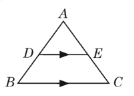
- ✓
$5.4 \ cm$
- B
$4.8 \ cm$
- C
$5.8 \ cm$
- D
$3.5 \ cm$
AnswerCorrect option: A. $5.4 \ cm$
Since $D E \| B C$,
so we have $\frac{A D}{A B}=\frac{A E}{A C}$
$\therefore \frac{3.4}{8.5}=\frac{A E}{13.5} $
$\Rightarrow A E=\frac{3.4 \times 13.5}{8.5}$
$\Rightarrow A E=5.4 \ cm$
View full question & answer→MCQ 1711 Mark
In given figure, $P Q \| B C$. Find $A B \ ($in $\ cm).$
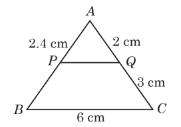
AnswerGiven $, P Q \| A C$
$\therefore \frac{A P}{B P}=\frac{A Q}{C Q}\ ($By Thales theorem$)$
$\Rightarrow \frac{2.4}{B P}=\frac{2}{3} $
$\Rightarrow B P=\frac{2.4 \times 3}{2}=3.6 \ cm$
$A B=A P+B P$
$=2.4+3.6=6 \ cm$
View full question & answer→MCQ 1721 Mark
If $\triangle \text{ABC} \sim \triangle \text{PQR}$ such that $\angle B=\angle Q$ and $\angle C=\angle R$, then find $\frac{\operatorname{ar}(\triangle \text{ABC})}{\operatorname{ar}(\triangle \text{PQR})}$ if $BC=3.5 m$ and $QR=7 cm$.
AnswerCorrect option: C. $2500$
Given, $\triangle \text{ABC} \sim \triangle \text{PQR}$
We know, areas of similar triangles are proportional to the squares of corresponding sides.
$\therefore \frac{\operatorname{ar}(\triangle \text{ABC})}{\operatorname{ar}(\triangle \text{PQR})}=\left(\frac{BC}{Q R}\right)^2=\left(\frac{3.5 m }{7 \ cm }\right)^2$
$=\left(\frac{350 \ cm }{7 \ cm }\right)^2$
$=(50)^2$
$=2500$
View full question & answer→MCQ 1731 Mark
In the given figure, $D E \| B C$. If $D E=4 \ cm , B C=8 \ cm$ and area of $\triangle A D E=25 sq . \ cm$. The area of $\triangle A B C$ is
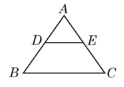
- A
$150 \ cm ^2$
- ✓
$100 \ cm ^2$
- C
$200 \ cm ^2$
- D
$80 \ cm ^2$
AnswerCorrect option: B. $100 \ cm ^2$
$\because D E \| B C$
$\therefore \angle A D E=\angle A B C$ and $\angle A E D=\angle A C B$
$($Corresponding angles$)$
$\therefore \triangle A D E \sim \triangle A B C$
$($By $AA$ similarity criterion$)$
$\Rightarrow \frac{\operatorname{ar}(\triangle A B C)}{\operatorname{ar}(\triangle A D E)}=\frac{B C^2}{D E^2}$
$ \Rightarrow \frac{\operatorname{ar}(\triangle A B C)}{25}=\frac{64}{16}$
$\Rightarrow \operatorname{ar}(\triangle A B C)$
$=\frac{64 \times 25}{16}=100 \ cm ^2$
View full question & answer→MCQ 1741 Mark
In the given figure $, D$ and $E$ are two points lying on side $A B,$ such that $\text{AD=BE}$. If $\ce{DP \| BC}$ and $\ce{EQ \| AC}$, then
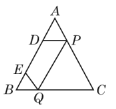
- ✓
$\ce{PQ \| AB}$
- B
$\text{PQ=AB}$
- C
$\ce{PQ \| CD}$
- D
$\text{PQ=AC}$
AnswerCorrect option: A. $\ce{PQ \| AB}$
In $\triangle \text{ABC}$, we have $\ce{DP \| BC}$ and $\ce{EQ \| AC}$
$\therefore$ By Thales theorem,
$\frac{A D}{D B}=\frac{A P}{P C}$ and $\frac{B E}{E A}=\frac{B Q}{Q C}$
$\Rightarrow \frac{A D}{D B}=\frac{B Q}{Q C}$
$(\because \ce{E A=E D + D A=E D + B E=B D)}$
$\Rightarrow \frac{AP}{PC}=\frac{BQ}{QC}$
$\therefore P Q \| A B \ ($By converse of Thales theorem$)$
View full question & answer→MCQ 1751 Mark
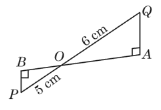
If $\triangle O A Q \sim \triangle O B P, P B$ and $Q A$ are perpendiculars to segment $A B$ and $P O=5 \ cm$, $Q O=6 \ cm$ and $\operatorname{ar}(\triangle P O B)=125 \ cm ^2$, then the area of $\triangle Q O A$ is
- A
$100 \ cm ^2$
- B
$150 \ cm ^2$
- C
$200 \ cm ^2$
- ✓
$180 \ cm ^2$
AnswerCorrect option: D. $180 \ cm ^2$
$ \frac{\operatorname{ar}(\triangle O A Q)}{\operatorname{ar}(\triangle O B P)}=\frac{O Q^2}{O P^2} \quad(\because \triangle O A Q \sim \triangle O B P)$
$\Rightarrow \frac{\operatorname{ar}(\triangle O A Q)}{125}=\frac{6^2}{5^2} \quad\left(\because \operatorname{ar}(\triangle O B P)=125 \ cm ^2\right)$
$\Rightarrow \operatorname{ar}(\triangle O A Q)=\frac{36}{25} \times 125$
$=180 \ cm ^2$
View full question & answer→MCQ 1761 Mark
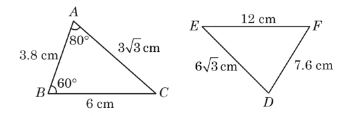
In the given figure, find $\angle F$.
- ✓
$60^{\circ}$
- B
$80^{\circ}$
- C
$40^{\circ}$
- D
$100^{\circ}$
AnswerCorrect option: A. $60^{\circ}$
In triangles $\text{ABC}$ and $\text{DFE}$, we have
$\frac{AB}{DF}=\frac{3.8}{7.6}=\frac{1}{2}, \frac{BC}{FE}=\frac{6}{12}=\frac{1}{2}, \frac{CA}{ED}=\frac{3 \sqrt{3}}{6 \sqrt{3}}=\frac{1}{2}$
$\therefore \triangle \text{ABC} \sim \triangle \text{DFE} ($By $\text{SSS}$ similarity criterion $)$
$\Rightarrow \angle A=\angle D, \angle B=\angle F$ and $\angle C=\angle E$
$($Corresponding angles of similar triangles$)$
Hence, $\angle F=60^{\circ}$
View full question & answer→MCQ 1771 Mark
$D$ and $E$ are points on the sides $A B$ and $A C$ of a $\triangle A B C . A B=12 cm , A D=8 cm , A E=12 cm$ and $A C=18 cm$. Then
- A
$B D \| C E$
- B
$A D \perp A E$
- C
$D E \perp BC$
- D
$D E \| B C$
Answer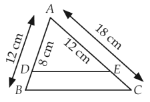
(d) : $B D=A B-A D=12-8=4 cm$
$
C E=A C-A E=18-12=6 cm
$
Now, $\frac{A D}{B D}=\frac{8}{4}=2$
Again, $\frac{A E}{C E}=\frac{12}{6}=2$
From (i) and (ii), we get $\frac{A D}{B D}=\frac{A E}{C E}$
$\Rightarrow D E \| B C$ (By Converse of Thales theorem) View full question & answer→MCQ 1781 Mark
In the given figure, $B A \| Q R$, and $C A \| S R$.
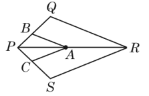
Then, $\frac{Q B}{B P}=$ - A
$\frac{A B}{A C}$
- B
$\frac{A P}{R A}$
- ✓
$\frac{S C}{C P}$
- D
$\frac{P C}{S C}$
AnswerCorrect option: C. $\frac{S C}{C P}$
(c) : In $\triangle P R Q, A B|| R Q$
$\therefore \quad \frac{Q B}{B P}=\frac{R A}{A P} \quad$ (By Thales theorem)$\ldots(i)$
In $\triangle P R S, C A|| S R$
$\therefore \quad \frac{R A}{A P}=\frac{S C}{C P} \quad$ (By Thales theorem)$\ldots(ii)$
From (i) and (ii), we have $\frac{Q B}{B P}=\frac{S C}{C P}$
View full question & answer→MCQ 1791 Mark
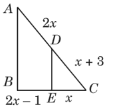
In the given figure, $D E \| A B, A D=2 x$, $D C=x+3, B E=2 x-1$ and $C E=x$. Then, find the value of $x$.
- A
$5 / 3$
- ✓
$3 / 5$
- C
$3 / 2$
- D
$2 / 3$
AnswerCorrect option: B. $3 / 5$
$ \operatorname{In} \triangle A B C, D E \| A B$
$\therefore \frac{C D}{D A}=\frac{C E}{E B}$
$\Rightarrow \frac{x+3}{2 x}=\frac{x}{2 x-1} $
$\Rightarrow(x+3)(2 x-1)=(2 x)(x)$
$\Rightarrow 2 x^2-x+6 x-3=2 x^2$
$\Rightarrow 5 x-3=0 $
$\Rightarrow x=3 / 5$
View full question & answer→MCQ 1801 Mark
If $\triangle \text{ABC} \sim \triangle \text{PQR, AB}=6.5 \ cm , \text{PQ}=10.4 \ cm$ and perimeter of $\triangle \text{ABC}=60 \ cm$, then find the perimeter of $\triangle \text{PQR}$.
- ✓
$96 \ cm$
- B
$100 \ cm$
- C
$12 \ cm$
- D
$60 \ cm$
AnswerCorrect option: A. $96 \ cm$
Given, $\triangle \text{ABC} \sim \triangle \text{PQR}$
$\therefore \frac{A B}{P Q}=\frac{\text { Perimeter of } \triangle ABC}{\text { Perimeter of } \triangle P Q R}$
$\Rightarrow \frac{6.5}{10.4}=\frac{60}{\text { Perimeter of } \triangle P Q R}$
$\Rightarrow$ Perimeter of $\triangle \text{PQR}=\frac{60 \times 10.4}{6.5}$
$=\frac{60 \times 104}{65}=\frac{60 \times 8}{5}=96 \ cm $
View full question & answer→MCQ 1811 Mark
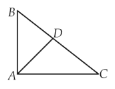
$D$ is a point on side $B C$ of a $\triangle A B C$ such that $\angle A D C=\angle B A C$, then $C A^2=$
- A
$B C \times A D$
- B
$B C^2$
- C
$A B^2$
- ✓
$B C \times C D$
AnswerCorrect option: D. $B C \times C D$
In $\triangle A B C$ and $\triangle D A C$,
$\angle B A C=\angle A D C \ ($Given$)$
$\angle B C A=\angle A C D \ ($Common$)$
$\therefore \triangle A B C \sim \triangle D A C$
$($By $AA$ similarity criterion$)$
$\Rightarrow \frac{B C}{C A}=\frac{C A}{C D} $
$\Rightarrow C A^2=B C \times C D$
View full question & answer→MCQ 1821 Mark
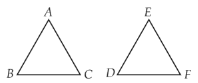
If in triangles $A B C$ and $D E F, \frac{A B}{D E}=\frac{B C}{F D}$, then they will be similar, when
- A
$\angle B=\angle E$
- B
$\angle A=\angle D$
- ✓
$\angle B=\angle D$
- D
$\angle A=\angle F$
AnswerCorrect option: C. $\angle B=\angle D$
(c) : Given, in $\triangle A B C$ and $\triangle E D F, \frac{A B}{D E}=\frac{B C}{F D}$
So, $\triangle A B C \sim \triangle E D F$
if $\angle B=\angle D$
(By SAS similarity criterion)
View full question & answer→MCQ 1831 Mark
In triangles $A B C$ and $D E F, \angle B=\angle E, \angle F=\angle C$ and $A B=3 D E$. Then, the two triangles are
- A
congruent but not similar
- ✓
similar but not congruent
- C
neither congruent nor similar
- D
congruent as well as similar
AnswerCorrect option: B. similar but not congruent
(b): In $\triangle A B C$ and $\triangle D E F, \angle B=\angle E, \angle F=\angle C$ and $A B$ $=3 DE$
We know that, if in two triangles corresponding two angles are same, then they are similar by AA similarity criterion.
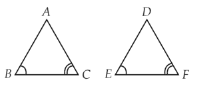
Since, $A B \neq D E$
Therefore, $\triangle A B C$ and $\triangle D E F$ are not congruent. View full question & answer→MCQ 1841 Mark
If in two triangles $\text{DEF}$ and $\text{PQR}, \angle D=\angle Q$ and $\angle R=\angle E,$ then which of the following is not true?
- A
$\frac{E F}{P R}=\frac{D F}{P Q}$
- ✓
$\frac{D E}{P Q}=\frac{E F}{R P}$
- C
$\frac{D E}{Q R}=\frac{D F}{P Q}$
- D
$\frac{E F}{R P}=\frac{D E}{Q R}$
AnswerCorrect option: B. $\frac{D E}{P Q}=\frac{E F}{R P}$
Given, in $\triangle D E F$ and $\triangle P Q R$
$\angle D=\angle Q, \angle R=\angle E$
$\therefore \triangle D E F \sim \triangle Q R P$
$($By $AA$ similarity criterion$)$
$\therefore \frac{D E}{ P Q}=\frac{E D}{R Q}=\frac{E F}{P R}$
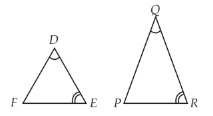
View full question & answer→MCQ 1851 Mark
If in two triangles $A B C$ and $P Q R$, $\frac{A B}{Q R}=\frac{B C}{P R}=\frac{C A}{P Q}$, then
- ✓
$\triangle P Q R \sim \triangle C A B$
- B
$\triangle P Q R \sim \triangle A B C$
- C
$\triangle C B A \sim \triangle P Q R$
- D
$\triangle B C A \sim \triangle P Q R$
AnswerCorrect option: A. $\triangle P Q R \sim \triangle C A B$
(a): Given, in triangles $A B C$ and $P Q R$, $\frac{A B}{Q R}=\frac{B C}{P R}=\frac{C A}{P Q}$, which shows that sides of one triangle are proportional to the sides of the other triangle, then their corresponding angles are also equal. So, by SSS similarity, triangles are similar i.e., $\triangle C A B \sim \triangle P Q R$.
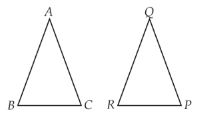
View full question & answer→MCQ 1861 Mark
$\triangle A B C \sim \triangle P Q R$ such that $\operatorname{ar}(\triangle A B C)$
$=4 \operatorname{ar}(\triangle P Q R)$. If $B C=12 \ cm$, then $Q R=$
- A
$9 \ cm$
- B
$10 \ cm$
- ✓
$6 \ cm$
- D
$8 \ cm$
AnswerCorrect option: C. $6 \ cm$
Since $ \triangle A B C \sim \triangle P Q R$
$\therefore \frac{\operatorname{ar}(\triangle A B C)}{\operatorname{ar}(\triangle P Q R)}=\frac{B C^2}{Q R^2} $
$\Rightarrow \frac{4 \operatorname{ar}(\triangle P Q R)}{\operatorname{ar}(\triangle P Q R)}=\frac{12^2}{Q R^2}$
$[\because $ Given $, \operatorname{ar}(\triangle A B C)=4 \operatorname{ar}(\triangle P Q R)]$
$\Rightarrow Q R^2=\frac{144}{4}=36 $
$\Rightarrow Q R=6 \ cm $
View full question & answer→MCQ 1871 Mark
The areas of two similar triangles are $121 \ cm ^2$ and $64 \ cm ^2$ respectively. If the median of the first triangle is $12.1 \ cm$, then the corresponding median of the other triangle is
- A
$11 \ cm$
- ✓
$8.8 \ cm$
- C
$11.1 \ cm$
- D
$8.1 \ cm$
AnswerCorrect option: B. $8.8 \ cm$
Let the corresponding median of the other triangle be $x \ cm$.
As the ratio of the areas of two similar triangles is equal to the square of the ratio of their corresponding medians.
$\therefore \frac{121}{64}=\left(\frac{12.1}{x}\right)^2$
$\Rightarrow x^2=\frac{(12.1)^2 \times 64}{121}=77.44$
$\Rightarrow x=8.8 \ cm$
View full question & answer→MCQ 1881 Mark
The areas of two similar triangles are $25 cm ^2$ and $36 cm ^2$. If the median of the smaller triangle is $10 cm$, then the median of the larger triangle is
- ✓
$12 cm$
- B
$15 cm$
- C
$10 cm$
- D
$18 cm$
AnswerCorrect option: A. $12 cm$
(a) : Let the median of the larger triangle be $x cm$. We know, the ratio of the areas of two similar triangles is equal to the square of the ratio of their corresponding medians.
$
\Rightarrow \quad \frac{25}{36}=\left(\frac{10}{x}\right)^2 \Rightarrow x^2=\frac{100 \times 36}{25}=144 \Rightarrow x=12 cm
$
View full question & answer→MCQ 1891 Mark
Ratio of areas of two similar triangles is $2: 3$. The ratio of their corresponding sides is
- A
$\sqrt{3}: \sqrt{2}$
- B
$\sqrt{6}: 1$
- C
$1: \sqrt{6}$
- ✓
$\sqrt{2}: \sqrt{3}$
AnswerCorrect option: D. $\sqrt{2}: \sqrt{3}$
(d) : Since, ratio of the areas of two similar triangles is equal to the square of the ratio of their corresponding sides.
$\therefore \quad$ Square of ratio of corresponding sides $=\frac{2}{3}$.
$\Rightarrow \quad$ Ratio of the corresponding sides $=\frac{\sqrt{2}}{\sqrt{3}}$
View full question & answer→MCQ 1901 Mark
In the figure, find $x$ in terms of $a, b$ and $c$.
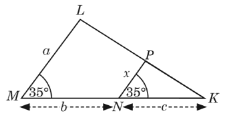
- A
$\frac{a b}{a+c}$
- ✓
$\frac{a c}{b+c}$
- C
$\frac{b c}{a+b}$
- D
$\frac{a c}{a+b}$
AnswerCorrect option: B. $\frac{a c}{b+c}$
In $\triangle \text{KNP}$ and $\triangle \text{KML}$
$\angle \text{KNP}=\angle \text{KML}=35^{\circ}($ Given $)$
$\angle K=\angle K\ ($ Common $)$
$\Rightarrow \triangle \text{KNP} \sim \triangle \text{KML} \ ($ By $\text{AA}$ similarity criterion $)$
$\Rightarrow \frac{P N}{L M}=\frac{K N}{K M}$
$\Rightarrow \frac{x}{a}=\frac{c}{K N+N M}=\frac{c}{c+b}$
$\Rightarrow x=\frac{a c}{b+c}$
View full question & answer→MCQ 1911 Mark
In two triangles $\text{ABC}$ and $\text{DEF,} \angle A=\angle E$ and $\angle B=\angle F$. Then, $\frac{AB}{AC}$ is equal to
- A
$\frac{D E}{D F}$
- B
$\frac{E D}{E F}$
- ✓
$\frac{E F}{E D}$
- D
$\frac{E F}{D F}$
AnswerCorrect option: C. $\frac{E F}{E D}$
$\angle A=\angle E$ and $\angle B=\angle F \ ($ Given $)$
$\Rightarrow \triangle \text{ABC} \sim \triangle \text{EFD} \ ($ By $AA$ similarity criterion $)$
$\Rightarrow \frac{A B}{E F}=\frac{A C}{E D}$
$\Rightarrow \frac{A B}{A C}=\frac{E F}{E D}$
View full question & answer→MCQ 1921 Mark
If in two similar triangles $A B C$ and $D E F$, $\frac{A B}{D E}=\frac{B C}{E F}$, then
- ✓
$\angle B=\angle E$
- B
$\angle A=\angle E$
- C
$\angle B=\angle D$
- D
$\angle A=\angle F$
AnswerCorrect option: A. $\angle B=\angle E$
(a) : We have, $\triangle A B C \sim \triangle D E F$
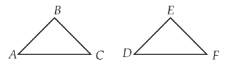
Also, $\frac{A B}{D E}=\frac{B C}{E F}$ (Given)
By SAS similarity criterion, $\angle B=\angle E$. View full question & answer→MCQ 1931 Mark
If in two triangles, corresponding sides are in the same ratio, then the two triangles are similar. This criterion is known as
- ✓
- B
- C
- D
AAA similarity criterion.
Answer(a) : SSS similarity criterion
View full question & answer→MCQ 1941 Mark
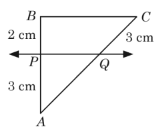
In the given figure, if $P Q \| B C$. Find $A Q$.
- A
$3.5 cm$
- ✓
$4.5 cm$
- C
$9 cm$
- D
$9.5 cm$
AnswerCorrect option: B. $4.5 cm$
(b): In $\triangle A B C$, we have $P Q \| B C$ $\Rightarrow \quad \frac{A Q}{Q C}=\frac{A P}{P B}$ (By Thales theorem)
$\Rightarrow \quad \frac{A Q}{3}=\frac{3}{2} \Rightarrow A Q=\frac{9}{2}=4.5 cm$
View full question & answer→MCQ 1951 Mark
The perimeters of two similar triangles $\text{ABC}$ and $\text{PQR}$ are $60 \ cm$ and $36 \ cm$ respectively. If $\text{PQ}=9 \ cm$, then $\text{AB}$ equals
- A
$6 \ cm$
- B
$10 \ cm$
- ✓
$15 \ cm$
- D
$24 \ cm$
AnswerCorrect option: C. $15 \ cm$
Given, $\triangle \text{ABC} \sim \triangle \text{PQR}$
$\Rightarrow \frac{AB}{PQ}=\frac{\text { Perimeter of } \triangle ABC}{\text { Perimeter of } \triangle PQR}$
$\Rightarrow \frac{A B}{9}=\frac{60}{36}$
$\Rightarrow A B=15 \ cm$
View full question & answer→MCQ 1961 Mark
In $\triangle \text{ABC}$, it is given that $A B=9 \ cm$, $BC=6 \ cm$ and $C A=7.5 \ cm$. Also, $\triangle \text{DEF}$ is given such that $\text{EF}=8 \ cm$ and $\triangle \text{DEF} \sim \triangle \text{ABC}$. Then, perimeter of $\triangle \text{DEF}$ is
- A
$22.5 \ cm$
- B
$25 \ cm$
- C
$27 \ cm$
- ✓
$30 \ cm$
AnswerCorrect option: D. $30 \ cm$
Perimeter of
$\triangle \text{ABC} =(9+6+7.5) \ cm$
$ =22.5 \ cm$
Let the perimeter of $\triangle \text{DEF}$ be $p \ cm$.
Given $\triangle \text{DEF} \sim \triangle \text{ABC}$
$\Rightarrow \frac{\text { Perimeter of } \triangle DEF}{\text { Perimeter of } \triangle A B C}=\frac{E F}{B C}$
$\Rightarrow \frac{p}{22.5}=\frac{8}{6}$
$\Rightarrow p=\frac{22.5 \times 8}{6}$
$=\frac{225 \times 8}{60}$
$=30 \ cm$
View full question & answer→MCQ 1971 Mark
If $\triangle \text{ABC} \sim \triangle \text{PQR}$, perimeter of $\triangle \text{ABC}=20 \ cm$, perimeter of $\triangle \text{PQR}=40 \ cm$ and $P R=8 \ cm$, then the length of $\text{AC}$ is
- A
$8 \ cm$
- B
$6 \ cm$
- ✓
$4 \ cm$
- D
$5 \ cm$
AnswerCorrect option: C. $4 \ cm$
Since, $\triangle \text{ABC} \sim \triangle \text{PQR}$
$\Rightarrow \frac{AC}{PR}=\frac{\text { Perimeter of } \triangle ABC}{\text { Perimeter of } \triangle P Q R}$
$\Rightarrow \frac{AC}{8}=\frac{20}{40}$
$\Rightarrow AC=\frac{20 \times 8}{40}$
$=4 \ cm $
View full question & answer→MCQ 1981 Mark
In a $\triangle A B C$, it is given that $A B=6 cm$, $A C=8 cm$ and $A D$ is the bisector of $\angle A$. Then, $B D: D C$ is equal to
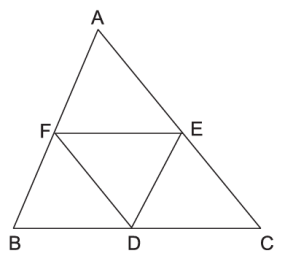
AnswerCorrect option: A. $3: 4$
(a) : We know that the bisector of an angle of a triangle divides the opposite side in the ratio of the sides containing the angle.
$
\Rightarrow B D: D C=A B: A C=6: 8=3: 4
$
View full question & answer→MCQ 1991 Mark
If triangle $\text{ABC}$ is similar to triangle $\text{DEF}$ such that $3\text{AB=DE}$ and $\text{BC}=9 \ cm$, then $\text{EF}$ is equal to
- ✓
$27 \ cm$
- B
$3 \ cm$
- C
$6 \ cm$
- D
$9 \ cm$
AnswerCorrect option: A. $27 \ cm$
Given, $\triangle \text{ABC} \sim \triangle \text{DEF}$
$\Rightarrow \frac{AB}{DE}=\frac{B C}{EF}$
$\Rightarrow \frac{AB}{3 AB}=\frac{9}{EF}$
$[\because 3\text{AB=DE}]$
$\Rightarrow \text{EF}=27 \ cm$
View full question & answer→MCQ 2001 Mark
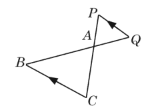
In the given figure, $\triangle \text{ACB} \sim \triangle \text{APQ}$. If $A B=6$
$cm , \text{BC}=8 \ cm$ and $\text{PQ}=4 \ cm$, then $\text{AQ}$ is equal to
- A
$2 \ cm$
- B
$2.5 \ cm$
- ✓
$3 \ cm$
- D
$3.5 \ cm$
AnswerCorrect option: C. $3 \ cm$
Given, $\triangle \text{ACB} \sim \triangle \text{APQ}$
$\Rightarrow \frac{BC}{PQ}=\frac{AB}{AQ}$
$\Rightarrow \frac{8}{4}=\frac{6}{AQ}$
$\Rightarrow \text{AQ}=\frac{6 \times 4}{8}$
$\Rightarrow \text{AQ}=3 \ cm$
View full question & answer→