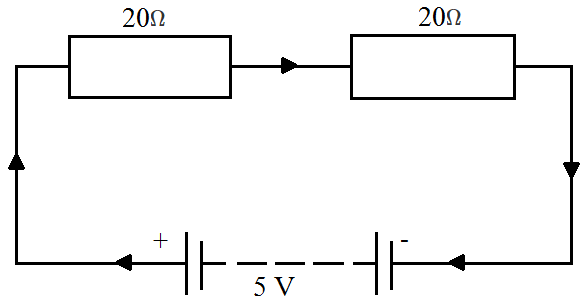
$\Rightarrow \ \text{R}=\frac{12}{2.5\times10^{-3}}=4800 \ \Omega=4.8 \ \text{K}\Omega$.
47 questions · timed · auto-graded
$\Rightarrow \ \text{R}=\frac{12}{2.5\times10^{-3}}=4800 \ \Omega=4.8 \ \text{K}\Omega$.
$\text{R}=\rho\frac{\text{l}}{\text{A}}$
$\text{l}=\frac{\text{RA}}{\rho}$
$=\frac{10\times3.14\times\Big(\frac{0.0005}{2}\Big)^2}{1.6\times10^{-8}}$
$=\frac{10\times3.14\times25}{4\times1.6}=122.72\text{m} $
$\therefore$ length of the wire = 122.72m
if the diameter of the wire is doubled, new diameter = 2 × 0.5 = 1 mm = 0.001 m Let new resistance be R'$\text{R}'=\rho\frac{\text{l}}{\text{A}}$
$=\frac{1.6\times10^{-8}\times122.72}{\pi\Big(\frac{1}{2}\times10^{-3}\Big)^2}$
$=\frac{1.6\times10^{-8}\times122.72\times4}{3.14\times10^{-6}}$
$=250.2\times10^{-2}=2.5 \ \Omega$

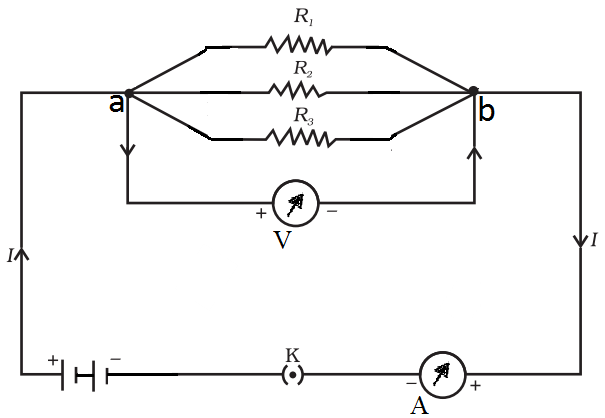
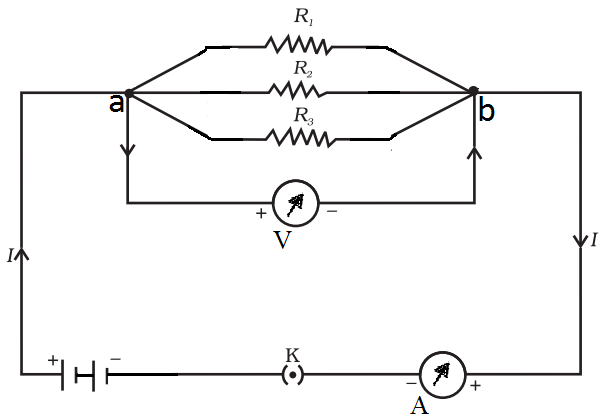
V = IR .....(i)
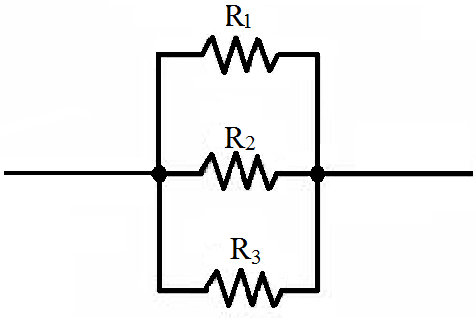
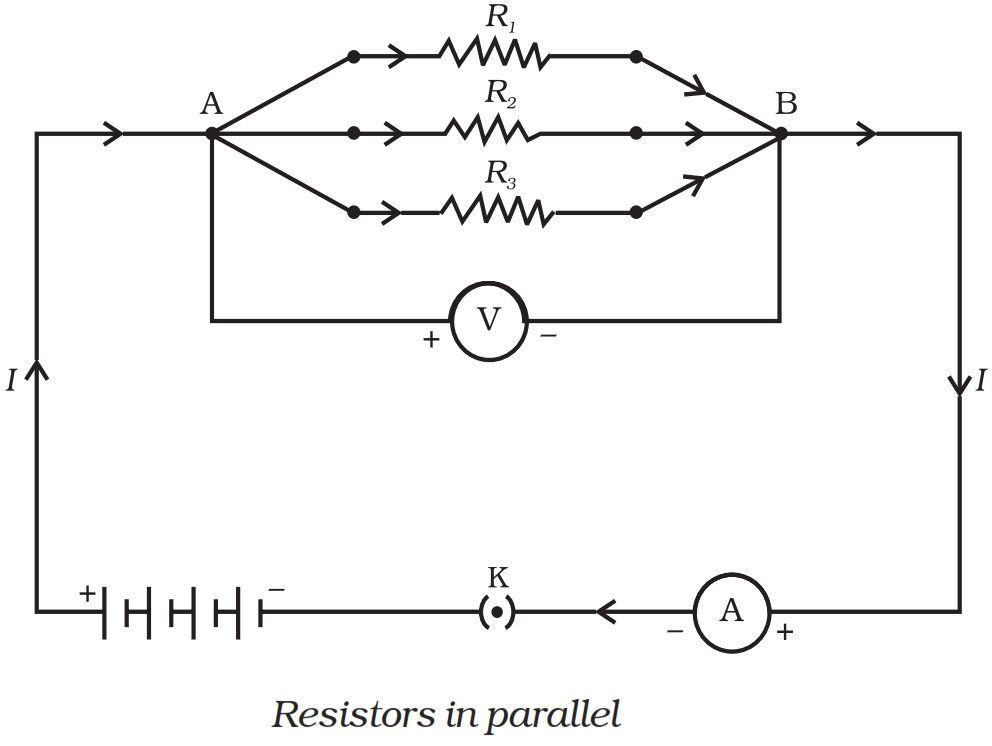
We know that when the resistors are connected in parallel, the potential drop across each resistance is the same.
Therefore:
I = I1 + I2 + I3
$\text{I}=\frac{\text{V}}{\text{R}_1}+\frac{\text{V}}{\text{R}_2}+\frac{\text{V}}{\text{R}_3}$
$\text{I}=\frac{\text{V}}{\Big(\frac{1}{\text{R}_1}+\frac{1}{\text{R}_2}+\frac{1}{\text{R}_3}\Big)}\ .....(\text{ii})$
From equations (1) and (2) we have:
$\frac{1}{\text{R}}=\frac{1}{\text{R}_1}+\frac{1}{\text{R}_2}+\frac{1}{\text{R}_3}$
Power input,
$\text{P} = \frac{VQ}{t}$
$= {VI}$
$\therefore \text{Eergy, E = P}\times t = \text{V I t}$
This energy gets dissipated in the form of heat.
$\therefore \text{H = V I t}$
Applying Ohm's law, we get,
$H = \text{I}^{2}Rt$
$H = P \times t$
$\text{= 12 W} \times \text{60s}$
$\text{H = 720 J}$
| Silver | $1.60\times10^{-8} \Omega \text{ m}$ |
| Copper | $1.62\times10^{-8} \Omega \text{ m}$ |
| Tungsten | $5.20\times10^{-8} \Omega \text{ m}$ |
| Iron | $10.0\times10^{-8} \Omega \text{ m}$ |
| Mercury | $94.0\times10^{-8} \Omega \text{ m}$ |
| Nichrome | $100\times10^{-6} \Omega \text{ m}$ |
Answer the following questions in relation to them:
Device - Voltmeter.
Silver is the best conductor of electricity and heat among all metals as it has more number of free electrons in the outermost shell. Its resistivity (1.60 × 10⁻⁸ Ωm) is less than copper (1.62 × 10⁻⁸ Ωm). Of couse, silver is the best conductor of electricity. Still, we find use of copper on a large scale in domestic wiring because silver is quite expensive.
Nichrome is the best material for heating elements. It is because the resistivity of the nichrome is more than the resistivities of the metals used to make it and it does not oxidise at higher temperature.
Unit is ampere: when 1 coulomb of charge flows through a conductor in 1 second then 1 ampere of current is said to flow through it.


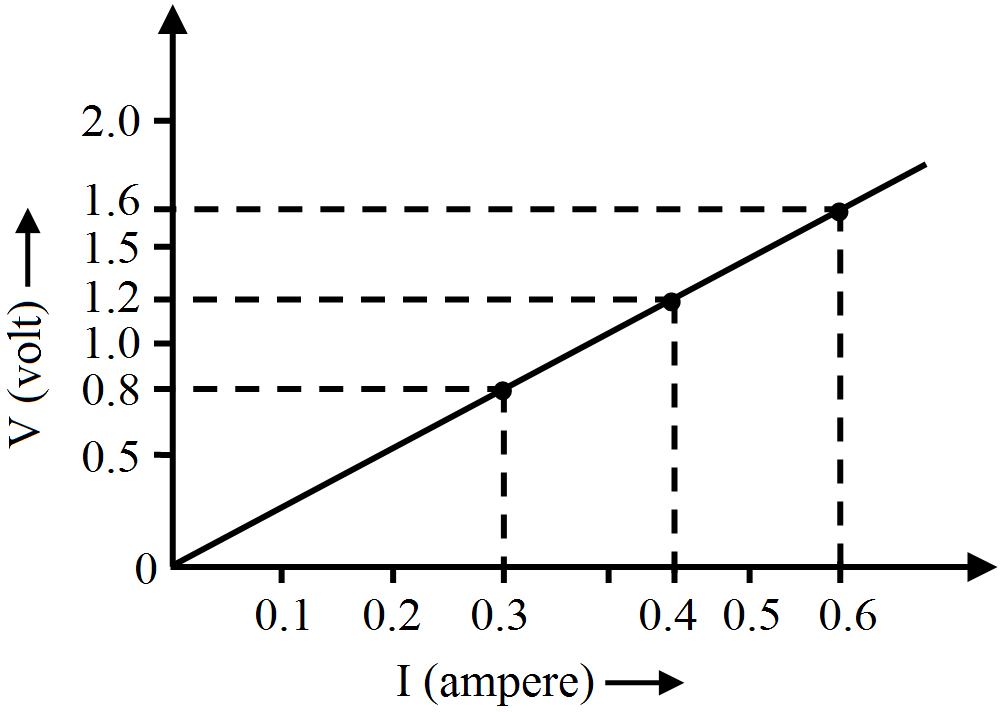
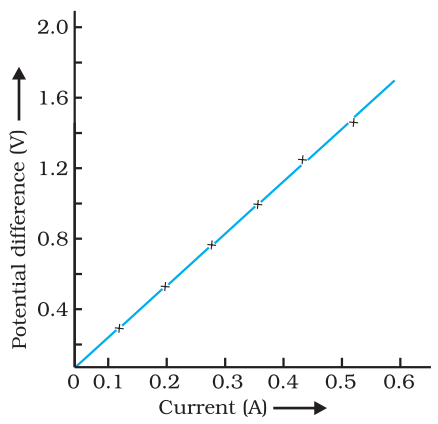
$\frac{\text{V}}{\text{I}}=\frac{0.8}{0.3}=\frac{8}{3}\ .....(1)$
At potential difference 1.2 V,
$\frac{\text{V}}{\text{I}}=\frac{1.6}{0.45}=\frac{8}{3}\ .....(2)$
At potential difference 1.6 v,
$\frac{\text{V}}{\text{I}}=\frac{1.6}{0.6}=\frac{8}{3}\ .....(3)$
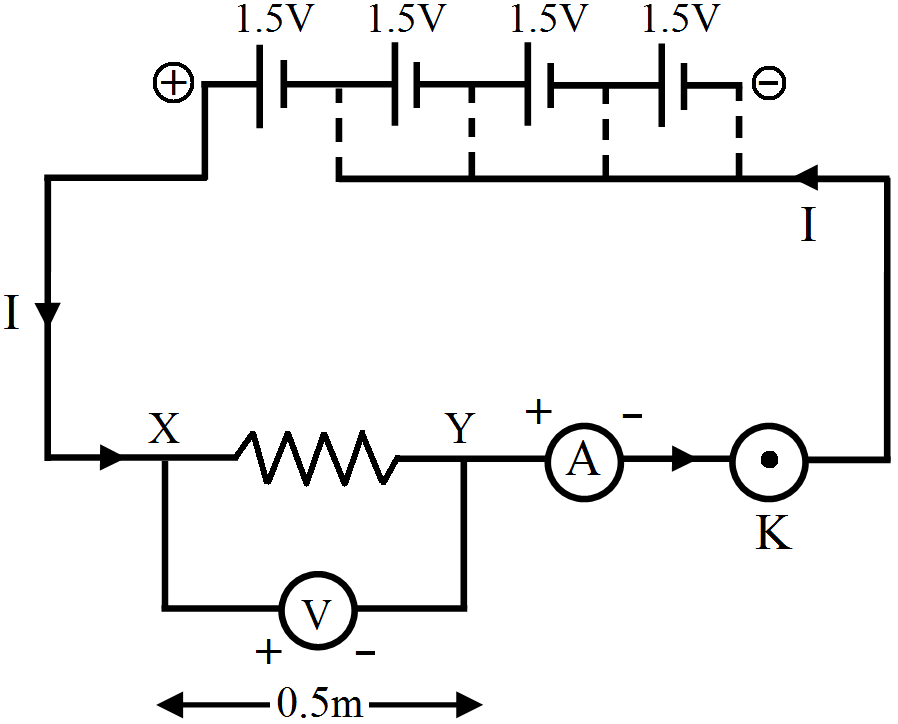
Conclusion: If i be the current through XY resistor and V be the potential difference across.
It, then the radio $\frac{\text{V}}{\text{I}}=\text{constant}.$
$\Rightarrow\text{V}\propto\text{I and Ohm's}$
Law is obeyed.

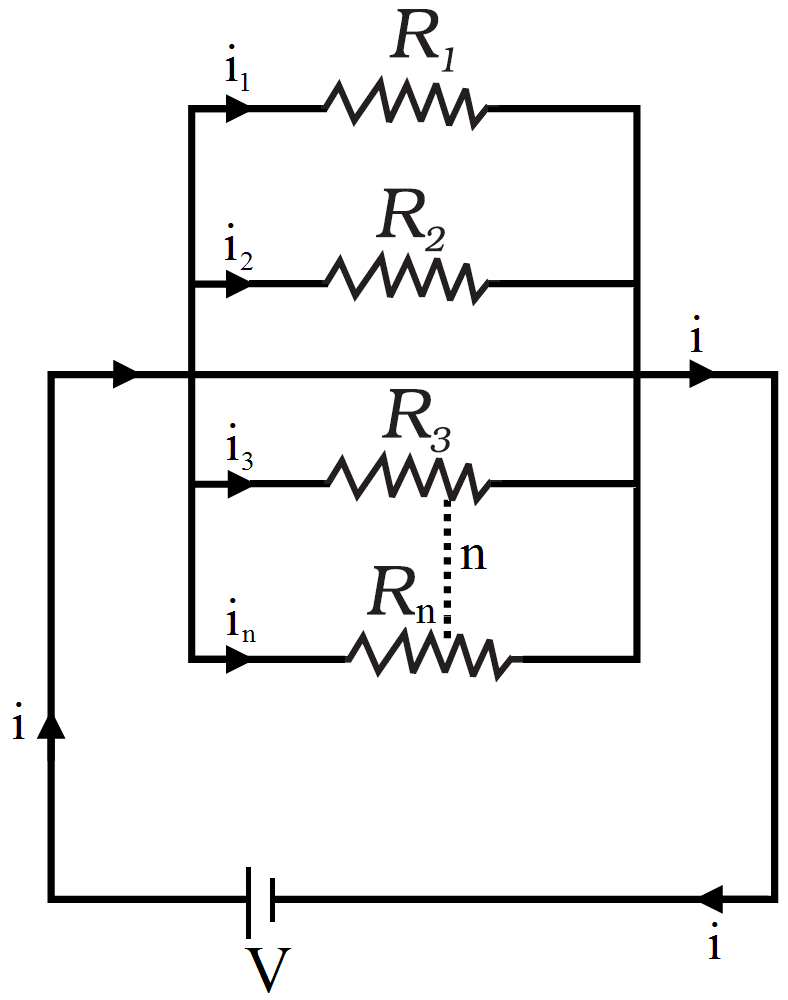
The total current i then divides into i1, i2, i3.....in, respectively in the given resistors.
As all the resistances are connected in parallel, hence the voltage across each resistor is V volt.
Now we can write,
$\text{i}=\text{i}_1+\text{i}_2+\text{i}_3+\ ...\ +\text{i}_\text{eq}$
$\frac{\text{V}}{\text{R(eq)}}=\frac{\text{V}}{\text{R}_1}+\frac{\text{V}}{\text{R}_2}+\frac{\text{V}}{\text{R}_3}+\ ...\ +\frac{\text{V}}{\text{R}_\text{n}}\dots(1)$
From equation 1,
$\frac{1}{\text{R(eq)}}=\frac{1}{\text{R}_1}+\frac{1}{\text{R}_2}+\frac{1}{\text{R}_3}+\ ...\ +\frac{1}{\text{R}_\text{n}}$
Hence, reciprocal of the equivalent resistance is equal to the sum of reciprocal of each resistor joined in parallel.
$\frac{1}{\text{R}_\text{net}}=\frac{1}{12}+\frac{1}{12}$
$\frac{1}{\text{R}_\text{net}}=\frac{2}{12}=\frac{1}{6}$
$\Rightarrow\ \text{R}_\text{net}=6\Omega$
Hence, current, $\text{i}=\frac{\text{V}}{\text{R}_\text{net}}=\frac{6\text{V}}{6\Omega}=1\text{A}$


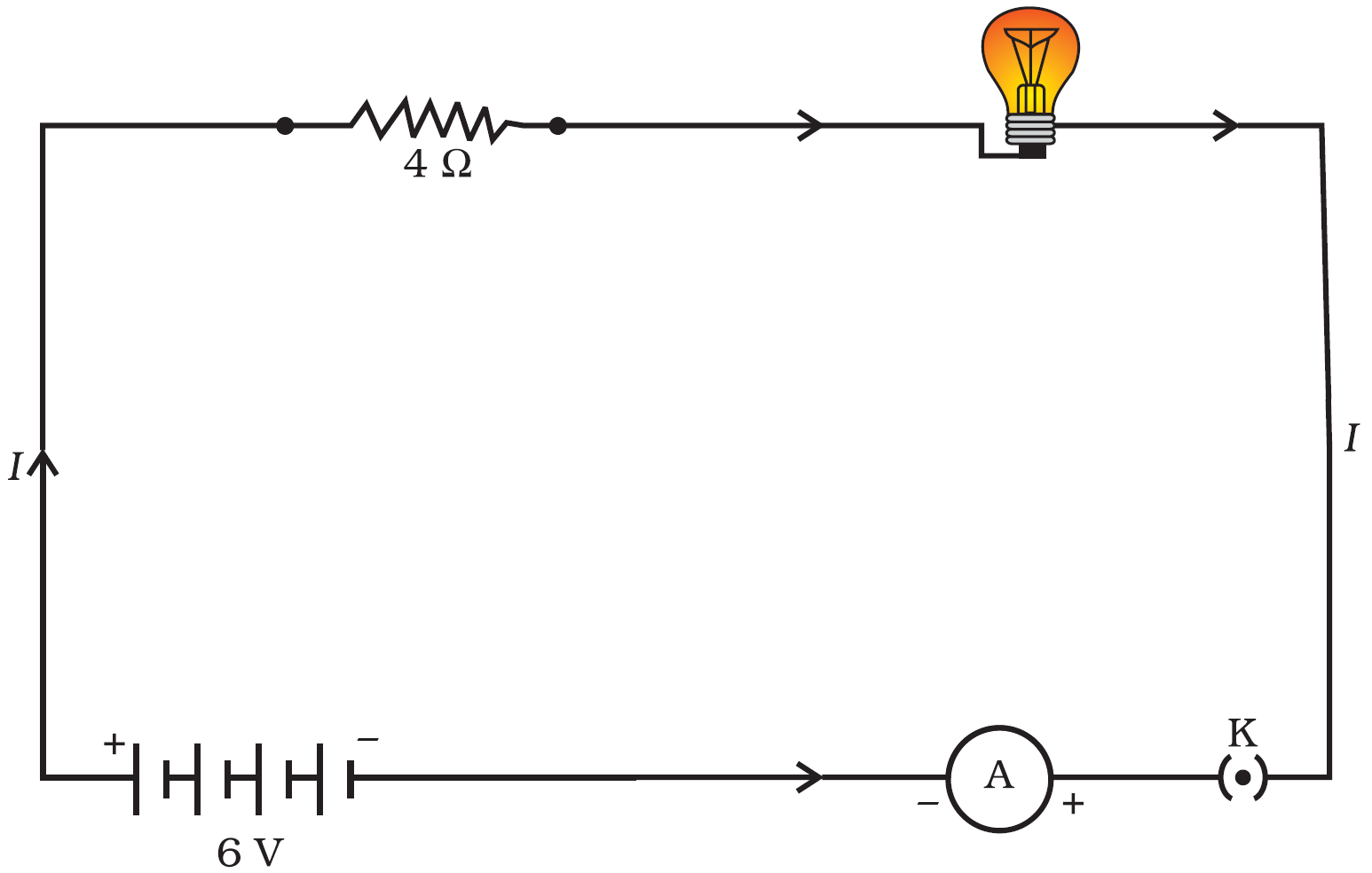
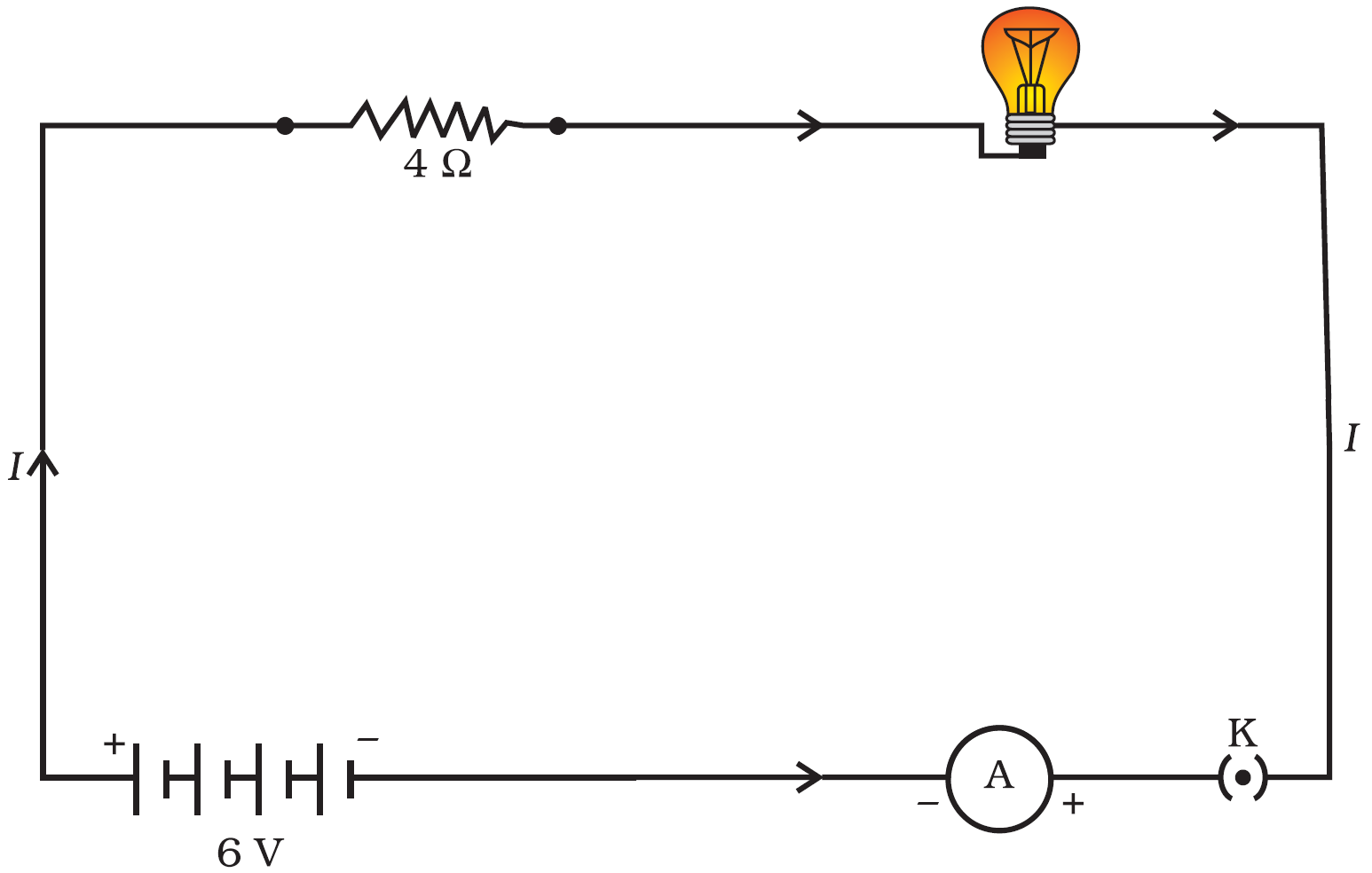
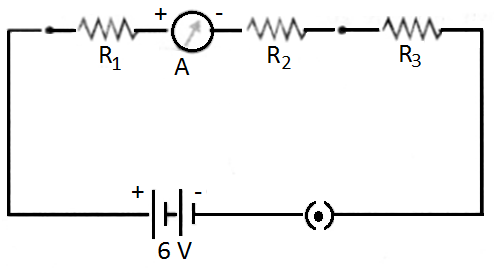
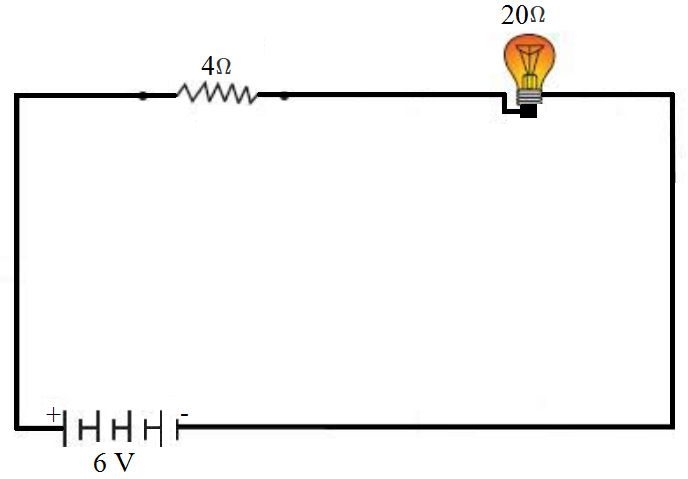
Applying Ohm's law in the circuit,
$\text{V}=\text{IR}$
$6\text{V}=\text{I}\times24\Omega$
$\text{I}=\frac{6\text{V}}{24\Omega}=0.25\text{A}$
Hence current in the circuit is 0.25 Ampere.
$\text{V}_\text{lamp}=\text{IR}$
$\text{V}_\text{lamp}=0.25\text{A}\times20\Omega=5\text{V}$
$\therefore\ \text{V}_\text{lamp}=5\text{V}$
Potential difference across conductor,
$\text{V}_\text{Conductor}=\text{IR}$
$\text{V}_\text{Conductor}=0.25\text{A}\times4\Omega=1\text{V}$
$\therefore\ \text{V}_\text{Conductor}=1\text{V}$


$6\Omega$
$\frac{6}{11}\Omega$
$1.5\Omega$


$\therefore\text{R}=\frac{6}{11}\Omega$

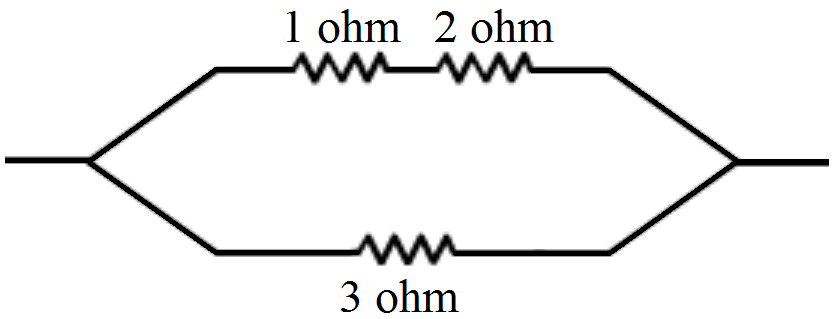
$=1\Omega+2\Omega=3\Omega$
Resistance of the secound line $=3\Omega$ Equivalent resistance$\frac{1}{\text{R}}=\frac{1}{3}+\frac{1}{3}=\frac{2}{3}$
$\therefore\text{R}=\frac{3}{2}=1.5\Omega$

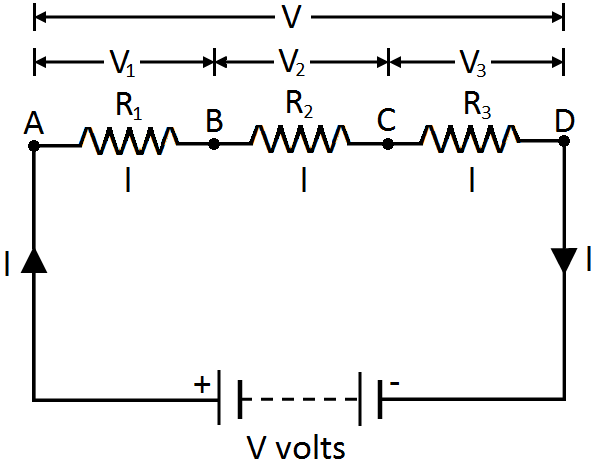
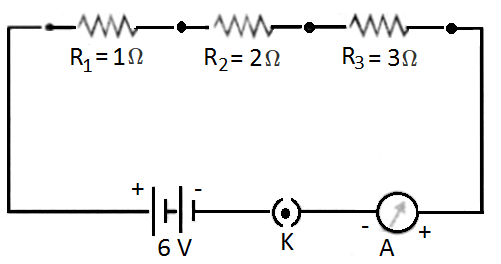
Lets the p.d. across R1, R2 and R3 is V1, V2 and V3 respectively.
s.t. V = V1 + V3 + V2 .........(1)
Let the equivalent resistance be R and current flowing through whole circuit is 1.
By ohm's law
$\frac{\text{V}}{\text{I}}=\text{R}$
V = I × R .....(2)
Applying ohm's law to both R1, R2 and R3.
V1 = I × R1 ......(3)
V2 = I × R2 ..........(4)
V3 = I × R3 ......(5)
From eq. (1), (2), (3), (4) and (5), we get
I × R = I × R1 + I × R2 + I × R3
I × R = I × (R1 + R2 + R3)
R = R1 + R2 + R3
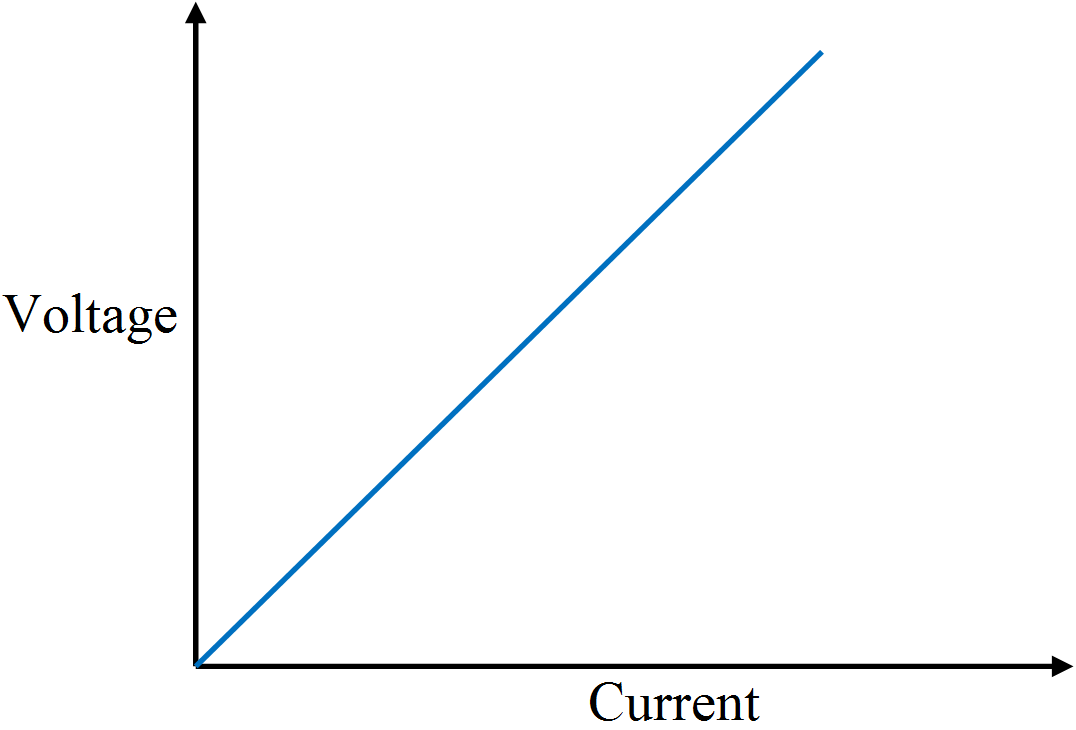
Show nature of graph thus obtained.
This can be expressed by following equation:
H = I2Rt
Here; I is electric current, R is resistance, t is time and H is heating effect.
Experiment to Demonstrate Joule’s Law of Heating:
Experiment to study the factors on which resistance of conducting wire depends:
Observations:
Total resistance = 5 + 10 = 15 ohms
Therefore total current drawn $= \frac{\text{V}}{\text{R}}=\frac{6}{15}=0.4\ \text{amps}$
In parallel,
Total resistance R is given as
$\frac{1}{\text{R}}=\frac{1}{\text{R}_1}+\frac{1}{\text{R}_2}$
$\frac{1}{\text{R}}=\frac{1}{5}+\frac{1}{10}$
$\frac{1}{\text{R}}=\frac{3}{10}$
$\text{R}=\frac{10}{3}\ \text{ohm}$
Therefore total current drawn by the circuit $=\frac{\text{V}}{\text{R}}=\frac{6}{\big(\frac{10}{3}\big)}=1.8\ \text{amps}.$

$\text{I}=\sqrt{\frac{\text{P}}{\text{R}}}=\sqrt{\frac{18}{2}}=\sqrt{9}=3\text{A}$
$\therefore$ Maximum current that can flow through a resistor A = 3A
Since resistors B and C are connected in parallel, so potential difference across B and C is same. Let I1, be the current flowing through resistor. B and I2 be the current flowing through resistor C,
$\therefore$ I1R1 = I2R2
or $\frac{\text{I}_1}{\text{I}_2}=\frac{\text{R}_2}{\text{R}_1}=\frac{2\Omega}{2\Omega}=1$ or, I1 = I2 But I1 + I2 = I = 3$\therefore$ 2I1 = 3 or I1 = 1.5A
and I2 = I1 = 1.5A

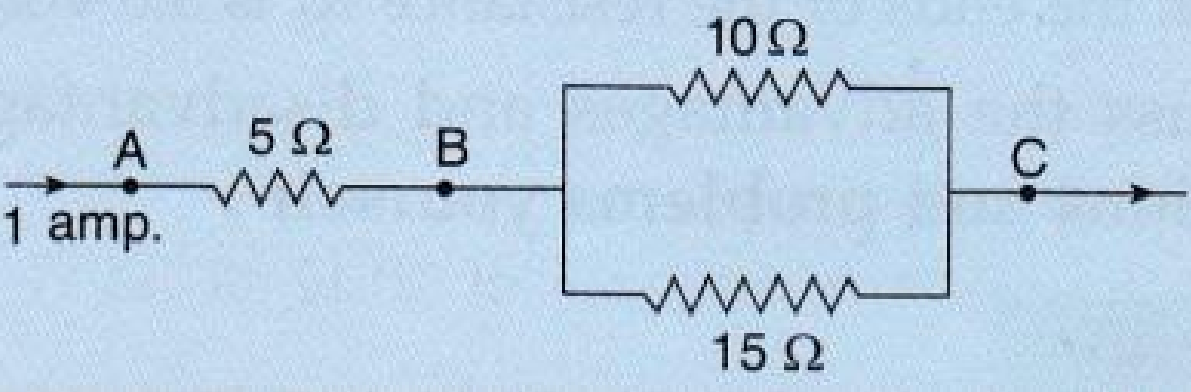
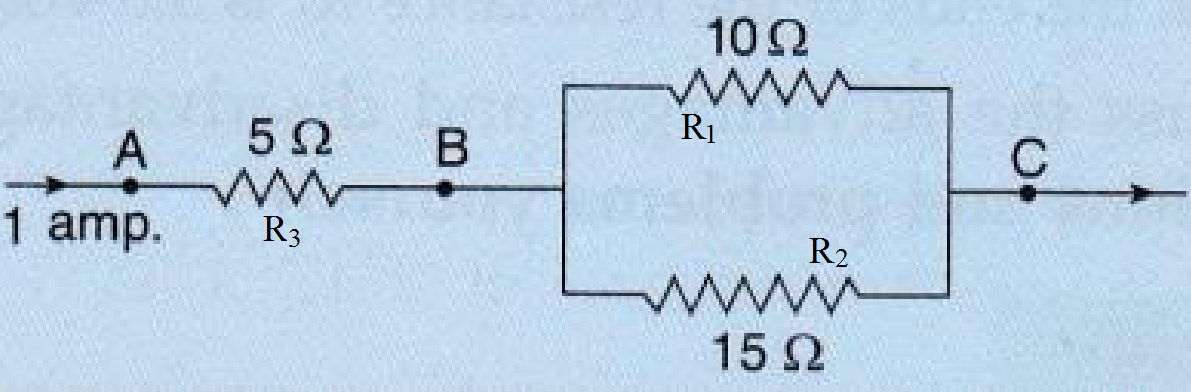
Then
$\text{I}_1=\frac{\text{IR}_2}{\text{R}_1+\text{R}_2}$
$=\frac{1\times15}{10+15}=0.6\text{A}$
$\text{I}_2=\frac{\text{IR}_2}{\text{R}_1+\text{R}_2}$
$=\frac{1\times10}{10+15}=0.4\text{A}$
Equivalent resisyance between B and C is
$\frac{1}{\text{R}'}=\frac{1}{\text{R}_1}+\frac{1}{\text{R}_2}=\frac{1}{10}+\frac{1}{15}$
$\frac{1}{\text{R}'}=\frac{5}{30}$
R' = 6 ohm
Total resistance between A and C is R = 5 + 6 = 11 ohm
p.d. across AC = IR = 1 × 11 = 11V

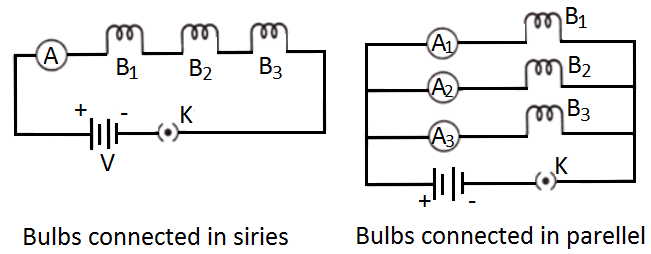
Equivalent resistance in series combination = Req = R + R + R = 3R.
Let current through each bulb in series combination be I1.
Now, $\text{V}=\text{I}_1\times3\text{R}\Rightarrow\ \text{I}_1=\frac{\text{V}}{3\text{R}}$
Now, power consumption across each bulb in series combination is,
$\text{P}_1=\text{I}^2_1(3\text{R})=\Big(\frac{\text{V}}{3\text{R}}\Big)^2\times3\text{R}$
$=\frac{\text{V}^2}{9\text{R}^2}\times3\text{R}=\frac{\text{V}^2}{3\text{R}}\ ....(\text{i})$
In case of parallel circuit,
Resistance of each bulb = R and
Voltage across each bulb = V
$\therefore$ Power consumption of each bulb in parallel combination is
$\text{P}_2=\frac{\text{V}^2}{\text{R}}\ ....(\text{ii})$
From eq. (i) and (ii), we have, $\frac{\text{P}_1}{\text{P}_2}=\frac{\Big(\frac{\text{V}^2}{3\text{R}}\Big)}{\Big(\frac{\text{V}^2}{\text{R}}\Big)}\Rightarrow\ \text{P}_2=3\text{P}_1.$
So, brightness of each bulb in parallel combination will increase. Each bulb will glow 3 times brighter to that of each bulb in series combination.
If one bulb gets fused in series combination then, same voltage continue to act on the remaining voltage and hence, other bulbs continue to glow with same brightness.
Work done = P.d. × Charge moved
= 12 × 1 = 12J
Amount of electrical energy changed into heat and light = 12J
= 12 × 5 = 60J
Amount of electrical energy changed into heat and light = 60J
Q × I × t
= 2 × 10 = 20C
Work done = p.d. × Charged moved
= 12 × 20 - 240J
Amount of electrical energy changed into heat and light = 240J

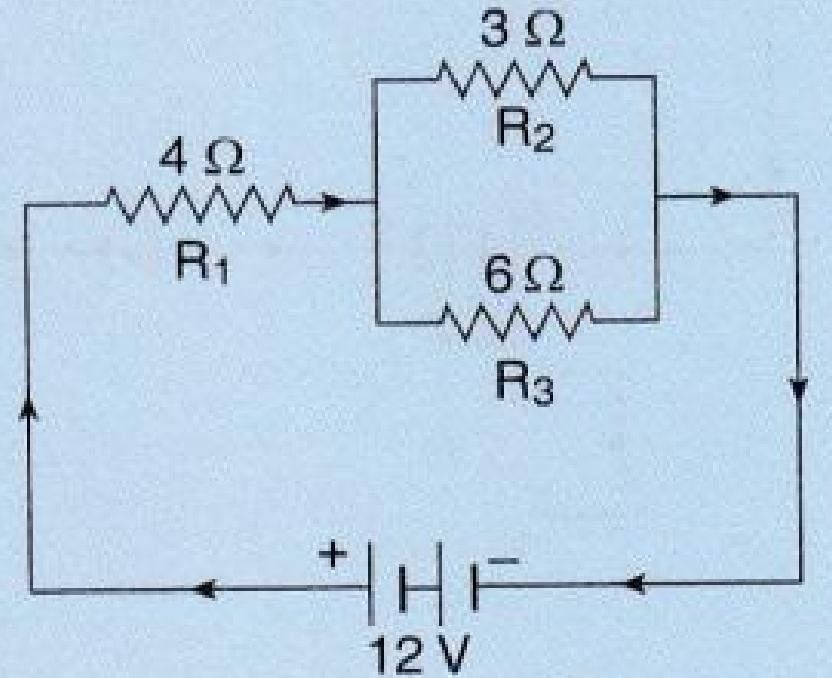
$\frac{1}{\text{R}'}=\frac{1}{3}+\frac{1}{6}$
$\frac{1}{\text{R}'}=\frac{3}{6}$
R’ = 2ohms
Total resistance of the circuit = 2 + 4 ohms = 6 ohms
$\text{I}=\frac{12}{6}=2\ \text{amps}$

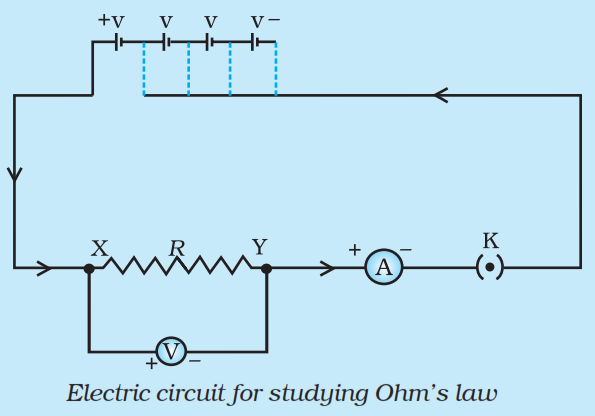
| S.No. | Number of cells used in the circuit | Current through the nichrome wire, I (ampere) | Potential difference across the nichrome wire, V (Volt) | $\frac{\text{V}}{\text{I}}$$\Big(\frac{\text{Volt}}{\text{Ampere}}\Big)$ |
| 1. | 1 | |||
| 2. | 2 | |||
| 3. | 3 | |||
| 4. | 4 |

Resultant resistance for parallel circuit = R
$\frac{1}{\text{R}}=\frac{1}{6}+\frac{1}{6}$
$\frac{1}{\text{R}}=\frac{2}{6}$
$\text{R} = 3$
Effective resistance = 6 + 3 = 9 ohms
Resultant resistance for each parallel circuit = R
$\frac{1}{\text{R}}=\frac{1}{6}+\frac{1}{6}+\frac{1}{6}$
$\frac{1}{\text{R}}=\frac{3}{6}$
$\text{R} = 2$
Therefore effective resistance = 2 + 2 = 4 ohms.

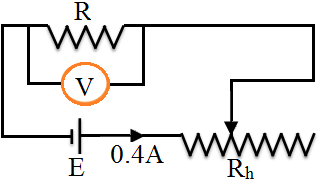
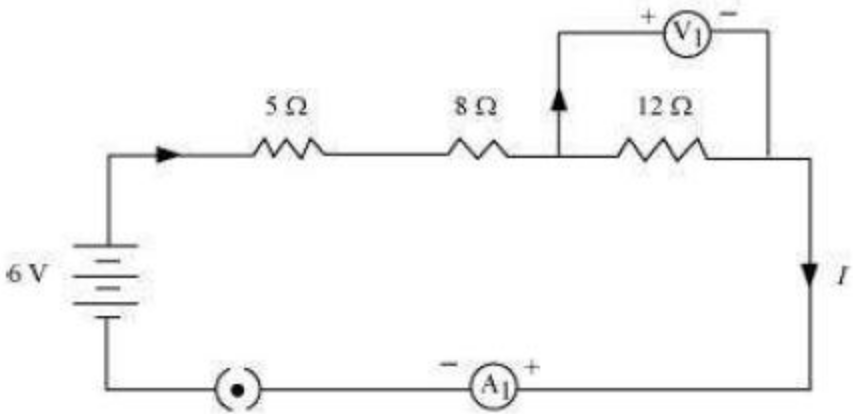
To measure the current flowing through the resistors, an ammeter should be connected in the circuit in series with the resistors. To measure the potential difference across the 12 G resistor, a voltmeter should be connected parallel to this resistor, as shown in the following figure.
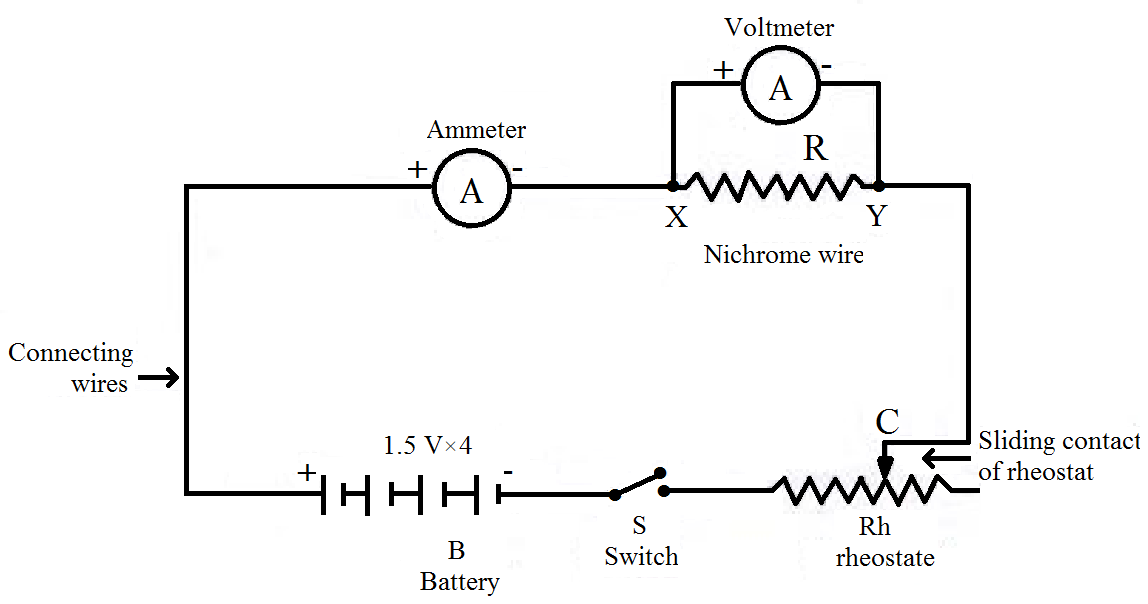
Resistance of the circuit, $\text{R} = 5 + 8 + 12 = 25\Omega$
$\text{I}=\frac{\text{V}}{\text{R}}=\frac{6}{25}=0.24 \ \text{A}$
potential difference across $12\Omega$ resistor = V1
Current flowing through the $12\Omega$ resister, I = 0.24 A.
Therefore, using Ohm's law, we obtain
V1 = IR = 0.24 × 12 = 2.88 V
Therefore, the reading of the ammeter will be 0.24 A.
The reading of the voltmeter will be 2.88 V.
$\frac{1}{\text{R}}=\frac{1}{3}+\frac{1}{6}$
$\frac{1}{\text{R}}=\frac{3}{6}$
R = 2 ohms p.d. across the combined resistance = IR = 6 × 2 12V p.d. across the 3 ohm resistor = p.d. across the combined resistance = 12V Current flowing through the 3 ohm resistor $=\frac{\text{V}}{\text{R}_1}=\frac{12}{3}=4\text{A}$ Current flowing through the 3 ohm resistor $=\frac{\text{V}}{\text{R}_2}=\frac{12}{6}=2\text{A}$
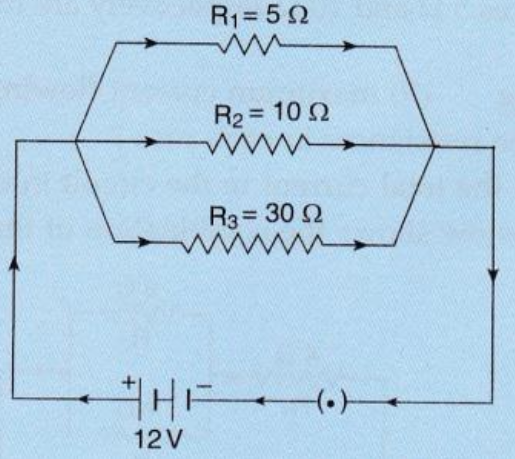
$\frac{1}{\text{R}}=\frac{1}{\text{R}_1}+\frac{1}{\text{R}_2}+\frac{1}{\text{R}_3}$
$\frac{1}{\text{R}}=\frac{1}{5}+\frac{1}{10}+\frac{1}{30}$
$\frac{1}{\text{R}}=\frac{10}{30}$
$\text{R}=3\ \text{ohm}$

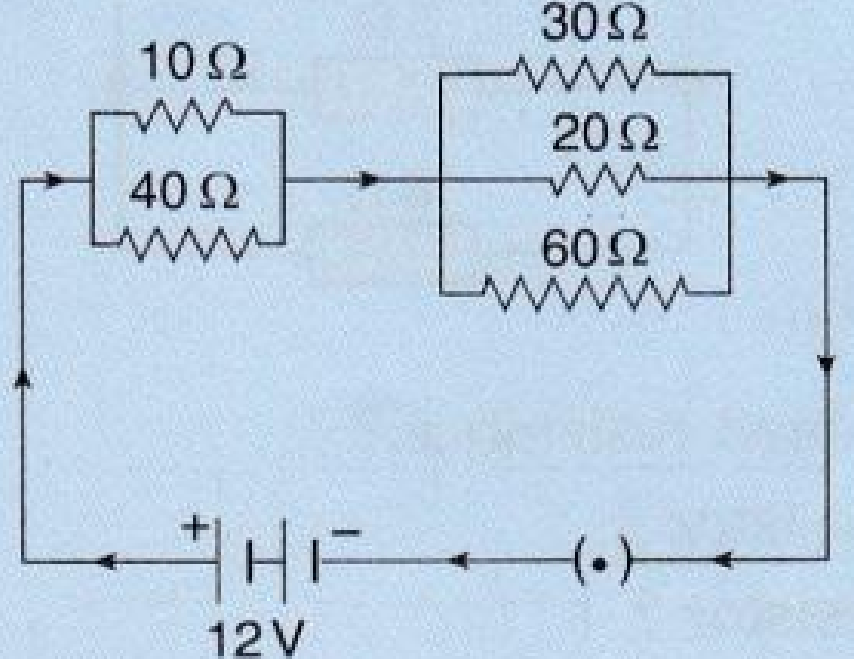
$\frac{1}{\text{R}_1}=\frac{1}{10}+\frac{1}{40}=\frac{5}{40}$
$\text{R}_1=8\Omega$
Equivalent resistance of $30\Omega, 20\Omega$ and $60\Omega$ resistance (connected in parallel) is R2 given as:
$\frac{1}{\text{R}_2}=\frac{1}{30}+\frac{1}{20}+\frac{1}{60}=\frac{6}{60}$
$\text{R}_2=10\Omega$
R1 and R2 are connected in series.
$\therefore$ Total resistance in the circuit is R = R1 + R2 = 8 + 10 = 18
Power, P1 = 60W
Number, n1 = 2
Time for use, t1 = 4h everyday
Electrical energy consumed in 30 days = 30 × 0.48 = 14.4KWh
Case 2:
Power, P2 = 100W
Number, n2 = 3
Time for use, t2 = 5h everyday
Electrical energy consumed in everyday, E2 = n2 × P2 × t2
= 3 × 100 × 5 = 1500 = 1.5kWh
Electrical energy consumed in 30 days = 30 × 1.5 = 45kWh
Total electrical energy consumed in 30 days = 14.4kWh + 45 kWh = 59.4KWh


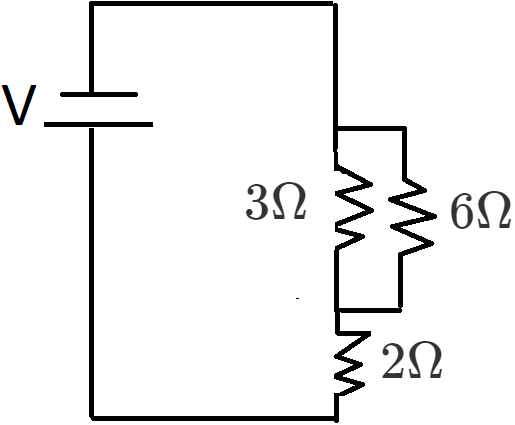
Here, $6\Omega$ and $3\Omega$ resistors are connected in parallel.
Therefore, their equivalent resistance will be given by
$\frac{1}{\frac{1}{6}+\frac{1}{3}}=\frac{6\times3}{6+3}=2 \ \Omega$
This equivalent resistor of resistance $2\Omega$ is connected to a $2\Omega$ resistor in series.
Therefore, the equivalent resistance of the circuit = $2\Omega$ + $2\Omega$ = $4\Omega$
Hence the total resistance of the circuit is $4\Omega.$

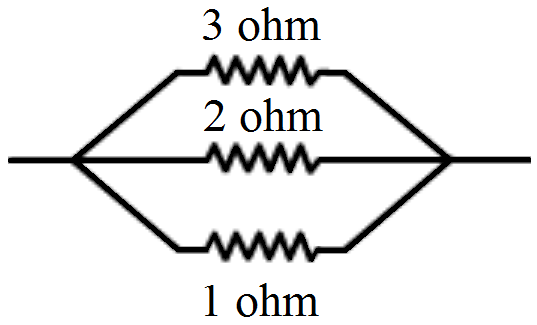
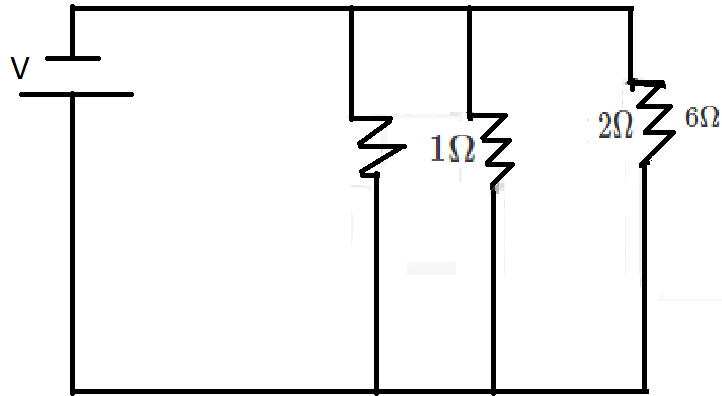
$\frac{1}{\frac{1}{2}+\frac{1}{3}+{\frac{1}{6}}}=\frac{1}{\frac{3+2+1}{6}}=\frac{6}{6}=1 \ \Omega$
Therefore, the total resistance of the circuit is $1\Omega.$
Power = VI = 250 × I
4000 = 250I
I = 16amp
P = I2R
P = 162 × R
$\text{R}=\frac{4000}{16^2}$
R = 15.25 ohm
= 4 × 2
= 8Kw - hr
total cost = 8 × 4.6 = Rs. 36.8

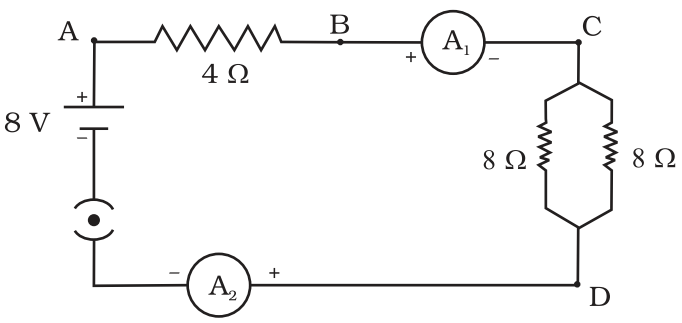
$\frac{1}{\text{R}}=\frac{1}{8}+\frac{1}{8}=\frac{1}{4}\ \text{or R }=4\Omega$
$\text{V}=8\text{V}$
$\therefore$ Current in the circuit, $\text{I}=\frac{\text{V}}{\text{R}}=\frac{8}{8}=1\text{A}$
Hence current flowing through $4\Omega$ resistor = 1A
= 1 × 4 = 4V
= 1 × 4 = 4W

$=\frac{12}{12}$
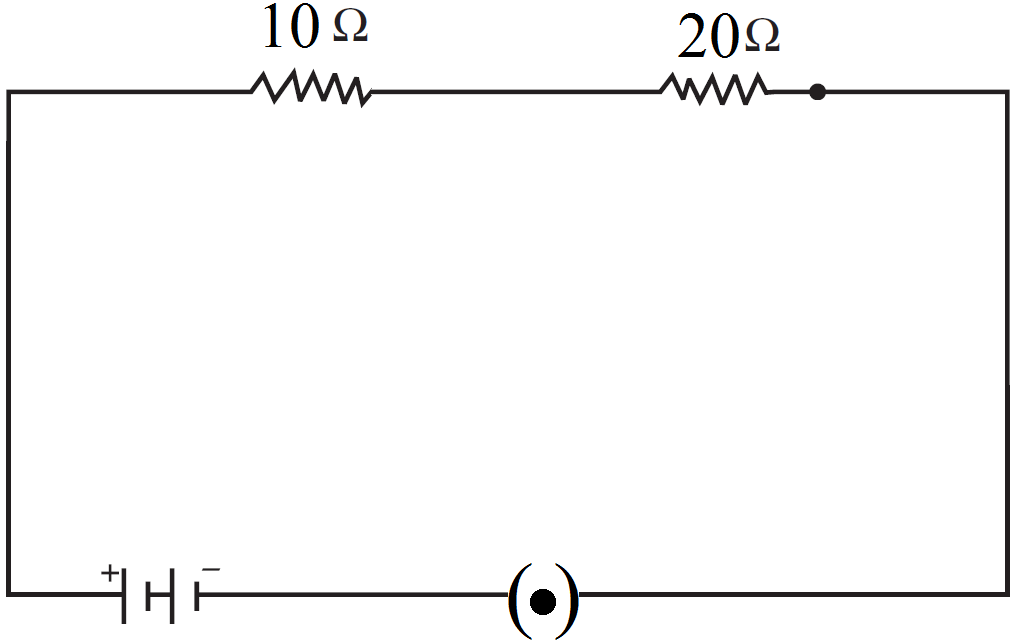
=1 A now H=VIt =12(1)60 =12(60) = 720 J R = R1 = R1 + R2 =10 + 20 $30\Omega$ V = 3V 1. From ohm's law V = IR.$3 = 1\times 30\Rightarrow 1=\frac{3}{30}=\frac{1}{10}\text{Ampere or }0.1\text{A}$
2. Potential difference across $10\Omega$ reistor. V = IR$= \frac{1\times10}{10} = 1\text{volt}.$

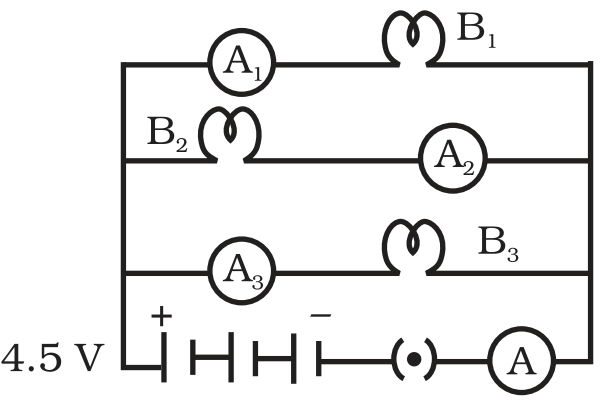
When all bulbs glow, net resistnace of the circuit is given by,
$\frac{1}{\text{R}'}=\frac{1}{\text{R}}+\frac{1}{\text{R}}+\frac{1}{\text{R}}=\frac{3}{\text{R}}$
Or, $\text{R}'=\frac{\text{R}}{3}$
I = 3A, V = 4.5V
Using, V = IR', we get
$4.5=3\times\frac{\text{R}}{3}\ \text{or R }=4.5\Omega$
When B2 gets fused, only two bulbs B1 and B2 in parallel are in the circuit.
$\therefore$ Net resistance of the circuit is given by,
$\frac{1}{\text{R}}=\frac{1}{4.5}+\frac{1}{4.5}=\frac{2}{4.5}\ \text{or R }=\frac{4.5}{2}\Omega$
$\therefore\ \text{I}=\frac{\text{V}}{\text{R}}=\frac{4.5\times2}{4.5}=2\text{A}$
Thus, reading of ammeter A = 2A
Since B1 and B3 are in parallel and have same resistance, so 2A current will be equally distributed between B1 and B3. Therefore, reading of ammeter A1 = 1A Reading of ammeter A3 = 1A Circuit containing B2 is broken, so no current flows through this circuit. Hence reading of ammeter A2 = zero.
P = V × I
= 4.5 × 3 = 13.5W
$\frac{1}{\text{R}_{\text{eq}}}=\frac{3}{\text{R}_{1}}+\frac{3}{\text{R}_{2}}+\frac{3}{\text{R}_{3}}$
$\frac{1}{\text{R}_{\text{eq}}}=\frac{1}{\frac{\text{R}}{3}}+\frac{1}{\frac{\text{R}}{3}}+\frac{1}{\frac{\text{R}}{3}}$
$\frac{1}{\text{R}_{\text{eq}}}=\frac{3}{\text{R}}+\frac{3}{\text{R}}+\frac{3}{\text{R}}$
$\frac{1}{\text{R}_{\text{eq}}}=\frac{9}{\text{R}}$
$\frac{1}{\text{R}_{\text{eq}}}=\frac{\text{R}}{9}\Omega $
The resistivity is dependent on the nature of the material.
Hence, there will be no change in the reisitivity of the wire.
$\text{V}=\text{I}\times\text{R}$
$\text{I}=\frac{\text{V}}{\text{R}}=\frac{\text{V}}{\frac{\text{R}}{9}}=\frac{9\text{V}}{\text{R}}$
$\therefore\text{I}=9\times\text{I}$
Thus, the current will increase 9 times than the previous current.

As per given figure,
R = R1 + R2 = 500 + 1000 = 1500 ohm.
As per given figure,
$\frac{1}{\text{R}}=\frac{1}{\text{R}_1}+\frac{1}{\text{R}_2}$
$\frac{1}{\text{R}}=\frac{1}{2}+\frac{1}{2}$
R = 1 ohm
As per given figure,
$\frac{1}{\text{R}}=\frac{1}{\text{R}_1}+\frac{1}{\text{R}_2}$
$\frac{1}{\text{R}}=\frac{1}{4}+\frac{1}{4}$
R = 2 ohm
Total resistance = R + R3
= 2 + 3 = 5 ohm
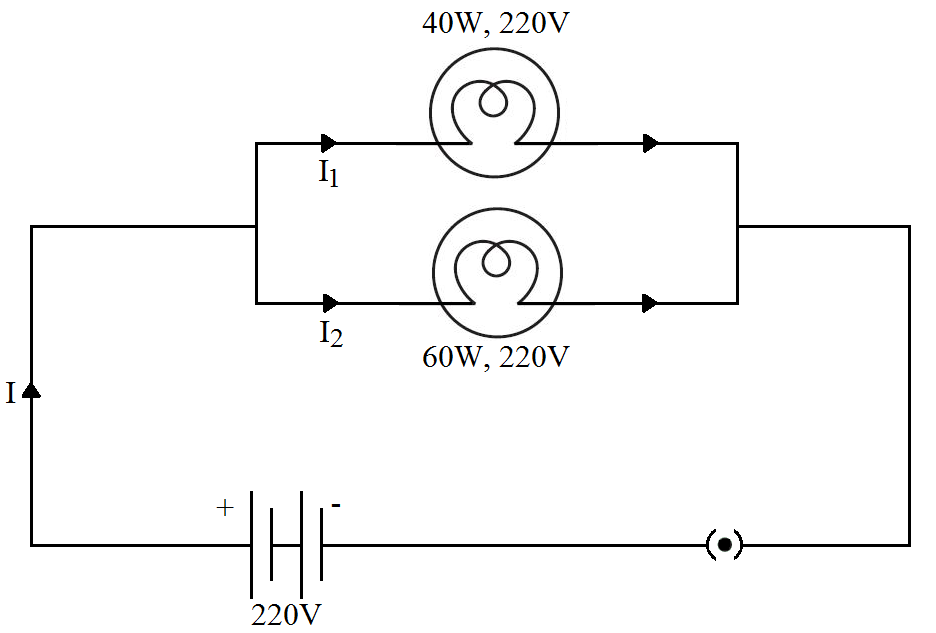
RA = RB = 24 ohm
Current drawn when only coil A is used:
$\text{I}=\frac{\text{V}}{\text{R}_\text{A}}=\frac{220}{24}$
= 9.16 amps
Total resistance, R = RA + RB = 24 + 24 = 48 ohm
$\text{I}=\frac{\text{V}}{\text{R}}=\frac{220}{48}$
= 4.58 amps
Total resistance, $\frac{1}{\text{R}}=\frac{1}{\text{R}_\text{A}}+\frac{1}{\text{R}_\text{B}}=\frac{1}{24}+\frac{1}{24}=\frac{2}{24}=\frac{1}{12}$
R = 12 ohm
$\text{I}=\frac{\text{V}}{\text{R}}=\frac{220}{12}$
$=18.33\ \text{amps}$
What would be the values of ratios when the potential difference is 0.8V, 1.2V and 1.6V respectively? What conclusion do you draw from these values?

Hence, the ration $\frac{\text{V}}{\text{I}}$ remains constant.
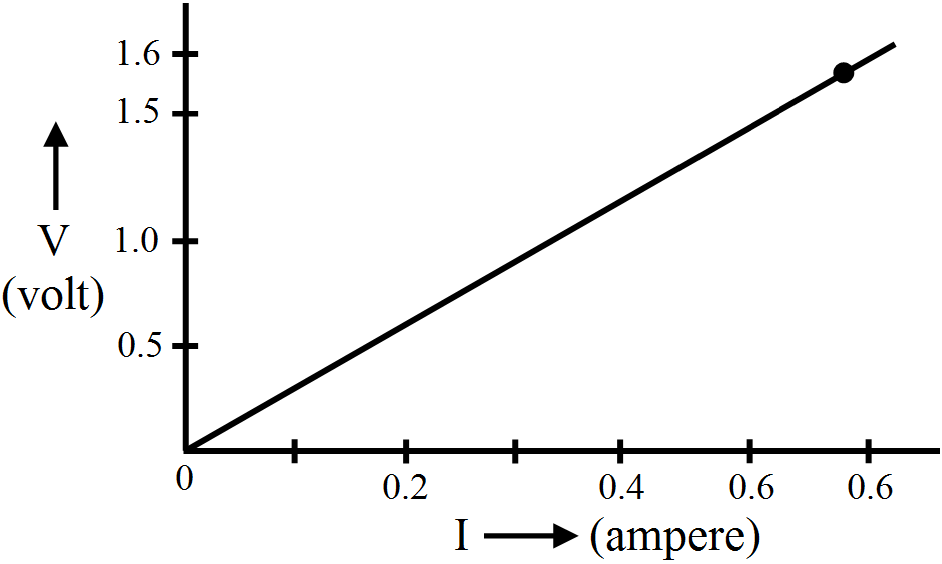
From graph when V = 1.5 volt, I = 0.6 amp
So, $\frac{\text{V}}{\text{I}}=-\frac{15}{0.6}-25\Omega$
For p.d. 0.8V, 1.2V and 1.6V, the value of $\frac{\text{V}}{\text{I}}$ ratio the same i.e., 2.5 ohm.
$\text{R}-\frac{\text{V}}{\text{I}}-25\Omega$

V = IR
Therefore
6 = I × 24
$\text{I}=\frac{6}{24}=0.25\text{amp}$