Question types

Unit 2 Ch 1 : Resources and Development question types

810 questions across 16 question groups — pick any mix to generate a Social Studies paper with step-by-step answer keys.

810
Questions
16
Question groups
5
Question types
Sample Questions

Unit 2 Ch 1 : Resources and Development questions

One sample from each question group in this chapter. Select any group above to see the full set with answer keys.

Q 1MCQ (1 Mark)1 Mark
“M” gave his friend clues about a type of soil that suits for growing cotton. Which of the following clues provided by "M" would be most useful in identifying the ideal type of soil? Clues:
i. It is well-known for its capacity to hold moisture.
ii. It turns yellow when it is hydrated.
iii. It is rich in kankur and bhangar nodules.
iv. It is a well-drained loamy soil.
  • A
    Clue i
  • B
    Clue i and iii
  • C
    Clue i and ii
  • Clue iv

Answer: D.

View full solution
Q 3MCQ (1 Mark)1 Mark
The Brundtland Commission Report published in $ ..........,$ shared ideas about sustainable development and how it could be achieved.
  • A
    $1997.$
  • $1987.$
  • C
    $1992.$
  • D
    $1977.$

Answer: B.

View full solution
Q 4MCQ (1 Mark)1 Mark
Human beings have indiscriminately used resources which have. This has led to which of the following major problems.
  • A
    Depletion of resources for satisfying the greed of a few individuals.
  • B
    Accumulation of resources in few hands, which, divided the society into two segments i.e. haves and have nots.
  • Both $(A)$ and $(B).$
  • D
    None of the above.

Answer: C.

View full solution
What is a resource?
  • A
    Extracts from nature.
  • B
    Man Made products.
  • Extracts from environment $-$ technologically accessible, economically feasible and culturally acceptable.
  • D
    Any thing from which a product can be manufactured.

Answer: C.

View full solution
Read the text given below and answer the following questions.
We have shared our land with the past generations and will have to do so with the future generation too. Ninety five percent of our basic needs of food, shelters and clothing are obtained from land.
Human activities have not only brought about degradation of land but have also aggravated the pace of natural forces to cause damage to land. Some human activities such as deforestation, overgrazing, mining and quarrying too have contributed significantly and land degradation.
Mining sites are abandoned, after excavation work is complete, leaving deep scars and traces of over burdening. In states like Jharkhand, Chhatisgarh, M.P. and Odisha, deforestation due to mining have caused severe land degradation. In states like Gujarat, Rajasthan, M.P. and Maharashtra overgrazing is one of the main reasons for land degradation. In the states like Punjab, Haryana, Western Uttar Pradesh, over irrigation is responsible for land degradation due to water logging leading to increase in salinity and alkalinity in the soil.
Answer the following MCQs by choosing the most appropriate option:
  1. Most of the basic needs for food, shelter and clothing are obtained from:
  1. Land.
  2. Human activities.
  3. Mining.
  4. Land degradation.
  1. Deforestation due to mining have caused severe land degradation in the state of:
  1. Jharkhand.
  2. U.P.
  3. Punjab
  4. Haryana.
  1. Over irrigation is responsible for land degradation due to the following reasons.
  1. Deforestation and overgrazing
  2. Increase in alkalinity of the soil.
  3. Increase in alkalinity of the soil.
  4. None of these.
  1. Human is considered as the main culprit for land degradation because:
  1. Of his excavation work at mining sites.
  2. Of his significant contribution to deforestation.
  3. He has aggravated the pace of natural forces causing damage to land.
  4. All of these.
View full solution
Read the passage given below and answer the following questions:
India is fortunate to have fairly rich and varied mineral resources. However, these are unevenly distributed. Broadly speaking, peninsular rocks contain most of the reserves of coal, metallic minerals, mica and many other non-metallic minerals. Sedimentary rocks on the western and eastern flanks of the peninsula, in Gujarat and Assam have most of the petroleum deposits. Rajasthan with the rock systems of the peninsula, has reserves of many non- ferrous minerals. The vast alluvial plains of north India are almost devoid of economic minerals. These variation exist largely because of the differences in the geological structure, processes and time involved in the formation of minerals.
Q.1. What is the reason for uneven distribution of minerals in India?
Q.2. Where are Petroleum deposits found in India?
Q.3. Which regions have the highest amounts and which contain lowest deposition of economic minerals?
View full solution
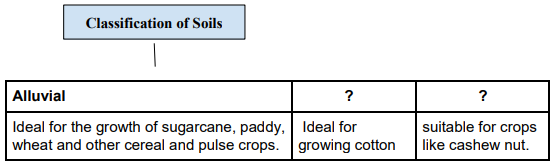
Identify the appropriate option to fill in the empty boxes :
Image
  • A
    Black soil, Red and Yellow soils
  • B
    Laterite soil, Black soil.
  • C
    Red & Yellow soils & Black soil.
  • Black soil & Laterite soil.

Answer: D.

View full solution
What is essential for resource development to contribute to overall development?
  • A
    The availability of resources alone is enough.
  • B
    The presence of foreign invaders and their governance.
  • Technological development and institutional changes.
  • D
    Only human resources can contribute to development.

Answer: C.

View full solution
Read the passage given below and answer the following questions:
India is fortunate to have fairly rich and varied mineral resources. However, these are unevenly distributed. Broadly speaking, peninsular rocks contain most of the reserves of coal, metallic minerals, mica and many other non-metallic minerals. Sedimentary rocks on the western and eastern flanks of the peninsula, in Gujarat and Assam have most of the petroleum deposits. Rajasthan with the rock systems of the peninsula, has reserves of many non- ferrous minerals. The vast alluvial plains of north India are almost devoid of economic minerals. These variation exist largely because of the differences in the geological structure, processes and time involved in the formation of minerals.
Q.1. What is the reason for uneven distribution of minerals in India?
Q.2. Where are Petroleum deposits found in India?
Q.3. Which regions have the highest amounts and which contain lowest deposition of economic minerals?
View full solution
Read the text given below and answer the following questions.
We have shared our land with the past generations and will have to do so with the future generation too. Ninety five percent of our basic needs of food, shelters and clothing are obtained from land.
Human activities have not only brought about degradation of land but have also aggravated the pace of natural forces to cause damage to land. Some human activities such as deforestation, overgrazing, mining and quarrying too have contributed significantly and land degradation.
Mining sites are abandoned, after excavation work is complete, leaving deep scars and traces of over burdening. In states like Jharkhand, Chhatisgarh, M.P. and Odisha, deforestation due to mining have caused severe land degradation. In states like Gujarat, Rajasthan, M.P. and Maharashtra overgrazing is one of the main reasons for land degradation. In the states like Punjab, Haryana, Western Uttar Pradesh, over irrigation is responsible for land degradation due to water logging leading to increase in salinity and alkalinity in the soil.
Answer the following MCQs by choosing the most appropriate option:
  1. Most of the basic needs for food, shelter and clothing are obtained from:
  1. Land.
  2. Human activities.
  3. Mining.
  4. Land degradation.
  1. Deforestation due to mining have caused severe land degradation in the state of:
  1. Jharkhand.
  2. U.P.
  3. Punjab
  4. Haryana.
  1. Over irrigation is responsible for land degradation due to the following reasons.
  1. Deforestation and overgrazing
  2. Increase in alkalinity of the soil.
  3. Increase in alkalinity of the soil.
  4. None of these.
  1. Human is considered as the main culprit for land degradation because:
  1. Of his excavation work at mining sites.
  2. Of his significant contribution to deforestation.
  3. He has aggravated the pace of natural forces causing damage to land.
  4. All of these.
View full solution

Generate a Unit 2 Ch 1 : Resources and Development paper free

Pick question groups from the list above, set marks and difficulty, and export a branded PDF with step-by-step answer keys. First 3 chapters free — no signup.

Download App