Questions · Page 1 of 2

LONG ANS. QUESTIONS(5 Mark)

🎯

Test yourself on this topic

50 questions · timed · auto-graded

Question 15 Marks
How have technical and economic development led to more consumption of resources?
Answer
Technical and economic developments have led to more consumption of resources on account of various factors such as:
  • Technological development provides sophisticated equipment. As a result, production increases ultimately leading to consumption of more resources.
  • Technological development also leads to economic development. When the economic condition of a country rises, the needs of people also rise. It again results into more consumption of resources.
  • Economic development provides favorable environment for the development of latest technologies. It helps to make or convert various materials found around us into resources. Finally, it results into the consumption of new available resources too.
View full question & answer
Question 25 Marks
Explain land use pattern in India and why has the land under forest not increased much since 1960-61?
Answer
Land use pattern in India:Total geographical area of India is 3.28 million sq km. Land use data, however, is available only for 93 per cent of the total geographical area because the land use reporting for most of the north-east states except Assam has not been done fully. Moreover, some areas of Jammu and Kashmir occupied by Pakistan and China have also not been surveyed.
The land under permanent pasture has also decreased. Most of the other than the current fallow lands are either of poor quality or the cost of cultivation of such land is very high. Hence, these lands are cultivated once or twice in about two to three years and if these are included in the net sown area then the percentage of NSA in India comes to about 54 per cent of the total reporting area. The pattern of net sown area varies greatly from one state to another. It is over 80 per cent of the total area in Punjab and Haryana and less than 10 per cent in Arunachal Pradesh, Mizoram, Manipur and Andaman Nicobar Islands. Forest area in the country is far lower than the desired 33 per cent of geographical area, as it was outlined in the National Forest Policy (1952). It was considered essential for maintenance of the ecological balance. The livelihood of millions of people who live on the fringes of these forests depends upon it.
Continuous use of land over a long period of time without taking appropriate measures to conserve and manage it, has resulted in land degradation.
View full question & answer
Question 35 Marks
Write a short note on the following topics.
  1. Terrace farming.
  2. Shelter belts.
  3. Forest or mountainous soils.
Answer
  1. Terrace farming is a type of farming that consists of different "steps" or terraces that were developed in various places around the world. On each level, various crops are planted. When it rains, instead of washing away all of the nutrients in the soil, the nutrients are carried down to the next level. Additionally, these steps prevent a free flowing avalanche of water that would take plants with it and destroy all of the crops on the hillside. This system also allowed them to build aqueducts, which carried water to each level.
  2. Shelter belts are rows of trees, usually along fence lines. They are planted mainly to protect animals or crops from cold winds, but also to give shade in hot weather. In regions such as Canterbury where there is a lot of cultivated land, shelter belts also reduce wind erosion.
  3. Forest soils form where it is not too hot, and not too cold. The type of soil that forms depends on what type of vegetation grows. Soils that formed under deciduous forests are very fertile and productive agricultural lands because of the decomposing leaves at the soil surface. However, soils formed under pine trees are usually more acidic and sandy, and are less suited to growing crops. Forests are very important, as they store a great deal of carbon in the leaves, trees, and soil, which is why it is important to protect the forests.
View full question & answer
Question 45 Marks
Distinguish between Khadar and Bangar.
Answer
Khadar:
  1. The Khadar soils are found in the low areas of the valley, bottom of a valley which are flooded every year.
  2. These soils are finer in texture.
  3. The Khadar soils are more fertile as these are found in the low areas of the bottom of a valley which are flooded almost every year.
Shangar:
  1. The Bhangar soils are found in the higher reaches, about 30m above the flood level.
  2. These are coarser in texture.
  3. These soils are less fertile as these are found on the higher reaches, about 30m above the flood level.
View full question & answer
Question 55 Marks
Suggest measures to check soil erosion by rivers.
Answer
Soil erosion is a major reason for land slides in the mountains, soil erosion is caused due to blatant human negligence.
There are many ways on how soil erosion could be averted, some of the ways how soil erosion could be averted are:
  • Planting trees on the river banks instead of uprooting the old ones.
  • Building dams and barrages to control the flow and direction of rivers.
  • Prevent deforestation for erecting buildings near rivers.
View full question & answer
Question 65 Marks
What is resource planning? Why is balance resource planning necessary in India? Give examples.
Answer
Planning is a widely accepted strategy for cautious use of resources. In a country like India it is very important to follow and execute such planning. India has enormous diversity in the availability of resources. Some regions are rich in certain types of resources but deficient in some other resources. Some regions are self-sufficient in terms of the availability of resources while others have acute shortage of some vital resources.For example:
  1. The states of Jharkhand, Chhattisgarh and Madhya Pradesh are rich only in minerals and coal deposits.
  2. Arunachal Pradesh has abundance of water resources but lacks in infrastructural development.
  3. The state of Rajasthan is very well gifted with solar and wind energy but lacks in water resources.
  4. The cold desert of Ladakh is relatively isolated from the rest of the country. It has very rich cultural heritage but it is deficient in water, infrastructure and some vital minerals.
So considering such cases of diversity, balanced resource planning at the national, state, regional and local levels is required.
View full question & answer
Question 75 Marks
Write down different method of checking soil erosion.
Answer
The following measures can be taken to prevent soil erosion and ensure soil conservation:
  1. Terrace Farming: On hilly slopes, terraces act as bunds and prevent the soil from being washed away by running water. Terrace farming is practiced with successful results in Japan, South-East Asia and the USA.
  2. Shelter Belts: Peasants plant trees in several rows to reduce wind erosion. They are called ‘wind breaks’.
  3. Contour Ploughing: Ploughing along contours on a slope prevents soil being washed away by rains or by surface run off. Contours act like bunds. Terraces are leveled into step-like small fields with even slopes. Contour ploughing is common in countries like Japan, China and some of the South-East Asian countries.
  4. Strip Cropping: In this system, crops are grown in alternate strips of land in order to check the effect of the winds.
  5. Construction of Dams: Rivers are known to cause soil erosion. Dams are built in the upper course of the rivers in order to control the erosion of soil.
View full question & answer
Question 85 Marks
Examine the three major problems created as a result of indiscriminate utilization of natural resources.
Answer
Resources are vital for human survival as well as for maintaining the quality of life. It was believed that resources are free gifts of nature. As a result, human beings used them indiscriminately and this has led to the following major problems.
  1. Depletion of resources for satisfying the greed of few individuals.
  2. Accumulation of resources in few hands, which, in turn, divided the society into two segments i.e. haves and have nots or rich and poor.
  3. Indiscriminate exploitation of resources has led to global ecological crises such as, global warming, ozone layer depletion, environmental pollution and land degradation.
View full question & answer
Question 95 Marks
State the diverse relief features of India and mention one significance of each.
Answer
India is a land of great physical and relief diversity which can be understood with the given points:
  • Northern mountains: It is composed of some of the highest peaks in the world. e.g. Mount Everest. They protect the Indian territory from the cold Siberian winds.
  • Gangetic plains: These plains are drained by rivers like Ganga, Yamuna etc. These rivers deposit the silt making it conducive for agricultural production.
  • Deccan plateau: It is the mineral house of our country.
  • Coastal plains: Both the western and eastern coastal plains contribute towards the trade in the country.
View full question & answer
Question 105 Marks
Discuss the basis on which soil is classified in India.
Answer
Type of soil in India:
Alluvial Soils:
  1. Alluvial soils cover 24% of land surface in India and is found in Indo Ganga – Brahmaputra plain, coastal plains and river valleys. These are also found in foothills regions in plenty. It contains sand, loam and clay in different proportion.
  2. There are two types of alluvial soils:
  • Khadar: which are newer alluvium. it is the soil deposited by the rivers every year. It is more fertile than the Bangar.
  • Bangar: which are older alluvium. It contains pebbles and calcium carbonates.
  1. The colour of alluvium soils can be grey, light brown or yellowish. these soils are very rich in chemicals like Potash, Phosphoric acid, lime and carbon compounds but are deficient in Nitrogen and humus.
Black Cotton Soils:
  1. The local ame of cotton soil is regur in Maharastra. it is also known as cotton soil’
  2. It is formed by weathering and erosion of volcanic lavas and hence found mainly in Deccan lava plateau. It is the most suitable soil for dry farming.
  3. These are dark black in colour due to presence of ‘Titaniferrous Magnetite’, a compond of iron and aluminium.regur soils show high swelling on wetting and high shrinkage on drying due to the presence of Montmorillonite mineral.
  4. Regur soils have high moisture retaining capacity, therefore suitable for Cotton, coarse grains, sunflower and citrus fruits but not suitable for heavy irrigation.
  5. these soils are deficient in Nitrogen, humus and phosphoric acid but rich in lime, potash, iron, aluminium, calcium and magnesium.
Red Soils:
  1. Red soils develop generally on disintegration of crystalline and metamorphic rocks in the areas of heavy rainfall. hence are rich in ferro magnesium minerals and the red colour of these soils is due to excesssive presence of Iron oxide.
  2. These soils areporus and coarse grained and having low moisture retaining capacity. So, it is relatively less fertile soil and needs heavy and frequent irrigation for agriculture.
  3. In the low lying areas, it is found as clay and in the higher land, it is found as unconsolidated soil. In the higher parts, it is suitable for growing bazra, groundnut and Potato whereas in low lying areas, rice, ragi and vegetables are grown in it.
  4. These soils are rich in iron, magnesium and aluminium compounds, but poor in lime, humus, nitrogen and phosphoric acid.
Laterite Soils:
  1. Laterite soils is formed in the areas of heavy rainfall (200cm or more) due to washing away of lime and silica and these are mainly found on top of hills and mountains in humid climate such as hills of Deccan plateau, Western Ghats, top of Eastern Ghats, Assam, Mysore, Malabar & Rajmahal hills.
  2. These are residual in nature which are formed under typical monsoonal conditions. The process of formation is called leaching. In leaching process, siliceous compounds of soil are washed away by heavy rain in hot climate and sloppy terrain, hence such soils are deficient in siliceous compounds.
  3. These soils are not very fertile but proved to be suitable for bushes and pastures only. With the help of fertilizers, this soil can be made suitable for the cultivation of plantation crops such as coffee, coconut, cashew nut, ragi etc.
  4. These soils are rich in oxides of iron and aluminium but deficient in nitrogen, phosphoric acid, lime and potash.
Mountainous or Forest Soils:
  1. Variations are found in these soils due to various climatic and ecological conditions in which they are found. These soil contains kankars, stone pieces and pebbles, differ from place to place depending upon climate. These soils are, yet. under formation process. These are distributed in Himalayas, Vindhyas, Satpura, Nilgiri and other mountains of India.
  2. These are acidic in nature due to excessive presence of less decomposed humus. These soils require fertilizers for agricultural purposes. In the regions of heavy rainfall, it contains more humus. therefore, in these regions it is suitable for the cultivation of various fruits, wheat, maize, barley etc.
  3. These soils are rich in organic matter and humus but poor in potash, phosphoric acid and lime.
Arid and Desert Soils:
  1. Acid and desert soils are distributed mainly in acid and semi-acid regions of Rajasthan. It comes sand in large quantities and is suitable for the cultivation of crops like Jowar and bajra. But, wherever irrigation facilities are available like Sri Ganganagar of Rajasthan, wheat and cotton are also grown in it.
  2. These soils are light in colour and contain high soluble salts and phosphorus in large quantities, but lack in carbon compounds and nitrogen.
Saline and Alkaline Soils:
  1. These soils are found in area of arid and semi arid parts of Rajasthan, Punjab, Haryana, Uttar Pradesh, Bihar, Maharastra and Tamil Nadu. These soils are found in patches and are locally known as Reh, Kallar and Usar. such soils are infertile and not suitable for agriculture.
  2. These soils can be treated by irrigation with mixing lime and gypsum and by growing anti-salinity crops like rice and sugar cane, cotton, wheat, tobacco etc.
  3. Excessive amounts of sodium and magnesium cause salinity in the soil, while higher amount of calcium cause alcanity. So, these are unsuitable for agriculture purposes. TThese are deficient in nitrogen, poor in water holding capacity.
Peaty and Marshy Soils:
  1. These soils are formed due to accumulation of large quantity of organic matters under water-logged conditions for long periods. These are mainly found in coastal areas like Orissa, West Bengal, Tamil Nadu and Kerala in various patches. n Kerala. such soils are also called as Kari.
  2. These soils are highly saline and deficient in phosphate and potash. so, this soil is useless for agriculture. The colour of marshy soils are dark grey or black due to presence of organic matter.
View full question & answer
Question 115 Marks
Distinguish between khadar and Bangar soils.
Answer
Khadar:
  1. The Khadar soils are found in the low areas of the valley, bottom of a valley which are flooded every year.
  2. These soils are finer in texture.
  3. The Khadar soils are more fertile as these are found in the low areas of the bottom of a valley which are flooded almost every year.
Shangar:
  1. The Bhangar soils are found in the higher reaches, about 30m above the flood level.
  2. These are coarser in texture.
  3. These soils are less fertile as these are found on the higher reaches, about 30m above the flood level.
View full question & answer
Question 125 Marks
What are the causes of land degradation? What are the ways to solve this problem?
Answer
Causes of land degradation:
  • Mining sites are abandoned after excavation work is complete leaving deep scars and traces of over-burdening. In states like Jharkhand, Chhattisgarh, Madhya Pradesh and Orissa deforestation due to mining have caused severe land degradation.
  • In states like Gujarat, Rajasthan, Madhya Pradesh and Maharashtra overgrazing is one of the main reasons for land degradation.
  • In the states of Punjab, Haryana, western Uttar Pradesh, over irrigation is responsible for land degradation due to water logging leading to increase in salinity and alkalinity in the soil.
  • The mineral processing like grinding of limestone for cement industry and calcite and soapstone for ceramic industry generate huge quantity of dust in the atmosphere. It retards the process of infiltration of water into the soil after it settles down on the land.
  • In recent years, industrial effluents as waste have become a major source of land and water pollution in many parts of the country.
There are many ways to solve the problems:
  • Management of grazing can help to some extent.
  • Planting of shelter belts of plants, control on over grazing, stabilisation of sand dunes by growing thorny bushes are some of the methods to check land degradation.
  • Proper management of waste lands, control of mining activities, proper discharge and disposal of industrial effluents and wastes after treatment can reduce land and water degradation in industrial and suburban areas.
View full question & answer
Question 135 Marks
What is soil erosion? What are the main causes of soil erosion?
Answer
The denudation of the soil cover and subsequent washing down is described as soil erosion.
causes of soil erosion:
  • Sometimes, this balance is disturbed due to human activities like deforestation, over-grazing, construction and mining etc., while natural forces like wind, glacier and water lead to soil erosion.
  • The running water cuts through the clayey soils and makes deep channels as gullies. The land becomes unfit for cultivation and is known as bad land. In the Chambal basin such lands are called ravines.
  • Sometimes water flows as a sheet over large areas down a slope. In such cases the top soil is washed away. This is known as sheet erosion.
  • Wind blows loose soil off flat or sloping land known as wind erosion.
  • Soil erosion is also caused due to defective methods of farming. Ploughing in a wrong way i.e. up and down the slope form channels for the quick flow of water leading to soil erosion.
View full question & answer
Question 145 Marks
Give any four characteristics of arid soils of India.
Answer
  1. Arid soils range from red to brown in colour.
  2. They are generally sandy in texture and saline in nature. In some areas the salt content is very high and common salt is obtained by evaporating the water.
  3. Due to the dry climate, high temperature, evaporation is faster and the soil lacks humus and moisture.
  4. The lower horizons of the soil are occupied by Kankar because of the increasing calcium content downwards. The Kankar layer formations in the bottom horizons restrict the infiltration of water.
  5. After proper irrigation these soils become cultivable as has been in the case of western Rajasthan.
View full question & answer
Question 155 Marks
Name the different types of soils found in India and also mention the regions they are found.
Answer
The different types of soils found in India are:
  1. Alluvial soil: This is the most widely spread and important soil which is found in the entire northern plains and also extend in Rajasthan and Gujarat through a narrow corridor. It is also found in the eastern coastal plains particularly in the deltas of the Mahanadi, the Godavari, the Krishna and the Kaveri rivers. Such soils are also common in plains such as Duars, Chos and Terai.
  2. Black soil: It is found in the Deccan trap (Basalt) region spread over northwest Deccan plateau and the plateaus of Maharashtra, Saurashtra, Malwa, Madhya Pradesh VIO and Chhattisgarh.
  3. Laterite soil: Mainly found in Karnataka, Kerala, Tamil Nadu, Madhya Pradesh, Odisha, Assam, Andhra Pradesh and Kerala.
  4. Red and Yellow soils: Found in parts of Odisha, Chhattisgarh, southern parts of the middle Ganga plain and la along the Western Ghats.
  5. Arid soil: Mainly found in the western part of Rajasthan.
  6. Forest soil: Found in the hilly and mountainous areas where adequate rain forests are available.
View full question & answer
Question 165 Marks
Describe the type of resources classified on the basis of exhaustibility.
OR
Explain the classification of resources on the basis of exhaustibility.
Answer
On the basis of exhaustibility, resources are classified as following:
  1. Renewable resources: These resources can be renewed in a short period of time. They can be used again and again and can be reproduced by physical, chemical or mechanical processes are known as renewable or replenishable resources, for example, solar and wind energy, water, forests and wildlife, etc.
  2. Non-renewable resources: The te resources which take millions of years in their formation and occur over a very long geological time are known as non-renewable resources, for example, minerals and fossil fuels. Some of the resources like metals are recyclable while fossil fuels cannot be recycled and get exhausted with their use.
View full question & answer
Question 175 Marks
What is regur soil? Write its two features. Mention any two regions where they are found.
Answer
Regur soil, also called black cotton soil. It is mainly found in the Deccan region of India. It is made up of lava flow, that is igneous and metamorphic rocks.
Features:
  1. Capacity to hold moisture that makes it ideal for growing cotton.
  2. Rich in soil nutrients such as calcium carbonate, magnesium, potash and lime.
  3. These soils are generally poor in phosphoric contents.
  4. Develop deep cracks during dry hot weather which helps in the proper aeration of soil.
  5. These soils are sticky when wet and difficult to work unless tilled immediately after the first shower.
Regions where Regur soil is found:
  1. This soil is typical of the Deccan Trap region.
  2. It is spread over north west Deccan plateau and is made up of lava flows.
  3. This soil covers the plateaus of Maharashtra, Saurashtra, Malwa, M.P. and Chhattisgarh and extends along the Godavari and Krishna valleys.
View full question & answer
Question 185 Marks
“India is rich in certain types of resources but deficient in some other resources”. Do you agree with the statement? Support your answer with examples.
Answer
Yes, I agree with the statement, that in India there are regions which are rich in certain types, of resources, but are deficient in some other resources. There are some regions which can be considered self-sufficient in terms of the availability of resources and there are some regions which have acute shortage of some vital resources, e.g. The states of Jharkhand, Chhattisgarh and Madhya Pradesh are rich in minerals and coal deposits.
Arunachal Pradesh has abundance of water resources, but lacks in infrastructural development.
The state of Rajasthan is very well endowed with solar and wind energy, but lacks in water resources.
View full question & answer
Question 195 Marks
Explain the classification of resources on the basis of exhaustibility with the help of examples.
Answer
Resources On the Basis of Exhaustibility
  1. Renewable Resources: Those resources that can be used again and again or can be reproduced by physical, mechanical and chemical processes.
Example : Solar energy, air, water, soil, forest & wild life.
  1. Non-Renewable Resources: Those resources that can not be replaced at all.
  • They take millions of years to form.
  • They occur over a long geological time.
  • It is divided into Recyclable and Non Recyclable Resources.
  • Metals and Fossil fuels are non renewable resources. However metals are Recyclable but fossil fuels are non- recyclable.
View full question & answer
Question 205 Marks
How laterite soils are formed? Give any one negative and one positive aspect of the soil.
Answer
The laterite soil develops in areas with high temperature and heavy rainfall. This is the result of intense leaching due to heavy rain.
Negative aspect: Humus content of the soil is low because most of the micro organisms, particularly the decomposers, like bacteria, get destroyed due to high temperature. Laterite soils are suitable for cultivation with adequate doses of manures and fertilizers.
Positive aspect: After adopting appropriate soil conservation techniques particularly in the hilly areas of Karnataka, Kerala and Tamil Nadu, this soil is very useful for growing tea and coffee.
View full question & answer
Question 215 Marks
What efforts were made for resource planning in the First Five Year Plan?
Answer
The availability of resources is a necessary condition for the development of any region, but mere availability of resources in the absence of corresponding changes in technology and institutions may hinder development. There are many regions in our country that are rich in resources but these are included in economically backward regions. On the contrary there are some regions which have a poor resource base but they are economically developed.
Resources can contribute to development only technological development and institutional changes. India has experienced all this indifferent phases of colonisation. Therefore, in India, development, in general, and resource development in particular does not only involve the availability of resources, but also the technology, quality of human resources and the historical experiences of the people.
View full question & answer
Question 225 Marks
Distinguish between renewable and non-renewable resources.
Answer
S.No.
Renewable Resources
Non-renewable Resources
(i)
These resources can be used again and again, and can be reproduced by physical, chemical or mechanical processes.
These resources cannot be renewed or reproduced.
(ii)
They take a short time for renewal.
These resources take millions of years to form.
(iii)
These are free gifts of nature.
Once they get exhausted cannot be remade.
(iv)
They are pollution-free and, therefore, eco-friendly.
They cause pollution and damage our environment.
(v)
Example: Solar energy and wind energy, water, forests and wildliafe, etc.
Example: Minerals and fossil fuels.
View full question & answer
Question 235 Marks
“More availability of resources will not bring economic development.” Justify the statements.
Answer
Mere availability of resources does not necessarily guarantee economic development, this is because of the following:
  1. There are certain regions which are rich in resources but aren't economically developed.Along with resources, it is imperative to have appropriate technology to ensure optimum utilisation of resources.
  2. Regions along with resources require proper institutional set up to make sure that resources are put to use for the development progarmmes.
  3. One requires quality human resource as well to ensure proper utilisation of resources.
  4. Most importantly, political will, effective implementation mechanism is also required to ensure economic development.
  5. We may give example of North east sates which are fairly rich in mineral resources but are considered to be underdeveloped because of lack of appropriate technology, instability in the region etc.
  6. On the other hand there are regions which do not have adequate resources but are developed because of the initiative on part of the state governments to import technology. For example Bangalore, which does not have abundant resources but is an IT hub. We may also give example of Delhi, one of the developed regions of India, lacks natural mineral resources but has one of the best infrastructure .Also being the political capital of the country.
View full question & answer
Question 245 Marks
Over a period of time land has degraded up to an extent. Giving examples explain how human activities are be responsible for that.
OR
Explain any four human activities which are mainly responsible for land degradation in India.
Answer
Human activities such as deforestation, overgrazing, construction and mining, etc. have contributed significantly in land degradation.
  1. Mining sites are abandoned after plot mining work is complete leaving deep scars and traces of over-burdening.
  2. In states like Jharkhand, Chhattisgarh, Madhya Pradesh and Odisha deforest-ation has occurred due to mining.
  3. In states like Gujarat, Rajasthan, Madhya Pradesh and Maharashtra overgrazing is one of the main reasons for land degradation.
  4. In Punjab, Haryana, western Uttar Pradesh, over-irrigation is responsible for land degradation due to waterlogging leading to increase in salinity and alkalinity in the soil.
  5. The mineral processing like grinding of limestone for cement industry and calcite and soapstone for ceramic industry generate huge quantity of dust in the atmosphere which retards the process of infiltration of water into the soil after it settles down on the land.
  6. Industrial effluents as waste have become a major source of land and water pollution.
View full question & answer
Question 255 Marks
Imagine yourself as one of the heads of states attending the international Earth summits at Rio de Janeiro, Brazil in 1992. Discuss some measures taken by your country to combat environmental damage, poverty and disease.
Answer
From 3$^{th}$ to the 14$^{th}$ of June in the year 1992, Rio de Janeiro hosted the United Nations Conference on Environment and Development to discuss the state of the global environment. It concluded with the Earth Summit, and the leaders of 105 nations attended this conference to show their commitment to sustainable development. These nations
Some measures taken by my country are:
  1. Introduction of agro-industries or farm industries in the rural areas to provide employment to farmers and labourers.
  2. Introduction of HIV seeds, agricultural machinery, eco-friendly fertilizers to boost the agricultural economy and better production.
  3. Spreading awareness of environmental pollution and other issues like health, sanitation, and diseases among rural and urban areas on a massive level, by rallies, movements, programs, etc.
  4. Building organizations to protect the environment and contribute to the welfare of poverty-stricken areas, the minorities like women children and elderly, providing facilities for healthcare, education and sanitation.
  5. Undertaking steps to protect forests and promote deforestation and reforestation, preserve the wildlife of forests by building national parks and biological reserves.
  6. Protect marine life and ocean by curbing disposal of wastes from factories, domestic waste, and litter. Taking steps to prevent oils spill from petroleum platforms.
View full question & answer
Question 265 Marks
Mention any two human activities which are responsible for the process of soil erosion. Explain the two types of soil erosion mostly observed in India.
Answer
Due to human activities like deforestation, over-grazing, construction and mining etc., while natural forces like wind, glacier and water lead to soil erosion. The running water cuts through the clayey soils and makes deep channels as gullies. The land becomes unfit for cultivation and is known as bad land. In the Chambal basin such lands are called ravines.
Types of Soil Erosion:
  1. Gullies: The running water cuts through the clayey soils and makes deep channels/ gullies. The unfit land caused by gullies is called bad land or ravines.
  2. Sheet erosion: Water flows as a sheet over large areas down a slope. The top soil is washed away. This process is known as sheet erosion.
View full question & answer
Question 275 Marks
What are the various methods of soil conservation?
Answer
Many different techniques have been invented throughout the years with the aim of preserving the nutrient level of the soil and preventing erosion:
  1. Contour Plowing: Originating in ancient Phoenicia, Contour Plowing involves plowing grooves into the desired farmland, then planting the crop furrows in the grooves and following the contours. It a very effective way for farmland on slopes to prevent run off improve crop yields.
  2. Terrace Farming: Terracing is a method of carving multiple, flat leveled areas into hills. Steps are formed by the terraces which are surrounded by a mud wall to prevent run off and hold the soil nutrients in the beds. More commonly found in lesser developed nations due to the difficulty of using mechanized farming equipment in the terraces. Very popular in Asia for planting rice.
  3. Keyline Design: A more enhanced version of Contour Plowing, maximum water retention is achieved by taking into account all the watershed properties when making the contour lines. The Keyline refers to topographic feature linked to water flow. This allows the water run off to run directly into an existing water channel, and prevent soil erosion caused by the water.
  4. Perimeter Runoff Control: This is the practice of planting trees, shrubs and ground cover around the perimeter of your farmland which impedes surface flows and keeps nutrients in the farmed soil. Using the grass way is a specialized way of handling perimeter runoff that uses surface friction to channel and dissipate runoff.
  5. Windbreaks: Rows of tall trees are used in dense patterns around the farmland and prevents wind erosion. Evergreen trees can provide year round protection but deciduous trees can be adequate as long as foliage is apparent during the seasons when the soil is bare.
View full question & answer
Question 285 Marks
Describe any two important characteristics of each type of soil available in India.
Answer
India has varied relief features, land forms, climatic realms and vegetation types, which have contributed in the development of various types of soils, such as:
  1. Alluvial soil
  • Mostly these soils contain adequate A proportion of potash, phosphoric acid and lime which are ideal for the growth of sugarcane, paddy, wheat and other cereals and pulse crops.
  • These soils are highly fertile. Therefore, regions of this soil are intensively cultivated and thickly populated.
  1. Black soil
  • These soils are black in colour and are also known as regur or black cotton soils. These are ideal for growing cotton.
  • It is made up of extremely fine, i.e. clayey material which has good moisture-holding capacity.
  1. Red and Yellow soils
  • They become red due to diffusion of iron in crystalline and metamorphic rocks.
  • It looks yellow when it occurs in a hydrated form.
  1. Laterite soil
  • Humus content of the soil is low because most of the micro-organisms, particularly the decomposers, like bacteria, get destroyed due to high temperature.
  • These soils are suitable for cultivation with adequate doses of manures and fertilisers.
  1. Arid soil
  • Arid soils vary from red to brown in colour.
  • They are generally sandy in texture and saline in nature and common salt is obtained from it by evaporating the water.
  1. Forest soil
  • The soil texture varies according to the mountain environment where they zisi are formed.
  • They are loamy and silty in valley sides and coarse grained in the upper slopes.
View full question & answer
Question 295 Marks
For what purposes are land resources used?
Answer
Land resources are used for the following purposes:
  1. Forests.
  2. Land not available for cultivation: Barren and waste land, Land put to non-agricultural uses, e.g. buildings, roads, factories, etc.
  3. Other uncultivated land (excluding fallow land): Permanent pastures and grazing land, Land under miscellaneous tree crops groves (not included in net sown area).
  4. Fallow lands: left without cultivation for one or less than one agricultural year.
  5. Net sown area: Area sown more than once in an agricultural year plus net sown area is known as gross cropped area.
View full question & answer
Question 305 Marks
Explain what is meant by national resources and individual resources.
Answer
  1. National Resources: All the resources which are under the control of state or union government are known as national resources. All the resources within political boundaries are national resources because the government has the power to acquire even the private properties.
  2. International Resources: These resources are owned and regulated by international institutions. The oceanic resources beyond 200km of the Exclusive Economic Zone belong to the open ocean, and no individual country can utilise these without the concurrence of international institutions. India has got the right to mine manganese nodules from the bed of the Indian Ocean from that area which lies beyond the Exclusive Economic Zone.
View full question & answer
Question 315 Marks
In which category of resources would metals be classified?
Answer
Metals of all types are important and valuable resources. Although their natural supply or the supplies of elements that go into producing various alloys are fixed, metals are highly recyclable and reusable. Metals, such as copper, tin, lead, aluminum, gold and silver, are elements. They are nonrenewable. Steel is are made from iron, which is also nonrenewable. Aluminum, iron and titanium are among the three most abundant elements in the Earth's crust. There are many benefits to recycling metals in addition to their cash value. Recycling them saves nonrenewable resources and reduces the need for additional mining.
View full question & answer
Question 325 Marks
Which is the most widespread soil in India?
Answer
Alluvial soil s the most widespread soil in India.
Characteristics of the Alluvial soil:
  1. Alluvial soils are transported soils. Most of the soils are derived from the sediments deposited by rivers as in the Indo-Gangetic plain. Thus, the parent material of these soils is of transported origin.
  2. These soils consist of varying proportion of sand, silt and clay. In the upper course of the river, the soil is coarse. In the middle course, it is medium, and fine grained in the lower course.
  3. Apart from the size of their grains or particles, soils are described according to their age as well. They are old alluvium and new alluvium. Locally, the old alluvium is called ‘Bhangar’ and the new alluvium is called ‘Khadar’.
  4. The old alluvium often contains ‘kankar, nodules, with calcium carbonates in the sub-soil. The new alluvium is more fertile than the old alluvium.
View full question & answer
Question 335 Marks
Define the term ‘Resource’. Do you think that resources are free gifts of nature? Support your argument.
Answer
Everything available in our environment which can be used to satisfy our needs, provided, it is technologically accessible, economically feasible and culturally acceptable can be termed as ‘Resource’.They are not free gifts of nature as:
  1. Resources are a function of human activities.
  2. Human beings themselves are essential components of resources.
  3. They transform material available in our environment into resources and use them.
For example river is a natural resource but river become a resource when its water is used for irrigation or power production.
View full question & answer
Question 345 Marks
How is red soil different from lateritr soil?
Answer
Red soil:
  1. Red soil develops on crystalline igneous rocks in areas of low rainfall.
  2. Red soil is found in parts of Odisha and Chhattisgarh, southern parts of the middle of Ganga plain and along the piedmont zone of the Western ghats.
  3. Red soil develops a reddish colour due to diffusion of iron in crystalline and metamorphic rocks.
Laterite soil:
  1. Laterite soil develops in areas with high temperature and heavy rainfall.
  2. Laterite soil is mainly found in Karnataka, Kerala and the hilly areas of Odisha and Assam.
  3. In laterite soil, humus content is very low.
View full question & answer
Question 355 Marks
State the different causes of soil erosion pertaining to the following region and suggest remedial measures for the same.
  1. Mountainous regions.
  2. Steep slopes and plateaus.
  3. Coastal areas.
  4. Desert areas.
  5. River plains.
Answer
  1. Causes of soil erosion in mountains may be due to human activities like farming, building houses, deforestation etc and natural occurrence of landslides, earthquake, heavy rainfall etc. This can be reduced by putting check on deforestation, building of settlements incessantly etc.
  2. Causes of soil erosion in plateaus and steep slopes are mainly due to human activities like mining, quarrying, crop cultivation on slopes which loosen the top layer of the soil. It may also cause due to landslides, debris flow, heavy rainfall etc.This can be reduced by lowering down human activities in the steep slopes and increasing vegetation.
  3. Causes of soil erosion in coastal areas is mainly due to changes in currents, waves and sea level. To protect the coasts we need to build barriers along the coasts.
  4. Causes of erosion in deserts is mainly due to wind and drought. This can be checked by restoring water, rain harvesting etc.
  5. Causes of erosion in river plains is mainly due to floods or human activities like deforestation, agriculture etc. It can be reduced by protecting the river banks by building barriers and walls to strengthen the soil so that it does not get washed away.
View full question & answer
Question 365 Marks
Difference current fallow land from another fallow land.
Answer
Difference between current fallow land and fallow land:
  • Fallow lands are lands that are used for purpose of cultivation but for a certain period of time albeit temporality kept out of cultivation anywhere from one year to five years.
  • Not less than one year and not more than five years. It is land that is intentionally left fallow to rejuvenate the nutrients of the land through natural process that is then later used for cultivation.
  • Current fallow is land that is left fallow for a period of one year for the same goal of regaining nutrients of the soil, consisting generally of a cropped area.
View full question & answer
Question 375 Marks
Classify resources on the basis of development with examples.
Answer
On the basis of the status of development, resources are classified into four groups, namely potential, developed, stock and reserve.
  1. Potential Resources: Potential resources are those which are found in a region, but have not been utilised. For example, solar energy and wind energy, available in Rajasthan and Gujarat, have not been developed properly.
  2. Developed Resources: Developed resources are those which are estimated in terms of their quantity and quality for utilisation, e.g., water, soil, forests.
  3. Stock Resources: Materials in the environment which have the potential to satisfy human needs but are not technologically accessible to human beings, e.g., use of water as a rich source of energy.
  4. Reserve Resources: Reserve is a part of stock which can be put to use in the near future with the help of existing technology, e.g., water in dams, forests.
View full question & answer
Question 385 Marks
Describe different idea put forward for Sustainable development.
Answer
Different ideas put forward for sustainable development are the following:
  1. Using LED Bulbs: These bulbs consume less electricity and do not have the dangerous mercury in it.
  2. Using Solar Energy: Solar energy is a natural source of energy that can be conserved.
  3. Using Wind Energy: Wind energy is also a natural resource that can be conserved.
  4. Using Recyclable Goods: Recyclable goods can be used in order to reduce pollution.
  5. Avoid Plastic: Plastic is very harmful for the environment hence avoiding their use can lead to sustainable development.
  6. Using Reusable Goods: Goods can be reused which reduces their production and saves the cost that can be invested elsewhere.
View full question & answer
Question 395 Marks
What is land degradation? What do you know about India’s degraded land?
Answer
Continuous use of land over a long period of time without taking appropriate measures to conserve and manage it, has resulted in land degradation.
At present, there are about 130 million hectares of degraded land in India. Approximately, 28 percent of it belongs to the category of forest degraded area, 56 percent of it is water eroded area and the rest is affected by saline and alkaline deposits. Some human activities such as deforestation, over grazing, mining and quarrying too have contributed significantly in land degradation.
View full question & answer
Question 405 Marks
Discuss the importance of soil for human beings.
Answer
The following are importance of soil for human beings:
  • Medium for plant growth. Soil is where most plants grow. Soil provides anchorage for the plants as well as protection of roots from damage.It is where or a medium through which water, air and nutrients are made available to plants. The well-aerated soil facilitates the absorption of water and nutrients from the soil by plants.
  • Soil provide habitat for living organisms. In the soil there are some animals living there example burrowing animals like rodents, earthworms and termites.
  • Provide sites for agricultural activities The fertile soil promotes agriculture activities, both animal husbandry and crop cultivation. This is because soil supports the growth of pasture for animals.
  • Provide settlement. Soil influences distribution of settlement for example the areas with good fertile soil are densely populated compared to the areas with poor soil.
  • Soil provide building materials Soil is used in making bricks, tiles and white wash. All these materials are used in building houses, bridges etc. Also soil is used directly in road construction.
  • Source of minerals. There are some minerals found in soil that can be extracted for commercial purposes. Also it is used to manufacture fertilizers as it contain minerals for example the fertilizers that contain phosphate e.g. In Minjingu (Manyara) region.
  • It provides raw materials for pottery and ceramics. Soil is used in making pots and these help to provide income to those who engage in this activity.
View full question & answer
Question 415 Marks
Explain the different methods of controlling soil erosion in different areas.
Answer
In hilly areas:
  1. Ploughing along the contour lines can slow down the flow of water down theslopes. This is called contour ploughing.
  2. Steps can be cut out on the slopes in making terraces. Terrace cultivation to restricts erosion. Western and central Himalayas have well developed terrace farming.
  • In agricultural regions: Large fields can be divided into strips. Strips of grass are left to grow between the crops. This breaks up the force of the wind. This method is known as strip cropping.
  • In dry areas: Planting lines of trees to non create shelter also works in a similar way. Rows of such trees are called shelter shelter belts. These shelter belts have contributed significantly to the Pre stabilisation of sand dunes desert in western India.
  • In industrial and sub-urban areas: Proper management of waste lands, control of mining activities, proper discharge and disposal of industrial effluents and wastes after treatment can reduce land and water degradation.
View full question & answer
Question 425 Marks
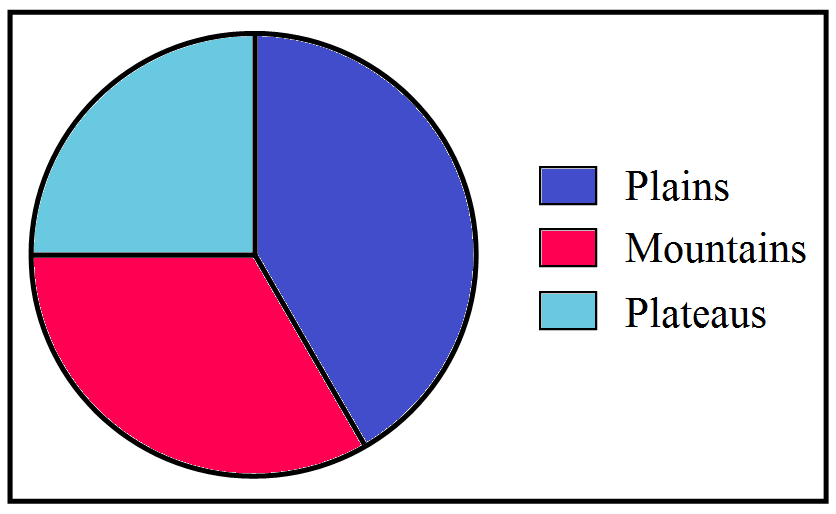
Study the pie-chart showing landuse patterns and answer the following question:

"India has a wide variety of relief features which are the most important resources." Justify the statement.
Answer
India has a wide variety of relief a features such as mountains, plains and plateaus.
  1. About 43% of the land area is plain which provides facilities for agriculture and industry.
  2. Mountains account for 30% of the land area which provides facilities for tourism and ecological aspects. It also ensures perennial flow of some rivers.
  3. About 27% of the plateau region possesses rich resources of minerals, fossil fuels and forests.
View full question & answer
Question 435 Marks
Under what conditions do you think resources can become developed resources?
Answer
  1. Stocks are materials in the environment which have the capacity to satisfy human needs but human beings do not have the appropriate technology to access these. For example, water is a compound of two inflammable gases, hydrogen and oxygen, which can be used as a rich source of energy.
  2. But the required technical knowhow to use these abundant gases for this purpose is not available at present.
  3. Similarly, by development of desalinisation project we can make ocean water usuable for drinking purpose. But we do not have the proper expertise and funds to use them, but our future generations may be able to do so with the advancement of science and technology.
  4. This is how stock can become developed resources with technical know how and development.
View full question & answer
Question 445 Marks
Which is the most widely spread and important soil of India? State any six characteristics of this type of soil.
Answer
Alluvial soil is the most widely spread and important soil of India.
For characteristics of this type of soil:
Alluvial soil: This is the most widely spread and important soil which is found in the entire northern plains and also extend in Rajasthan and Gujarat through a narrow corridor. It is also found in the eastern coastal plains particularly in the deltas of the Mahanadi, the Godavari, the Krishna and the Kaveri rivers. Such soils are also common in plains such as Duars, Chos and Terai.
  • Mostly these soils contain adequate A proportion of potash, phosphoric acid and lime which are ideal for the growth of sugarcane, paddy, wheat and other cereals and pulse crops.
  • These soils are highly fertile. Therefore, regions of this soil are intensively cultivated and thickly populated.
View full question & answer
Question 455 Marks
Explain the classification of resources on the basis of ownership.
Answer
  1. Individual Resources: These are also owned privately by individuals. For example, land owned by farmers.
  2. Community-owned Resources: There are resources which are accessible to all the members of the community. For example, grazing grounds, burial grounds, village ponds, public parks, picnic spots, playgrounds, etc.
  3. National Resources: The resources but that belong to the nation. For example, roads, canals, railways, all the minerals, water resources, forests, wildlife, land within the political boundaries and oceanic area up to 12 nautical miles (19.2km) from the coast termed as territorial waters and resources therein belong to the nation.
  4. International Resources: The resources that do not belong to any individual country. For example, the oceanic resources beyond 200km of the Exclusive Economic Zone belongs to open ocean and no individual country can utilise these without the decision of international institutions. There are international institutions to regulate such resources.
View full question & answer
Question 465 Marks
Mentions any four characteristics of forest soils.
Answer
Forest soils are mainly found in the hilly and mountains areas where sufficient rain forests are available. The soil texture varies according to the mountain environment where they are formed. Characteristics of forest soils:
  1. These soils are heterogeneous in nature, and their character changes with mountainous environment and altitude.
  2. The soils are very rich in humus, but are deficient in potash, phosphorus and lime.
  3. The soils are especially suitable for plantation of tea, coffee, spices and tropical fruits.
  4. The soil is loamy and silty in valley sides and coarse grained in the upper slopes. It is acidic with low humus content in the snow covered areas. It is fertile in the lower parts of the valleys.
View full question & answer
Question 475 Marks
“Indiscriminate used of resources has led to numerous problems’’. Justify the statements in three points.
Answer
Resources are essential for human survival and for maintaining the quality of life. But indiscriminate use of resources had led to many problems like:
  1. Depletion of resources for satisfying the need of few greedy individuals.
  2. Accumulation of resources in the hands of few individuals dividing the society into haves and have nots or rich and poor.
  3. Over exploitation of resources has led to global ecological crisis like global warming, depletion of ozone layer, environmental pollution and land degradation.
View full question & answer
Question 485 Marks
Describe any fie distinct characteristics of arid soils.
Answer
The main characteristics of the arid soils are as follows:
  1. These soils range from red to brown in colour.
  2. They are generally sandy in texture and saline in nature.
  3. Due to the dry climate, high temperature, evaporation is faster and the soil lacks humus and moisture.
  4. In some areas, the salt content is very high and common salt is obtained by evaporating the water.
  5. The lower horizons of the soil are occupied by Kankar because of the increasing calcium content downwards.
View full question & answer
Question 495 Marks
Explain the importance of conservation of resources.
Answer
Here are few reasons listed below which will through light regarding the importance of natural resources and the need to conserve them:
  1. Nature helps to maintain the environmental balance and satisfy the needs to the fullest.
  2. A wide range of industrial material and biological material from plant and animal, directly or indirectly are used in production and in the manufacturing of medicine.
  3. Resource are known as capital converted to commodity inputs to infrastructural capital processes.
  4. These are the “3R Concept” 3R means “REDUCE”, “REUSE” and “RECYCLE”. An example is papers, our used papers will reuse by recycling it and turn it into a new paper product.
  5. Resources are important for the development of any country. For example, to generate energy, one need fossil fuels; and for industrial development, we require mineral resources.
  6. Irrational consumption and over utilisation of natural resources has led to socio-economic and environmental problems.
  7. Natural resources are available in fixed quantity and they are non – renewable,
  8. Natural resources are getting scarce with the increasing population, so it is essential to conserve them. This empowers us as well as our future generation to utilise the natural resources to the full extent.
  9. It takes millions of year for the formation of natural resources.
  10. They play a vital role in the economic development of the country by enriching agriculture, trade, imports and exports, etc.
View full question & answer
Question 505 Marks
Why is it important to have a planned strategy for the developing of resources in India?
Answer
It is essential to have resource planning because of the following reasons:
  1. It helps to identify the various resources present in different regions of the country.
  2. It helps in the conservation of various non-renewable/extinguishable resources.
  3. It helps in reducing wastage of resources.
  4. It helps in equal distribution of resources among the regions that have acute shortage of it.
  5. It helps in keeping track of remaining resources.
  6. It helps to take care of future generations.
View full question & answer