Questions · Page 1 of 2

6 Marks Question

🎯

Test yourself on this topic

50 questions · timed · auto-graded

Question 16 Marks
Raghav & Co. have two bank accounts. Account No. I and Account No. II. From the following particulars relating to Account No. I, find out the balance on that account of March 31, 2017 according to the cash book of the firm.
  1. Cheques paid into bank prior to March 31, 2017, but not credited for ₹ 10,000.
  2. Transfer of funds from account No. II to account no. I recorded by the bank on March 31, 2017 but entered in the cash book after that date for ₹ 8,000.
  3. Cheques issued prior to March 31, 2017 but not presented until after that date for ₹ 7,429.
  4. Bank charges debited by bank not entered in the cash book for ₹ 200.
  5. Interest Debited by the bank not entered in the cash book ₹ 580.
  6. Overdraft as per Passbook ₹ 18,990.
View full question & answer
Question 26 Marks
Prepare Bank Reconciliation Statement from the following particulars on 31st July, 2018:
  1. Balance as per the Pass Book ₹ 50,000.
  2. Three cheques for ₹ 6,000, ₹ 3,937 and ₹ 1,525 issued in last week of July, 2018 were presented for payment to the bank in August, 2018.
  3. Two cheques of ₹ 500 and ₹ 650 sent to the bank for collection were not entered in the Pass Book by 31st July, 2018.
  4. The bank charged ₹ 460 for its commission and allowed interest of ₹ 100 which were not mentioned in the Bank Column of the Cash Book.
View full question & answer
Question 36 Marks
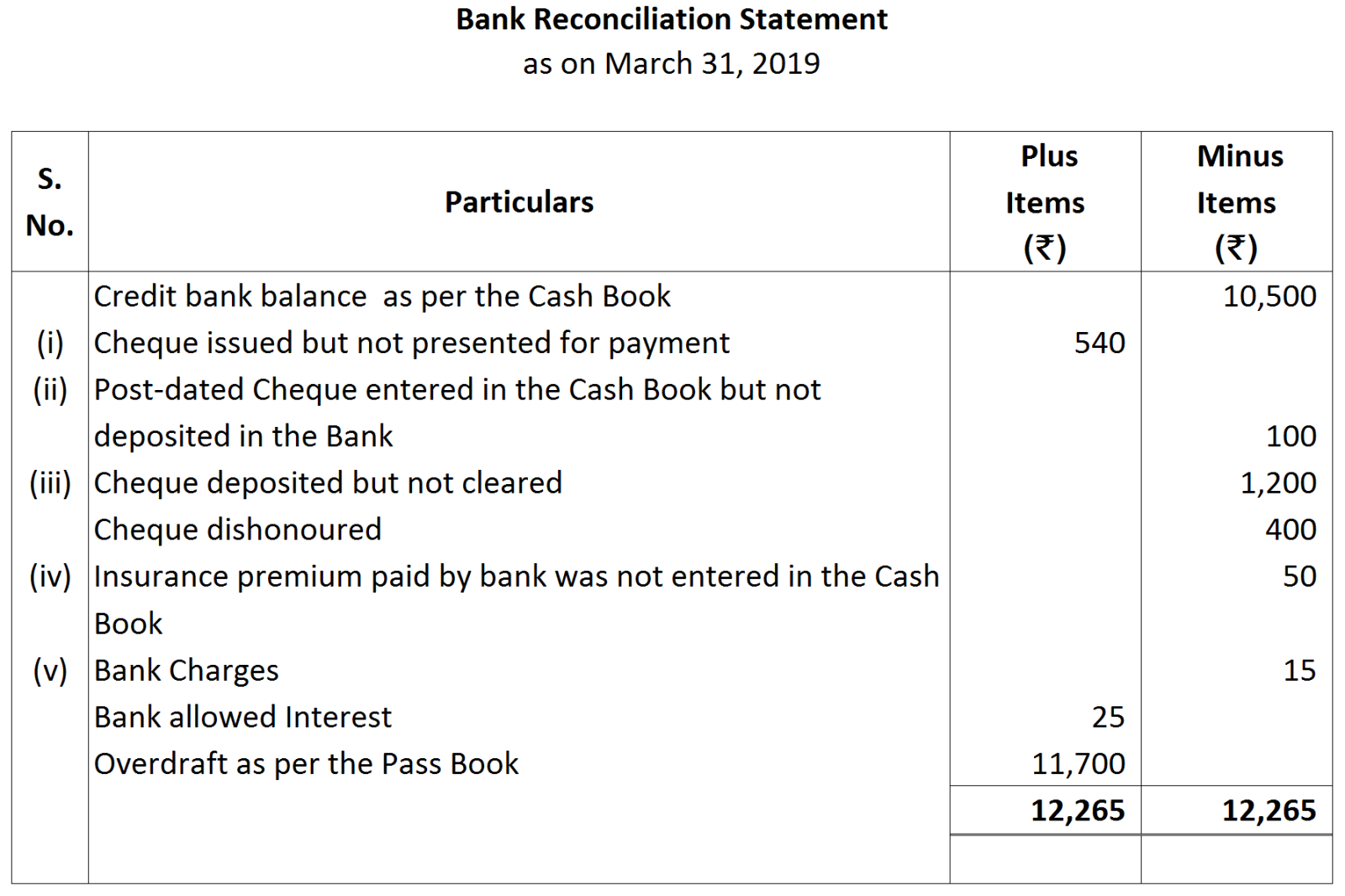
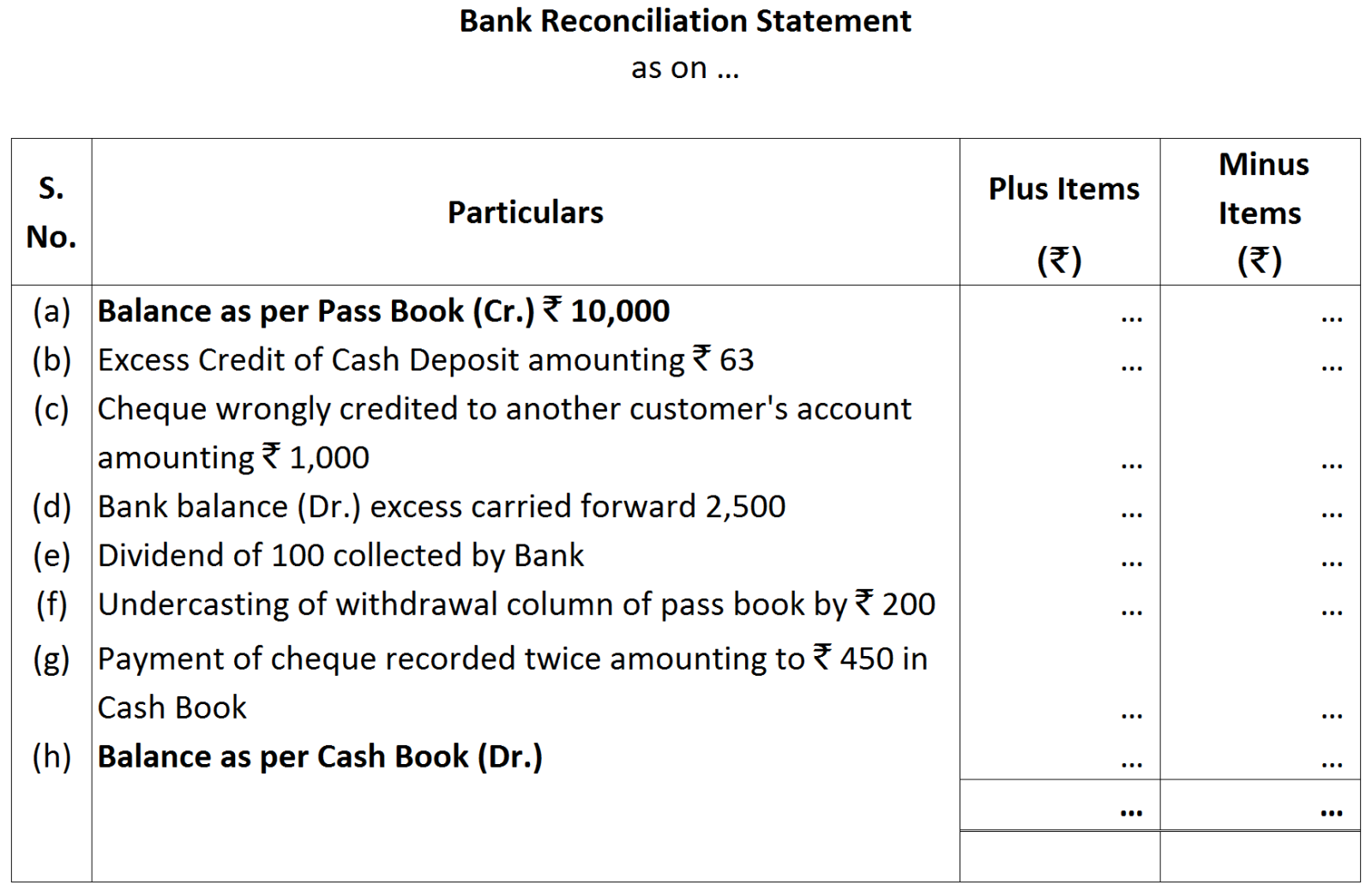
Prepare Bank Reconciliation Statement from the following:On 31st March, 2019, a merchant's Cash Book showed a credit bank balance of ₹ 10,500 but due to the following reasons the Pass Book showed a difference:
  1. A cheque of ₹ 540 issued to Mohan has not been presented for payment.
  2. A post-dated cheque for ₹ 100 has been debited in the bank column of the Cash Book but under no circumstances was it possible to present it.
  3. Four cheque of ₹ 1,200 sent to the bank have not been collected so far. A cheque of ₹ 400 deposited in the bank has been dishonoured.
  4. As per instructions, the bank paid ₹ 50 as Fire Insurance premium but the entry has not been made in the Cash Book.
  5. There was a debit in the Pass Book of ₹ 15 in respect of bank charges and a credit of ₹ 25 for interest on Current Account but no record exists in the Cash Book.
  6. Cheque of ₹ 5,000 dated 15th April, 2019 issued to M & Co. was dishonoured being post dated. It was also not recorded in the books of account yet.
Answer

Note: Cheque dated 15th April, 2019 issued to M & Co. dishonoured will have no impact as this statement is as on 31st March 2019.
View full question & answer
Question 46 Marks
Prepare a bank reconciliation statement from the following particulars and show the balance as per cash book.
  1. Balance as per passbook on March 31, 2017 overdrawn ₹ 20,000.
  2. Interest on bank overdraft not entered in the cash book ₹ 2,000.
  3. ₹ 200 insurance premium paid by bank has not been entered in the cash book.
  4. Cheques drawn in the last week of March 2017, but not cleared till date for ₹ 3,000 and ₹ 3,500.
  5. Cheques deposited into bank on February 2017, but yet to be credited on dated March 31, 2017 ₹ 6,000.
  1. Wrongly debited by bank ₹ 500.
View full question & answer
Question 56 Marks
On 1st January, 2019, Naresh had an overdraft of ₹ 40,000 as shown by his Cash Book in the bank column. Cheques amounting to ₹ 10,000 had been deposited by him but were not collected by the bank by 1st January, 2019. He issued cheques of ₹ 7,000 which were not presented to the bank for payment up to that day. There was also a debit in his Pass Book of ₹ 600 for interest and ₹ 500 for bank charges.Prepare a Bank Reconciliation Statement.
View full question & answer
Question 66 Marks
On 31st March, 2019, Cash Book of Mahesh showed debit bank balance of ₹ 75,000. When compared with the Bank Statement, following facts were discovered. On 30th March, two cheques of ₹ 5,000 and ₹ 7,000 were deposited in the bank but were not realised till date. On 28th March, three cheques of ₹ 6,000, ₹ 8,000 and ₹ 12,000 were issued but none of these were presented to the bank for payment. On 31st March, bank credited ₹ 1,250 as interest but this was not recorded in the Cash Book. Similarly, the bank had charged ₹ 150 as bank charges but this was not recorded in the Cash Book.
Bank paid insurance premium of ₹ 5,000 but it was recorded as ₹ 500 in Cash Book. Prepare Bank Reconcilation Statement on 31st March, 2019.
View full question & answer
Question 76 Marks
Prepare bank reconciliation statement.
  1. Overdraft shown as per cash book on December 31, 2017 ₹ 10,000.
  2. Bank charges for the above period also debited in the passbook ₹ 100.
  3. Interest on overdraft for six months ending December 31, 2017 ₹ 380 debited in the passbook.
  4. Cheques issued but not incashed prior to December 31, 2017 amounted to ₹ 2,150.
  5. Interest on Investment collected by the bank and credited in the passbook ₹ 600.
  6. Cheques paid into bank but not cleared before December, 31, 2017 were ₹ 1,100.
View full question & answer
Question 86 Marks
Prepare bank reconciliation statement of Shri Bhandari as on March 31, 2017
  1. The Payment of a cheque for ₹ 550 was recorded twice in the passbook.
  2. Withdrawal column of the passbook under cast by ₹ 200
  3. A Cheque of ₹ 200 has been debited in the bank column of the Cash Book but it was not sent to bank at all.
  4. A Cheque of ₹ 300 debited to Bank column of the cash book was not sent to the bank.
  5. ₹ 500 in respect of dishonoured cheque were entered in the passbook but not in the cash book. Overdraft as per passbook is ₹ 20,000.
View full question & answer
Question 106 Marks
On December 31, 2017, the cash book of Mittal Bros. Showed an overdraft of ₹ 6,920. From the following particulars prepare a Bank Reconciliation Statement and ascertain the balance as per passbook.
  1. Debited by bank for ₹ 200 on account of Interest on overdraft and ₹ 50 on account of charges for collecting bills.
  2. Cheques drawn but not encashed before December, 31, 2017 for ₹ 4,000.
  3. The bank has collected interest and has credited ₹ 600 in passbook.
  4. A bill receivable for ₹ 700 previously discounted with the bank had been dishonoured and debited in the passbook.
  5. Cheques paid into bank but not collected and credited before December 31, 2017 amounted ₹ 6,000.
View full question & answer
Question 116 Marks
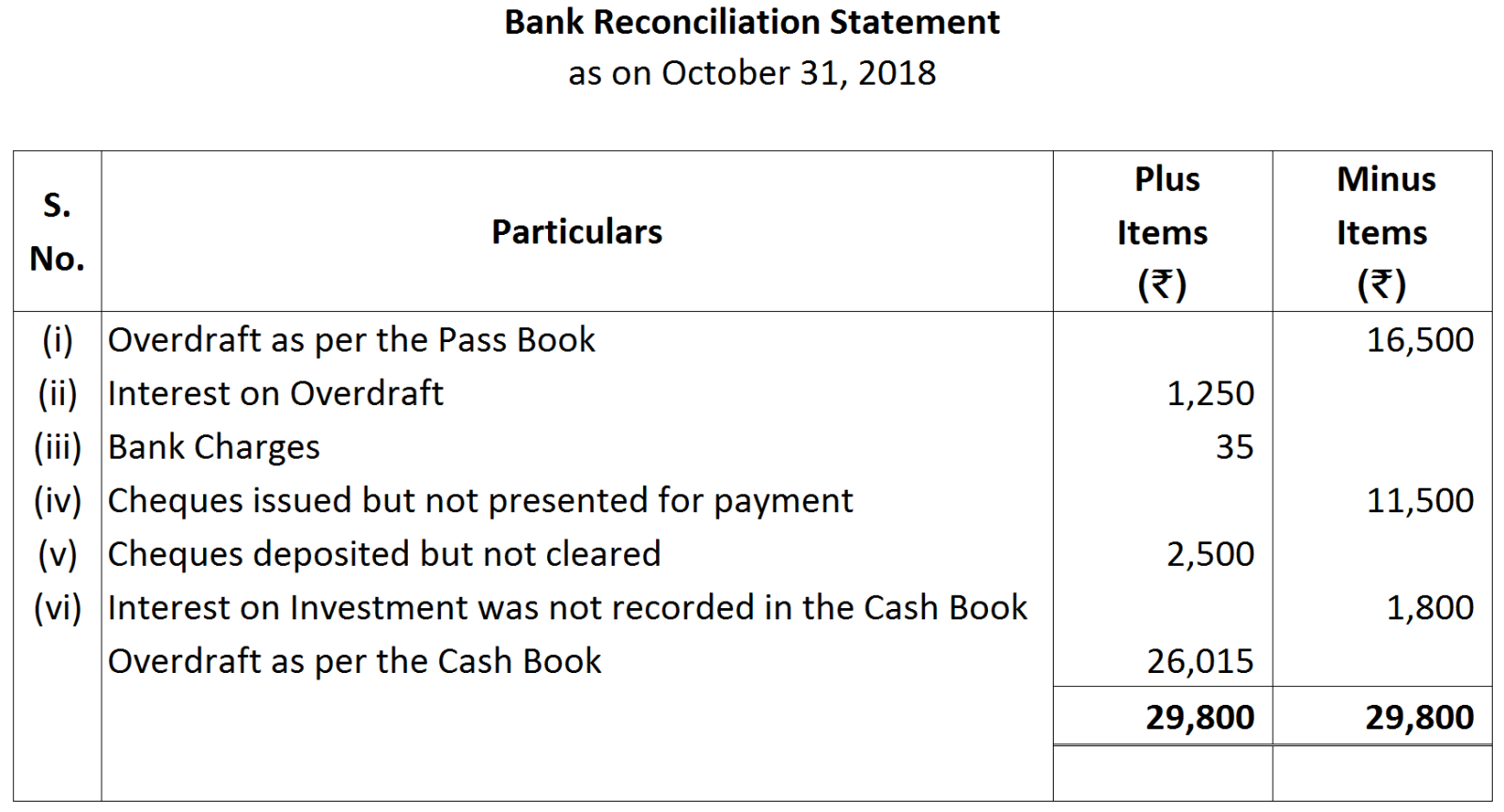
From the following particulars, you are required to ascertain the bank balance as would appear in the Cash Book of Ramesh as on 31st October, 2018:
  1. Bank Pass Book showed an overdraft of ₹ 16,500 on 31st October.
  2. Interest of ₹ 1,250 on overdraft up to 31st October, 2018 has been debited in the Bank Pass Book but it has not been entered in the Cash Book.
  3. Bank charges debited in the Bank Pass Book amounted to ₹ 35.
  4. Cheques issued prior to 31st October, 2018 but not presented till that date, amounted to ₹ 11,500.
  5. Cheques paid into bank before 31st October, but not collected and credited up to that date, were for ₹ 2,500.
  6. Interest on investment collected by the bankers and credited in the Bank Pass Book amounted to ₹ 1,800.
Answer
Solution is as follow:
View full question & answer
Question 126 Marks
On 31st March, 2019, Pass Book of Shri Bhama Shah shows debit balance of ₹ 10,000. From the following particulars, prepare Bank Reconciliation Statement.
  1. Cheques amounting to ₹ 8,000 drawn on 25th March of which cheques of ₹ 5,000 cashed in April, 2019.
  2. Cheques paid into bank for collection of ₹ 5,000 but cheques of ₹ 2,200 could only be collected in March 2019.
  3. Bank charges ₹ 25 and dividend of ₹ 350 on investment collected by bank could not be shown in the Cash Book.
  4. A cheque of ₹ 600 debited in the Cash Book omitted to be banked.
  5. Bill of ₹ 5,000 discounted with Bank but was not recorded in the Cash Book.
View full question & answer
Question 136 Marks
From the following information, prepare Bank Reconciliation Statement as on 31st March, 2019:
 
 
(i)
Bank overdraft as per Pass Book.
36,000
(ii)
Cheques issued but not presented for payment.
19,700
(iii)
Cheques deposited with bank but not collected.
25,000
(iv)
Cheques entered in Cash Book but not banked.
9,000
(v)
Directly deposited to bank by a customer.
11,000
View full question & answer
Question 146 Marks
Explain the process of preparing bank reconciliation statement with amended cash balance.
Answer
Bank Reconciliation Statement can be prepared with the adjusted/ amended bank column of the Cash Book by the below given steps.
Step 1: Note down the bank balance as per the Cash Book.
Step 2: Rectify all the errors committed in the Cash Book.
Step 3: Enter those transactions in the debit column of the Cash Book that are only in the credit column of the Pass Book.
Step 4: Enter those transactions in the credit column of the Cash Book that are only in the debit column of the Pass Book.
Step 5: After completing the above steps, the balance or the overdraft, as per amended Cash Book, arrives, with which Bank Reconciliation Statement can be prepared.
The performa of Bank Reconciliation Statement through amended balance is given below.
View full question & answer
Question 156 Marks
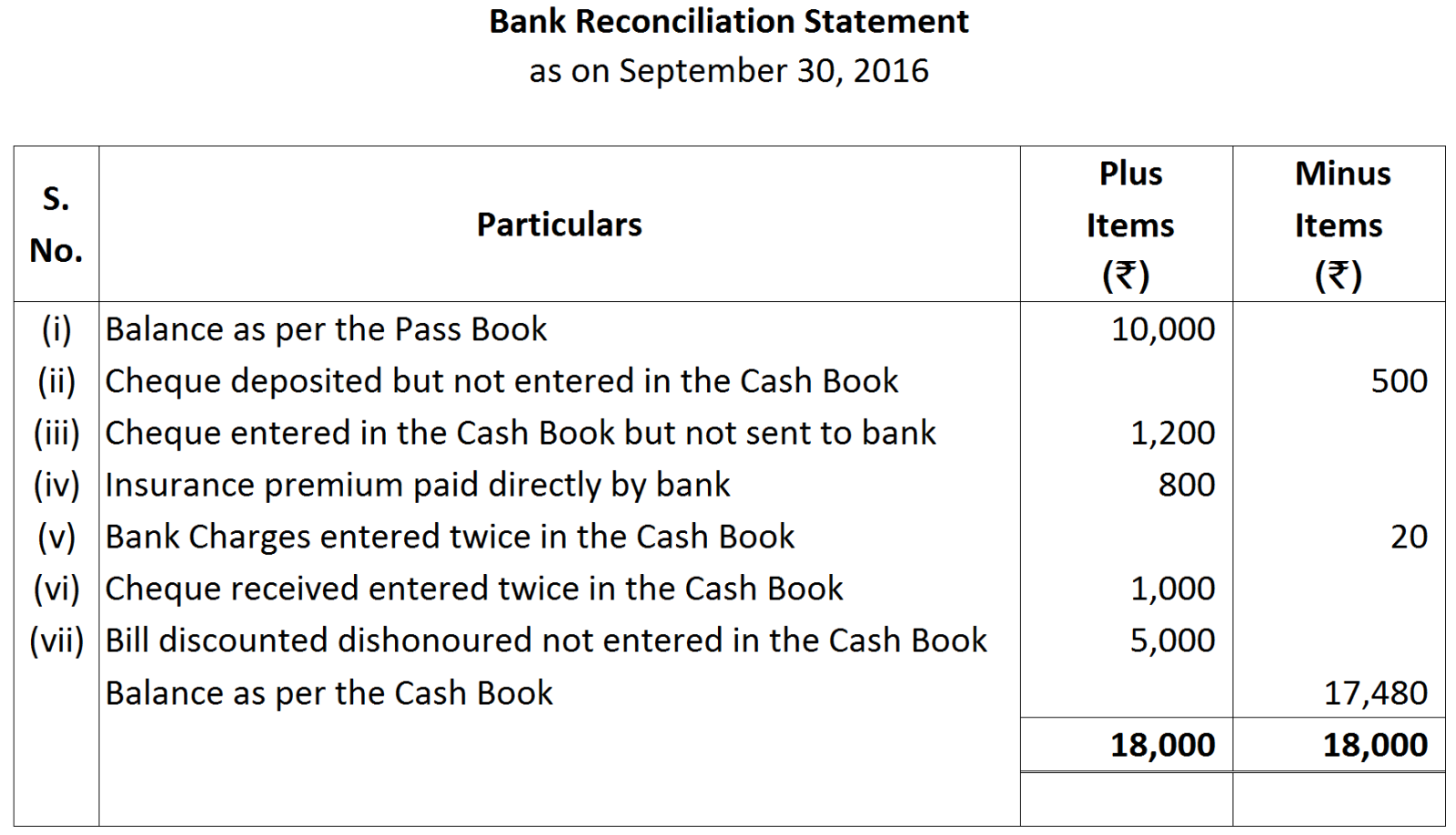
Prepare Bank Reconciliation Statement as on 30th September, 2016 from the following particulars:
 
 
(i)
Bank Balance as per Pass Book.
10,000
(ii)
Cheque deposited into bank but no entry was passed in Cash Book.
500
(iii)
Cheque received and entered in Cash Book but not sent to bank.
1,200
(iv)
Insurance premium paid directly by the bank.
800
(v)
Bank charges entered twice in the Cash Book.
20
(vi)
Cheque received entered twice in Cash Book.
1,000
(vii)
Bill discounted dishonoured not recorded in the cash book.
5,000
Answer
Solution is as follow:
View full question & answer
Question 166 Marks
Prepare Bank Reconciliation Statement from the following particulars as on 31st March, 2019 when Pass Book shows a debit balance of ₹ 2,500:
  1. Cheque issued for ₹ 5,000 but up to 31st March, 2019 only ₹ 3,000 could be cleared.
  2. Cheques deposited for ₹ 5,500 but cheques of ₹ 500 were collected on 10th April, 2019.
  3. A discounted Bill of Exchange dishonoured ₹ 2,000.
  4. A cheque of ₹ 300 debited in Cash Book but omitted to be banked.
  5. Interest allowed by bank ₹ 400 but no entry was passed in the Cash Book.
View full question & answer
Question 176 Marks
Prepare Bank Reconciliation Statement as on 31st March, 2019 from the following particulars:
 
 
(i)
Bank balance as per Pass Book.
10,000
(ii)
Cheque deposited into the Bank, but no entry was passed in the Cash Book.
500
(iii)
Cheque received and entered in the Cash Book but not sent to bank.
1,200
(iv)
Credit side of the Cash Book bank column cast short.
200
(v)
Insurance premium paid directly by the bank under the standing advice.
600
(vi)
Bank charges entered twice in the Cash Book.
20
(vii)
Cheque issued but not presented to the bank for payment.
500
(viii)
Cheque received entered twice in the Cash Book.
1,000
(ix)
Bill discounted dishonoured not recorded in the Cash Book.
5,000
(x)
Bank had wrongly allowed interest of ₹ 5,000, which was reversed by it on 5th April, 2019
View full question & answer
Question 186 Marks
On 30th June, 2019, bank column of the Cash Book showed balance of ₹ 12,000 but the Pass Book showed a different balance due to the following reasons:
  1. Cheques paid into the bank ₹ 8,000 but out of these only cheques of ₹ 6,500 credited by bankers.
  2. The receipts column of the Cash Book undercast by ₹ 200.
  3. On 29th June, a customer deposited ₹ 3,000 directly in the Bank Account but it was entered in the Pass Book only.
  4. Cheques of ₹ 9,200 were issued of which ₹ 2,200 were presented for payment on 15th July.
  5. Pass Book shows a credit of ₹ 330 as interest and a debit of ₹ 60 as bank charges.
Prepare Bank Reconciliation Statement as on 30th June, 2019.
View full question & answer
Question 196 Marks
Bank Statement of a customer shows bank balance of ₹ 62,000 on 31st March, 2019. On comparing it with the Cash Book the following discrepancies were noted:
  1. Cheques were paid into the bank in March but were credited in April:
P - ₹ 3,500; Q - ₹ 2,500; R - ₹ 2,000.
  1. Cheques issued in March were presented in April:
X - ₹ 4,000; Q - ₹ 4,500.
  1. Cheque for ₹ 1,000 received from a customer entered in the Cash Book but was not banked.
  2. Pass Book shows a debit of ₹ 1,000 for bank charges and credit of ₹ 2,000 as interest.
  3. Interest on investment ₹ 2,500 collected by the bank appeared in the Pass Book.
Prepare Bank Reconciliation Statement showing the balance as per Cash Book on 31st March, 2019.
View full question & answer
Question 206 Marks
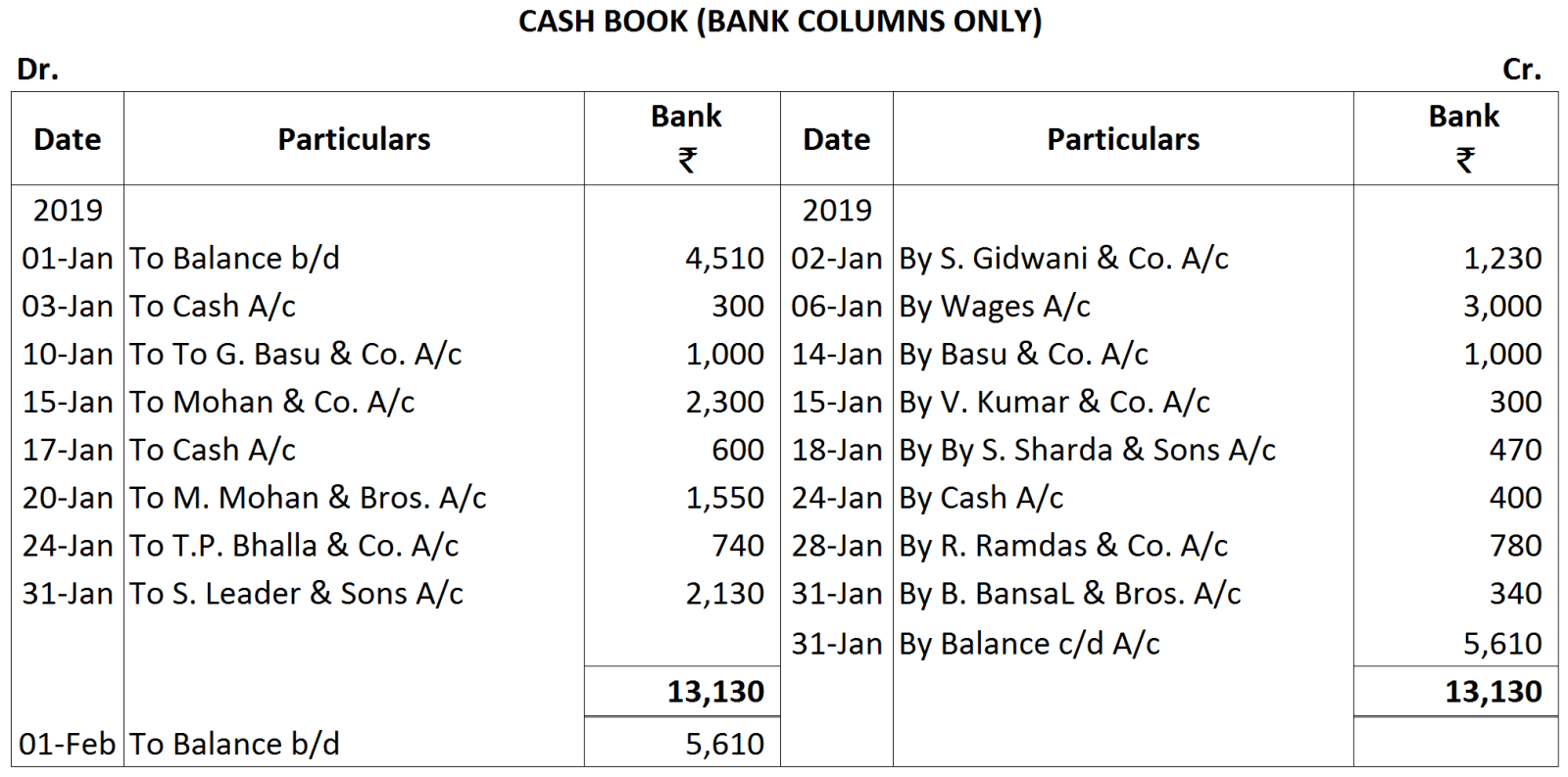
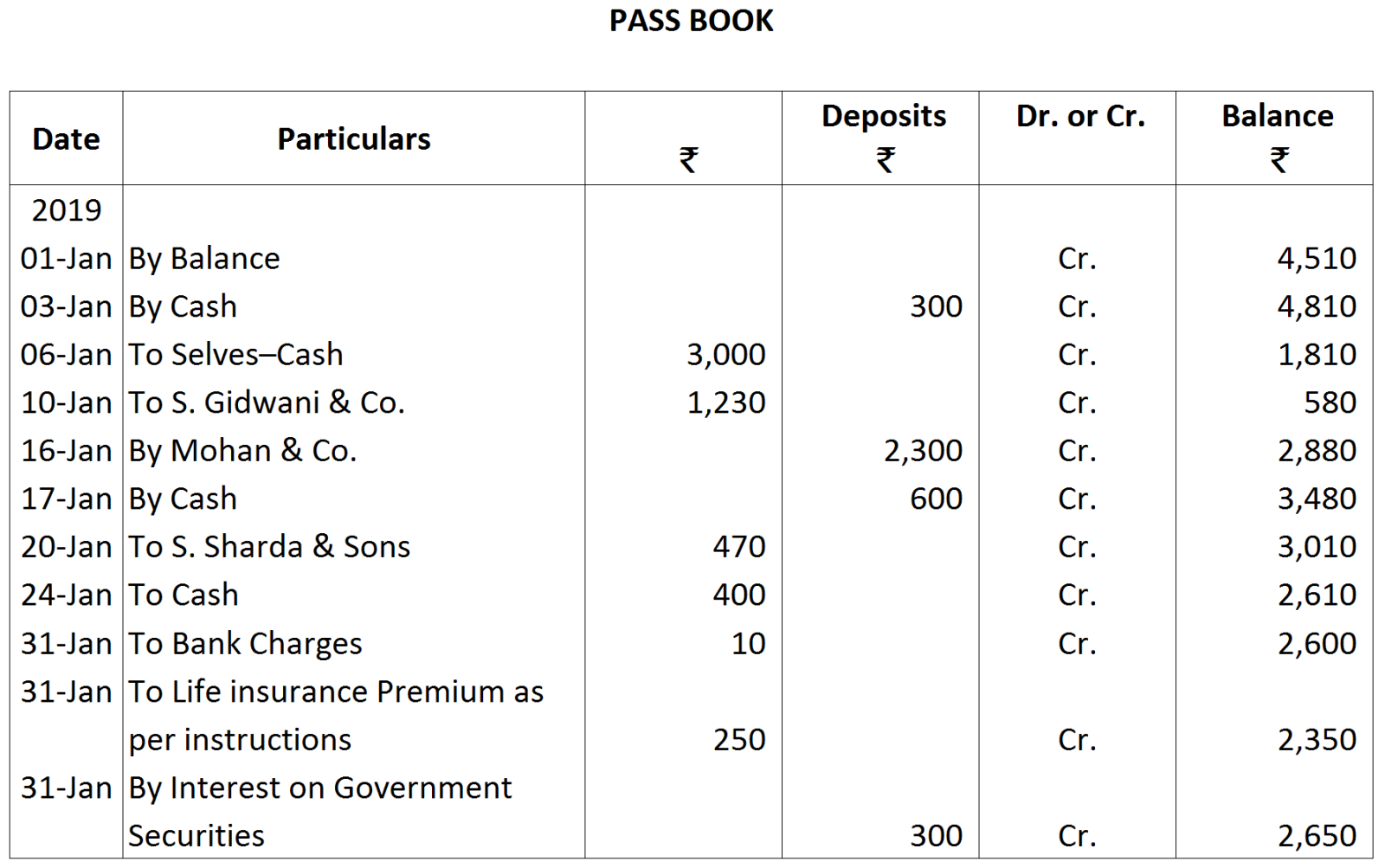
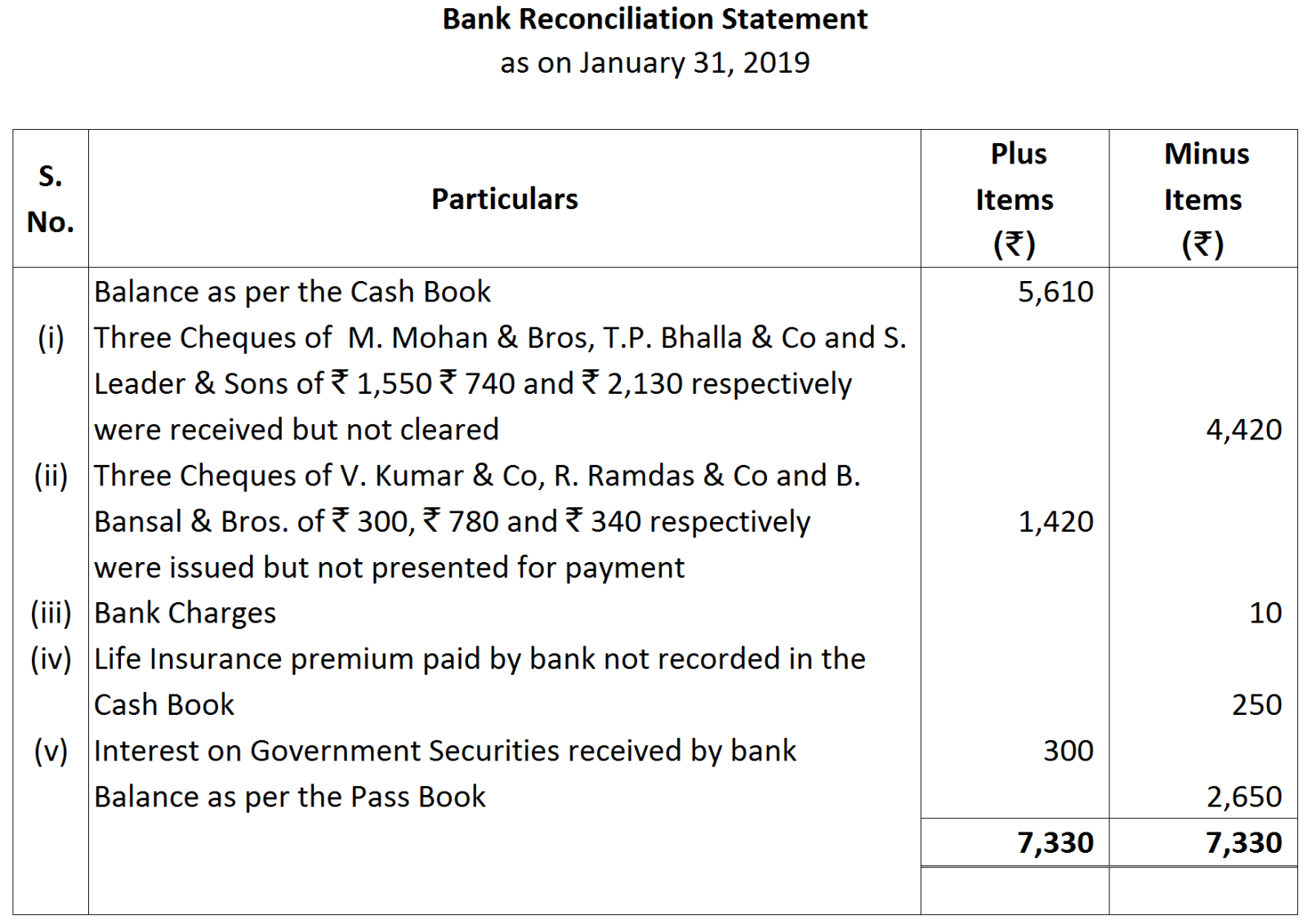
From the following extracts from the Cash Book and the Pass Book for the month of January, 2019, prepare Bank Reconciliation Statement:
Answer

Note: In Cash Book cheque received from G. Basu & Co is debited with ₹ 1,000 and at the time of dishonour entry is reversed by crediting G. Basu & Co with ₹ 1,000. Therefore its net effect is nil in Cash Book.
View full question & answer
Question 216 Marks
Draw Bank Reconciliation Statement showing adjustment between your Cash Book and Pass Book as on 31st March, 2011.
  1. On 31st March, 2011 your pass book showed a balance of ₹ 6,000 to your credit.
  2. Before that date, you had issued cheques amounting to ₹ 1,500 of which cheques of ₹ 900 have been presented for payment.
  3. A cheque of ₹ 800 paid by you into the bank on 29th March, 2011 is not yet credited in pass book.
  4. There was a credit of ₹ 85 for interest on Current Account in the pass book.
  5. On 31st March, 2011 a cheque for ₹ 510 received by you and was paid into bank but the same was omitted to be entered in cash book.
View full question & answer
Question 226 Marks
The cash book shows a bank balance of ₹ 7,800. On comparing the cash book with passbook the following discrepancies were noted:
  1. Cheque deposited in bank but not credited ₹ 3,000
  2. Cheque issued but not yet present for payment ₹ 1,500
  3. Insurance premium paid by the bank ₹ 2,000
  4. Bank interest credit by the bank ₹ 400
  5. Bank charges ₹ 100
  6. Directly deposited by a customer ₹ 4,000
View full question & answer
Question 236 Marks
The bank statement of Mr. James Flint showed an overdraft to the tune of ₹ 60,400 as on 31-12-2014. Cash Book showed a debit balance of ₹ 2,00,120 as on the same date. The following further facts are available:
 
 
(a)
Cheque issued to Tax Consultants was not cashed till 31-12-2014.
12,000
(b)
Cheque issued to Management Consultancy Services was cashed on 14-1-2015.
20,000
(c)
Cheque received from M/s General Studies and deposited into the bank was credited in the account on 3-1-2015.
2,20,000
(d)
Dividend warrant deposited on 29-12-2014 was not credited by the bank till 31-12-2014.
74,400
(e)
Bank charge not adjusted in books of Mr. Flint till 31-12-2014
680
(f)
Interest credited by the bank and not adjusted in the books till 31-12-2014
2,560
Prepare a Bank Reconciliation Statement of Mr. James Flint as on 31-12-2014.
View full question & answer
Question 246 Marks
On March 31, 2017 the cash book showed a balance of ₹ 3,700 as cash at bank, but the bank passbook made up to same date showed that cheques for ₹ 700, ₹ 300 and ₹ 180 respectively had not presented for payment, Also, cheque amounting to ₹ 1,200 deposited into the account had not been credited. Prepare a bank reconciliation statement.
View full question & answer
Question 256 Marks
On 31st January, 2017 the Pass Book of Shri M.L. Gupta shows a debit balance of ₹ 41,000. Prepare a bank reconciliation statement from the following particulars:-
  1. Cheques amounting to ₹ 15,600 were drawn on 27th January, 2017. Out of which cheques for ₹ 11,000 were encashed up to 31-1-2017.
  2. A wrong debit of ₹ 800 has been given by the bank in the Pass Book.
  3. A cheque for ₹ 200 was credited in the Pass Book but was not recorded in the Cash Book.
  4. Cheques amounting to ₹ 21,000 were deposited for collection. But out of these, cheques for ₹ 7,400 have been credited in the Pass Book on 5th February, 2017.
  5. A cheque for ₹ 1,000 was returned dishonoured by the bank and was debited in the Pass Book only.
  6. Interest on overdraft and bank charges amounting to ₹ 100 were not entered in the Cash Book.
  7. A cheque of ₹ 500 debited in the Cash Book omitted to be banked.
View full question & answer
Question 266 Marks
Explain the reasons where the balance shown by the bank passbook does not agree with the balance as shown by the bank column of the cash book.
Answer
The reason for the error in balance between the cash book and pass book can be stated as follows:
Timing difference on recording of the transactions: While comparing the balances of both the accounts, transactions found usually appear only in the cash book or only in the pass book. Such differences are caused by the time gap in recording the transactions in the books relating to either receipts or payments.
Transactions which appear in the cash book but not in the pass book:
  1. Cheques issued but not presented for payment at the bank: The firm/ customer issues cheques to its suppliers and creditors, but not all these cheques are presented to the bank. The entry in the cash book is made immediately on issue of the cheque but the bank will not pass an entry until the cheque is presented for payment.
  2. Cheques paid or deposited but not collected and credited by the bank: Entry is passed by the firm in the cash book when it receives cheques from its debtors which increase the balance as per the cash book. But the bank credits the firm’s account only when they receive the payment from the customer’s bank or in other words, once the cheque is collected by the bank.
Transactions which appear in the pass book but not in the cash book:
  1. Direct bank charges, commission and interest debited by the bank: Bank provides us various services for which it levies some charges which is directly debited from the firm’s account. The firm will know of these charges only after she/he verifies the entries with the bank statement.
Example: Interest on overdraft, unpaid cheques and cheque collection charges.
  1. Expenses directly paid by the bank on behalf of the customers: Depending upon the standing instruction of the customer, the bank makes regular payment on behalf of the customer. The bank debits the customer’s account when the payment is made but the firm will pass the entry in his book only after he receives the bank statement. Thus, the balance as per the pass book will be less than the balance in the cash book.
Example: Insurance premium, telephone bills and rent.
  1. Amounts directly deposited in the customer’s account: There are times when the firm’s debtors deposit money or make payments directly into the firm’s bank account. This results in an increase in the balance of the bank account. As no intimation is received by the firm, there will be no record of the same in the cash book.
  1. Incomes directly collected by the bank on behalf of customer but not recorded in cash book: As per the agreement between the customer and the bank, the bank directly accepts payments such as dividends and rents and credits the same into the customer’s account. This increases the balance as per the pass book and causes a decrease in the balance in the pass book.
  1. Cheques deposited dishonoured or bills discounted dishonoured: The bank sometimes allows the facility of discounting the bills of the customers. If such a bill is dishonoured on its date of maturity, the same is debited to customers account. As this information is not available to the firm, there will be no entry in the cash book. Similarly, when a cheque deposited by the firm in the bank is dishonoured, the same is debited to the customer’s account. As a result, there is a difference between the balances of the cash book and the pass book.
Errors in recording transactions by the firm or by the bank: Errors such as wrong recordings relating to cheques deposited/ issued, wrong totaling or omission can be committed by the bank or the firm which can cause a difference between the cash book and the pass book balance.
Example: Wrong recording can be passed by the bank because of the similarity in names of its customers or some error caused by the clerk of the bank.
Cheques received by the firm are sent to the bank without passing an entry in the cash book or cheques received from the customers are omitted to be sent to the bank but an entry has been passed in the cash book.
View full question & answer
Question 276 Marks
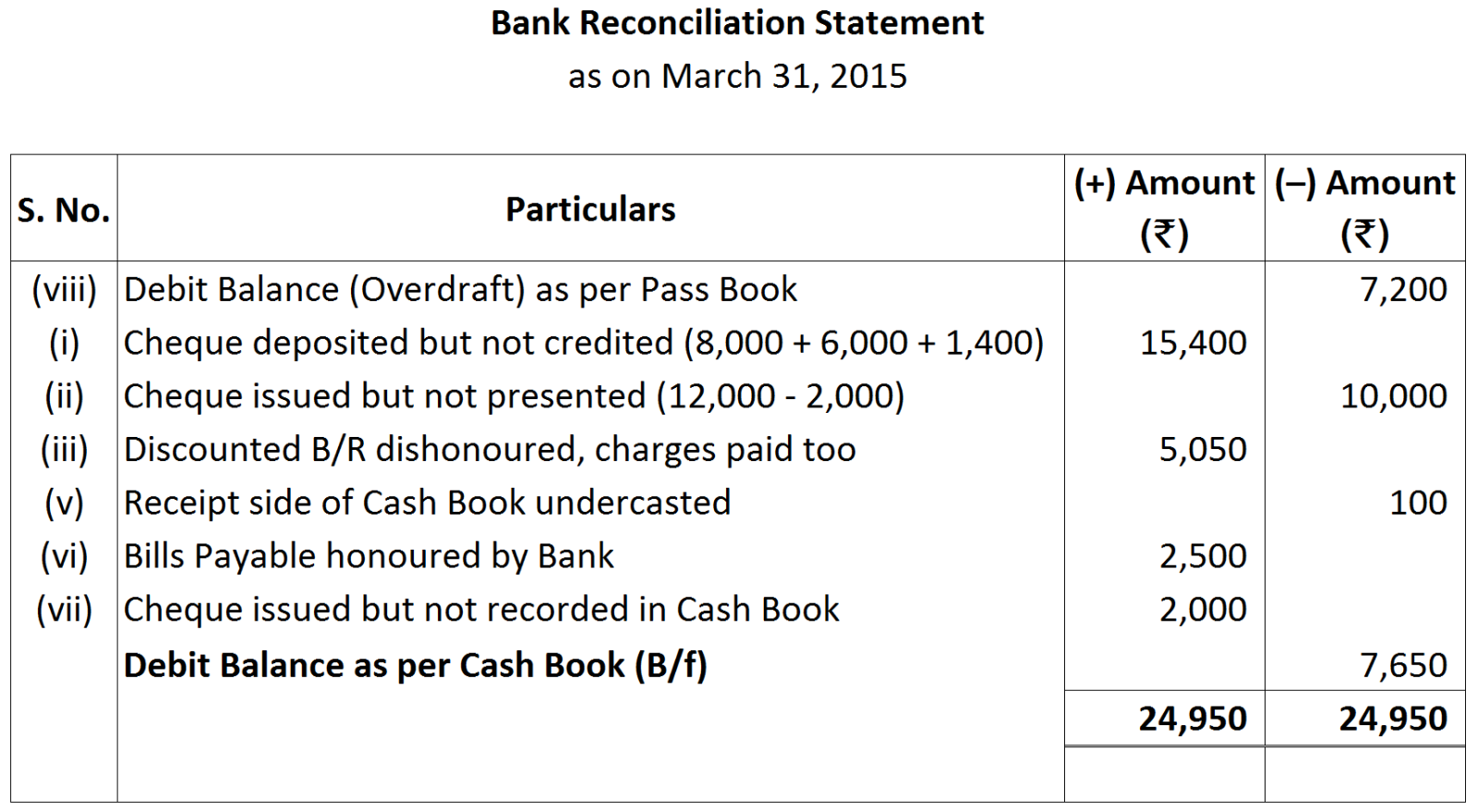
Prepare a Bank Reconciliation Statement from the following particulars as on 31st March 2015:
  1. Cheques were deposited into bank on 25th March for ₹ 20,000. Out of these cheques for ₹ 8,000 were cleared on 4th April, cheques for ₹ 6,000 on 6th April and one cheque for ₹ 1,400 was dishonoured on 7th April.
  2. Cheques amounting to ₹ 12,000 were issued in March, out of which cheques for ₹ 2,000 were encashed upto 31st March.
  3. A bill for ₹ 5,000 (discounted with the bank in January) dishonoured on 30th March 2015 and noting charges paid by bank ₹ 50. No information regarding the dishonour was received from the bank in March 2015.
  4. Cheque issued to a creditor for ₹ 2,000 was through mistake entered in the cash column of the Cash Book. The same has not been presented for payment till today.
  5. Receipt side of the Cash Book (bank column) was undercast by ₹ 100.
  6. Bank has paid a bill payable amounting to ₹ 2,500 but it has not been entered in the Cash Book.
  7. A cheque for ₹ 2,000 issued to Mr. X was omitted to be recorded in Cash Book.
  8. Dr. balance as per Pass Book was ₹ 7,200.
Answer

Note:
Transaction no. (iv) will have no effect on the bank balance as the issued cheque was recorded in the cash column and was not presented for payment till the date of preparation of Bank Reconciliation Statement.
View full question & answer
Question 286 Marks
On 30th June, 2014, the bank column of Mohan Kapoor's Cash Book showed a debit balance of ₹ 12,000. On checking the Cash Book with bank statement you find that:-
  1. Cheques paid into Bank ₹ 8,000, but out of these only cheques of ₹ 6,500 were cleared and credited by the Bankers upto 30th June.
  2. Cheques of ₹ 9,200 were issued but out of these only cheques of ₹ 7,000 were presented for payment upto 30th June.
  3. The receipt column of the Cash Book has been undercast by ₹ 200.
  4. The Pass Book shows a credit of ₹ 330 as interest on investments collected by bankers and debit of ₹ 60 for bank charges.
  5. On 29th June a Customer deposited ₹ 3,000 direct in the bank account but it was entered only in the Pass Book.
Prepare a Bank Reconciliation Statement.
View full question & answer
Question 296 Marks
From the following particulars, find out corrected bank balance as per Cash Book and thereafter prepare a Bank Reconciliation Statement as on 31st March, 2019 of a sole proprietor:
 
 
(i)
Bank overdraft as per the Cash Book.
80,000
(ii)
Cheques deposited as per the bank statement but not entered in the Cash Book.
3,000
(iii)
Cheques recorded for collection but not sent to the bank.
10,000
(iv)
Credit side of bank column casted short.
1,000
(v)
Bank charges recorded twice in the Cash Book.
100
(vi)
Customer's cheque returned as per the Bank Statement.
4,000
(vii)
Cheques issued but dishonoured on technical grounds.
3,000
(viii)
Bills collected by bank directly.
20,000
(ix)
Cheque received entered twice in the Cash Book.
5,000
View full question & answer
Question 306 Marks
Prepare a Bank Reconciliation Statement as on 31st March, 2019 from the following:
  1. On 31st March, 2019, Cash Book of a firm showed bank balance of ₹ 36,000 (Dr.).
  2. Cheques had been issued for ₹ 30,000, out of which cheques of ₹ 24,000 were presented for payment.
  3. Cheques of ₹ 8,400 were deposited in the bank on 28th March, 2019 but had not been credited by the bank. Also, a cheque of ₹ 3,000 entered in the Cash Book on 30th March, 2019 was banked on 3rd April.
  4. A cheque from Suresh for ₹ 2,400 was deposited in the bank on 26th March, 2019 was dishonoured, advice was received on 2nd April.
  5. Pass Book showed bank charges of ₹ 120 debited by the bank.
  6. One of the Debtors deposited ₹ 3,000 in the bank account of the firm on 26th March, 2019, but the intimation in this respect was received from the bank on 2nd April.
View full question & answer
Question 316 Marks
On 30th June 2014, the Cash Book of a trader shows a bank overdraft of ₹ 2,500. Following informations are available:-
  1. Cheques amounting to ₹ 14,600 had been paid to the bank, but of these only ₹ 12,200 were credited in the Pass Book, up to 30th June, 2014.
  2. He had also issued cheques amounting to ₹ 10,000, out of which only ₹ 3,600 had been presented for payment.
  3. A cheque of ₹ 500 which he had debited to the bank account was not sent to bank for collection by mistake.
  4. There is a debit in the Pass Book of ₹ 10 for Bank Charges and ₹ 50 for interest.
  5. A customer directly paid into his bank ₹ 1,000, but it was not shown in the Cash Book.
  6. Bank has paid insurance premium of ₹ 400 according to his instructions, but this is not recorded in the Cash Book.
Prepare a Bank Reconciliation Statement.
View full question & answer
Question 326 Marks
Prepare Bank Reconciliation Statement from the following particulars and show balance as per Cash Book:
  1. Balance as per Pass Book on 31st March, 2019 overdrawn ₹ 10,000.
  2. Cheques drawn in the last week of March, 2019 but not cleared till 3rd April, 2019 ₹ 20,000.
  3. Interest on bank overdraft not entered in the Cash Book ₹ 1,500.
  4. Cheques of ₹ 20,000 deposited in the bank in March, 2019 but not collected and credited till 3rd April, 2019.
  5. ₹ 100 Insurance Premium paid by the bank under a standing order has not been entered in the Cash Book.
  6. A draft of ₹ 10,000 favouring Atul & Co. was issued by the bank charging commission of ₹ 200. However, in the Cash Book entry was passed by ₹ 10,000.
View full question & answer
Question 336 Marks
Prepare Bank Reconciliation Statement as on 31st March, 2019 from the following particulars:
  1. R's overdraft as per Pass Book ₹ 12,000 as on 31st March.
  2. On 30th March, cheques had been issued for ₹ 70,000 of which cheques amounting to ₹ 3,000 only had been encashed up to 31st March.
  3. Cheques amounting to ₹ 3,500 had been paid into the bank for collection but of these only ₹ 500 had been credited in the Pass Book.
  4. Bank has charged ₹ 500 as interest on overdraft and the intimation of which has been received on 2nd April, 2019.
  5. Bank Pass Book shows credit for ₹ 1,000 representing ₹ 400 paid by debtor of Rdirect into the bank and ₹ 600 collected directly by the bank in respect of interest on R's investment. R had no knowledge of these items.
  6. A cheque for ₹ 200 has been debited in the bank column of Cash Book by R but it was not sent to the bank at all.
View full question & answer
Question 346 Marks
Prepare a Bank Reconciliation Statement on 31 December, 2014 from the following particulars:
  1. A's overdraft as per Pass Book ₹ 20,000 as at 31st Dec.
  2. On 30th December, cheques had been issued for ₹ 80,000, of which cheques worth ₹ 15,000 only had been encashed up to 31st December.
  3. Cheques amounting to ₹ 6,500 had been paid into the bank for collection but of these only ₹ 2,500 had been credited in the Pass Book.
  4. The bank has charged ₹ 700 as interest on overdraft and the intimation of which has been received on 2nd January 2015.
  5. The Bank Pass Book shows credit for ₹ 2,000 representing ₹ 1,400 paid by debtor of A direct into the bank and ₹ 600 collected direct by bank in respect of interest on A,s investment. A had no knowledge of these items.
  6. A cheque for ₹ 3,600 has been debited in bank column of Cash Book by A, but it was not sent to bank at all.
View full question & answer
Question 356 Marks
Prepare Bank Reconciliation Statement from the following particulars as on 31st March, 2019, when Pass Book shows a debit balance of ₹ 2,500:
  1. Cheque issued for ₹ 5,000 but up to 31st March, 2019 only ₹ 3,000 could be cleared.
  2. Cheques issued for ₹ 1,000 but omitted to be recorded in the Cash Book.
  3. Cheques deposited for ₹ 5,500 but cheques for ₹ 500 were collected on 4th April 2019.
  4. A discounted Bill of Exchange dishonoured ₹ 1,000.
  5. A cheque of ₹ 500 debited in Cash Book but omitted to be banked.
  6. Interest allowed by bank ₹ 200 but no entry was passed in the Cash Book.
View full question & answer
Question 366 Marks
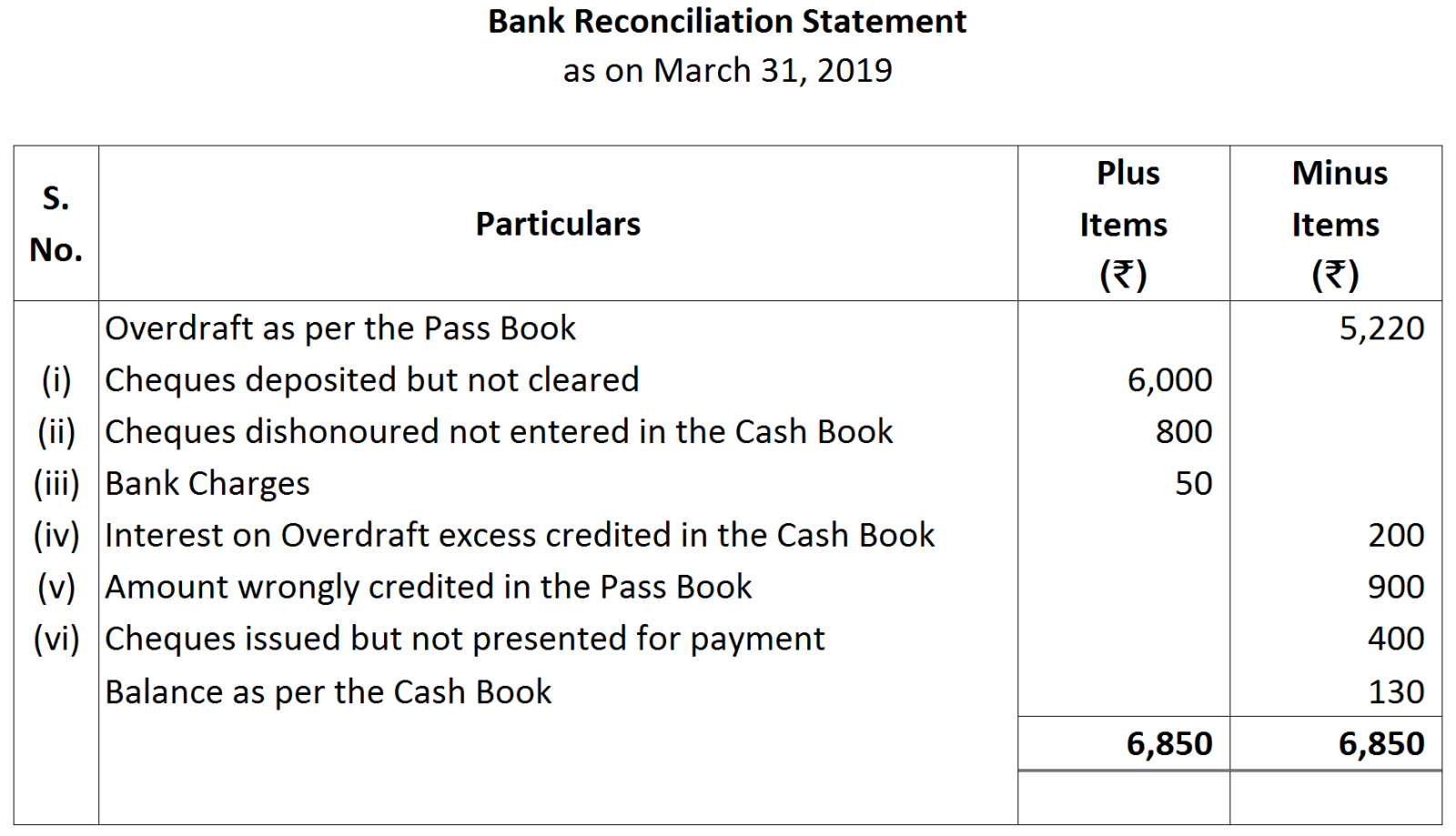
On checking the Bank Pass Book it was found that it showed an overdraft of ₹ 5,220 as on 31st March, 2019, while as per Ledger it was different. The following differences were noted:
  1. Cheques deposited but not yet credited by the bank ₹ 6,000.
  2. Cheques dishonoured and debited by the bank but not given effect to it in the Ledger ₹ 800.
  3. Bank charges debited by the bank but Debit Memo not received from the bank ₹ 50.
  4. Interest on overdraft excess credited in the Ledger ₹ 200.
  5. Wrongly credited by the bank to account, deposit of some other party ₹ 900.
  6. Cheques issued but not presented for payment ₹ 400.
Answer

\
View full question & answer
Question 376 Marks
From the following particulars, prepare a Bank Reconciliation Statement of Alpha Electronic Motor. Private Ltd. as on 30th September, 2014:
  1. Overdraft on 30th September 2014 as per Pass Book ₹ 10,000.
  2. Cheque deposited in the bank but not recorded in Cash Book ₹ 100.
  3. Cheque received and recorded in the Cash Book but not sent to bank for collection ₹ 1,000.
  4. Several cheques were drawn in the last week of September, totalling ₹ 15,000; of these cheques totalling only ₹ 9,000 were cashed before 30th September.
  5. Similarly, several cheques, totaling ₹ 9,000 were sent for collection; of these cheques of the value of ₹ 1,500 were credited on 5th October and ₹ 2,000 on 7th October, balance being credited before 30th September.
  6. Fees of ₹ 250 was paid directly by the bank but was not recorded in the Cash Book.
  7. In the Cash Book, a bank charge of ₹ 30 was recorded twice while another bank charge of ₹ 50 was not recorded at all.
  8. Interest of ₹ 1,400 was charged by the bank but was not recorded in the Cash Book.
View full question & answer
Question 386 Marks
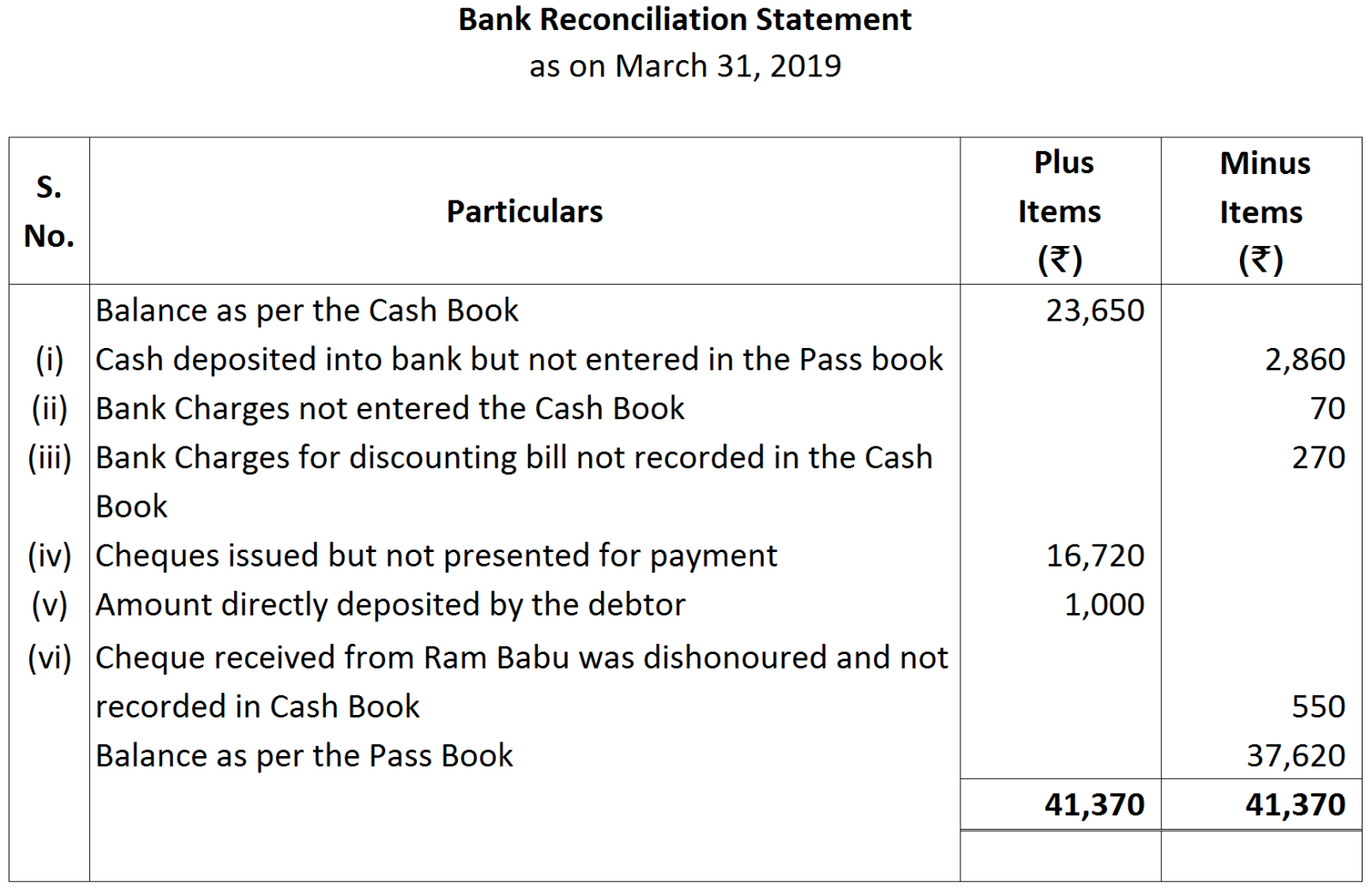
On examining the Bank Statement of Green Ltd., it is found that the balance shown on 31st March, 2019, differs from the bank balance of ₹ 23,650 shown by the Cash Book on that date. From a detailed comparison of the entries it is found that:
  1. ₹ 2,860 is entered in the Cash Book as paid into the bank on 31st March, 2019 but not credited by the bank until the following day.
  2. Bank charges of ₹ 70 on 31st March, 2019 are not entered in the Cash Book.
  3. A bill for ₹ 5,500 discounted with the bank is entered in the Cash Book without recording the discount charges of ₹ 270.
  4. Cheques totalling ₹ 16,720 were issued by the company and duly recorded in the Cash Book before 31st March, 2019 but had not been presented at the Bank for payment until after that date.
  5. On 25th March, 2019, a debtor paid ₹ 1,000 into the Company's Bank in settlement of his account but no entry was made in the Cash Book of the company in respect of this.
  6. No entry has been made in the Cash Book to record the dishonour on 15th March, 2019, of a cheque for ₹ 550 received from Ram Babu. Prepare a Bank Reconciliation Statement as on 31st March, 2019.
Answer
Solution is as follow:
View full question & answer
Question 396 Marks
From the following particulars make out the Bank Reconciliation Statement as on 31st December 2016.
  1. Pass book showed a credit balance of ₹ 15,000 on 31st December 2016.
  2. Cheques of ₹ 17,500 were issued but cheques of ₹ 12,000 only presented for payment till 31st December.
  3. Cheques of ₹ 10,000 were sent to the bank for Collection. Out of which cheques of ₹ 2,000 were credited in the month of January 2017.
  4. Bank paid ₹ 300 as per standing instructions but no record made in the cash book.
  5. Bank charged interest on overdraft ₹ 800 and it was entered twice in pass book by bank.
  6. ₹ 40 as bank charges not recorded in the cash book.
  7. Bank receives ₹ 200 as interest on debentures, but no information being sent to the customer.
View full question & answer
Question 406 Marks
What is a Bank Reconciliation Statement? Explain any four points regarding need and importance of preparing a Bank Reconciliation Statement.
Answer
Bank Reconciliation Statement is a statement prepared by the account holder on a particular date to reconcile the bank balance as per Cash Book with the balance as per Bank Statement or Bank Pass Book showing entries because of which differences between the two balances exist.
By Patil- "Bank reconciliation statement is a statement prepared mainly to reconcile the difference between the Bank Balance shown by the Cash Book and Bank Pass Book.''
Need and Importance of Bank Reconciliation Statement
It is essential to prepare a bank reconciliation statement due to the following reasons:
  1. A bank reconciliation statement locates the errors or omissions that may have been committed either on the part of the customer or the bank. The errors so detected can be rectified accordingly.
  2. By preparing a bank reconciliation statement, the customer becomes sure of the correctness of the bank balance shown by the cash book. It helps him in making further transactions with the bank. For example, suppose the cash book shows a bank balance of ₹ 20,000, whereas the balance shown by the pass book is ₹ 15,000. By reconciling the two, it is disclosed that cheques for ₹ 5,000 were deposited into the bank but have not been collected so far (or some of these have been dishonoured). In such a case, further cheques will be issued by assuming the bank balance of ₹ 15,000 only.
  3. A reconciliation statement facilitates the preparation of a revised cash book. For example, the entries relating to bank charges, interest allowed or charged by the bank, direct payment by the bank on our behalf etc. will be recorded in the pass book but for which there is no entry in the cash book. Such entries will now be recorded in the cash book as well.
  4. Periodic preparation of this statement reduces the chances of embezzlement by the staff of the firm or even that of the bank. For example, if a cashier merely makes an entry in the cash book but does not deposit the cash and cheques into the bank, it will be disclosed by preparing a bank reconciliation statement.
  5. A reconciliation statement helps in revealing the unnecessary delay in the collection of cheques by the bank.
  6. It also helps in keeping a track of cheques which have been sent to the bank for collection.
View full question & answer
Question 416 Marks
From the following particulars, prepare Bank Reconciliation Statement as on 31st December, 2008:Debit balance as per Cash Book ₹ 10,000.
  1. A cheque for ₹ 500 issued in favour of Karan has not been presented for payment.
  2. A bill for ₹ 700 retired by bank under a rebate of ₹ 20, the full amount of the bill was credited in the Cash Book.
  3. A cheque for ₹ 295 deposited in the bank has been dishonoured.
  4. A sum of ₹ 800 deposited in the bank has been credited as ₹ 80 in the Pass Book.
  5. Payments side of the Cash Book has been undercast by ₹ 200.
  6. A bill receivable for ₹ 1,000 (discounted with the bank in November 2008) dishonoured on 31st December, 2008.
View full question & answer
Question 426 Marks
On Checking Ram's Cash Book with the bank statement of his overdraft current account for the month of November 2014, you find the following:
  1. Cash Book showed an overdraft of ₹ 16,200.
  2. The payment side of the Cash Book had been undercast by ₹ 500.
  3. A cheque for ₹ 13,600 drawn on his saving deposit account has been wrongly recorded as drawn on current account in the Cash Book.
  4. Cheques amounting to ₹ 18,800 drawn and entered in the Cash Book had not been presented.
  5. Cheques amounting to ₹ 7,500 sent to the bank for collection though entered in the Cash Book, had not been credited by the bank.
  6. Bank charge of ₹ 150 as per bank statement of account had not been taken in the Cash Book.
  7. Dividend of the amount of ₹ 420 had been paid direct to the bank and not entered in the Cash Book.
You are requested to arrive at the balance as it would appear in the bank statement as on 30th November 2014.
View full question & answer
Question 436 Marks
On comparing the cash book with passbook of Naman it is found that on March 31, 2014, bank balance of ₹ 40,960 showed by the cash book differs from the bank balance with regard to the following:
  1. Bank charges ₹ 100 on March 31, 2017, are not entered in the cash book.
  2. On March 21, 2017, a debtor paid ₹ 2,000 into the company’s bank in settlement of his account, but no entry was made in the cash book of the company in respect of this.
  3. Cheques totaling ₹ 12,980 were issued by the company and duly recorded in the cash book before March 31, 2017, but had not been presented at the bank for payment until after that date.
  4. A bill for ₹ 6,900 discounted with the bank is entered in the cash book without recording the discount charge of ₹ 800.
  5. ₹ 3,520 is entered in the cash book as paid into bank on March 31st, 2017, but not credited by the bank until the following day.
  6. No entry has been made in the cash book to record the dishon or on March 15, 2017 of a cheque for ₹ 650 received from Bhanu. Prepare a reconciliation statement as on March 31, 2017.
View full question & answer
Question 446 Marks
Prepare a Bank Reconciliation Statement as on 31st Dec., 2012 from the following transactions:
  1. Bank overdraft as per Pass Book ₹ 22,000 as on 31st Dec.
  2. On 28th Dec., cheques had been issued for ₹ 50,000 of which cheques worth ₹ 6,000 only had been encashed upto 31st Dec.
  3. Cheques amounted to ₹ 4,500 had been paid into the bank for collection but out of these only ₹ 1,000 had been credited in the Pass Book.
  4. The bank has charged ₹ 1,500 as interest on overdraft and the intimation of which has not been received as yet.
  5. Bank has collected ₹ 1,600 directly in respect of interest on investment.
  6. A cheque of ₹ 1,200 has been debited in bank column of Cash Book, but it was not sent to bank at all.
View full question & answer
Question 456 Marks
On 31st March, 2019, Bank Pass Book of Naresh & Co. showed an overdraft of ₹ 10,700. From the following particulars, prepare Bank Reconciliation Statement:
  1. Cheques issued before 31st March, 2019 but presented for payment after that date amounted to ₹ 900.
  2. Cheques paid into the bank but not collected and credited until 31st March, 2019 amounted to ₹ 2,200.
  3. Interest on overdraft amounting to ₹ 1,200 did not appear in the Cash Book.
  4. ₹ 5,000 being interest on investments collected by the bank and credited in the Pass Book were not shown in the Cash Book.
  5. Bank charges of ₹ 50 were not entered in the Cash Book.
  6. ₹ 800 in respect of dishonoured cheque were entered in the Pass Book but not in the Cash Book.
View full question & answer
Question 466 Marks
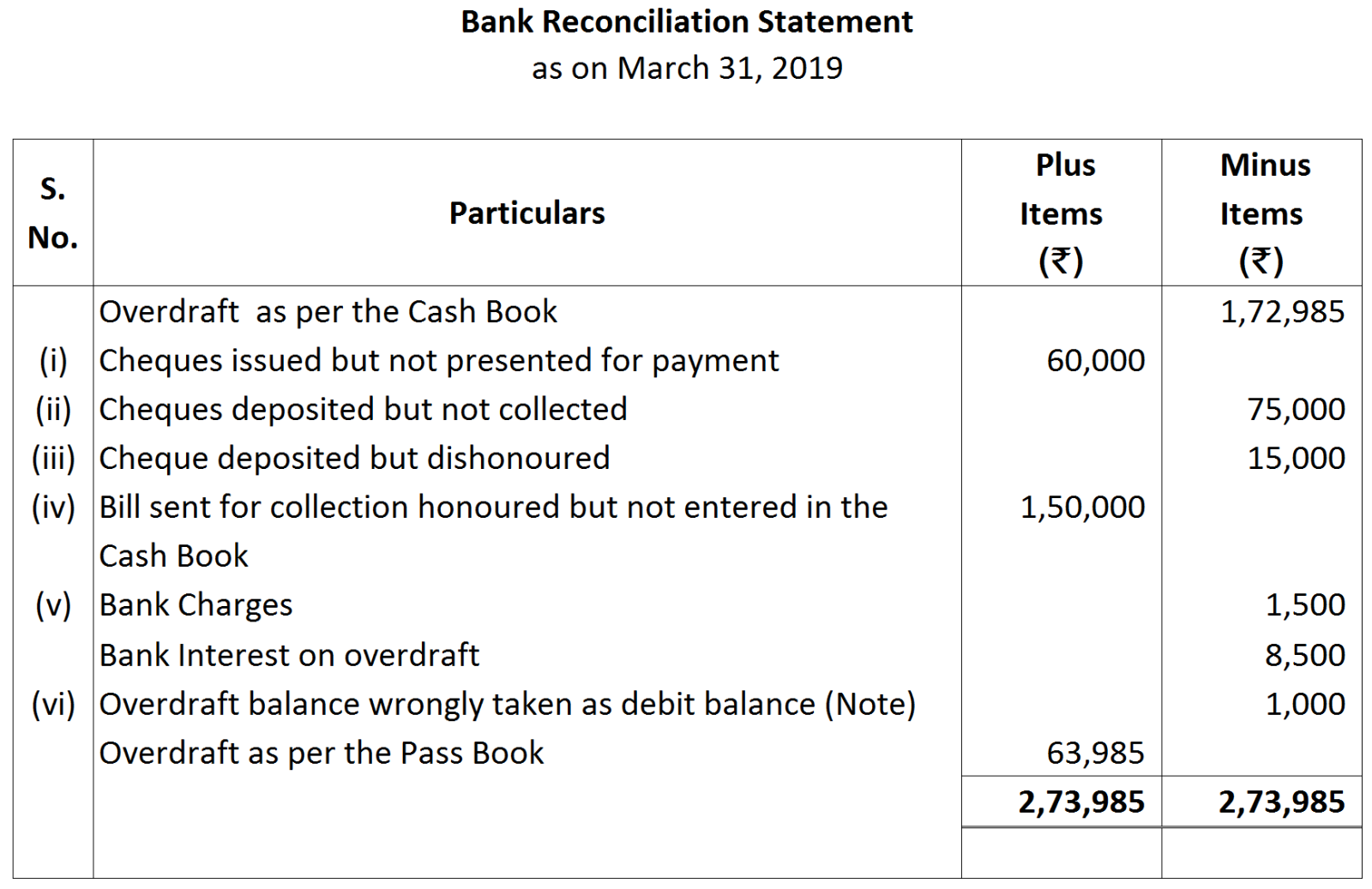
On 31st March, 2019, Cash Book of a merchant showed bank overdraft of ₹ 1,72,985. On comparing the Cash Book with Bank Statement, following discrepancies were noted:
  1. Cheques issued for ₹ 60,000 were not presented in the bank till 7th April, 2019.
  2. Cheques amounting to ₹ 75,000 were deposited in the bank but were not collected.
  3. A Cheque of ₹ 15,000 received from Mahesh Chand and deposited in the bank was dishonoured but the non-payment advice was not received from the bank till 1st April, 2019.
  4. ₹ 1,50,000 being the proceeds of a bill receivable collected appeared in the Pass Book but not in the Cash Book.
  5. Bank charges ₹ 1,500 and interest on overdraft ₹ 8,500 appeared in the Pass Book but not in the Cash Book.
  6. Overdraft balance as per Cash Book of ₹ 500 on 28th February, 2019 was wrongly carried forward as debit balance. The error was noted at the time of preparing the Bank Reconciliation Statement as on 31st March, 2019.
Prepare Bank Reconciliation Statement.
Answer

Note: Overdraft balance has credit balance but taken as debit balance, so to correct the error credit cash book by double amount.
Therefore, 1,000 should be shown in the minus side.
View full question & answer
Question 476 Marks
On 30th June 2014, the bank balance as per Sanjay Yadav's Cash Book was ₹ 1,500. On comparing with the Pass Book the following information was received:-
  1. Cheques amounting to ₹ 7,290 were issued on 28th June, of which one cheque of ₹ 1,300 was presented in the bank for payment on 4th July.
  2. Cheques deposited into bank for ₹ 10,000, but of these cheques for ₹ 4,000 were cleared and credited in July.
  3. Interest and Dividend on investments ₹ 580 collected by bank and credited to his account but he did not have any information for this.
  4. Life Insurance Premium ₹ 750 paid by bank according to his standing orders.
  5. Bank Charges ₹ 25 not recorded in the Cash Book.
Prepare a Bank Reconciliation Statement.
View full question & answer
Question 486 Marks
On 30th June, 2016, the pass book of Nataraj showed a bank overdraft of ₹ 46,000. The following additional information is available. You are required to prepare a bank reconciliation statement as on the above mentioned date:
  1. Out of total cheques issued, cheques for ₹ 22,000 have not been presented for payment so far.
  2. Cheques paid into bank for collection, but not yet cleared total ₹ 31,000.
  3. Bank has charged ₹ 2,300 as interest on overdraft; it does not appear in cash book.
  4. A customer has directly deposited ₹ 8,300 with bank in Nataraj's account for which there is no entry in cash book.
  5. Dividend on shares collected by bank and credited in the pass book amounts to ₹ 2,000 for which no intimation has been given to Nataraj so far.
  6. A bill for ₹ 10,000 discounted with the bank was dishonoured on maturity. Bank has debited Nataraj with ₹ 10,100 including ₹ 100 for noting charges, the transaction has not yet been recorded in cash book.
View full question & answer
Question 496 Marks
While comparing the cash book of Mayank with the bank pass book on 30th September, 2016 you find the following:
  1. The bank pass book showed a debit balance of ₹ 15,000.
  2. Bank paid insurance premium ₹ 2,000, but it was recorded as ₹ 200 only in cash book.
  3. Cheques issued in favour of suppliers in September, 2016 amounted to ₹ 55,000, but cheques for ₹ 50,000 only were presented for payment upto 30th September, 2016.
  4. Direct deposit of ₹ 10,000 in Mayank's bank account by a customer on 25th September, 2016 had not been recorded in the cash book.
  5. Dividend collected by bank, but not recorded in cash book ₹ 1,000.
  6. Bank charged ₹ 300 for its services, but they were yet to be recorded in cash book.
  7. Cheques amounting to ₹ 78,000 were deposited with bank in the last week of September, 2016 but cheques for ₹ 51,000 only had been cleared before 1st October, 2016.
Prepare the bank reconciliation statement ascertaining bank balance/overdraft as per cash book.
View full question & answer
Question 506 Marks
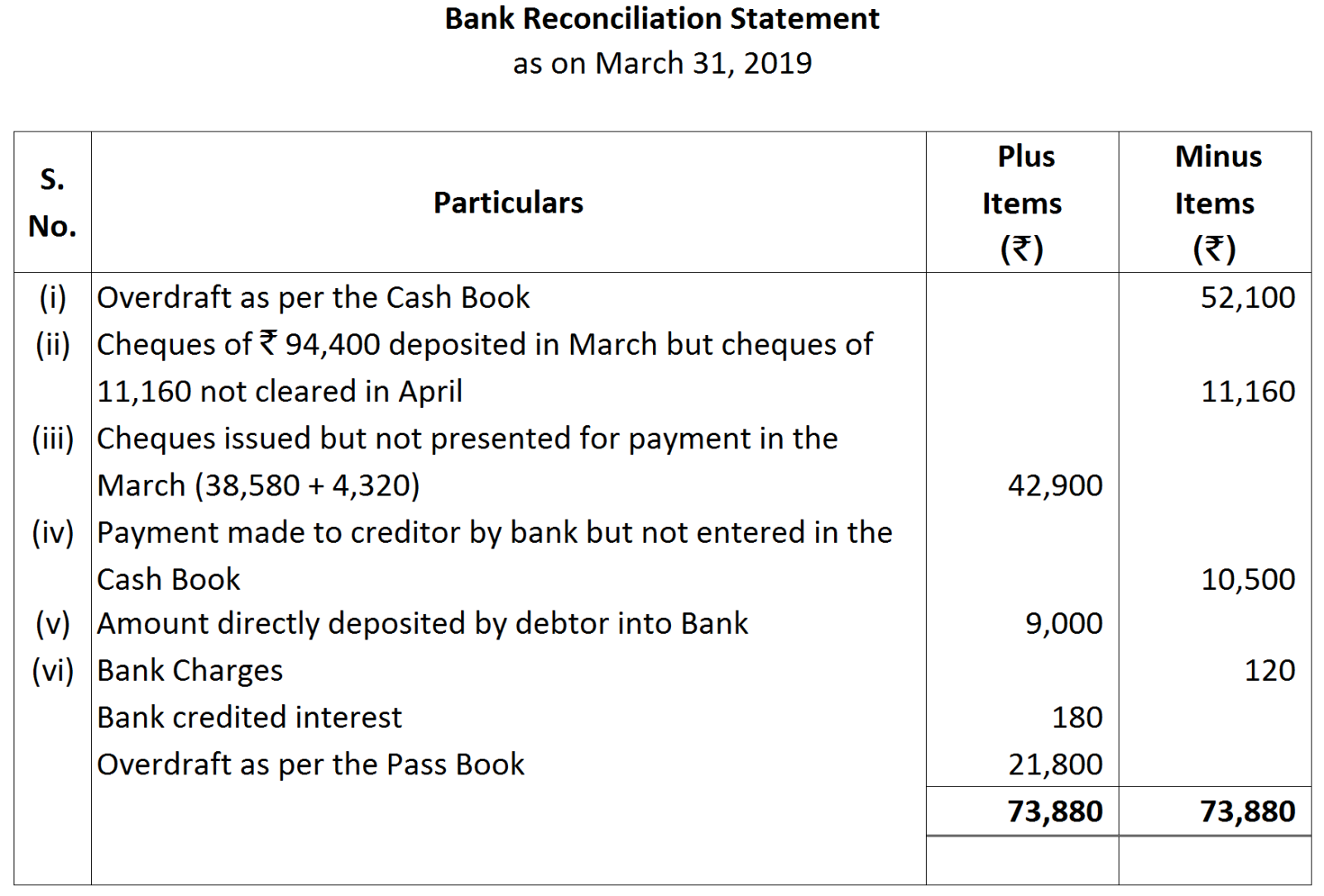
From the following particulars of a trader, prepare a Bank Reconcilation Statement as on 31st March, 2019.
  1. Bank overdraft as per Cash Book ₹ 52,100.
  2. During the month, the total amount of cheques for ₹ 94,400 were deposited into the bank but of these, one cheque for ₹ 11,160 has been entered into the Pass Book on 5th April.
  3. During the month, cheques for ₹ 89,580 were drawn in favour of creditors. Of them, one creditor for ₹ 38,580 encashed his cheque on 7th April whereas another for ₹ 4,320 have not yet been encashed.
  4. As per instructions the bank on 28th March paid out ₹ 10,500 to a creditor but by mistake, the same has not been entered in the Cash Book.
  5. According to agreement, on 25th March, a debtor deposited directly into the bank ₹ 9,000 but the same has not been recorded in the Cash Book.
  6. In the month of March, the bank without any intimation, debited his account for ₹ 120 as bank charges and credited the same for ₹ 180 as interest.
  7. Cash deposit of ₹ 5,780 in bank was recorded as ₹ 7,580. The error was rectified by the Bank before 31st March, 2019.
Answer
Note: Point (vii) will have no affect on the statement as error in recording cash deposit entry is already rectified.
View full question & answer
6 Marks Question - Account STD 11 Commerce Questions - Vidyadip