Questions

4 Marks Question

🎯

Test yourself on this topic

48 questions · timed · auto-graded

Question 14 Marks
Name the books of original entry where the following transactions will be recorded with reasons thereof:
a Goods Purchased from Ram Lal ₹ 5,000 on credit.
b Provision for doubtful debts created @ 5% on debtors with book value of ₹ 10,000.
c Defective goods sold to Babita on credit worth ₹ 4,000 were returned by her.
d Purchased furniture on credit from Mr. Ratan Singh for ₹ 15,000 for use in the business.
Answer
Transactions
Books of Original Entry
Reason
Goods purchased from Ram Lal @ ₹ 5,000 on credit.
Purchases Book
Purchases book records only credit purchase of goods.
Provision for doubtful debts created @ 5% on debtors with book value of ₹ 10,000
Journal Proper
Provision for doubtful debts is recorded in journal proper.
Defective goods sold to Babita on credit worth ₹ 4,000 were returned by her.
Sales Return Book
Goods returned by customer which were earlier sold on credit are recorded in Sales Return Book.
Purchased furniture on credit from Mr. Ratan Singh for ₹ 15,000 for use in the business.
Journal Proper
Purchases book records only credit purchase of goods, so Furniture purchased on credit will be recorded in Journal Proper.
View full question & answer
Question 24 Marks
Distinguish between Sales Book and Sales Account. Difference between Sales Book and Sales Account Basis Sales Book.
Answer
Difference between sales Book and sales Account.
  Basis Sales Book Sales Account
1. Part It is part of journal Book. It is part of Ledger.
2. Format Like a ledger account, it does not have debit and credit columns. It has debit and credit columns.
3. Contents Only credit sales of goods are recorded. Credit as well as cash sales of goods are recorded.
4. Amount Total amount of sales book is posted to the sales account periodically. Balance in the account is transferred to the Trading Account.
View full question & answer
Question 34 Marks
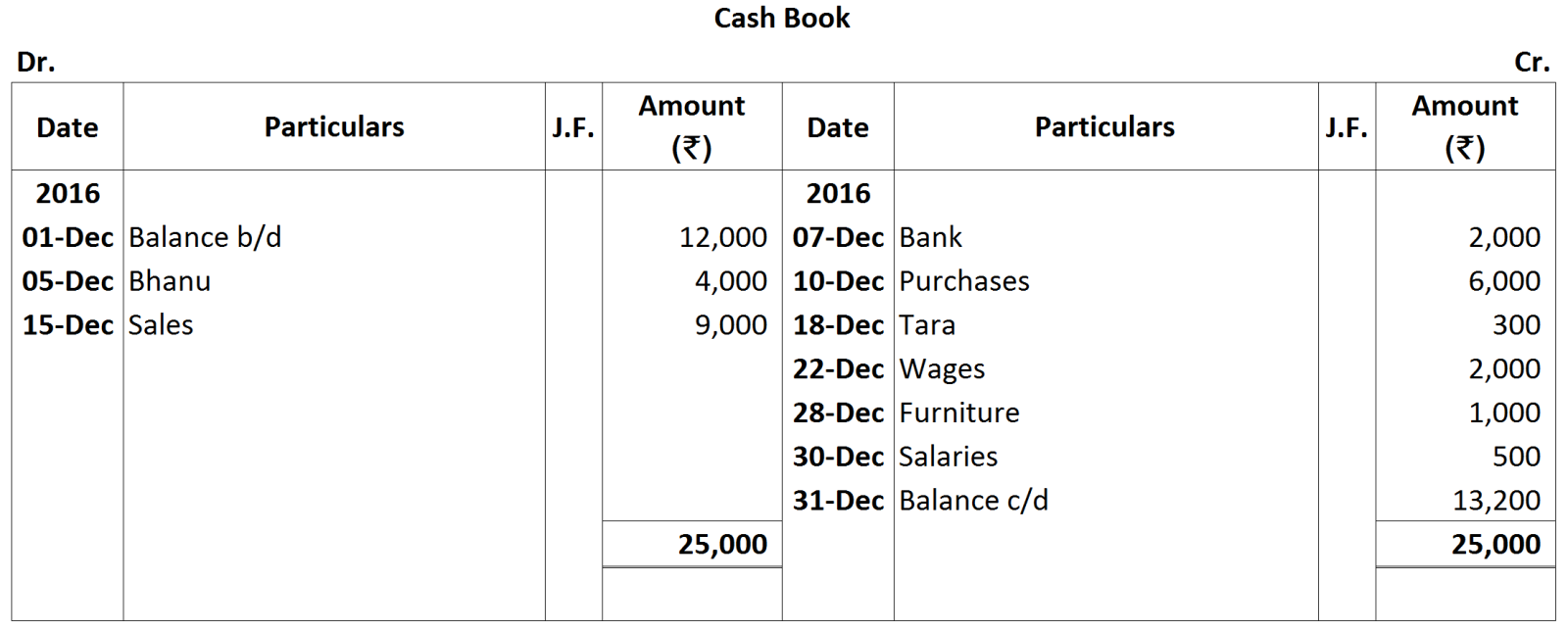
Enter the following transactions in a simple cash book for December 2016:
 
 
01
Cash in hand
12,000
05
Cash received from Bhanu
4,000
07
Rent Paid
2,000
10
Purchased goods Murari for cash
6,000
15
Sold goods for cash
9,000
18
Purchase stationery
300
22
Cash paid to Rahul on account
2,000
28
Paid salary
1,000
30
Paid rent
500
Answer
Solution is as follows.
View full question & answer
Question 44 Marks
Journalise the following transactions:
 
 
(a)
Shyam became insolvent. A first and final compensation of 75 paise in a rupee was received from his official receiver. He owed a debt of
50,000
(b)
Received cash for a bad debt written off last year
25,000
(c)
Rent due to landlord
40,000
(d)
Depreciation on office furniture
5,000
(e)
Salaries due to staff
50,000
(f)
Paid income tax
1,50,000
(g)
Received commission ₹ 25,000, half of which is in advance.
 
View full question & answer
Question 54 Marks
Name the various books of original entries.
Answer
  1. Cash Book: To record receipts and payments of cash, including receipts into and payments from the bank.
  2. Purchases Book: To record credit purchases of goods.
  3. Sales Book: To record the credit sales of goods.
  4. Purchases Return Book: To record the return of goods previously purchased on credit.
  5. Sales Return Book: To record the return of credit sales made by customers.
  6. Journal Proper: To record the transactions which cannot be recorded in any of the above books.
View full question & answer
Question 64 Marks
What is petty cash book? How it is prepared?
Answer
Petty Cash Book is used for recording payment of petty expenses, which are of smaller denominations like postage, stationery, conveyance, refreshment, etc. Person who maintains petty cash book is known as petty cashier and these small expenses are termed as petty expenses.
It is prepared by two methods:
Ordinary system: In this case, a fixed sum of money is paid to petty cashier for the payment of petty expenses and after spending the whole amount, the account is submitted by the petty cashier to the main cashier.
Imprest system: In this case, a fixed sum of the money is given to the petty cashier in the beginning of a period and at the end of the period the amount spent by him is reimbursed, so that he has a fixed amount in the beginning of every new period.
View full question & answer
Question 74 Marks
Record the following transactions during the week ending Dec.30, 2014 with a weekly imprest ₹ 500.
 
2017 January
24
Stationery
100
25
Bus fare
12
25
Cartage
40
26
Taxi fare
80
27
Wages to casual labour
90
29
Postage
80
View full question & answer
Question 84 Marks
Record the following transactions in Double Columns Cash Book and balance the book on 31st March, 2019:
2019
 
March 1
Cash in Hand
12,750
 
Cash at Bank
72,400
March 4
Received from Asha cash ₹ 1,200 and a cheque for ₹ 3,200, allowed discount ₹ 400
 
March 7
Paid salary to staff by cheque
25,600
March 9
Withdrawn cash from bank for office use
21,900
March 12
Interest paid by bank on bank balance
1,200
March 16
Purchased furniture in cash
16,500
March 21
Paid Mohan & Co. by cheque, discount received ₹ 100
10,900
March 24
Proprietor withdrew from office cash for his personal use
11,600
March 29
Sold goods to Manoj for cash
14,800
March 31
Deposited office cash into bank
21,200
View full question & answer
Question 94 Marks
Write the difference between return Inwards and return ouwards.
Answer
Basis of Difference
Return Inwards
Return Inwards
Meaning
Goods sold to the customers, are returned by them.
Goods purchased are returned to the suppliers.
Balance
It has debit balance.
It has credit balance.
Treatment
It is deducted from Sales in the Trading Account.
It is deducted from Purchases in the Trading Account.
Issued
Credit note is prepared by the seller.
Debit note is prepared by the buyer.
Reduction
It reduces the payment from the Debtors.
It reduces the payment made to the Creditors.
Term
It is also termed as Sales Returns.
It is also termed as Purchases Returns.
View full question & answer
Question 104 Marks
Explain the statement 'Cash book is a Journalised Ledger'.
Answer
Cash Book is a Journalised Ledger:
Sometimes a question arises whether Cash book is a journal or ledger? It is a journal since the transactions are recorded in it for the first time from the source documents and from there these are posted to the respective accounts in the ledger. The Cash book is also a ledger in the sense that it serves the purpose of a Cash account also. When a Cash book is prepared, no separate Cash account is opened in the ledger. As such, the Cash book is a journal as well as a ledger and hence it may be called “journalised ledger”.
View full question & answer
Question 114 Marks
From the following information, prepare an Analytical Petty Cash Book:
2019  
April 1 Received for cash payment 20,000
April 2 Paid for postage 1,600
April 5 Paid for stationery 1,000
April 8 Paid for advertisement 2,000
April 12 Paid for wages 800
April 16 Paid for carriage 600
April 20 Paid for conveyance 880
April 25 Paid for travelling expenses 3,200
April 27 Paid for postage 480
April 28 Paid for office cleaning 400
April 29 Paid for courier 800
April 30 Sent registered notice to landlord 190
View full question & answer
Question 124 Marks
Enter the following transactions in sales (journal) book of M/s.Bansal electronics:
2014 September
01 Sold to Amit Traders as per bill no.4321
20 Pocket Radio @ 70 per Radio
2, T.V. set, B&W.(6”) @ 800 Per T.V.
10. Sold to Arun Electronics as per bill no.4351
5 T.V. sets (20”) B&W @ ₹ 3,000 per T.V.
2 T.V. sets (21”) Colour @ ₹ 4,800 per T.V.
22 Sold to Handa Electronics as per bill no.4,399
10 Tape recorders @ ₹ 600 each
5 Walkman @ ₹ 300 each
28 Sold to Harish Trader as per bill no.4430
10 Mixer Juicer Grinder @ ₹ 800 each.
View full question & answer
Question 134 Marks
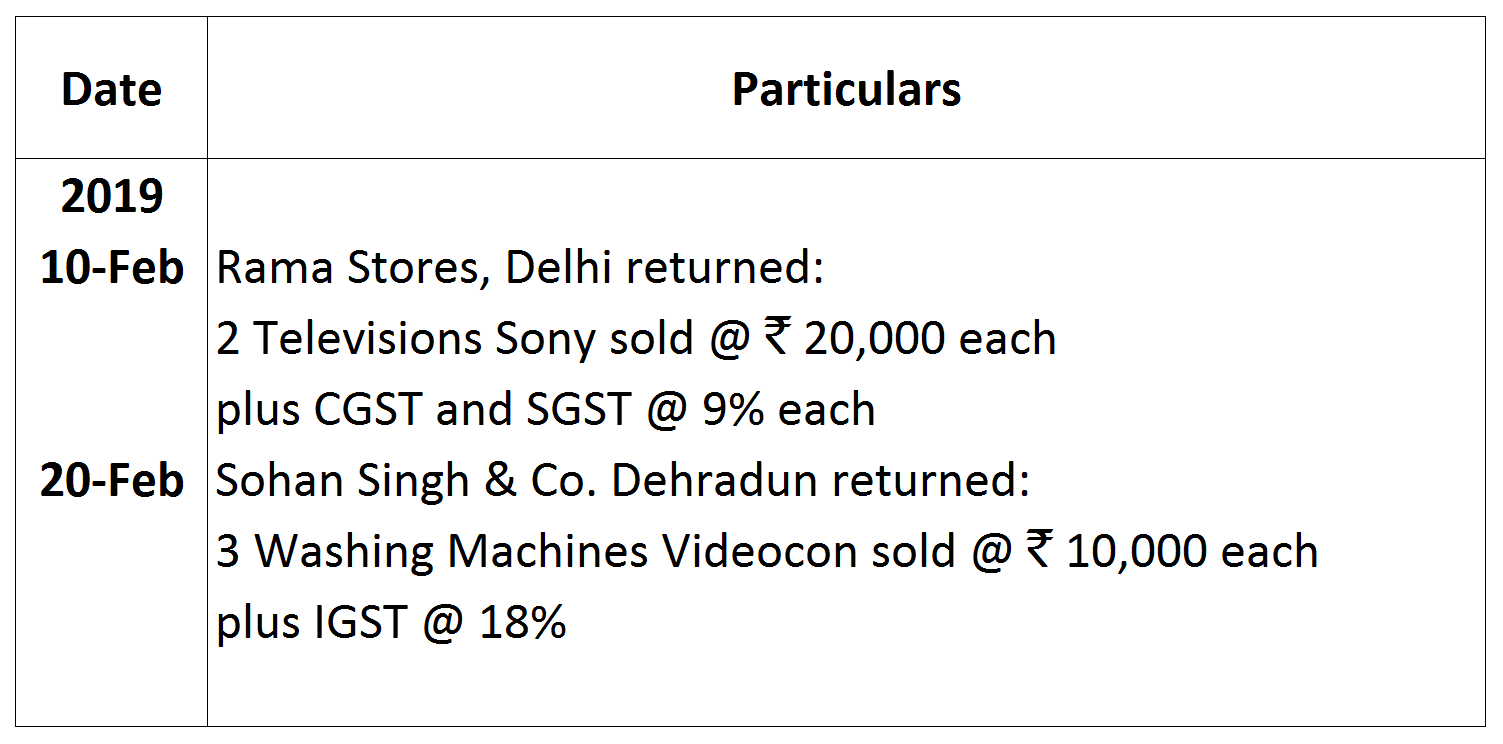
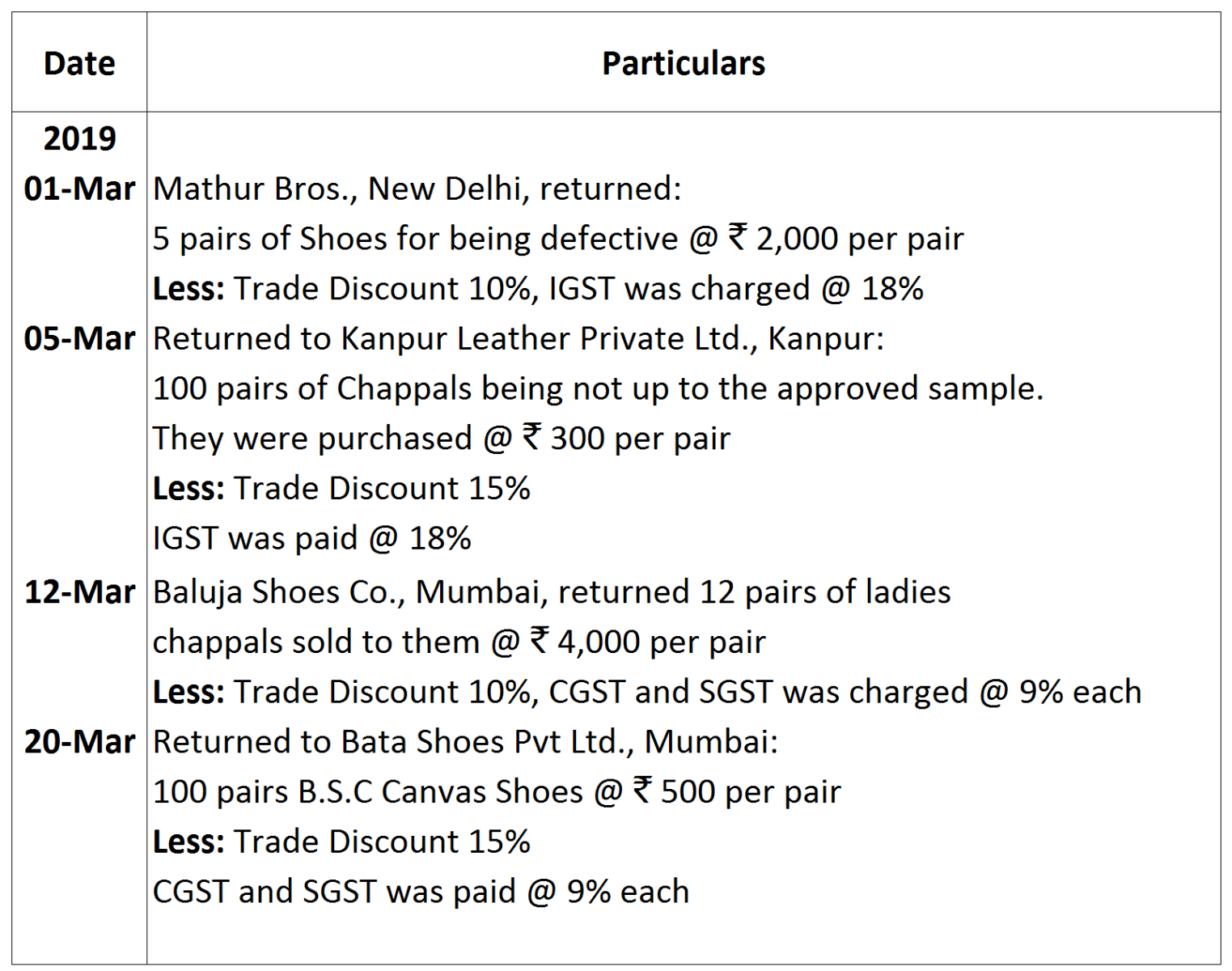
Prepare Sales Return Book of Shiv Shankar, Delhi from the following transactions and post them into Ledger:
View full question & answer
Question 144 Marks
Feb 1, 2017
Purchased from M/s Brown & Co. on credit.
5 gross pencils @ ₹ 100 per gross.
1 gross registers @ ₹ 200 per dozen.
Less: 10% trade discount.
Feb 2, 2017
Purchased for cash from stationery Mart.
10 gross exercise books @ ₹ 60 per dozen.
Feb 6, 2017
Purchased from The Paper Co.
5 reams of white paper @ ₹ 100 per ream
10 reams of brown paper @ ₹ 65 per ream
Less: trade discount @ 10%
View full question & answer
Question 154 Marks
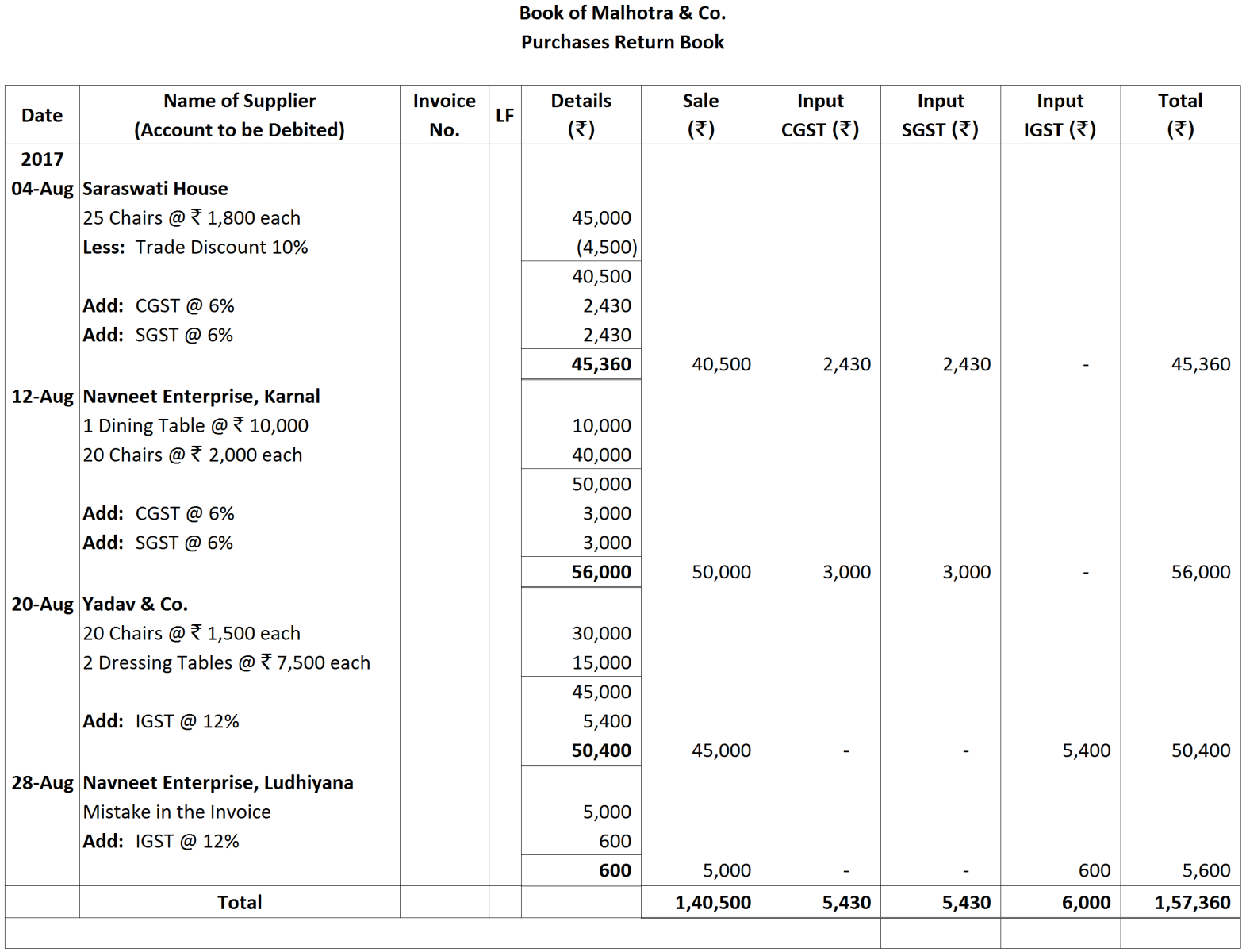
Write up Return Outward Book of Malthotra & Co., Bhiwani (Haryana) from the following transactions assuming CGST @ 6% and SGST @ 6%.
2017
 
August 4
Returned to Saraswati House, Bhiwani 25 Chairs @ ₹ 1,800 per Chair, being not of specified quality.
Trade Discount 10%
August 12
Sent back one Dining Table to Navneet Enterprise, Karnal (Haryana) for not being polished @ ₹ 10,000 and 20 Chairs @ ₹ 2,000 each.
August 20
Returned to Yadav & Co., Patiala (Punjab), being not according to sample
20 Chairs @ ₹ 1,500 each.
2 Dressing Tables @ ₹ 7,500 each.
August 28
Allowance claimed from Navneet Enterprise, Ludhiana (Punjab) on account of mistake in the invoice ₹ 5,000.
Answer
Solution is as follows.
View full question & answer
Question 164 Marks
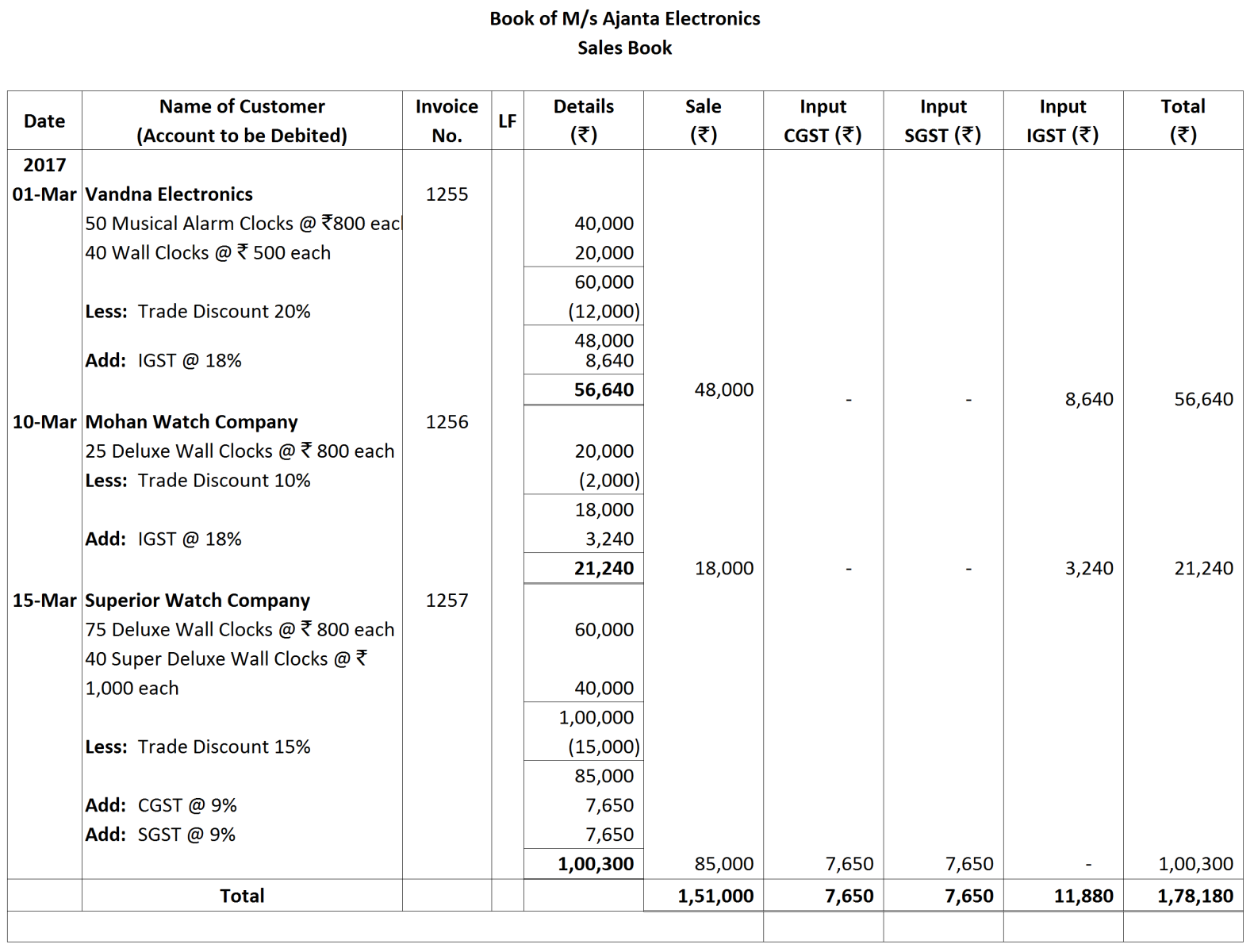
Record the following transactions in the Sales Book of M/s Ajanta Electronics, Ranchi (Jharkhand) assuming CGST @ 9% and SGST @ 9%.
2018
 
March 1
Sold to Vandna Electronics, Kolkata (West Bengal) Vide Invoice No. 1255
50 Musical Alarm Clocks @ ₹ 800 each
40 Wall Clocks @ ₹ 500 each
Trade Discount 20%
March 10
Sold to Mohan Watch Company, Patna (Bihar) Vide Invoice No. 1256
25 Deluxe Wall Clocks @ ₹ 800 each
Trade Discount 10%
March 15
Sold to Superior Watch Company, Ranchi Vide Invoice No. 1257
75 Deluxe Wall Clocks @ ₹ 800 each
40 Super Deluxe Wall Clocks @ ₹ 1,000 each
Trade Discount 15%
March 20
Sold to Modern Electronics, Ranchi Vide Cash Memo No. 5234
100% Musical Alarm Clocks @ ₹ 800 each
Trade Discount 20%
Answer

Note: In Sales Book, we record only the credit sale of goods, so transaction dated March 20 (being sale of electronics for cash) will not be recorded.
View full question & answer
Question 174 Marks
Explain the need for drawing up the special purpose books.
Answer
The needs for drawing up the special purpose book are given below.
  1. Quick and efficient recording: It is a time consuming process to record all the transactions in a journal. If there are separate books, then recording of transactions can be done more efficiently and timely. So, the need of special purpose book arises.
  2. Repetitive nature: In every business, some transactions are similar and repetitive in nature. It will be more convenient to record all similar transactions at one place. For example, all credit sales transactions are recorded in the Sales Book.
  3. Economical: It is more economical as recording through the special purpose books saves time and also enhances the efficiency of accountants and clerks.
  4. Easy posting: If similar transactions are recorded at one place, posting becomes easier.
  5. Complete information at one place: All information related to purchases, sales, cash receipts, payments, etc. are easily and hassle-free available.
View full question & answer
Question 184 Marks
Explain the meaning of Imprest System of Petty Cash Book.
Answer
Cash Under this system, an estimate is made of amount required for petty expenses for a period a week, (say for week, a fortnight or a month). The amount so ascertained is given to the Petty Cashier in the beginning of a period. The amount paid by him during the period. Thus, he will again have the fixed amount in the beginning of the new period reimbursed. This amount is called imprest money. This system of paying advance in the beginning and reimbursing the amount spent from time to time is called imprest system.
View full question & answer
Question 194 Marks
Explain how the following transactions would be recorded in a Cash Book with Cash and Bank Columns?
Deposit of Cash into Bank?
Answer
When cash is deposited into the bank it increases the bank balance and reduces tha cash balance hence it affects the Cash Column as tha Bank column As such tha same amount is recorded on tha debit side as well as on the credit side on tha to Cash A/c is written and the amount is recorded in the bank colimn On thr Cr.side 'By Bank A/c' is written and the amount is recorded in the Cash Column. Debit Bank A/c (As bank is receiving the Cash, i.e., Debit the receiver) Credit Cash A/c (As Cash is going out) For example, if we deposit ₹ 2,000 into the bank it will be recorded in the cash book as follows:
View full question & answer
Question 204 Marks
Enter the following transactions in the Double Column Cash Book of M/s. Gupta Store:
2019
 
June 1
Cash in Hand ₹ 800, Bank overdraft ₹ 5,700
 
June 7
Received a cheque from Bharati, discount allowed ₹ 150
3,250
June 9
Deposited the above cheque into Bank
 
June 15
Cheque received from Panna Lal
1,200
June 20
Bharati's cheque returned dishonoured
 
June 28
Panna Lal's cheque was endorsed to Kamal
 
June 30
Income tax paid by cheque
150
View full question & answer
Question 214 Marks
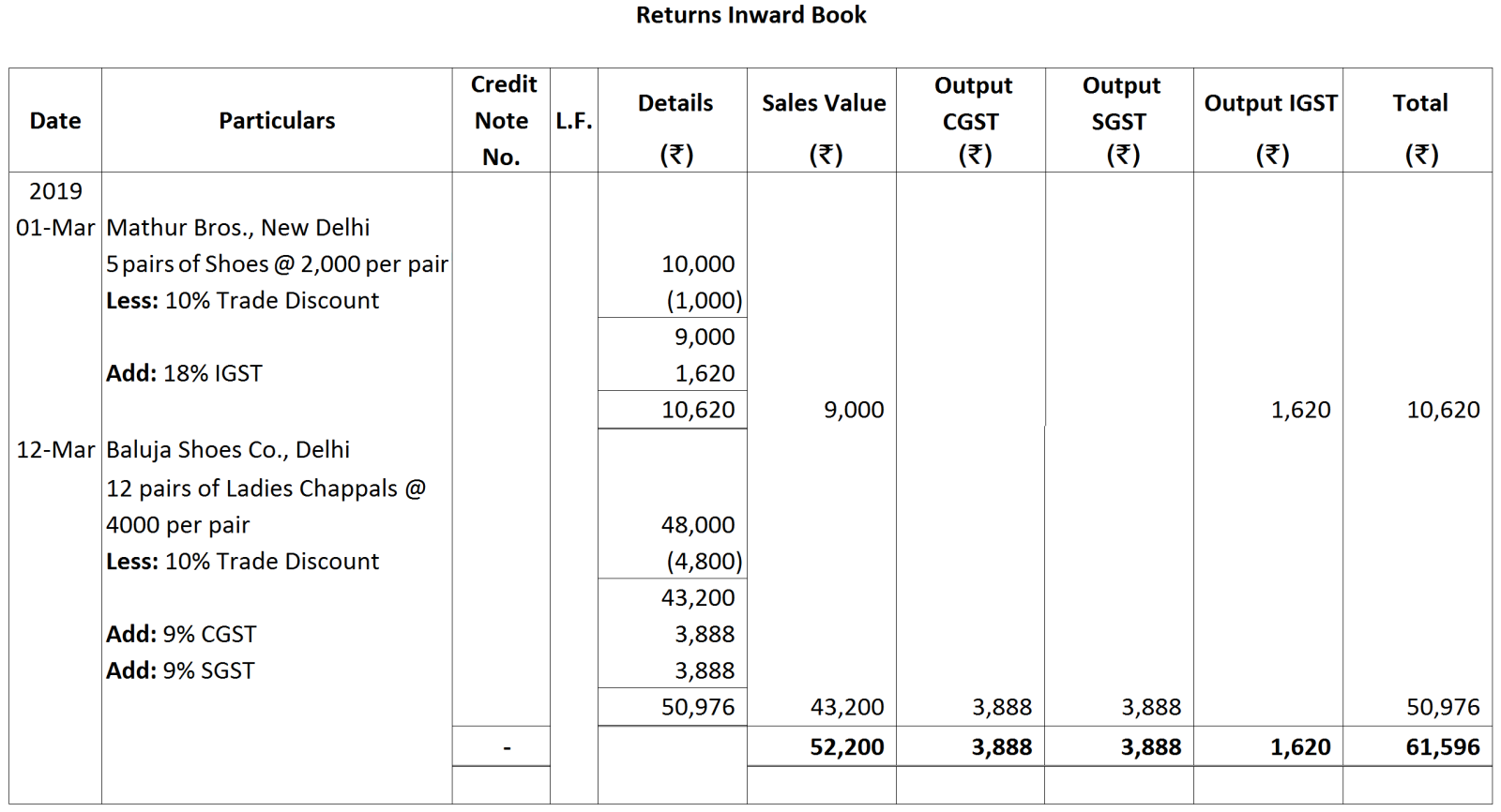
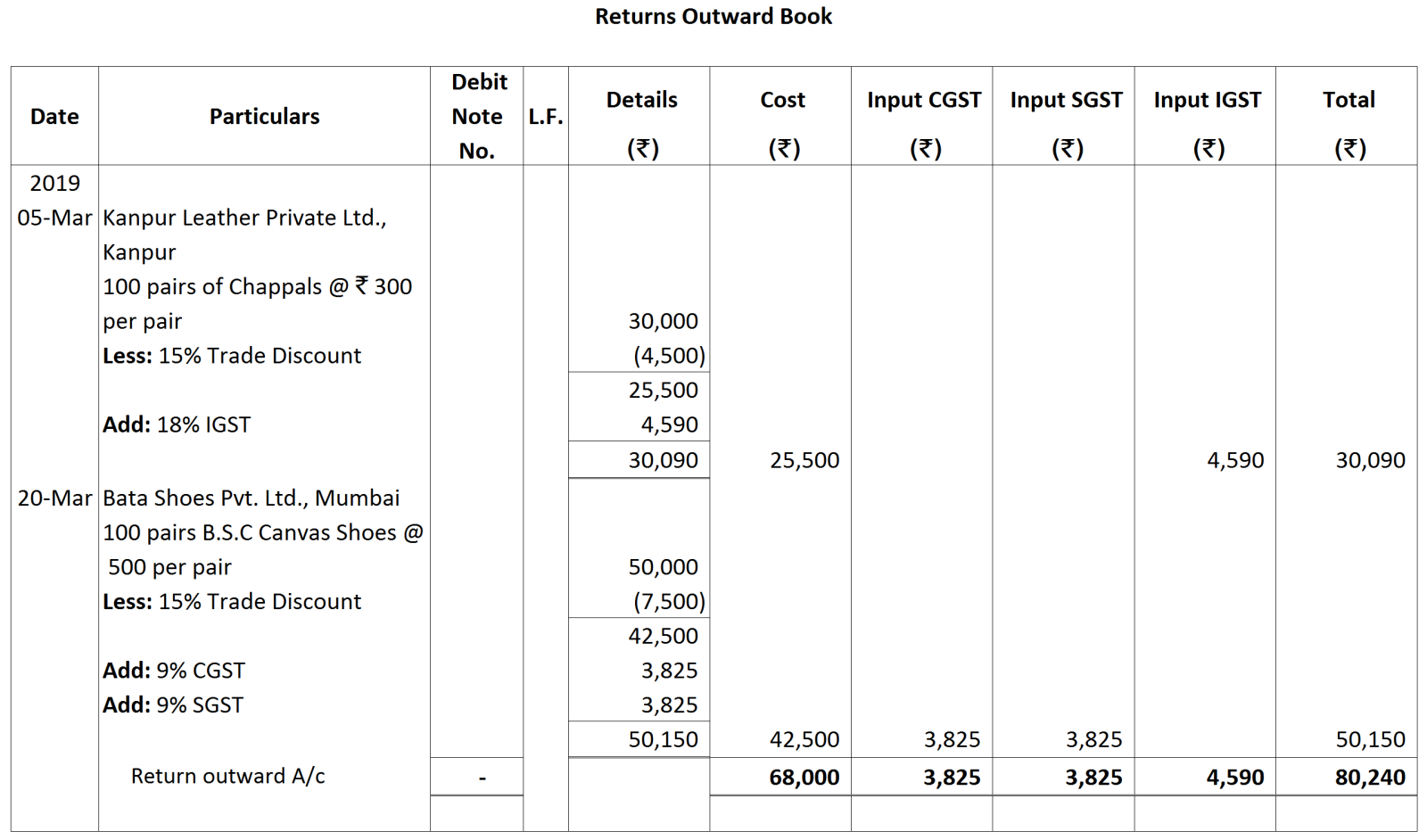
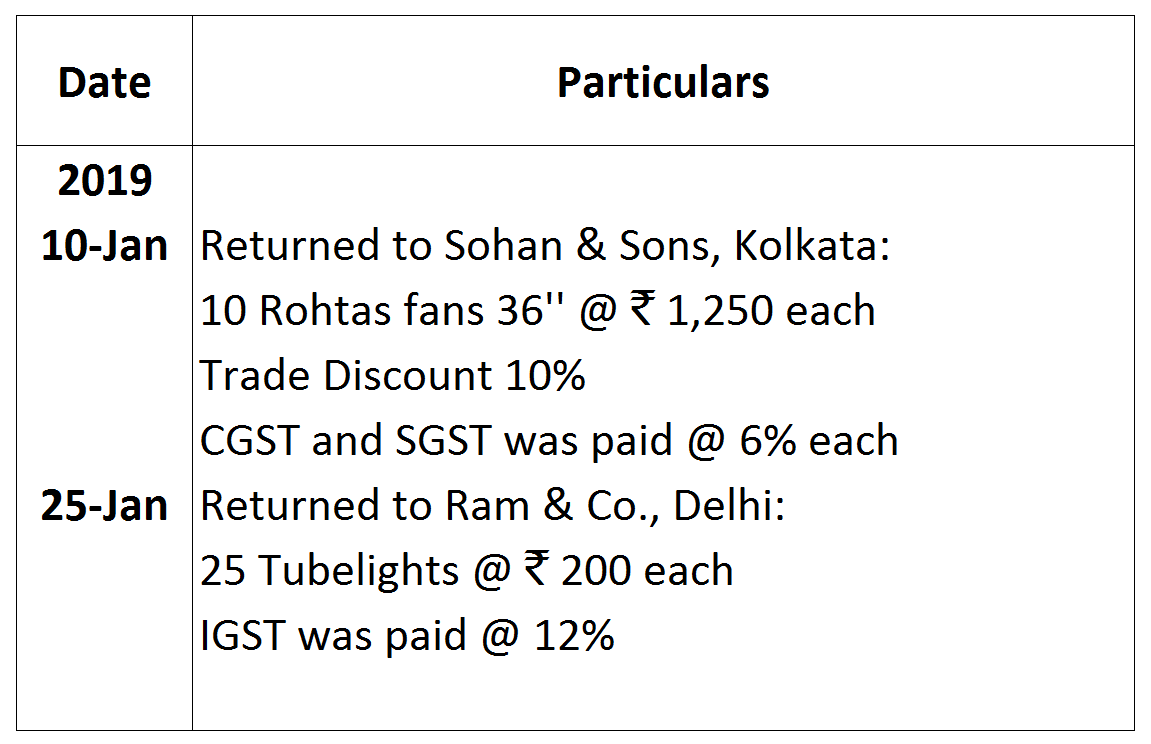
Prepare Returns Inward and Return Outward Books of Manoj, Mumbai from the following transactions and post them into Ledger Accounts:
Answer
Solution is as follows:

View full question & answer
Question 224 Marks
Distinguish between Cash Book and Cash A/c.
Answer
 
Cash A/c
 
Cash Book
1.
It is an account in tha Ledger.
1.
It is a separate book maintained for recording Cash transactions.
2.
Cash account is opened in tha ledger and posting is done in this account from journal.
2.
It is a book of original entry because all cash transactions are first of all recorded in Cash book and then posted from Cash book to various accounts in tha ledger.
3.
When transactions of Cash are recorded in journal, it is necessary to open a Cash A/c in ledger.
3.
When transaction of Cash are recorded in Cash book, there is no necessity to open a Cash A/c in tha ledger.
4.
It only records one aspect of a transaction i.e.,Cash.
4.
It fecords both tha aspects of a teansaction.
View full question & answer
Question 234 Marks
State any two advantages between a bill of exchange and a draft.
Answer
The advantages of Bill of Exchange are:
  1. Facilitates Purchase and Sale of Goods on Credit: It facilitates credit purchase and sale of goods because Bill of Exchange is an unconditional promise to pay.
  2. Serves as a Source of Finance: Bills of Exchange can be discounted with a bank or NBFC so that the enterprise allowing credit can receive the amount immediately without the debtor having to pay before time.
  3. Easy to Recover the Amount: If a Bill of Exchange is dishonoured, it is easier to recover the amount legally than in the case of an ordinary debt.
  4. Endorsement: A Bill of Exchange can be endorsed to other parties; thus it serves almost the same purpose as cash.
View full question & answer
Question 244 Marks
Give the similarities of Cash Book with Ledger.
Answer
Similarities of Cash Book with Ledger.
  1. Form of Cash book closely resembles to a ledger account. It has two equally divided sides having identical columns. The left side (receipts side) is the debit side and the right side (payment side) is the credit side.a
  2. Cash book itself serves as a Cash account also and as such when a Cash book is maintained, Cash account is not opened in the Ledger. The Cash book, hence, is a part of ledger also.
  3. Just like a ledger account, the words ‘To' and 'By' are used in a Cash Book also.
  4. It is balanced just like a ledger account.
View full question & answer
Question 254 Marks
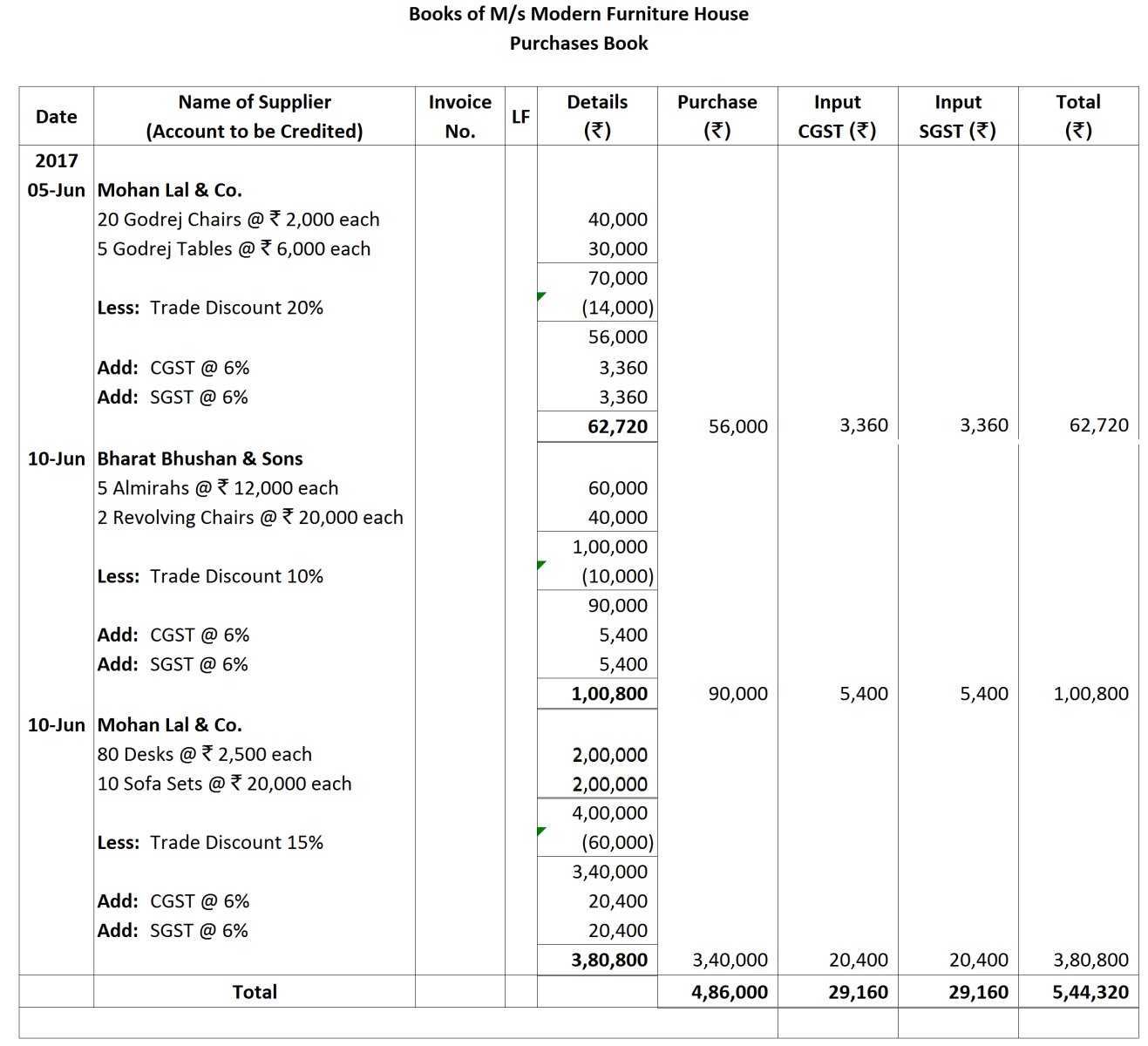
Prepare a Purchase Book in the books of M/s Modern Furniture House, Lucknow (U.P) from the following transactions assuming CGST @ 6% and SGST @ 6%.
2017
 
June 5


Bought from Mohan Lal & Co., Kanpur (U.P)
20 Godrej Chairs @ ₹ 2,000 each
5 Godrej Tables @ ₹ 6,000 each
Trade Discount 20%
June 10


Purchased from Bharat Bhushan & Sons, Varanasi (U.P)
5 Almirahs @ ₹ 12,000 each
2 Revolving Chairs @ ₹ 20,000 each
Trade Discount 10%
June 14


Purchased from Surya Traders, Lucknow (U.P)
80 Desks @ ₹ 2,500 each
10 Sofa Sets @ ₹ 20,000 each
Trade Discount @ 15%
June 20
 
Purchased for cash from Gopi Chand Haldi Ram, Delhi
4 Tables @ ₹ 5,000 each
25 June
 
Bought Furniture for office use from New Furniture House, Faridabad on Credit
5 Chairs @ ₹ 2,500 per Chair.
2 Tables @ ₹ 5,000 per Table.
Answer
Solution is as follows:
View full question & answer
Question 264 Marks
Record the following transaction in simple cash book for November 2016:
 
 
01
Cash in hand
12,500
04
Cash paid to Hari
600
07
Purchased goods
800
12
Cash received from Amit
1,960
16
Sold goods for cash
800
20
Paid to Manish
590
25
Paid cartage
100
31
Paid salary
1,000
View full question & answer
Question 274 Marks
M/s Ram Narain & Sons of Kerala, who are dealers in readymade garments, purchased the following.
2017
 
May 2
Purchased from Fashion House, Mumbai (Maharashtra)
   
100 Shirts @ ₹ 1,800 per Shirt
75 T-shirts @ ₹ 1,600 per piece
Less: Trade Discount 20%; and freight charges payable ₹ 10,000.
May 10
Purchased from Appolo Garments, Kerala
65 Shirts @ ₹ 2,000 per piece
80 T-shirts @ ₹ 1,500 per piece
May 15
Less: 20% Trade Discount and freight charges payable ₹ 2,000.
Purchased from Garden Furniture House, Kolkata
12 Chairs @ ₹ 5,000 per Chair
May 25
Purchased from Amitabh Shirts, New Delhi for cash
120 Shirts @ ₹ 1,500 per Shirt
Prepare Purchase Book assuming CGST @ 9% and SGST @ 9%.
View full question & answer
Question 284 Marks
Prepare Purchases Return Book of Aruna Stores, Kolkata from the following transactions and post them into Ledger:
View full question & answer
Question 294 Marks
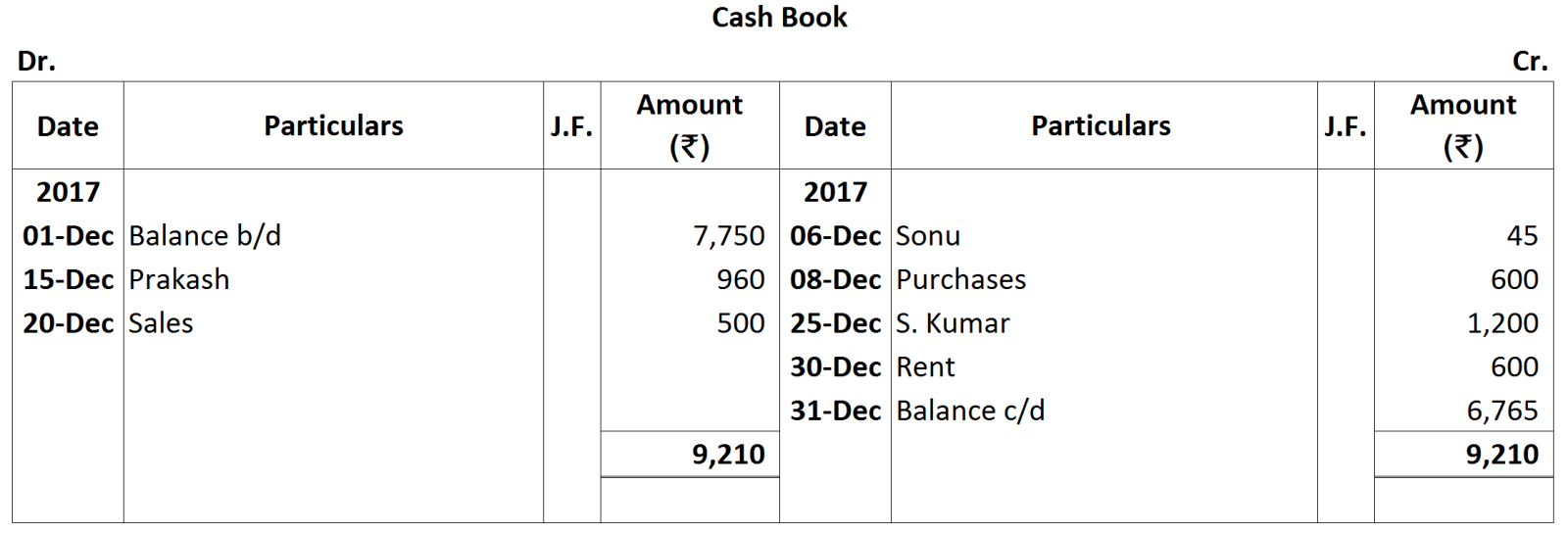
Enter the following transactions in a simple cash book for December 2017:
 
 
01
Cash in hand
7,750
06
Paid to Sonu
45
08
Purchased goods
600
15
Received cash from Parkash
960
20
Cash sales
500
25
Paid to S.Kumar
1,200
30
Paid rent
600
Answer
Solution is as follows.
View full question & answer
Question 304 Marks
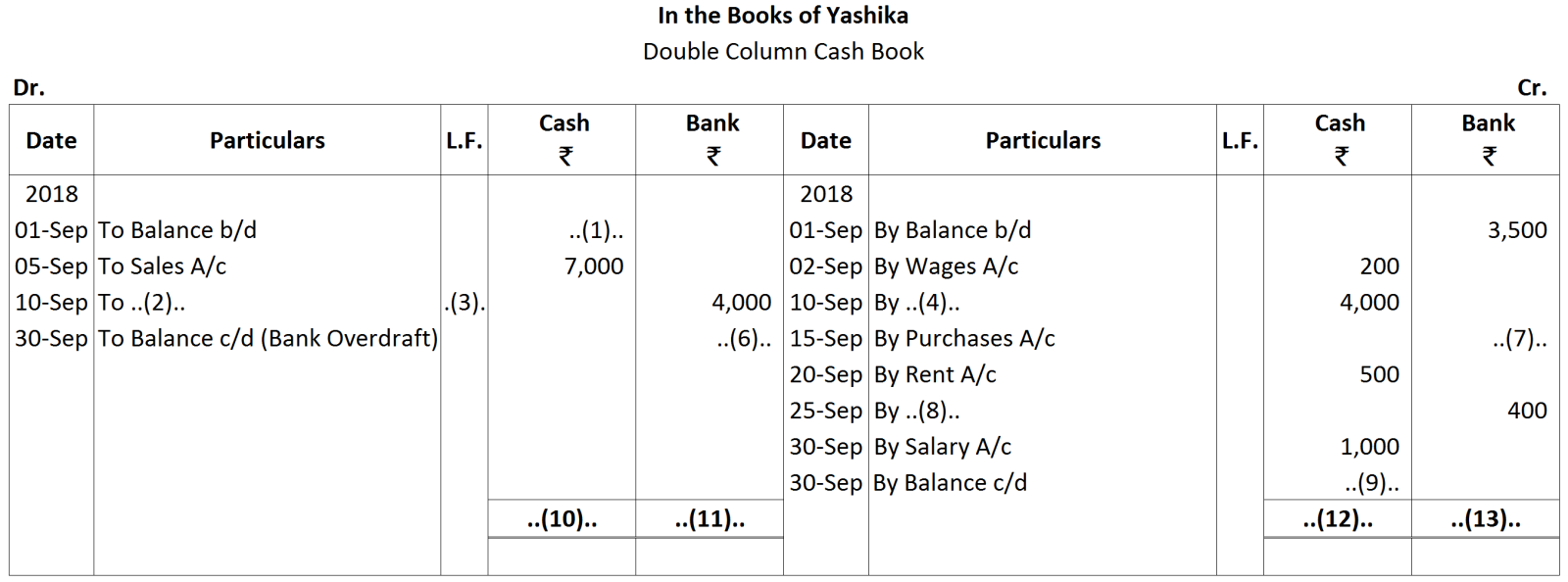
Determine the missing values of the Cash Book with Bank Column of Yashika 01 the basis of following transactions:
2018
 
Sept. 1
Cash in Hand
7,500
 
Bank Overdraft
3,500
Sept. 2
Paid Wages
200
Sept. 5
Cash Sales
7,000
Sept. 10
Cash Deposited into Bank
4,000
Sept. 15
Goods Purchased and Paid by Cheque
2,000
Sept. 20
Paid Rent
500
Sept. 25
Drew from bank for personal use
400
Sept. 30
Salary Paid
1,000
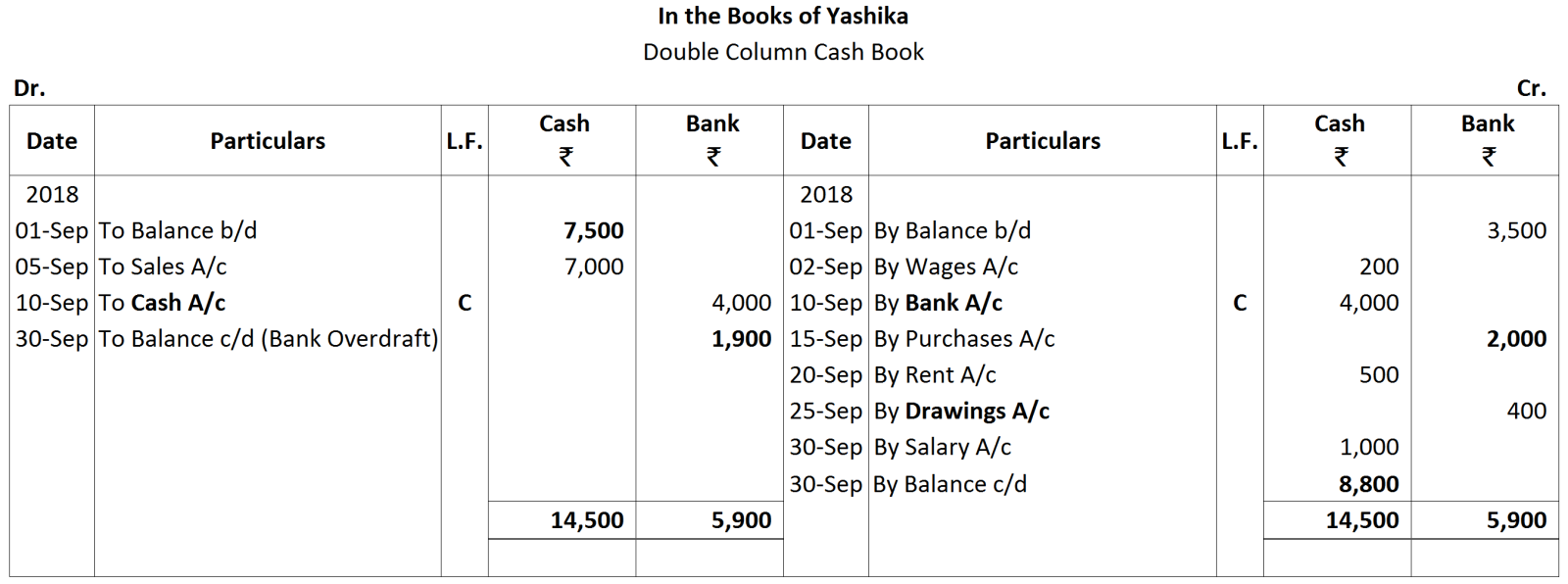
Answer
Solution is as follows.
View full question & answer
Question 314 Marks
Elucidate the following statement:
‘Only cash transactions are recorded in Cash Book'.
Answer
CASH BOOK is used to record all transactions relating to cash receipts and cash payments. The number of cash transactions is quite large in every business and it is quite unpracticable and inconvenient to record all cash transactions in the journal. It is, therefore, necessary to maintain a separate book for cash transactions. This book enables a businessman to know the balance of cash in hand and at bank at any point of time. It also gives information about the daily receipts, payments and the closing cash balance at the end of each day. Hence, this is a very popular book and is maintained by all the organisations - big or small.
View full question & answer
Question 324 Marks
Explain how the following transactions would be recorded in a Cash Book with Cash and Bank Columns?
Dishonour of cheques deposited into Bank.
Answer
If a cheque received from a customer a customer and deposited into Bank for collection is dishonoured an entry will be made on the credit side of the Cash by entering by entering the amount of the dishonoured cheque in the bank column in particulars column the name of the customer will be entered For example a cheque for 2,000 received from ram kumar is dishoured it will be recorded on the credit side as "By ram kumar" and amount will be entered in bank column.
View full question & answer
Question 334 Marks
Record the following transactions in a bank column cash book for December 2016:
 
 
01
Started business with cash
80,000
04
Deposited in bank
50,000
10
Received cash from Rahul
1,000
15
Bought goods for cash
8,000
22
Bought goods by cheque
10,000
25
Paid to Shyam by cash
20,000
30
Drew from Bank for office use
2,000
31
Rent paid by cheque
1,000
View full question & answer
Question 344 Marks
Pass Journal entry for purchase of goods by Amrit, Delhi from Add Gel Pens, Delhi for ₹ 15,000 less Trade Discount 10% and Cash Discount 3%. CGST and SGST is levied @ 6% each. Assume payment is made at the time of purchase.
View full question & answer
Question 354 Marks
State three advantages of Sub-Division of Journal.
Answer
Advantages of Sub-Division of Journal:
  1. Division of Work: Since in place of one Journal, Subsidiary Books are maintained, accounting work can be divided among a number of persons.
  2. Specialisation and Efficiency: When the same work is handled by a particular person for a considerable time, he acquires knowledge and expertise in it. He becomes more efficient in handling it. Thus, accounting is done more efficiently.
  3. Saving of Time: Various accounting processes can be undertaken simultaneously because of the use of number of books. Thus, it leads to completing the work timely.
  4. Availability of Information: Since a separate book is maintained for each class of transactions, information relating to each class is available at one place.
View full question & answer
Question 364 Marks
How does a Cash Book serve 'Dual Purpose?
Answer
It is both a subsidiary book (book of original entry) and a principal book. When a cash book is maintained, transactions of cash are not recorded in the journal. As all the cash transactions are recorded for the first time in the cash book, it is therefore a book of original entry. But when a cash book is prepared, cash account in the ledger is not prepared. In this way, cash book represents the cash account and hence, becomes the principal book of accounts. As such, the cash book is a subsidiary book as well as principal book.
View full question & answer
Question 374 Marks
What is a Contra Entry? How is it recorded? Give two examples of a Contra Entry.
Answer
Contra Entry: Contra entries are the entries which affect both cash and bank, i.e., balance of one will decrease and the other will increase due to such transactiors. Such transactions are recorded on both sides of the Cash Book. Let us take an example to understand it better.
  1. Cash deposited into the Bank ₹ 20,000: In this transaction, Bank Account is to be debited and Cash Account is to be credited. Debit aspect is recorded on the debit side of the Bank Column and credit aspect is recorded on the credit side of Cash Column.
  2. Cash withdrawn from Bank for Office Use 10,000: In this transacts: 09, Cash Account is to be debited and Bank Account is credited. Debit aspect is recorded on the debit side of the Double Column Cash Book in the Cash Column and credit aspect is recorded on the credit side of the Double Column Cash Book in the Bank Column.
View full question & answer
Question 384 Marks
The following transactions took place during the week ended 28th May, 2019. How will you record them in the Petty Cash Book which was maintained with a weekly 'float' of ₹ 3,000?
2019  
May 23 Postage 400
May 24 Casual labour 500
May 24 Taxi hire 600
May 26 Note pads and registers 800
May 27 Cartage 200
May 28 ​Bus fare​ 300
View full question & answer
Question 394 Marks
What is Sub-division of Journal?
Answer
When the size of the business grows and the number of transactions become very large, it is no longer possible to record all transactions in one Journal only. As such, the Journal is sub-divided into a number of Special Journal These special journals are also known as Sub-division of Journal.
Subsidiary books or the books of original entry Each subsidiary book is meant for recording all the transactions of a similar nature. For example, all cash transactions may be recorded in one book, all credit purchase transactions in another book and all credit sales transactions in yet another book, and so on. Thus, the subsidiary books may be defined as books where the transactions are entered first and then ledger accounts are prepared on their basis. Following subsidiary books are most commonly.
View full question & answer
Question 404 Marks
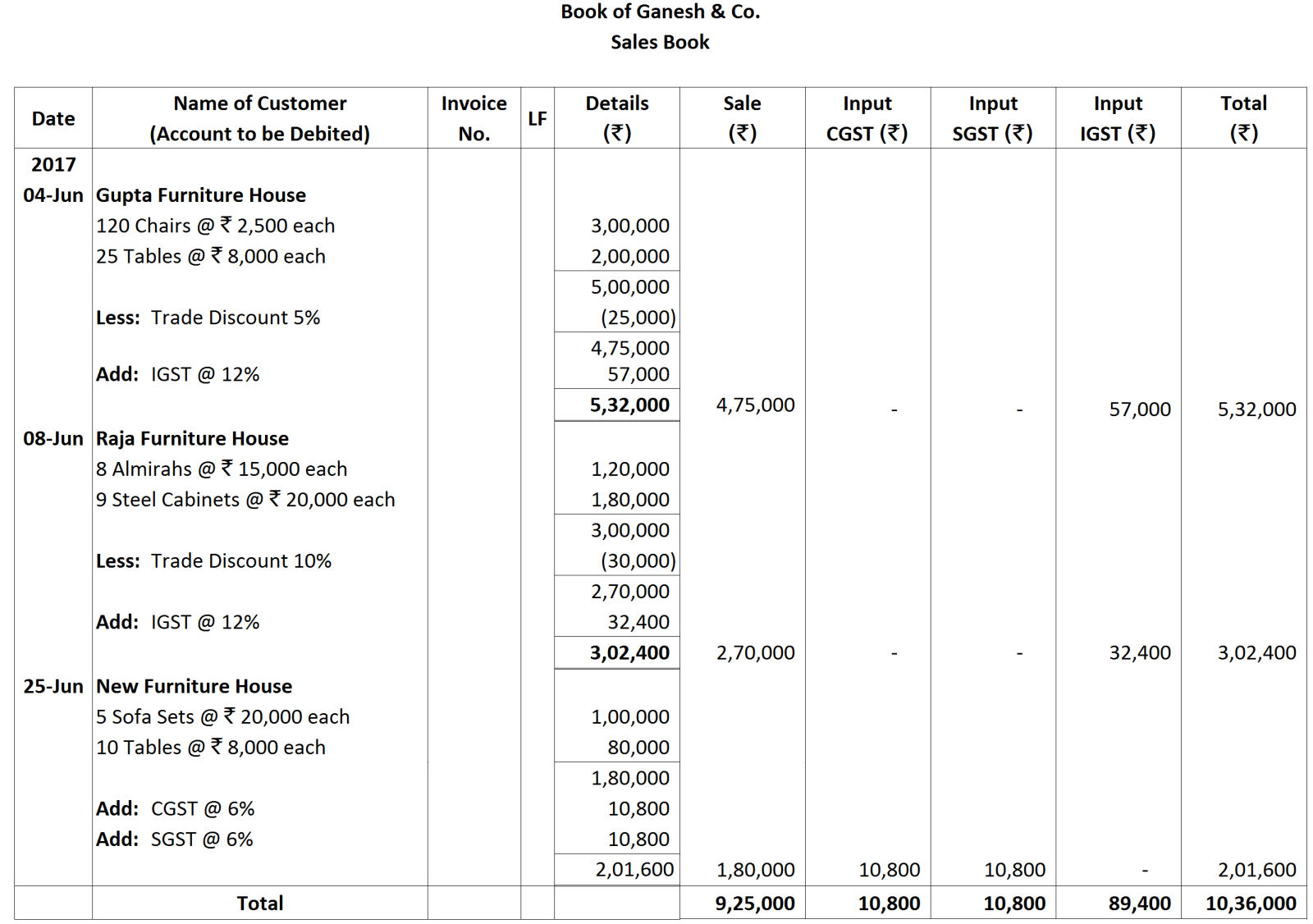
Record the following transactions in the Sales Book of Ganesh & Co. of Jaipur (Rajasthan), who deal in Furniture. Assume CGST @ 6% and SGST @ 6%.
2017
 
June 4
Sold to Gupta Furniture House, Agra (U.P.)
120 Chairs @ ₹ 2,500 per Chair
25 Tables @ ₹ 8,000 per Table
Less: 5%
June 8
Sold to Raja Furniture House, Ahmedabad (Gujarat)
8 Almirahs @ ₹ 15,000 each
9 Steel Cabinets @ ₹ 20,000 each
Less: Trade discount of 10%
June 12
Sold old Computer for ₹ 1,500 to Mohan & Co. on Credit.
June 20
Sold 4 Sofa sets @ ₹ 25,000 each to Varun & Co. for cash
June 25
Sold to New Furniture House, Jaipur
5 Sofa sets @ ₹ 20,000 each
10 Tables @ ₹ 8,000 each
June 28
Purchased from Ram Lal & Co. Jaipur on credit
50 chairs @ ₹ 2,000 each
Answer

Note: In Sales Book, we record only the credit sale of goods, so transaction dated June 12 (being Computer sold on credit) and June 20 (being Sofa Sets sold for cash) will not be recorded.
View full question & answer
Question 414 Marks
Explain the method of posting a Petty Cash Book.
Answer
Entries in the Petty Cash Book are posted into the ledger accounts at the end of the specified period, i.e., month or quarter as the case is. Petty Cash Book is considered as a memorandum book. The petty expenses are not directly posted to ledger accounts. A Petty Cash Account is maintained in the ledger. When Petty Cash is advanced to the petty cashier, the Chief Cashier records it on the credit side of Cash Book as “By Petty Cash A/c". At the end of specified period (say a week, a fortnight or a month), for the total expenses paid a Journal entry is passed by debiting individual petty expenses and crediting to Petty Cash Account. All the accounts reating to petty expenses are maintained in the ledger individually. Posting is made on the debit side of these accounts by writing "To Petty Cash A/c” in the Particulars Column.
View full question & answer
Question 424 Marks
Name the books of original entry where the following transactions will be recorded with reasons thereof:
  1. Goods purchased from Ram Lal for ₹ 5,000 on credit.
  2. Provision for doubtful debts created @ 5% on debtors with books value of ₹ 10,000.
  3. Defective goods sold to Babita on credit worth ₹ 4,000 were returned by her.
  4. Purchased furniture on credit from Mr. Ratan Singh for ₹ 15,000 for use in the business.
Answer
  1. Purchases Book, because it is credit purchase of goods for sale.
  2. Journal Proper, because it will not be recorded in any other subsidiary books.
  3. Sales Return Book, because it is return of goods sold.
  4. Journal Proper, because it will not be recorded in other subsidiary books.
View full question & answer
Question 434 Marks
Define the purpose of maintaining subsidiary journal.
Answer
The process of accounting starts from identification of financial and non-financial events. Financial events are first recorded in a Journal. A small business has lesser number of transactions and thereby it may be possible to record these transactions through Journal entry. However, on the contrary, as the business grows, there will be voluminous number of transactions and the firm may experience difficulty, thereby it becomes tedious to record through Journal entry. Thus, in order to save time and effort, it is recommended to sub-divide Journal. Sub-division of Journal provides scope for division of work. This leads to the improvement of efficiency and effectiveness and infuses higher degree of accountability to the accountants for the specific subsidiary Journal assigned to them. The purposes of maintaining subsidiary Journal are given below.
  1. It saves time and efforts in recording.
  2. It enables division of work, leading to an enhancement of efficiency and effectiveness, as particular accountant takes care of particular books.
  3. It also makes each accountant more responsible and accountable for the books assigned to them.
  4. It records routine and repetitive transactions at one place, which leads to easy accessibility of information and hassle-free communication.
View full question & answer
Question 444 Marks
State the rules of debiting and crediting of accounts.
Answer
S.No. Based on Traditional Classification of Account S.No. Based on Modern Classification of Accounts
  Type of Account Debit Credit   Types of Accounts Debit Credit
1. Personal A/c The Receiver The Giver 1. Asset A/c Increase Decrease
2. Real A/c What comes in What goes out 2. Liabilities A/c Decrease Increase
3. Nominal A/c All Expenses and Losses All Income and Gains 3. Capital A/c Decrease Increase
        4. Revenue A/c Decrease Increase
        5. Expense A/c Increase Decrease
View full question & answer
Question 454 Marks
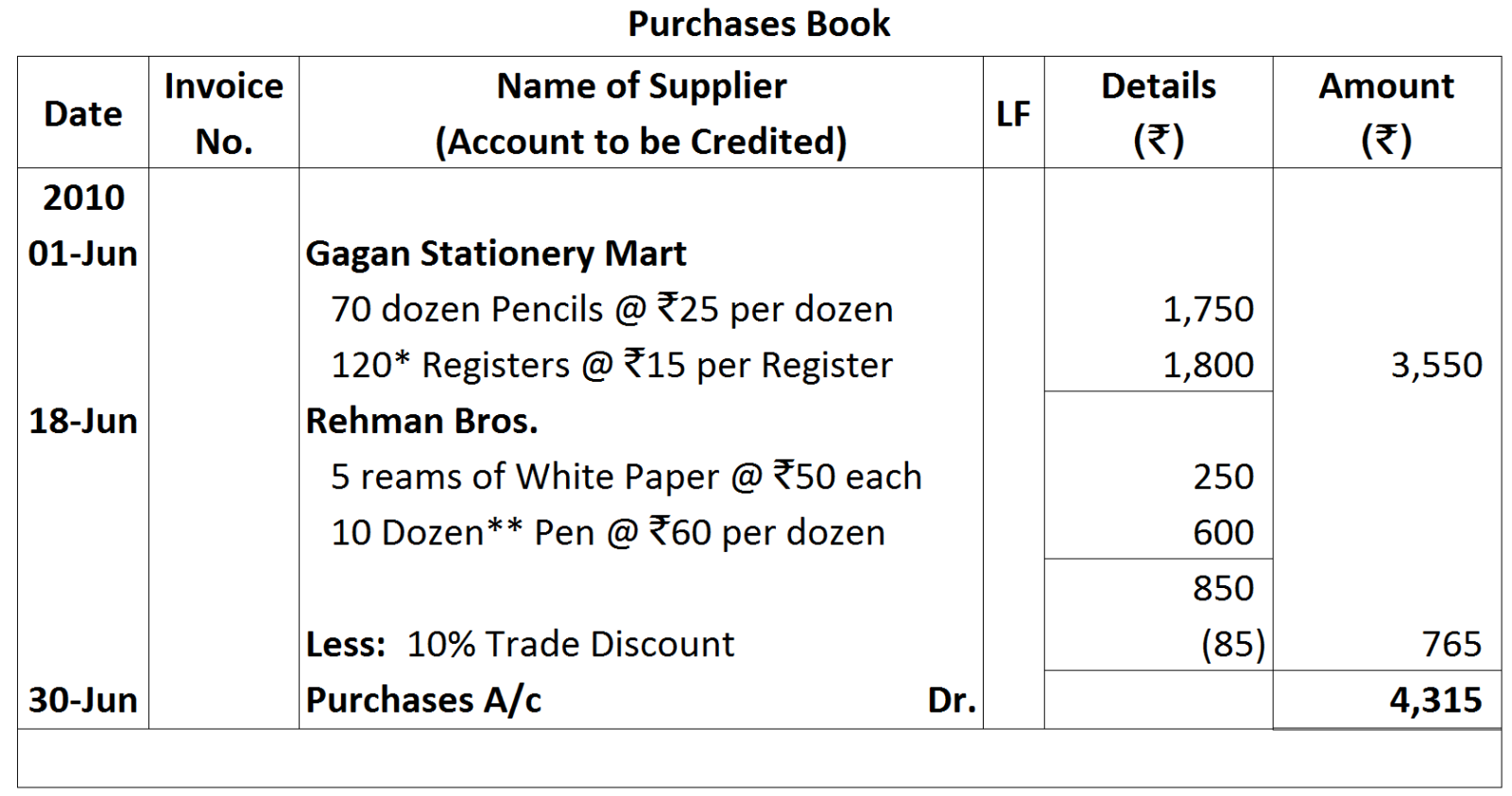
Prepare the purchase book of M/s Shiv Stationers from the following:
2010
 
June 1


Purchased from Gagan Stationery Mart on credit
70 dozens pencils @ ₹ 25 per dozen.
10 dozens registers @ ₹ 15 per register.
June 10
 
 
Purchased from Amrit Furniture.
2 Tables @ ₹ 1,500 per table.
June 15
Purchased 3 dozens ink pots @ ₹ 80 per dozen from Mehar Paper Co. And received cash discount of ₹ 50.
June 18


Purchased from Rehman Bros. on credit.
5 reams of white paper @ ₹ 50 per ream
120 pens @ ₹ 60 per dozen
Less: trade discount of 10%.
Answer

Note: Purchases book records only the credit purchase of goods, so transaction dated June 10 (being purchase of furniture) and June 15 (being purchase of goods for cash) will not be recorded.
Working Note:
1 Dozen contains a quantity of 12
So, 10 dozen will contain - 10 × 12 = 120 Registers
1 Dozen contains a quantity of 12
So, 120 Pens will be $=\frac{120}{12}=10$ Dozen
View full question & answer
Question 464 Marks
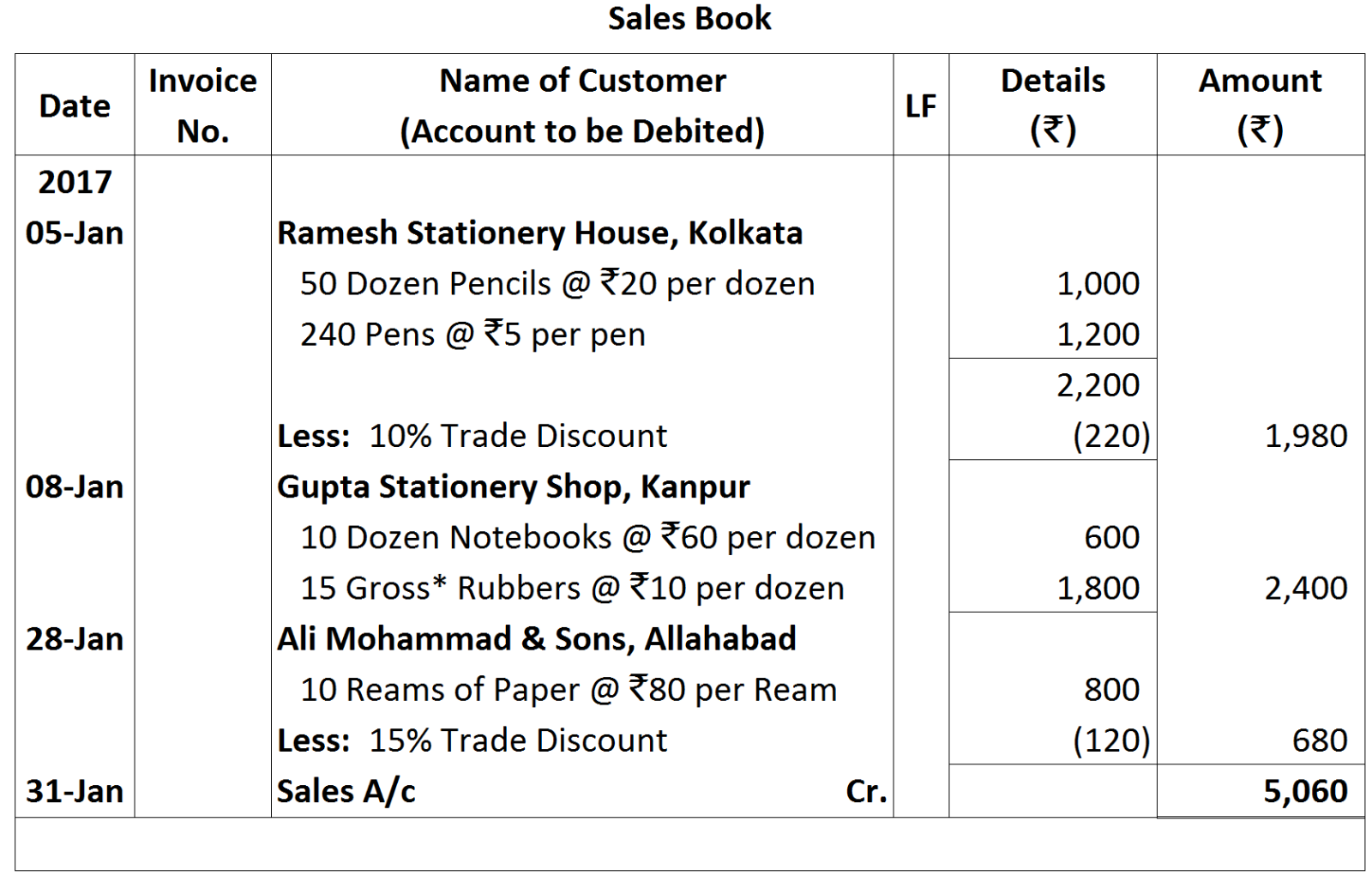
2017
 
Jan 5
Sold to Ramesh Stationery House, Kolkata
50 Dozen Pencils @ ₹ 20 per doz.
20 Dozen Pens @ ₹ 5 per Pen
Trade Discount 10%
Jan 8
Sold to Gupta Stationery Shop, Kanpur
10 Dozen Note Books @ ₹ 60 per doz
15 Gross Rubbers @ ₹ 10 per doz.
Jan 20
Sold old newspapers for ₹ 150
Jan 24
Sold to Modern Stationery House, Lucknow for Cash
25 Dozen Pencils @ ₹ 22 per doz.
Jan 28
Sold to Ali Mohammad & Sons, Allahabad
10 Reams of Paper @ ₹ 80 per Ream
Discount 15%
Jan 31
Sold old furniture to Kedar Nath & Co., Allahabad on credit ₹ 2,200
Answer

Note: Sales book records only the credit sale of goods, so transaction dated Jan 20 (being sale of newspapers), Jan. 24 (being cash sales) and June 31 (being credit sale of fixed asset) will not be recorded.
1 Gross = 12 Dozen.
15 Gross = 12 × 15 = 180 Dozen.
View full question & answer
Question 474 Marks
What do you understand by Imprest amount in petty cash book?
Answer
Imprest amount is an amount of money given by the main cashier to the petty cashier in the beginning of a period. At the end of the period, the amount spent by the petty cashier gets reimbursed in such a manner, that he has the same amount of cash in hand in the beginning of next period. For example, if the main cashier gives an imprest amount of ₹ 1,000 to the petty cashier on April 01, 2011 and at the end of the month the petty expenses amount to be ₹ 850, which is spent by the petty cashier during the month. In this case, ₹ 850 will be reimbursed, so, that on May 01, 2011, the petty cashier will have ₹ 1,000 at his disposable to meet petty expenses for the next month.
View full question & answer
Question 484 Marks
Record the following transactions in the Purchases Return Book of Kamla Stores, Delhi for April, 2019:
2019  
April 6 Returned goods to Ramesh Brothers, Delhi purchased for ₹ 5,000 plus CGST and SGST @ 6% each
April 8 Returned goods to Sohan Brothers, Meerut purchased for ₹ 10,000 plus IGST @ 12%
April 17 Returned goods to Mahesh Brothers of ₹ 2,000 plus CGST and SGST @ 6% each
View full question & answer
4 Marks Question - Account STD 11 Commerce Questions - Vidyadip