Questions · Page 2 of 2

4 Marks Question

Question 514 Marks
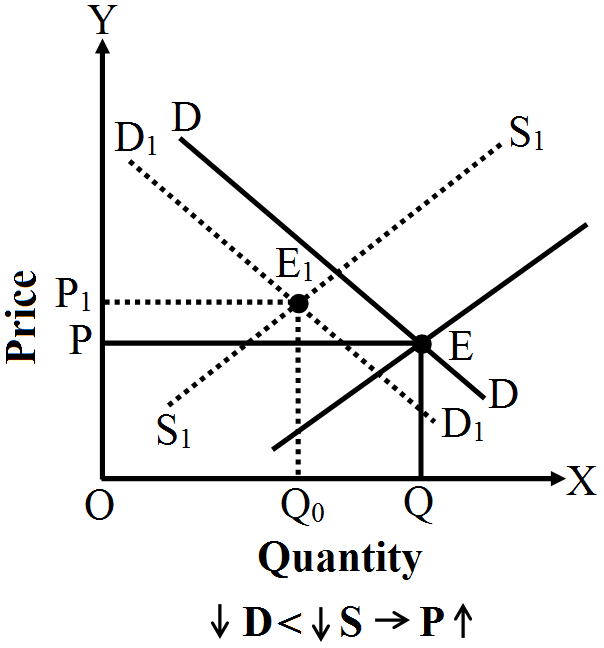
What can be the effect on equilibrium price of a commodity when its demand and supply curves both shift to left simultaneously? Show three effects with the help of diagrams.
OR
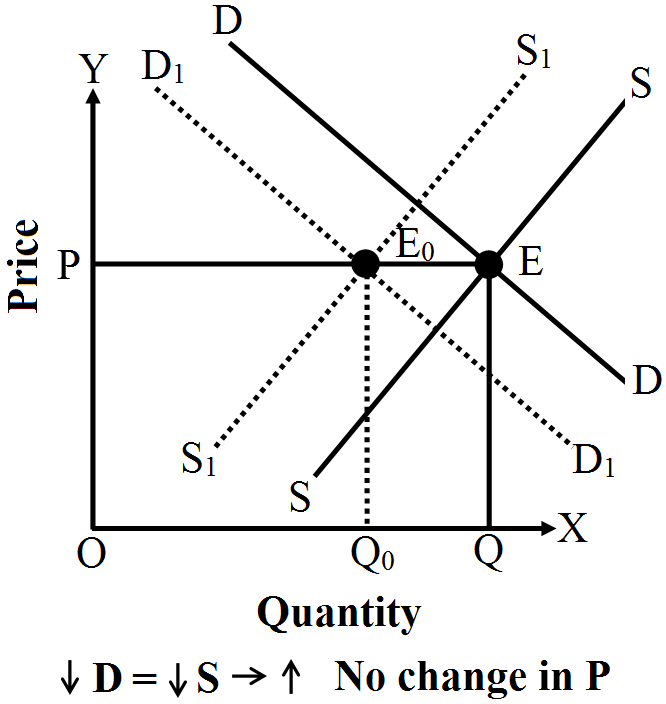
When will the equilibrium price of a commodity not change, if its demand and supply both decrease? Explain with the help of a diagram.
Answer
When both demand and supply of a commodity decrease (i.e., when demand and supply curve of a commodity shifts to the left), the equilibrium quantity will fall but the equilibrium price may or may not be affected. There may be three situations:
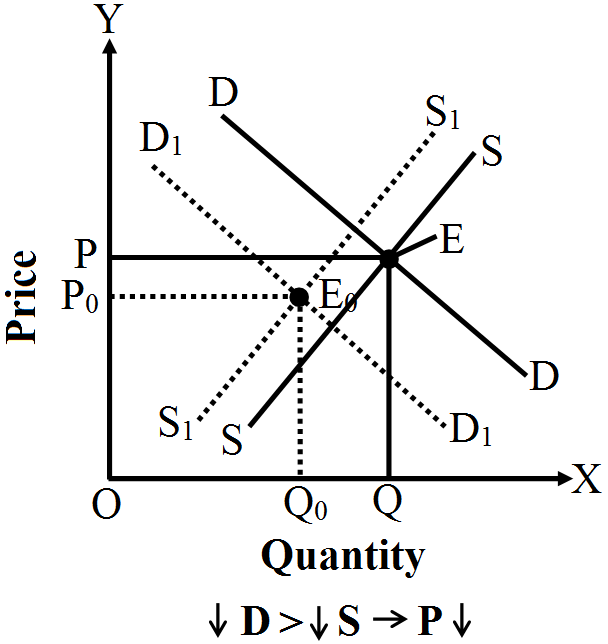
  1. When decrease in demand is more than decrease in supply, equilibrium price will fall.
  1. When decrease in demand is less than decrease in supply, equilibrium price will go up.
  1. When decrease in demand is equal to decrease in supply, there will be no change in equilibrium price.
View full question & answer
Question 524 Marks
How does the equilibrium price of a ‘normal’ commodity change when income of its buyers falls? Explain the chain of effects.
Answer
  • When income falls demand falls.
  • Supply remaining unchanged, there is excess supply at the given price.
  • This leads to competition among sellers leading to fall in price.
  • As a result, demand starts rising and supply starts falling.
  • These changes continue till a new equilibrium price is established where demand equals supply.
  • Equilibrium price falls.
View full question & answer
Question 534 Marks
Explain two points of distinction between monopoly and monopolistic competition.
Answer
Difference between monopoly and monopolistic competition are:
S .No
Basis
Monopoly
Monopolistic competition
1.
Meaning
Monopoly is a form of market in which there is a single seller selling a product which has no close substitutes
Monopolistic competition is a form of market in which there are large number of sellers selling differentiated but closely related goods.
2.
Number of sellers and buyers
Under this, there is a single seller of a commodity and large number of buyers.
There are a large number of buyers and sellers. Also, the size of each firm is small. Each firm has a limited share of the market.
View full question & answer
Question 544 Marks
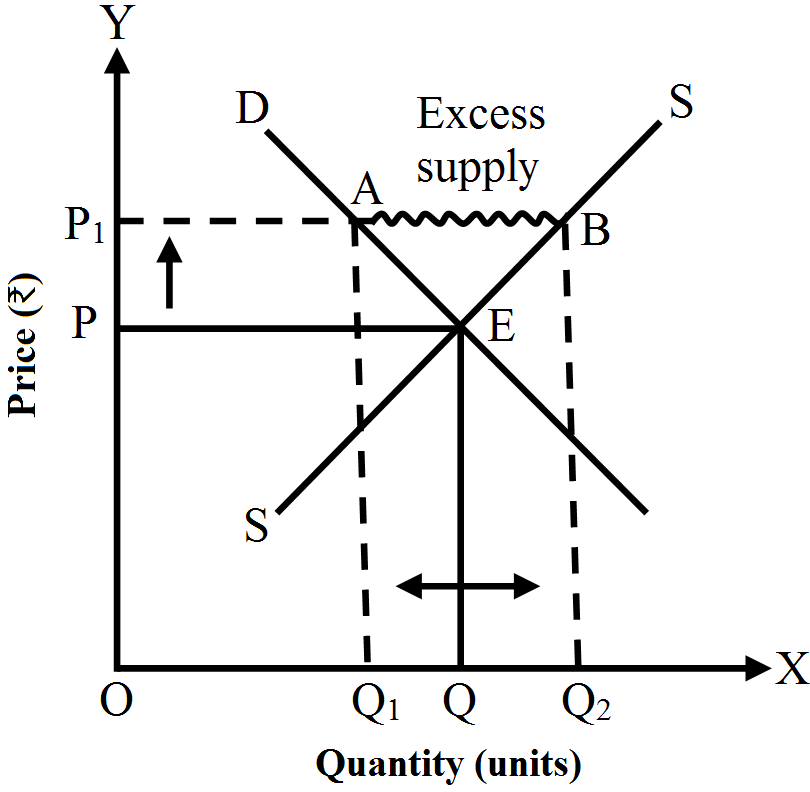
At a given price of a commodity, there is excess supply. Is this an equilibrium price? If not, how will the equilibrium price be reached?
Answer
Equilibrium price refers to the price at which market demand is equal to market supply (i.e. there is no excess demand or excess supply). No, the price with excess supply is not an equilibrium price. This can be illustrated with the help of following diagram.

In the given figure, excess supply is equal to = $Q_1Q_2 AB$. It implies market supply is greater than market demand. This puts pressure on price $(OP_1)$ to decline. The producers reduce the quantity supplied at the lower price $(OP)$ from $OQ_2$​​​​​​​ to $OQ$ with declining price. The consumer reacts by increasing the quantity demanded from $OQ_1$ (at $OP_1$ price) to $OQ$ (at $OP$ price), equilibrium is struck at point E. Thus, $OP$ and $OQ$ are the equilibrium price and equilibrium quantity respectively with no excess supply.
View full question & answer
Question 554 Marks
Perfectly competitive firms are considered as more efficient than monopolies. Do you agree?
Answer
Perfectly competitive firms are more efficient than monopolies because in a perfectly competitive market, firms have to accept the price prevailing in the market. So, they adjust their cost and revenue policy according to the prevailing price, thereby making them cost effective. One the other hand, a monopolist is a price-marker. He can formulate his own cost and revenue policy. So, there is no compulsion to control costs. So, firms under perfect competition are more efficient that a monopoly firm.
View full question & answer
Question 564 Marks
Explain the effect of increase in income of buyers of normal commodity on its equilibrium price.
Answer
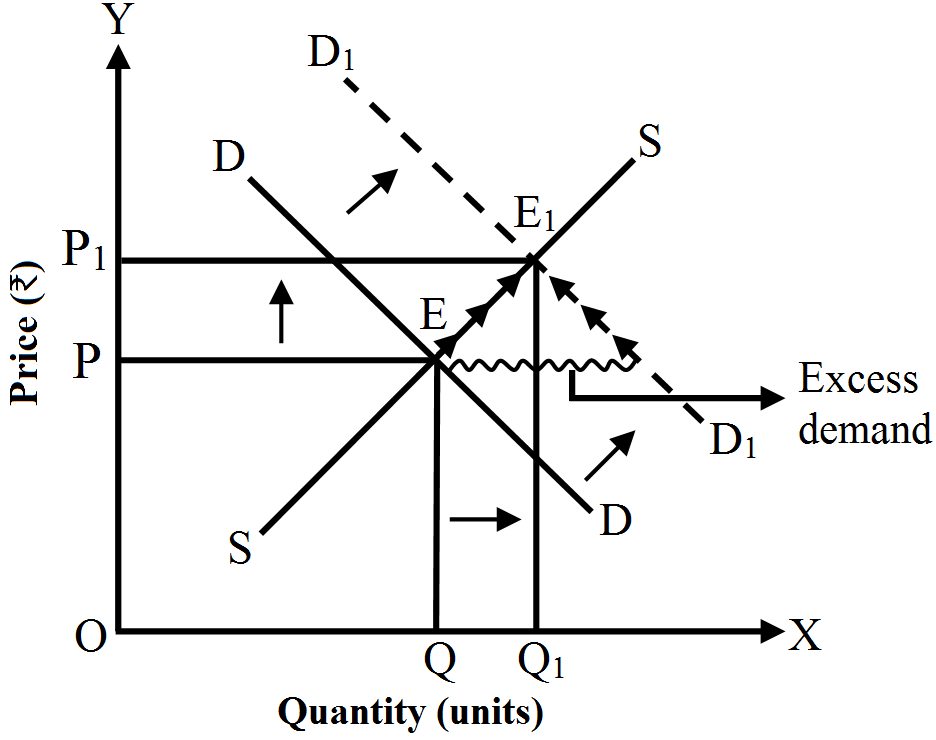
For a normal commodity, increase in income of the consumers means increase in its demand. Accordingly, demand curve shifts rightward and both equilibrium price and equilibrium quantity tends to increase. In the given diagram, actual demand curve $DD$ and actual supply curve $SS$ intersect at point $E$ . (i.e. equilibrium point). When income of the buyer increases, the demand for normal good also rises and demand curve shifts rightward from $DD$ to $D_1D_1$. As a result, equilibrium price and quantity both are increased from $OP$ to $OP_1$ and $OQ$ to $OQ_1$​​​​​​​
View full question & answer
4 Marks Question - Page 2 - Economics STD 11 Commerce Questions - Vidyadip