Questions

4 Marks Questions

🎯

Test yourself on this topic

8 questions · timed · auto-graded

Question 14 Marks
Find the equation of circle which passes through the points $(0,2),(3,0)$ and $(3,2)$. Find also the centre and radius of this circle.
Answer
Let the equation of required circle be
$x^2+y^2+2 g x+2 f y+c=0\quad \ldots(i) $
This circle will pass through the point $(0,2),(3,0)$ and $(3,2)$, if
$4+4 f+c=0$$\ldots($ ii)
$
9+6 g+c=0
$
Now, on adding eqs. (ii) & (iii), we get
$
13+6 g+4 f+2 c=0
$
and $13+6 g+4 f+c=0$
$
\therefore
$
$
c=0
$
Substituting value of $c$ in eqs. (ii) and (iii), we get
$4+4 f=0 \Rightarrow f=-1$
and $9+6 g=0 \Rightarrow g=-\frac{3}{2} \quad 1 / 2$
Putting these values of $g, f$ and $c$ in eq (i), we get the required equation of circle.
i.e., $x^2+y^2-3 x-2 y=0$
Now, centre of the circle, $(-g,-f)=\left(\frac{3}{2}, 1\right)$
and radius, $r=\sqrt{g^2+f^2-c}$
$=\sqrt{\left(\frac{3}{2}\right)^2+1^2-0}$
$=\sqrt{\frac{9}{4}+1}$
$=\sqrt{\frac{13}{4}}$
$=\frac{\sqrt{13}}{2}$


View full question & answer
Question 24 Marks
Find the equation of the circle which passes through $(1,-2)$ and $(4,-3)$ and whose centre lies on the line $3 x+4 y=7$
Answer
Let the required equation of the circle be
$x^2+y^2+2 g x+2 f y+c=0\quad \ldots(i) $
Since, the circle passes through the points $(1,-2)$ and $(4,-3)$, we have
$1+4+2 g-4 f+c=0$
$\begin{array}{lr}\text { or, } 2 g-4 f+c=-5\quad \ldots(ii) \\ \text { and } 16+9+8 g-6 f+c=0\end{array}$
$\Rightarrow 8 g-6 f+c=-25\quad \ldots(iii) $
Subtracting eq. (iii) from eq. (ii), we get
$-6 g+2 f=20$
$\Rightarrow 3 g-f=-10\quad \ldots(iv) $
Again, the centre of the circle $(-g,-f)$ lies on the line
$3 x+4 y=7$
Therefore, $-3 g-4 f=7\quad \ldots(v) $
Solving eq. (iv) and eq(v), we get 
$\Rightarrow f=\frac{3}{5}$ and $g=-\frac{47}{15}$
Now, from eq. (ii), we get
$\frac{-94}{15}-\frac{12}{5}+c=-5$
or, $c=\frac{55}{15}$
Substituting the values of $g, f$ and $c$ in eq. (i), the required equation of the circle is :
$x^2+y^2-\frac{94}{15} x+\frac{6}{5} y+\frac{55}{15}=0$
or, $15 x^2+15 y^2-94 x+18 y+55=0$.
View full question & answer
Question 34 Marks
Find the equation of circle concentric with circle $4 x^2+4 y^2-12 x-16 y-21=0$ and half its area.
Answer
The given equation of the circle is
$4 x^2+4 y^2-12 x-16 y-21=0$
$\begin{array}{l}\Rightarrow x^2+y^2-3 x-4 y-\frac{21}{4}=0 \\ \Rightarrow \left(x^2-3 x+\frac{9}{4}\right)+\left(y^2-4 y+4\right)-\frac{9}{4}-4-\frac{21}{4}=0\end{array}$
$\begin{array}{ll}\Rightarrow \left(x-\frac{3}{2}\right)^2+(y-2)^2-\frac{15}{2}-4=0 \\ \Rightarrow \left(x-\frac{3}{2}\right)^2+(y-2)^2=\left(\sqrt{\frac{23}{2}}\right)^2\end{array}$
$\therefore$ Centre $=\left(\frac{3}{2}, 2\right)$ and radius, $r_1=\sqrt{\frac{23}{2}}$
Let ' $r_2$ ' be the radius of the concentric circle.
$\therefore$ Its equation will be
$\left(x-\frac{3}{2}\right)^2+(y-2)^2=r_2^2$
Also,
$
\begin{array}{l}
\Rightarrow \frac{1}{2} \pi r_1^2=\pi r_2^2 \text {, } \\
\Rightarrow r_1^2=2 r_2^2 \\
\Rightarrow \frac{23}{4}=2 r_2^2 \\
\Rightarrow r_2^2=\frac{23}{4} \\
\Rightarrow r_2=\frac{\sqrt{23}}{2} \\
\therefore \left(x-\frac{3}{2}\right)^2+(y-2)^2=\frac{23}{4} \\
\Rightarrow x^2-3 x+\frac{9}{4}+y^2-4 y+4=\frac{23}{4} \\
\Rightarrow x^2+y^2-3 x-4 y+4-\frac{7}{2}=0
\end{array}
$
$\Rightarrow 2 x^2+2 y^2-6 x-8 y+1=0$, is the required equation of the circle.
View full question & answer
Question 44 Marks
Whatever be the value of $t$, prove that the locus of the point of intersection of the lines $x \cos t+y \sin t$ $=a$ and $x \sin t-y \cos t=b$ is a circle.
Answer
The given lines are
$\begin{aligned} x \cos t+y \sin t & =a\quad \ldots(i) \\ \text { and }x \sin t-y \cos t & =b\quad \ldots(ii) \end{aligned}$
Let $P(\alpha, \beta)$ be the point of intersection of given lines, then
$
\begin{aligned}
\alpha \cos t+\beta \sin t & =a\quad \ldots(iii) \\
\alpha \sin t-\beta \cos t & =b\quad \ldots(iv)
\end{aligned}
$
To eliminate the parameter $t$, on squaring and adding eqs. (iii) and (iv), we get
$\alpha^2\left(\cos ^2 t+\sin ^2 t\right)+\beta^2\left(\sin ^2 t+\cos ^2 t\right)=a^2+b^2$
$\Rightarrow \alpha^2+\beta^2=a^2+b^2$
$\left[\because \sin ^2 \theta+\cos ^2 \theta=1\right]$
Therefore, the locus of the point $P(\alpha, \beta)$ is $x^2+y^2=a^2+b^2$
Which represents a circle with centre $(0,0)$ and radius $=\sqrt{a^2+b^2}$.
View full question & answer
Question 54 Marks
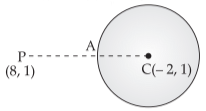
(i) Find the shortest distance of the point $(8,1)$ from the circle $(x+2)^2+(y-1)^2=25$.
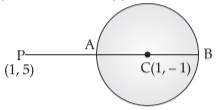
(ii) Find the farthest distance of the point $(1,5)$ from the circle $(x-1)^2+(y+1)^2=16$.
View full question & answer
Question 64 Marks
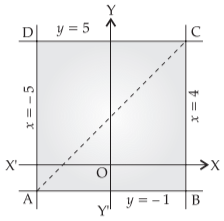
Find the equation of the circle drawn on a diagonal of the rectangle as its diameter whose sides are the lines $x=4, x=-5, y=5$ and $y=-1$.
View full question & answer
Question 74 Marks
If two diameters of a circle lie along the lines $x-y$ $-9=0$ and $x-2 y-7=0$ and the area of the circle is 38.5 sq. units, find the equation.
Answer
Given, two diameters of a circle lie along the lines
$\begin{aligned} x-y-9 & =0\quad \ldots(i)\\
and \quad x-2 y-7 & =0\quad \ldots(ii) \end{aligned}$
So, their point of intersection is the centre of the circle.
Solving eqs. (i) and (ii), simultaneously, we get
$x=11 \text { and } y=2$
$\therefore$ The centre of the circle is $(11,2)$
Let $r$ be the radius of the circle, then
area $=\pi r^2=38.5$ sq units (given)
$\Rightarrow \frac{22}{7} r^2=\frac{77}{2}$
$\begin{array}{ll}\Rightarrow r^2=\frac{49}{4} \\ \Rightarrow r=\frac{7}{2}\end{array}$
$\therefore$The equation of the circle is
$
(x-11)^2+(y-2)^2=\left(\frac{7}{2}\right)^2
$
$\begin{array}{l}\Rightarrow x^2+y^2-22 x-4 y+125=\frac{49}{4} \\ \Rightarrow x^2+y^2-22 x-4 y+125-\frac{49}{4}=0 \\ \Rightarrow 4\left(x^2+y^2\right)-88 x-16 y+451=0\end{array}$
View full question & answer
Question 84 Marks
If $2 x^2+\lambda x y+2 y^2+(\lambda-4) x+6 y-5=0$ is the equation of the circle, then find its radius.
Answer
Given, equation of circle is
$
\begin{array}{l}
2 x^2+\lambda x y+2 y^2+(\lambda-4) x+6 y-5=0 \\
\text { or } x^2+\frac{\lambda}{2} x y+y^2+\left(\frac{\lambda-4}{2}\right) x+3 y-\frac{5}{2}=0
\end{array}
$
If the above equation is the equation of circle, then coefficient of $x y=0$ i.e., $\frac{\lambda}{2}=0$ or $\lambda=0$
On substituting $\lambda=0$ in eq. (i), we get
$x^2+y^2-2 x+3 y-\frac{5}{2}=0$
$\therefore$ Centre of the circle,
$(-g,-f)=\left(1,-\frac{3}{2}\right)$
and constant term, $c=-\frac{5}{2}$
Thus,
$
\begin{aligned}
\text { radius } & =\sqrt{g^2+f^2-c} \\
& =\sqrt{(-1)^2+\left(\frac{3}{2}\right)^2-\left(-\frac{5}{2}\right)} \\
& =\sqrt{1+\frac{9}{4}+\frac{5}{2}} \\
& =\sqrt{\frac{4+9+10}{4}} \\
& =\sqrt{\frac{23}{4}} \\
& =\frac{\sqrt{23}}{2} \text { unit. }
\end{aligned}
$
View full question & answer
4 Marks Questions - Applied Maths STD 11 Science Questions - Vidyadip