Questions

5 Marks Questions

🎯

Test yourself on this topic

13 questions · timed · auto-graded

Question 15 Marks
Find equation of the line which is equidistant from parallel lines $9 x+6 y-7=0$ and $3 x+2 y+$ $6=0$.
Answer
The equations of given lines are
$9 x+6 y-7=0\ldots(i)$
$3 x+2 y+6=0\ldots(ii)$
Let $P(h, k)$ be the arbitrary point is equidistant from lines (1) and (2). The perpendicular distance of $P(h, k)$ from line (1) is given by
$d_1 =\left|\frac{9 h+6 k-7}{(9)^2+(6)^2}\right|$
$=\left|\frac{9 h+6 k-7}{\sqrt{117}}\right|$
$=\left|\frac{9 h+6 k-7}{3 \sqrt{13}}\right|$
The perpendicular distance of $P(h, k)$ from line (ii) is given by
$d_2=\left|\frac{3 h+2 k+6}{(3)^2+(2)^2}\right|=\left|\frac{3 h+2 k+6}{\sqrt{13}}\right|$
Since $P(h, k)$ is equidistant from lines (i) and (ii),
Therefore, $\quad d_1=d_2$
$\therefore$ $\left|\frac{9 h+6 k-7}{3 \sqrt{13}}\right|=\left|\frac{3 h+2 k+6}{\sqrt{13}}\right|$
⇒ $|9 h+6 k-7|=3|3 h+2 k+6|$
⇒ $|9 h+6 k-7|= \pm 3(3 h+2 k+6)$
$\text {Either } 9 h+6 k-7=3(3 h+2 k+6)$
$\text {or }\qquad 9 h+6 k-7=-3(3 h+2 k+6)$
The case $9 h+6 k-7=3(3 h+2 k+6)$ is not possible
$\text{as,}\quad 9 h+6 k-7=3(3 h+2 k+6)$
⇒ $-7=18 \quad$ (which is absurd)
$\therefore$ $9 h+6 k-7=-3(3 h+2 k+6)$
$\therefore$ $9 h+6 k-7=-9 h-6 k-18$
⇒ $18 h+12 k+11=0$
Thus, the required equation of the line is
$18 x+12 y+11=0$
View full question & answer
Question 25 Marks
If sum of the perpendicular distance of a variable point $P (x, y)$ from the lines $x+y-5=0$ and $3 x-2 y$ $+7=0$ is always 10 . Show that $P$ must move on a line.
Answer
Equations of the given lines are
$\begin{array}{r}
x+y-5=0\ldots(i) \\
3 x-2 y+7=0\ldots(ii)
\end{array}$
The perpendicular distance of $P(x, y)$ from lines (i) and (ii) are respectively
$\begin{aligned} d_1 & =\frac{|x+y-5|}{\sqrt{(1)^2+(1)^2}} \text { and } d_2=\frac{|3 x-2 y+7|}{\sqrt{(3)^2+(-2)^2}} \\ \text { i.e., } d_1 & =\frac{|x+y-5|}{\sqrt{2}} \text { and } d_2=\frac{|3 x-2 y+7|}{\sqrt{13}}\end{aligned}$
It is given that $d_1+d_2=10$
$\begin{array}{l}
\therefore \frac{|x+y-5|}{\sqrt{2}}+\frac{|3 x-2 y+7|}{\sqrt{13}}=10 \\
\Rightarrow \sqrt{13}|x+y-5|+\sqrt{2}|3 x-2 y+7|-10 \sqrt{26}=0 \\
\Rightarrow \sqrt{13}(x+y-5)+\sqrt{2}(3 x-2 y+7)-10 \sqrt{26}=0
\end{array}$
[Assuming $(x+y-5)$ and $(3 x-2 y+7)$ are positive]
$\Rightarrow \sqrt{13} x+\sqrt{13} y-5 \sqrt{13}+3 \sqrt{2} x-2 \sqrt{2} y+7 \sqrt{2}-10 \sqrt{26}=0$
$\Rightarrow x(\sqrt{13}+3 \sqrt{2})+y(\sqrt{13}-2 \sqrt{2})+(7 \sqrt{2}-5 \sqrt{13}-10 \sqrt{26})=0,$
which is equation of a line.
Similarly, we can obtain the equation of line for any signs of $(x+y-5)$ and $(3 x-2 y+7)$.
Thus, point $P$ must move on a line. Hence Proved.
View full question & answer
Question 35 Marks
Find the equations of the lines through the point of intersection of the lines $x-y+1=0$ and $2 x-3 y$ $+5=0$ and whose distance from the point $(3,2)$ is $\frac{7}{5}.$
Answer
Given equation of lines $x-y+1=0\ldots(i)$
and $\quad 2 x-3 y+5=0\ldots(ii)$
From eq. (i), $\quad x=y-1$
Now, put the value of $x$ in eq. (ii), we get
$2(y-1)-3 y+5=0$
$\Rightarrow$ $2 y-2-3 y+5=0$
$\Rightarrow$ $3-y=0$
$\Rightarrow$ y = 3
Putting $y=3$ in eq. (i), we get
$x=2$
Since, the point of intersection is $(2,3)$.
Let slope of the required line be $m$.
$\therefore$ Equation of line is $y-3=m(x-2)$
$\Rightarrow$ $m x-y+3-2 m=0\ldots(iii)$
Since, the distance from $(3,2)$ to line (iii) is $\frac{7}{5}$.
$\therefore$ $\frac{7}{5}=\left|\frac{3 m-2+3-2 m}{\sqrt{1+m^2}}\right|$
$\Rightarrow$ $\frac{49}{25}=\frac{(m+1)^2}{1+m^2}$
$\Rightarrow$ $49+49 m^2=25\left(m^2+2 m+1\right)$
$\Rightarrow$ $49+49 m^2=25 m^2+50 m+25$
$\begin{array}{l}\Rightarrow \quad 24 m^2-50 m+24=0 \\ \Rightarrow \quad 12 m^2-25 m+12=0\end{array}$
$\therefore$ $m=\frac{25 \pm \sqrt{625-4 \cdot 12 \cdot 12}}{24}$
$\begin{array}{l}=\frac{25 \pm \sqrt{49}}{24} \\ =\frac{25 \pm 7}{24} \\ =\frac{32}{24} \text { or } \frac{18}{24} \\ =\frac{4}{3} \text { or } \frac{3}{4}\end{array}$
$\therefore$ First equation $y-3=\frac{4}{3}(x-2)$
$\Rightarrow$ $3 y-9=4 x-8$
$\Rightarrow$ $4 x-3 y+1=0$
and second equation $y-3=\frac{3}{4}(x-2)$
$\Rightarrow$ $4 y-12=3 x-6$
$\Rightarrow$ $3 x-4 y+6=0$
View full question & answer
Question 45 Marks
Prove that the product of the lengths of the perpendicular drawn from the points $\left(\sqrt{a^2-b^2}, 0\right)$ and $\left(-\sqrt{a^2-b^2}, 0\right)$ to the line $\frac{x}{a} \cos \theta+\frac{y}{b} \sin \theta=1$ is $b^2$
Answer
Let $P_1$ and $P_2$ be the perpendicular distances of $\left(\sqrt{a^2-b^2}, 0\right)$ and $\left(-\sqrt{a^2-b^2}, 0\right)$ from $\frac{x}{a} \cos \theta+\frac{y}{b} \sin \theta$$=1$, then we have
$P_1=\left|\frac{\frac{\sqrt{a^2-b^2}}{a} \cos \theta-1}{\sqrt{\frac{\cos ^2 \theta}{a^2}+\frac{\sin ^2 \theta}{b^2}}}\right|, P_2=\left|\frac{\frac{-\sqrt{a^2-b^2}}{a} \cos \theta-1}{\sqrt{\frac{\cos ^2 \theta}{a^2}+\frac{\sin ^2 \theta}{b^2}}}\right|$
$\begin{aligned} P_1 P_2 & =\left|\frac{\left(\frac{\sqrt{a^2-b^2}}{a} \cos \theta-1\right)\left(\frac{-\sqrt{a^2-b^2}}{a} \cos \theta-1\right.}{\sqrt{\frac{\cos ^2 \theta}{a^2}+\frac{\sin ^2 \theta}{b^2}} \sqrt{\frac{\cos ^2 \theta}{a^2}+\frac{\sin ^2 \theta}{b^2}}}\right| \\ & =\left|\frac{-\left(\frac{\sqrt{a^2-b^2}}{a} \cos \theta-1\right)\left(\frac{\sqrt{a^2-b^2}}{a} \cos \theta+1\right.}{\left(\frac{\cos ^2 \theta}{a^2}+\frac{\sin ^2 \theta}{b^2}\right)}\right|\end{aligned}$
$\begin{array}{l}=\left|\frac{-\left(\frac{a^2-b^2}{a^2} \cos ^2 \theta-1\right)}{\left(\frac{\cos ^2 \theta}{a^2}+\frac{\sin ^2 \theta}{b^2}\right)}\right| \\=\left|\frac{-\left(\frac{a^2 \cos ^2 \theta-b^2 \cos ^2 \theta-a^2}{a^2}\right)}{\left(\frac{b^2 \cos ^2 \theta+a^2\sin ^2 \theta}{a^2 b^2}\right)}\right| \\=\left|\frac{b^2\left[\left(b^2-a^2\right) \cos ^2 \theta-a^2\right.}{b^2 \cos ^2 \theta+a^2 \sin ^2 \theta}\right| \\=\frac{b^2\left\{b^2 \cos ^2 \theta+a^2 \sin ^2 \theta\right\}}{\left\{a^2 \cos ^2 \theta+a^2 \sin ^2 \theta\right\}} \\=b^2 \quad\quad\text{Hence Proved.}\end{array}$
View full question & answer
Question 55 Marks
Find the equation of a straight line which passes through the point $(a, 0)$ and whose perpendicular distance from $(2 a, 2 a)$ is $a$.
Answer
Let the straight line be $A x+B y+C=0\quad\ldots\text{(i)}$
Since, (i) passes through $(a, 0)$, so
$A \cdot a+B \cdot 0+C=0$
⇒ $A a+C=0$
⇒ $C=-A a\quad\ldots\text{(ii)}$
Also, the $\perp$ distance of (i) from $(2 a, 2 a)$ is $a$.
∴ $a=\left|\frac{A \cdot 2 a+B \cdot 2 a+C}{\sqrt{A^2+B^2}}\right|$
$\begin{array}{l}⇒a=\left|\frac{A a+2 a B}{\sqrt{A^2+B^2}}\right| \quad[C=-A a] \\ ⇒1=\left|\frac{A+2 B}{\sqrt{A^2+B^2}}\right|\end{array}$
$\Rightarrow A^2+B^2 =A^2+4 A B+4 B^2$
$\Rightarrow -3 B^2 =4 A B$
$\Rightarrow 4 A B+3 B^2 =0$
$\Rightarrow B(4 A+3 B) =0$
$\Rightarrow$ $B=0$ or $4 A+3 B=0$
If $ 4 A+3 B=0$
⇒ $B=-\frac{4 A}{3}$
Substituting the values of $B$ and $C$ in eq. (i), we get
$A x-\frac{4}{3} A y-A a=0$
⇒ $3 x-4 y-3 a=0$
$\therefore$ Equation of line is $3 x-4 y-3 a=0$
Similarly, if $B=0$, then substituting the values of $B$ and $C$ in eq. (i), we get
$A x=-0 . y+A a$
⇒ $A(x-a)=0$
⇒ $x-a=0$
$\therefore$ Equation of required line is $x+a=0$.
View full question & answer
Question 65 Marks
Find the equation of the line through the points $(3,2)$ which make an angle of $45^{\circ}$ with the line $x-2 y=3 .$
Answer
Let the slope of the required line be $m_1$.
The given line can be written as
$y=\frac{1}{2} x-\frac{3}{2},$
which is of the form $\quad y=m x+c$
$\therefore$ Slope of the given line, $m_2=\frac{1}{2}$
It is given that the angle between the required line $x-2 y=3$ is $45^{\circ}$.
We know that if $\theta$ is the acute angle between lines $l_1$ and $l_2$ with slopes $m_1$ and $m_2$ respectively, then
$\tan \theta=\left|\frac{m_2-m_1}{1+m_1 m_2}\right|$
$\therefore \tan 45^{\circ}=\left|\frac{m_2-m_1}{1+m_1 m_2}\right|$
$\Rightarrow 1=\left|\frac{\frac{1}{2}-m_1}{1+\frac{m_1}{2}}\right|$
$\begin{array}{ll}\Rightarrow 1=\left|\frac{\left(\frac{1-2 m_1}{2}\right)}{\frac{2+m_1}{2}}\right| \\ \Rightarrow 1=\left|\frac{1-2 m_1}{2+m_1}\right|\end{array}$
$\begin{array}{ll}\Rightarrow 1= \pm\left(\frac{1-2 m_1}{2+m_1}\right) \\ \Rightarrow 1=\frac{1-2 m_1}{2+m_1}\end{array}$
$\begin{aligned} \text { or } 1 =-\left(\frac{1-2 m_1}{2+m_1}\right) \\ \Rightarrow 2+m_1 =1-2 m_1\end{aligned}$
$\text { or }\quad 2+m_1 =-1+2 m_1$
Case I: $m_1=3$
The equation of the line passing through $(3,2)$ and having a slope of 3 is :
$\begin{aligned} y-2 & =3(x-3) \\ y-2 & =3 x-9 \\ 3 x-y & =7\end{aligned}$
Case II : $m_1=-\frac{1}{3}$
The equation of the line passing through $(3,2)$ and having a slope of $-\frac{1}{3}$ is :
$\begin{aligned} y-2 & =-\frac{1}{3}(x-3) \\ 3 y-6 & =-x+3 \\ x+3 y & =9\end{aligned}$
Thus, the equations of the line are $3 x-y=7$ and $x+3 y=9$.
View full question & answer
Question 75 Marks
If three lines whose equations are $y=m_1 x+c_1$ $y=m_2 x+c_2$ and $y=m_3 x+c_3$ are concurrent, then show that $m_1\left(c_2-c_3\right)+m_2\left(c_3-c_1\right)+m_3\left(c_1-c_2\right)=0$.
Answer
The equation of the given lines are
$y=m_1 x+c_1\ldots(i)$
$\begin{array}{l}
y=m_2 x+c_2\ldots(ii) \\
y=m_3 x+c_3\ldots(iii)
\end{array}$
On subtracting equation (i) from (ii), we obtain
0 = (m2 - m1 x + (c2 - c1)
⇒(m1 - m2)x = c2 - c1
⇒$x=\frac{c_2-c_1}{m_1-m_2}$
On substituting this value of x in (i), we obtain
$y=m_1\left(\frac{c_2-c_1}{m_1-m_2}\right)+c_1$
$y=\frac{m_1 c_2-m_1 c_1}{m_1-m_2}+c_1$
$y=\frac{m_1 c_2-m_1 c_1+m_1 c_1-m_2 c_1}{m_1-m_2}$
$y=\frac{m_1 c_2-m_2 c_1}{m_1-m_2}$
$\therefore \quad\left(\frac{c_2-c_1}{m_1-m_2}, \frac{m_1 c_2-m_2 c_1}{m_1-m_2}\right)$ is the point of intersection of lines (i) and (ii).
It is given that lines (i), (ii) and (iii) are concurrent. Hence, the point of intersection of lines (i) and (ii) will also satisfy equation (iii),
$\frac{m_1 c_2-m_2 c_1}{m_1-m_2}=m_3\left(\frac{c_2-c_1}{m_1-m_2},\right)+c_3$
$\frac{m_1 c_2-m_2 c_1}{m_1-m_2}=\frac{m_3 c_2-m_3 c_1+c_3 m_1-c_3 m_2}{m_1-m_2}$
$\begin{aligned} m_1 c_2-m_2 c_1-m_3 c_2+m_3 c_1-c_3 m_1+c_3 m_2 & =0 \\ m_1\left(c_2-c_3\right)+m_2\left(c_3-c_1\right)+m_3\left(c_1-c_2\right) & =0\end{aligned}$
Hence, $m_1\left(c_2-c_3\right)+m_2\left(c_3-c_1\right)+m_3\left(c_1-c_2\right)=0$.
View full question & answer
Question 85 Marks
Find the value of $k$ for which the line
$(k-3) x-\left(4-k^2\right) y+k^2-7 k+6=0 \text { is }$
(i) Parallel to $X$-axis,
(ii) Parallel to $Y$-axis,
(iii) Passing through the origin.
Answer
The given question of line is
$(k-3) x-\left(4-k^2\right) y+k^2-7 k+6=0\ldots(i)$
(i) If the given line is parallel to the $X$-axis, then Slope of the given line $=$ Slope of the $X$-axis The given line can be written as
$\begin{aligned}\left(4-k^2\right) y & =(k-3) x+k^2-7 k+6 \\ y & =\frac{(k-3)}{\left(4-k^2\right)} x+\frac{k^2-7 k+6}{\left(4-k^2\right)},\end{aligned}$
which is of the form
$y=m x+c$
$\therefore$ Slope of the given line $=\frac{(k-3)}{\left(4-k^2\right)}$
Slope of the $X$-axis $=0$
∴$\frac{(k-3)}{\left(4-k^2\right)}=0$
⇒$k-3=0$
⇒k = 3
Thus, the given line is parallel to $X$-axis, then the value of $k$ is 3 .
(ii) If the given line is parallel to the $Y$-axis, it is vertical. Hence, its slope will be undefined
The slope of the given line is $\frac{(k-3)}{\left(4-k^2\right)}$
Now, $\frac{(k-3)}{\left(4-k^2\right)}$ is undefined at $k^2=4$
$k^2=4$
⇒$k= \pm 2$
Thus, if the given line is parallel to the $Y$-axis, then the value of $k$ is $\pm 2$.
(iii) If the given line is passing through the origin, then point $(0,0)$ satisfies the given equation of the line.
$(k-3)(0)-\left(4-k^2\right)(0)  +k^2-7 k+6=0$
$k^2-7 k+6  =0$
$k^2-6 k-k+6  =0$
$(k-6)(k-1)  =0$
$k  =1 \text { or } 6$
Thus, if the given line is passing through the origin, then the value of $k$ is either 1 or 6.
View full question & answer
Question 95 Marks
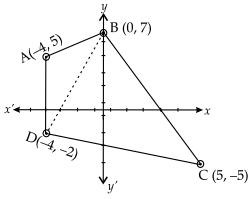
Draw a quadrilateral in the cartesian plane, whose vertices are $(-4,5),(0,7),(5,-5)$ and $(-4,-2)$. Also find its area.
Answer
Let the given points be $A(-4,5), B(0,7), C(5,-5)$ and $D(-4,-2) . A, B, C, D$ are plotted on a graph paper. $A$, $B ; B, C ; C, D$ and $D, A$ are joined.
Now, quadrilateral $A B C D$ is divided in two triangles, $\triangle A B D$ and $\triangle B C D$.
Image
Area of $\triangle A B D$
$\begin{array}{l}
=\frac{1}{2}|\{-4(7+2)+0(-2-5)-4(5-7)\}| \\
=\frac{1}{2}|(-36+8)| \\
=14 \text { sq. units }
\end{array}$
area of $\triangle B C D$
$\begin{array}{l}
=\frac{1}{2}|\{0(-5+2)+5(-2-7)-4(7+5)\}| \\
=\frac{1}{2}|-45-48| \\
=\frac{93}{2} \text { sq.units }
\end{array}$
Area of quadrilateral $A B C D=$ Area of $\triangle A B C+$ $\triangle B C D$
$\begin{array}{l}=14+\frac{93}{2} \\ =\frac{121}{2} \\ =60.5 \text { sq. units. }\end{array}$
View full question & answer
Question 105 Marks
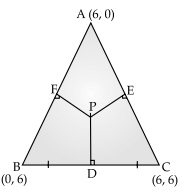
The vertices of a triangle are $(6,0),(0,6)$ and $(6,6)$. Find the distance between its circumcentre and centroid.
Answer
Let the vertices of the triangle are A( x1 , y1)= (6, 0) , B(x2, y2) = (0, 6) and C(x3,y3) = (6, 6) . 
Image
Let PD, PE and PF be the right bisectors of BC, CA and AB respectively with circumcentre P(h,k)
$\begin{aligned} \therefore \quad \text { Coordinates of } D & =\text { midpoint of } B C \\ & =\left(\frac{6+0}{2}, \frac{6+6}{2}\right) \\ & =(3,6)\end{aligned}$
$\begin{aligned} \therefore \quad \text { Coordinates of } E & =\text { midpoint of } A C \\ & =\left(\frac{6+6}{2}, \frac{6+0}{2}\right) \\ & =(6,3)\end{aligned}$
$\quad \begin{aligned} \text {and}\quad  \text{Coordinates of F} & =\text { midpoint of } A B \\ & =\left(\frac{6+0}{2}, \frac{0+6}{2}\right) \\ & =(3,3)\end{aligned}$
$\begin{array}{l}\text { since } P D \perp B C \text {, so } \\ \text { slope of } P D \times \text { slope of } B C=-1\end{array}$
⇒ $\frac{6-k}{3-h} \times \frac{6-6}{6-0}=-1$
$\Rightarrow$ $6(3-h) \times(-1)=0$
$\Rightarrow$ $h=3$
and, slope of $P E \times$ slope of $A C=-1$
$\Rightarrow$ $\frac{3-k}{6-h} \times \frac{6-0}{6-6}=-1$
⇒ $6(3-k)=0$
⇒ $k=3$
and centroid of $\triangle A B C$ has co-ordinates
$\left(\frac{0+6+6}{3}, \frac{6+6+0}{3}\right)=(4,4)$
$\therefore$ Distance between circumcentre and centroid
$=\left|\sqrt{(4-3)^2+(4-3)^2}\right|$
$=\sqrt{2}$ unit.
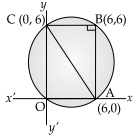
OR
Image
$\begin{array}{l}B C=\left|\sqrt{(6-0)^2+(6-6)^2}\right|=6 \\ A B=\left|\sqrt{(6-6)^2+(6-0)^2}\right|=6 \\ A C=\left|\sqrt{(6-0)^2+(0-6)^2}\right|=6 \sqrt{2}\end{array}$
$\begin{aligned} A C^2 & =72 \\ B C^2+A B^2 & =36+36=72 \\ A C^2 & =A B+B C^2\end{aligned}$
$\therefore A B C$ is a right angled triangle.
Hence $A C$ is the diameter of circumcircle
$\begin{aligned}
\therefore \text { center of circumcircle } & =\left(\frac{6+0}{2}, \frac{0+6}{2}\right) \\
& =(3,3)
\end{aligned}$
$\begin{array}{l}\text { Centroid of } \triangle A B C=\left(\frac{x_1+x_2+x_3}{3}, \frac{y_1+y_2+y_3}{3}\right) \\ =\left(\frac{6+0+6}{3}, \frac{6+0+6}{3}\right) \\ =(4,4)\end{array}$
Distance between center and centroid of $\triangle A B C$
$\begin{array}{l}
=\left|\sqrt{\left(x_2-x_1\right)^2+\left(y_2-y_1\right)^2}\right| \\
=\left|\sqrt{(4-3)^2+(4-3)^2}\right| \\
=\sqrt{1+1}=\sqrt{2} \text { units. }
\end{array}$

View full question & answer
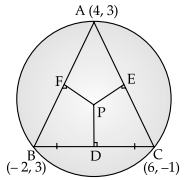
Question 115 Marks
Find the co-ordinates of the circumcentre of the triangle whose vertices are (4, 3), (-2, 3) and (6, -1).
View full question & answer
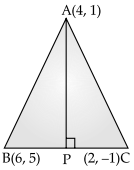
Question 125 Marks
Show that the perpendicular drawn from the point $(4,1)$ on the line segment joining $(6,5)$ and $(2,-1)$ divide it internally in the ratio $8: 5$.
View full question & answer
Question 135 Marks
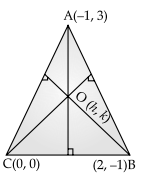
Find the co-ordinates of the orthocentre of the triangle whose vertices are $(-1,3),(2,-1)$ and $(0,0)$.
View full question & answer
5 Marks Questions - Applied Maths STD 11 Science Questions - Vidyadip