Sample QuestionsStraight Lines questions
One sample from each question group in this chapter. Select any group above to see the full set with answer keys.
The point on $X$-axis, whose distance from the line $\frac{x}{3}+\frac{y}{4}=1$ is 4 units are
- ✓
$(8,0)$ or $(-2,0)$
- B
$(-8,0)$ or $(2,0)$
- C
$(-8,0)$ or $(-2,0)$
- D
Answer: A.
View full solution →The $X$-intercept of the line $3 y+2=0$ is
- A
$\frac{-2}{3}$
- B
$\frac{3}{2}$
- C
$\frac{2}{3}$
- D
View full solution →The distance of the point $(-1,1)$ from the line $12(x+6)=5(y-2)$ is
Answer: D.
View full solution →The equation of the line perpendicular to line $x-7 y+5=0$ and having $X$-intercept 3 is
- A
$7 x-y-21=0$
- ✓
$7 x+y-21=0$
- C
$7 x+y+21=0$
- D
$7 x-y+21=0$
Answer: B.
View full solution →For specifying a straight line, how many geometric parameters should be known?
Answer: B.
View full solution →Prove that the line through the point $\left(x_1, y_1\right)$ and parallel to line $A x+B y+C=0$ is $A\left(x-x_1\right)+B(y-$ $\left.y_1\right)=0$.
View full solution →Find the equation of the line passing through $(1,2)$ and parallel to the line $y=3 x-1$.
View full solution →Reduce the equation $\sqrt{3} x+y=4$ into normal form and find the values of $p$ and $\alpha$.
View full solution →Reduce the equation $3 x+4 y=5$ into slope intercept form and find its slope.
View full solution →Find the acute angle between the lines $x+y=0$ and $y=0$.
View full solution →Reduce the equation $3 x-2 y+4=0$ to intercept form. Hence, find the length of the segment intercepted between the axes.
View full solution →Find the condition, if the two lines $a x+b y=c$ and $a^{\prime} x+b^{\prime} y=a^{\prime} b^{\prime}$ are perpendicular.
View full solution →Prove that the lines $3 x+y-14=0, x-2 y=0$ and $3 x-8 y+4=0$ are concurrent.
View full solution →Reduce the equation $6 x+2 y+5=0$ into intercept form and find its intercepts on the axes.
View full solution →Find the equation of the line passing through the point $(-1,3)$ and perpendicular to the line $3 x-4 y-16=0$
View full solution →Find equation of the line which is equidistant from parallel lines $9 x+6 y-7=0$ and $3 x+2 y+$ $6=0$.
View full solution →If sum of the perpendicular distance of a variable point $P (x, y)$ from the lines $x+y-5=0$ and $3 x-2 y$ $+7=0$ is always 10 . Show that $P$ must move on a line.
View full solution →Find the equations of the lines through the point of intersection of the lines $x-y+1=0$ and $2 x-3 y$ $+5=0$ and whose distance from the point $(3,2)$ is $\frac{7}{5}.$
View full solution →Prove that the product of the lengths of the perpendicular drawn from the points $\left(\sqrt{a^2-b^2}, 0\right)$ and $\left(-\sqrt{a^2-b^2}, 0\right)$ to the line $\frac{x}{a} \cos \theta+\frac{y}{b} \sin \theta=1$ is $b^2$
View full solution →Find the equation of a straight line which passes through the point $(a, 0)$ and whose perpendicular distance from $(2 a, 2 a)$ is $a$.
View full solution →If the perpendicular from the origin to the line y = mx + c meets it at the point (-1, 2), then values of m and c are ___________ and ___________ respectively.
If 'p' is the length of the perpendicular from the origin to the line whose intercepts on axes are 'a' and 'b', then relation between a, b and p is ___________ .
The distance between parallel lines l(x + y) + p = 0 and l(x + y) - r = 0 is ___________ .
The distance of (2, 3) from the line x + 4y = 5 is ___________ .
The equation of the line which is parallel to $Y$-axis and passes through $(-4,3)$ is ___________.
View full solution →Obtain the equation of the line passing through the intersection of lines $4 x-3 y-1=0$ and $2 x-5 y$ $+3=0$ and equally inclined to the axes.
View full solution →Find the image of the point (3, 8) with respect to the line x + 3y = 7 assuming the line to be a plane mirror.
Find the equation of a straight line which makes acute angle with positive direction of X-axis, passes through point (-5, 0) and is at a perpendicular distance of 3 units from the origin.
Find the foot of the perpendicular from the point (3, 8) to the line x + 3y = 7.
The line $2 x-3 y=4$ is the perpendicular bisector of the line segment $A B$. If coordinates of $A$ are $(-3,1)$, find the coordinates of $B$.
View full solution →The value of $\lambda$, if the lines $(2 x+3 y+4)+\lambda(6 x-y$ $+12)=0$ are| Column-I | Column-II |
| (a) Parallel to y-axis is | (i) $\lambda=-\frac{3}{4}$ |
| (b) Perpendicular to 7x + y -4 = 0 is | (ii) $\lambda=-\frac{1}{3}$ |
| (c) Passes through (1, 2) is | (iii) $\lambda=-\frac{17}{41}$ |
| (d) Parallel to x-axis is | (iv) $\lambda=3$ |
View full solution →| Column-I | Column-II |
| (a) Equation of X-axis | (i) y = 0 |
| (b) Equation of Y-axis | (ii) x = y |
| (c) Equation of line having equal intercepts | (iii) x = 0 |
| (d) Equation of line passing through origin | (iv) x + y = a |
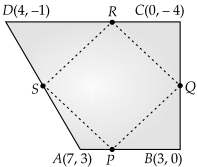
A quadrilateral has vertices at the points A( 7 , 3), B(3, 0) C( 0 , -4) and D(4, - 1) If P, Q, R and S are the mid-points of AB, BC, CD and DA respectively, as shown in figure, then match the following columns: | Column-I | Column-II |
| (a) Co-ordinates of point P | (i) 1 |
| (b) Slope of PQ | (ii) -1 |
| (c) Co-ordinates of point R | (iii) $\left(5, \frac{3}{2}\right)$ |
| (d) Slope of QR | (iv) $\left(2, \frac{-5}{2}\right)$ |