Questions

MCQ

🎯

Test yourself on this topic

12 questions · timed · auto-graded

MCQ 11 Mark
The point on $X$-axis, whose distance from the line $\frac{x}{3}+\frac{y}{4}=1$ is 4 units are
  • $(8,0)$ or $(-2,0)$
  • B
    $(-8,0)$ or $(2,0)$
  • C
    $(-8,0)$ or $(-2,0)$
  • D
    None of these
Answer
Correct option: A.
$(8,0)$ or $(-2,0)$
(A) $(8,0)$ or $(-2,0)$
Explanation : The given line is
$\frac{x}{3}+\frac{y}{4}=1$
$\Rightarrow$ 4x + 3y = 12
$\Rightarrow$ 4x + 3y - 12 = 0 ...(i)
Any point on X-axis in P(x,0)
So, the distance of P(x,0) from line (i) is
$4=\frac{|4 x+3.0-12|}{\sqrt{4^2+3^2}}$
$\Rightarrow$ $4=\frac{|4 x-12|}{\sqrt{25}}$
$\Rightarrow$ $|4 x-12|=20$
$\Rightarrow$ $4 x-12= \pm 20$
Either 4x - 12 = 20 or 4x - 12 = - 20
$\therefore$ 4x = 32 or 4x = - 8
Thus x = 8 or x = - 2
$\therefore$ Required points are (8, 0) or (-2, 0).
View full question & answer
MCQ 31 Mark
The distance of the point $(-1,1)$ from the line $12(x+6)=5(y-2)$ is
  • A
    2 units
  • B
    3 units
  • C
    4 units
  • 5 units
Answer
Correct option: D.
5 units
(D) 5 units
Explanation : The given line is
$\begin{aligned}
12(x+6) =5(y-2) \\
\Rightarrow \quad 12 x-5 y+82 =0
\end{aligned}$
$\therefore$ Distance of $(-1,1)$ from $12 x-5 y+82=0$ is
$\begin{aligned} d =\frac{|12(-1)-5.1+82|}{\sqrt{(12)^2+(-5)^2}} \\ =\frac{|-12-5+82|}{\sqrt{169}}=\frac{65}{13}\end{aligned}$
$=5$ units.
View full question & answer
MCQ 41 Mark
The equation of the line perpendicular to line $x-7 y+5=0$ and having $X$-intercept 3 is
  • A
    $7 x-y-21=0$
  • $7 x+y-21=0$
  • C
    $7 x+y+21=0$
  • D
    $7 x-y+21=0$
Answer
Correct option: B.
$7 x+y-21=0$
(B) $7 x+y-21=0$
Explanation : Any line perpendicular to the line $x-7 y+5=0$ is
$7 x+y+\lambda=0$
Since, it passes through $(3,0)$, so
$7.3+0+\lambda=0$
$\Rightarrow$ $\lambda=-21$
Thus, $7 x+y-21=0$ is the required equation of line.
View full question & answer
MCQ 51 Mark
For specifying a straight line, how many geometric parameters should be known?
  • A
    1
  • 2
  • C
    3
  • D
    4
Answer
Correct option: B.
2
(B) 2
Explanation : Different forms of straight line are :
(i) Slope intercept form, $y=m x+c$ ; parameters $=2$ i.e., $m$ and $c$
(ii) Intercept form, $\frac{x}{a}+\frac{y}{b}=1$; parameters $=2$ i.e., $a$ and $b$.
(iii) Normal form, $x \cos \alpha+y \sin \alpha=p$; parameters $=2$ i.e., $\alpha$ and $p$.
Hence, two parameters should be known.
View full question & answer
MCQ 61 Mark
The tangent of angle between the lines whose intercepts on the axes are $a,-b$ and $b,-a$, respectively, is
  • A
    $\frac{a^2-b^2}{a b}$
  • B
    $\frac{b^2-a^2}{2}$
  • $\frac{b^2-a^2}{2 a b}$
  • D
    None of these
Answer
Correct option: C.
$\frac{b^2-a^2}{2 a b}$
(C) $\frac{b^2-a^2}{2 a b}$
Explanation : Equation of line having intercepts $a$ and $-b$ is
$\frac{x}{a}+\frac{y}{-b}=1$
$\Rightarrow b x-a y=a b\ldots\text{(i)}$
Equation of line having intercepts $b$ and $-a$ is
$\frac{x}{b}+\frac{y}{-a}=1$
$\Rightarrow a x-b y=a b\ldots\text{(ii)}$
Now, slope of eq.(i), $m_1=\frac{b}{a}$
and slope of eq. (ii), $m_2=\frac{a}{b}$
$\therefore \tan \theta=\left|\frac{m_1-m_2}{1+m_1 m_2}\right|=\left|\frac{\frac{b}{a}-\frac{a}{b}}{1+\frac{b}{a} \times \frac{a}{b}}\right|=\frac{b^2-a^2}{2 a b}$
View full question & answer
MCQ 71 Mark
Slope of the line which cuts off intercept of equal lengths on the axes is
  • -1
  • B
    $0$
  • C
    2
  • D
    $\sqrt{3}$
Answer
Correct option: A.
-1
(A) -1
Explanation : We know that, intercept form of line is
$ \quad \quad \frac{x}{a}+\frac{y}{b}=1$
Here, given $\quad\quad  a=b$
$\therefore \quad \frac{x}{a}+\frac{y}{a}=1$
$\Rightarrow \quad x+y=a$
$\Rightarrow   \quad\quad\quad y=-x+a$
$\therefore \quad$ Slope $=-1 . \quad(\because y=m x+c)$
View full question & answer
MCQ 81 Mark
A line cutting off intercept -3 from the $Y$-axis and tangent at angle to the $X$-axis is $\frac{3}{5}$, its equation is
  • $5 y-3 x+15=0$
  • B
    $3 y-5 x+15=0$
  • C
    $5 y-3 x-15=0$
  • D
    None of these
Answer
Correct option: A.
$5 y-3 x+15=0$
(A) $5 y-3 x+15=0$
Explanation : Since, the lines cut off intercept - 3 on $Y$-axis, then the line is passing through the point $(0,-3)$.
Also, given that : $\tan \theta=\frac{3}{5}$
$m=\frac{3}{5}$ (slope of the line)
So, the equation of the required line is
$\left(y-y_1\right)=m\left(x-x_1\right)$
$\Rightarrow$ $[y-(-3)]=\frac{3}{5}(x-0)$
$\Rightarrow$ $5 y+15=3 x$
$\begin{array}{lr}\Rightarrow 5 y-3 x+15=0 x \\ \Rightarrow 3 x-5 y-15=0 .\end{array}$
View full question & answer
MCQ 91 Mark
The value of $x$ for which the points $(x,-1),(2,1)$ and $(4,5)$ are collinear is
  • A
    0
  • 1
  • C
    2
  • D
    3
Answer
Correct option: B.
1
(B) 1
Explanation: Let the given point be A(x, - 1) B(2, 1) and C(4,5)
Since, A, B, C are collinear, so
Slope of AB = Slope of BC
$\begin{array}{l}\text { Slope of } A B=\frac{1+1}{2-x}=\frac{2}{2-x} \\ \text { Slope of } B C=\frac{5-1}{4-2}=2\end{array}$
$\therefore$ $2=\frac{2}{2-x}$
$\Rightarrow$ 4 - 2x = 2
$\Rightarrow$ x = 1.
View full question & answer
MCQ 101 Mark
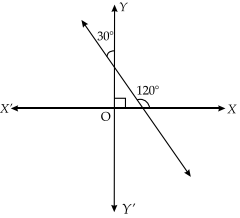
The slope of line, which makes an angle of $30^{\circ}$ with the positive direction of $\gamma$-axis measured anti-clock-wise is
  • A
    $\sqrt{3}$
  • B
    $\frac{1}{\sqrt{3}}$
  • C
    $-\sqrt{3}$
  • D
    $\frac{-1}{\sqrt{3}}$
View full question & answer
MCQ 111 Mark
A point on the $X$-axis, which is equidistant from the point $(7,6)$ and $(3,4)$ is
  • A
    $\left(0, \frac{15}{2}\right)$
  • $\left(\frac{15}{2}, 0\right)$
  • C
    $\left(\frac{2}{15}, 0\right)$
  • D
    $\left(\frac{8}{15}, 0\right)$
Answer
Correct option: B.
$\left(\frac{15}{2}, 0\right)$
(B) $\left(\frac{15}{2}, 0\right)$
Explanation : Let $P(x, 0)$ be the point, which is equidistant from $A(7,6)$ and $B(3,4)$
$\therefore$ $P A=P B$
$\Rightarrow$ $P A^2=P B^2$
$\Rightarrow$ $(7-x)^2+(6-0)^2=(3-x)^2+(4-0)^2$
$\Rightarrow$ $49-14 x+x^2+36=9-6 x+x^2+16$
$\Rightarrow$ $x=\frac{60}{8}=\frac{15}{2}$
$\therefore$ The point on $X$-axis is $\left(\frac{15}{2}, 0\right)$.
View full question & answer
MCQ 121 Mark
The distance between $P\left(x_1, y_1\right)$ and $Q\left(x_2, y_2\right)$ when PQ is parallel to $Y$-axis is
  • $\left|y_1-y_2\right|$
  • B
    $\left|x_1-x_2\right|$
  • C
    $\left|y_1+y_2\right|$
  • D
    $\left|x_1+x_2\right|$
Answer
Correct option: A.
$\left|y_1-y_2\right|$
(A) $\left|y_1-y_2\right|$
Explanation : If $P Q$ is parallel to $Y$-axis, then $x_1=x_2$
$\begin{aligned}\therefore \text{ Distance,}\quad P Q & =\left|\sqrt{\left(x_1-x_2\right)^2+\left(y_1-y_2\right)^2}\right| \\
& =\left|y_1-y_2\right| .
\end{aligned}$
View full question & answer
MCQ - Applied Maths STD 11 Science Questions - Vidyadip