MCQ 2011 Mark
If $\lim _{x \rightarrow \infty}\left(\frac{x^2+x+1}{x+1}-a x-b\right)=4$, then
- A
$a=1, b=4$
- ✓
$a=1, b=-4$
- C
$a=2, b=-3$
- D
$a=2, b=3$
AnswerCorrect option: B. $a=1, b=-4$
b
$\lim _{x \rightarrow \infty}\left(\frac{x^2+x+1}{x+1}-a x-b\right)=4 $
$\lim _{x \rightarrow \infty}\left(\frac{x^2(1-a)+x(1-a-b)+(1-b)}{x+1}\right)=4$
Limit is finite
It exists when $\quad 1- a =0 \quad \Rightarrow a =1$
then
$\lim _{x \rightarrow \infty}\left(\frac{1-a-b+\frac{1-b}{x}}{1+\frac{1}{x}}\right)=4$
$\therefore \quad 1-a-b=4 \quad \Rightarrow \quad b=-4$
View full question & answer→MCQ 2021 Mark
If $\lim _{x \rightarrow 0}\left[1+x \ln \left(1+b^2\right)\right]^{\frac{1}{x}}=2 b \sin ^2 \theta, b>0 \text { and } \theta \in(-\pi, \pi],$ then the value of $\theta$ is
- A
$\pm \frac{\pi}{4}$
- B
$\pm \frac{\pi}{3}$
- C
$\pm \frac{\pi}{6}$
- ✓
$\pm \frac{\pi}{2}$
AnswerCorrect option: D. $\pm \frac{\pi}{2}$
d
$e^{\ln \left(1+b^2\right)}=2 b \sin ^2 \theta$
$\Rightarrow \sin ^2 \theta=\frac{1+b^2}{2 b}$
$\Rightarrow \sin ^2 \theta=1 \text { as } \frac{1+b^2}{2 b} \geq 1$
$\theta=\pm \frac{\pi}{2}$
View full question & answer→MCQ 2031 Mark
Let $L=\lim _{x \rightarrow 0} \frac{a-\sqrt{a^2-x^2}-\frac{x^2}{4}}{x^4}, \quad a>0 .$ If $L$ is finite, then
$(A)$ $\quad a=2$ $(B)$ $a=1$ $(C)$ $L=\frac{1}{64}$ $(D)$ $L=\frac{1}{32}$
- A
$(A,B)$
- ✓
$(A,C)$
- C
$(B,D)$
- D
$(B,C)$
AnswerCorrect option: B. $(A,C)$
b
$L=\lim _{x \rightarrow 0} \frac{a-\sqrt{a^2-x^2}-\frac{x^2}{4}}{x^4}$
$=\lim _{x \rightarrow 0} \frac{a-a\left(1-\frac{x^2}{a^2} \frac{1}{2}-\frac{x^2}{4}\right.}{x^4}$
$=\lim _{x \rightarrow 0} \frac{a-a\left(1-\frac{1 x^2}{2 a^2}+\frac{\frac{1}{2}\left(\frac{1}{2} 1\right)}{2}\left(\frac{-x^2}{a^2}\right)^2\right)^{-\frac{x^2}{4}}}{x^4}$
$=\lim _{x \rightarrow 0} \frac{a-a\left(1-\frac{1 x^2}{2 a^2} \frac{1 x^4}{8 a_4}\right)-\frac{x^2}{4}}{x^4}$
$=\lim _{ x \rightarrow 0} \frac{\frac{1 x ^2}{2 a }+\frac{1 x ^4}{8 x ^2} \frac{ x ^4}{4}}{ x ^4}$
$=\lim _{x \rightarrow 0} \frac{x^2\left(\frac{1}{2 a} \frac{1}{4}\right)+\frac{x^4}{8 a^3}}{x^4}$
Limit is finite, when $\frac{1}{2 a }=\frac{1}{4}$
$a =2$
$\therefore L =\frac{1}{8 a ^3}$
$\therefore L =\frac{1}{8 \times 4}$
$\therefore L =\frac{1}{64}$
$\therefore L =\frac{1}{64}, a =2$
View full question & answer→MCQ 2041 Mark
Let $p(x)$ be a polynomial of degree $4$ having extremum at $x=1,2$ and $\lim _{x \rightarrow 0}\left(1+\frac{p(x)}{x^2}\right)=2 .$ Then the value of $p(2)$ is
Answerb
Let $P ( x )= ax ^4+ bx ^3+ cx ^2+ dx + e$
When $x \rightarrow o$ then, for existence of $\frac{P(x)}{x^2} d=e=o$ and $\lim _{x \rightarrow 0}\left(1+\frac{P(x)}{x^2}\right)=2$
So $c=1$.
$P^{\prime}(1)=P^{\prime}(2)=0$
$4 a+3 b+2 c+d=0$
$4 a+3 b+2=0 \quad \ldots \ldots \ldots . \text { eq. } 1$
$4 a \cdot 8+3 b \cdot 4+2 c \cdot 2+d=0$
$32 a+12 b+4 c+d=0$
$32 a+12 b+4=0 \quad \ldots \ldots . \text { eq. }$
By solving eq. $1$ and eq. $2$ we get $a =\frac{1}{4} ; b =-1$
So, $P ( x )=\frac{1}{4} x ^4- x ^3+ x ^2$.
$P (2)=4-8+4=0$
View full question & answer→MCQ 2051 Mark
If $f$ is strictly increasing function, then $\mathop {\lim }\limits_{x \to 0} \frac{{f({x^2}) - f(x)}}{{f(x) - f(0)}}$ is equal to
Answerc
(c) $\mathop {\lim }\limits_{x \to 0} \frac{{f({x^2}) - f(x)}}{{f(x) - f(0)}}$, $\left( {\frac{0}{0} \,\, {\rm{form}}} \right)$
$ = \mathop {\lim }\limits_{x \to 0} \frac{{2xf'({x^2}) - f'(x)}}{{f'(x)}}$, (using $L'$ Hospital's rule)
$ = - 1 + \mathop {\lim }\limits_{x \to 0} \frac{{2xf'({x^2})}}{{f'(x)}} = - 1,f'(0) \ne 0,\,$
as $f$ is strictly increasing.
View full question & answer→MCQ 2061 Mark
If $\mathop {\lim }\limits_{x \to 0} \frac{{[(a - n)\,nx - \tan x]\sin nx}}{{{x^2}}} = 0,$ where $n$ is non zero real number, then $a$ is equal to
- A
$0$
- B
$\frac{{n + 1}}{n}$
- C
$n$
- ✓
$n + \frac{1}{n}$
AnswerCorrect option: D. $n + \frac{1}{n}$
d
(d) $\mathop {\lim }\limits_{x \to 0} n\frac{{\sin nx}}{{nx}}.\mathop {\lim }\limits_{x \to 0} \left( {(a - n)n - \frac{{\tan x}}{x}} \right) = 0$
==> $n((a - n)n - 1) = 0 \Rightarrow (a - n)n = 1 $
$\Rightarrow a = n + \frac{1}{n}$.
View full question & answer→MCQ 2071 Mark
Given that$f'(2)=6$ and $f'(1) = 4) = $, then $\mathop {\lim }\limits_{h \to 0} \frac{{f(2h + 2 + {h^2}) - f(2)}}{{f(h - {h^2} + 1) - f(1)}} = $
Answerd
(d) $\mathop {\lim }\limits_{h \to 0} \frac{{f(2h + 2 + {h^2}) - f(2)}}{{f(h - {h^2} + 1) - f(1)}} = \mathop {\lim }\limits_{h \to 0} \frac{{f'(2h + 2 + {h^2})(2 + 2h)}}{{f'(h - {h^2} + 1)(1 - 2h)}}$
$ = \frac{{6 \times 2}}{{4 \times 1}} = 3$.
View full question & answer→MCQ 2081 Mark
The integer $n$ for which $\mathop {\lim }\limits_{x \to 0} \,\frac{{(\cos x - 1)\,(\cos x - {e^x})}}{{{x^n}}}$ is a finite non-zero number is
Answerc
(c) $n$ cannot be negative integer for then the limit $= 0$
Limit $ = \mathop {\lim }\limits_{x \to 0} \frac{{2{{\sin }^2}\frac{x}{2}}}{{{2^2}{{(x/2)}^2}}}\frac{{{e^x} - \cos x}}{{{x^{n - 2}}}} = \frac{1}{2}\mathop {\lim }\limits_{x \to 0} \frac{{{e^x} - \cos x}}{{{x^{n - 2}}}}$
$(n \ne 1$ for then the limit $ = 0)$
$ = \frac{1}{2}\mathop {\lim }\limits_{x \to 0} \frac{{{e^x} + \sin x}}{{(n - 2){x^{n - 3}}}}$.
So, if $n = 3,$ the limit is $\frac{1}{{2(n - 2)}}$ which is finite.
If $n = 4,$ the limit is infinite.
View full question & answer→MCQ 2091 Mark
Let $f:R \to R$ be such that $f(1)\, = 3$ and $f'\,(1) = 6$. Then $\mathop {\lim }\limits_{x \to 0} {\left\{ {\frac{{f(1 + x)}}{{f(1)}}} \right\}^{\frac{1}{x}}}$ equals
- A
$1$
- B
${e^{1/2}}$
- ✓
${e^2}$
- D
${e^3}$
AnswerCorrect option: C. ${e^2}$
c
(c) Limit $ = {e^{\mathop {\lim }\limits_{x \to 0} \frac{1}{x}\left[ {\log f(1 + x) - \log f(1)} \right]}} = {e^{\mathop {\lim }\limits_{x \to 0} \frac{{f'(1 + x)/f(1 + x)}}{1}}}$
$ = {e^{\frac{{f'(1)}}{{f(1)}}}} = {e^{6/3}} = {e^2}$.
View full question & answer→MCQ 2101 Mark
$\mathop {\lim }\limits_{x \to 0} \frac{{\sin (\pi {{\cos }^2}x)}}{{{x^2}}} = $
- A
$( - 1,1)$
- ✓
$\pi $
- C
$\pi /2$
- D
$1$
AnswerCorrect option: B. $\pi $
b
(b) Limit $ = \mathop {{\rm{lim}}}\limits_{x \to 0} \,\left( {\frac{{\cos (\pi {{\cos }^2}x).\pi .2\cos x( - \sin x)}}{{2x}}} \right)$
$ = \mathop {{\rm{lim}}}\limits_{x \to 0} \pi \cos (\pi {\cos ^2}x).\cos x.\left( {\frac{{ - \sin x}}{x}} \right)$
$ = \pi ( - 1).1.( - 1) = \pi $.
View full question & answer→MCQ 2111 Mark
For $x \in R,\,\,\,\mathop {\lim }\limits_{x \to \infty } \,{\left( {\frac{{x - 3}}{{x + 2}}} \right)^x}$ is equal to
- A
$e$
- B
${e^{ - 1}}$
- ✓
${e^{ - 5}}$
- D
${e^5}$
AnswerCorrect option: C. ${e^{ - 5}}$
c
(c) $\mathop {\lim }\limits_{x \to \infty } {\left( {\frac{{x + 2 - 5}}{{x + 2}}} \right)^x} = \mathop {\lim }\limits_{x \to \infty } {\left[ {{{\left( {1 - \frac{5}{{x + 2}}} \right)}^{\frac{{x + 2}}{{ - 5}}}}} \right]^{ - \,\frac{{5x}}{{x + 2}}}} = {e^{ - 5}}$
$\left( {\because \,\mathop {\lim }\limits_{x \to \infty } \frac{{ - 5x}}{{x + 2}} = \,\mathop {\lim }\limits_{x \to \infty } \frac{{ - 5}}{{1 + \frac{2}{x}}} = - 5} \right)$.
View full question & answer→MCQ 2121 Mark
$\mathop {\lim }\limits_{x \to 0} \frac{{x\tan 2x - 2x\tan x}}{{{{(1 - \cos 2x)}^2}}}$ is
- A
$2$
- B
$-2$
- ✓
$\frac{1}{2}$
- D
$ - \frac{1}{2}$
AnswerCorrect option: C. $\frac{1}{2}$
c
(c) $\mathop {\lim }\limits_{x \to 0} \,\frac{{x\tan 2x - 2x\tan x}}{{{{(1 - \cos \,\,2x)}^2}}}$
$ = \mathop {\lim }\limits_{x \to 0} \,\frac{{x(\tan \,\,2x - 2\tan x)}}{{{{(2\,{{\sin }^2}x)}^2}}} = \mathop {\lim }\limits_{x \to 0} \,\,\frac{1}{4}\,\frac{{x\,(\tan 2x - 2\tan x)}}{{{{\sin }^4}x}}$
$ = \mathop {\lim }\limits_{x \to 0} \frac{1}{4}\frac{{x\left\{ {\left( {2x + \frac{1}{3}{{(2x)}^3} + \frac{2}{{15}}\,{{(2x)}^5} + ...} \right) - 2\left( {x + \frac{{{x^3}}}{3} + \frac{2}{{15}}{x^5} + ...} \right)} \right\}}}{{{x^4}\,{{\left( {1 - \frac{{{x^2}}}{{3\,\,!}} + \frac{{{x^4}}}{{5\,\,!}} + ....} \right)}^4}}}$
$ = \frac{1}{4}\,.\,\left( {\frac{8}{3} - \frac{2}{3}} \right) = \frac{2}{4} = \frac{1}{2}$.
View full question & answer→MCQ 2131 Mark
$\mathop {\lim }\limits_{x \to 1} \frac{{\sqrt {1 - \cos 2(x - 1)} }}{{x - 1}}$
- A
Exists and it equals $\sqrt 2 $
- B
Exists and it equals $ - \sqrt 2 $
- C
Does not exist because $x - 1 \to 0$
- ✓
Does not exist because left hand limit is not equal to right hand limit
AnswerCorrect option: D. Does not exist because left hand limit is not equal to right hand limit
d
(d) $f(1 + ) = \mathop {\lim }\limits_{h \to 0} f(1 + h) = \mathop {\lim }\limits_{h \to 0} \,\,\frac{{\sqrt {1 - \cos \,\,2h} }}{h}$
$ = \mathop {\lim }\limits_{h \to 0} \,\sqrt 2 \frac{{\sin \,h}}{h} = \sqrt 2 $
$f(1 - ) = \mathop {\lim }\limits_{h \to 0} f(1 - h) = \mathop {\lim }\limits_{h \to 0} \,\,\frac{{\sqrt {1 - \cos \,( - 2h)} }}{{ - h}}$
$ = \mathop {\lim }\limits_{h \to 0} \,\sqrt 2 \frac{{\sin \,h}}{{ - h}} = - \sqrt 2 .$
$\therefore $ limit does not exist because left hand limit is not equal to right hand limit.
View full question & answer→MCQ 2141 Mark
$\mathop {\lim }\limits_{x \to 0} {\left( {\frac{{1 + 5{x^2}}}{{1 + 3{x^2}}}} \right)^{1/{x^2}}} = $
- ✓
${e^2}$
- B
$e$
- C
${e^{ - 2}}$
- D
${e^{ - 1}}$
AnswerCorrect option: A. ${e^2}$
a
(a) $\mathop {\lim }\limits_{x \to 0} \,{\left( {\frac{{1 + 5{x^2}}}{{1 + 3{x^2}}}} \right)^{1/{x^2}}} = A$
$ \Rightarrow \;{\log _e}A\; = \;\mathop {\lim }\limits_{x \to 0} \frac{1}{{{x^2}}}\log \;\left( {1 + \frac{{2{x^2}}}{{1 + 3{x^2}}}} \right)$
$ = \mathop {\lim }\limits_{x \to 0} \frac{1}{{{x^2}}}\left[ {\frac{{2{x^2}}}{{1 + 3{x^2}}} - \frac{1}{2}\left( {\frac{{2{x^2}}}{{1 + 3{x^2}}}} \right)\;\; + \;\;...} \right]$
$ = \;\mathop {\lim }\limits_{x \to 0} \left[ {\frac{2}{{1 + 3{x^2}}} - \frac{1}{2}\;\;\frac{{2{x^2}}}{{{{(1 + 3{x^2})}^2}}}\;\; + \;\;...} \right]\;\; = \;\;2$
$\therefore \;A\; = \;{e^2}$
View full question & answer→MCQ 2151 Mark
$\mathop {\lim }\limits_{x \to 0} {\left\{ {\tan \left( {\frac{\pi }{4} + x} \right)} \right\}^{1/x}} = $
AnswerCorrect option: C. ${e^2}$
c
(c) Given limit $ = \mathop {\lim }\limits_{x \to 0} \,\,{\left( {\frac{{1 + \tan x}}{{1 - \tan x}}} \right)^{1/x}}$
$ = \mathop {\lim }\limits_{x \to 0} \,\,\frac{{{{\{ {{(1 + \tan x)}^{1/\tan x}}\} }^{(\tan x)/x}}}}{{{{\{ {{(1 - \tan x)}^{1/\tan x}}\} }^{(\tan x)/x}}}} = \frac{e}{{{e^{ - 1}}}} = {e^2}$.
View full question & answer→MCQ 2161 Mark
$\mathop {\lim }\limits_{x \to \infty } \frac{{{x^n}}}{{{e^x}}} = 0$ for
- A
No value of $n$
- ✓
$n$ is any whole number
- C
$n = 0$ only
- D
$n = 2$ only
AnswerCorrect option: B. $n$ is any whole number
b
(b) $\mathop {\lim }\limits_{x \to \infty } \frac{{{x^n}}}{{{e^x}}} = \mathop {\lim }\limits_{x \to \infty } n\frac{{{x^{n - 1}}}}{{{e^x}}} = ......$
$ = \mathop {\lim }\limits_{x \to \infty } \frac{{n\,\,!}}{{{e^x}}} = \frac{{n\,\,!}}{\infty } = 0$,
where $n$ is any whole number
$( \because n! $ is defined for all positive integers including zero).
View full question & answer→MCQ 2171 Mark
$\mathop {\lim }\limits_{x \to \pi /4} \frac{{\sqrt 2 \cos x - 1}}{{\cot x - 1}} = $
- A
$\frac{1}{{\sqrt 2 }}$
- ✓
$\frac{1}{2}$
- C
$\frac{1}{{2\sqrt 2 }}$
- D
$1$
AnswerCorrect option: B. $\frac{1}{2}$
b
(b) $\mathop {\lim }\limits_{x \to \pi /4} \,\frac{{(\sqrt 2 - \sec x)\,\cos x\,(1 + \cot x)}}{{\cot x\,[2 - {{\sec }^2}x]}}$
$ = \mathop {\lim }\limits_{x \to \pi /4} \frac{{\sin x\,(1 + \cot x)}}{{(\sqrt 2 + \sec x)}} = \frac{{\frac{1}{{\sqrt 2 }}(2)}}{{\sqrt 2 + \sqrt 2 }} = \frac{1}{2}.$
Aliter : Apply $L-$ Hospital’s rule.
View full question & answer→MCQ 2181 Mark
$\mathop {\lim }\limits_{x \to \infty } \frac{{{{(2x + 1)}^{40}}{{(4x - 1)}^5}}}{{{{(2x + 3)}^{45}}}} = $
Answerc
(c) $\mathop {\lim }\limits_{x \to \infty } \frac{{{{(2 + \frac{1}{x})}^{^{40}}}{{(4 - \frac{1}{x})}^5}}}{{{{(2 + \frac{3}{x})}^{45}}}} = \frac{{{2^{40}}}}{{{2^{45}}}} = {2^5} = 32$
View full question & answer→MCQ 2191 Mark
$\mathop {\lim }\limits_{h \to 0} \frac{{{{(a + h)}^2}\sin (a + h) - {a^2}\sin a}}{h} = $
- A
$a\cos a + {a^2}\sin a$
- B
$a\sin a + {a^2}\cos a$
- ✓
$2a\sin a + {a^2}\cos a$
- D
$2a\cos a + {a^2}\sin a$
AnswerCorrect option: C. $2a\sin a + {a^2}\cos a$
c
(c) $\frac{d}{{da}}\,[{a^2}\sin a] = 2a\sin a + {a^2}\cos a.$
Aliter : Apply $ L-$ Hospital’s rule,
$\mathop {\lim }\limits_{h \to 0} \,\frac{{{{(a + h)}^2}\sin (a + h) - {a^2}\sin a}}{h}$
$ = \mathop {\lim }\limits_{h \to 0} \,\,\frac{{2\,(a + h)\,\sin \,(a + h) + {{(a + h)}^2}\cos \,(a + h)}}{1}$
$ = 2a\,\,\sin a + {a^2}\cos \,\,a.$
View full question & answer→MCQ 2201 Mark
If $f(x) = \left\{ \begin{array}{l}x\sin \frac{1}{x},\;\;\;\;\;x \ne 0\\\;\;\;\;\;\;0,\;\;\;\;\;x = 0\end{array} \right.$, then $\mathop {\lim }\limits_{x \to 0} f(x) = $
Answerb
(b) Here $f(0) = 0$
Since $ - 1 \le \sin \frac{1}{x} \le 1\,\, \Rightarrow \,\, - |\,\,x\,\,|\,\, \le x\sin \frac{1}{x} \le \,\,|\,\,x\,\,|$
We know that $\mathop {\lim }\limits_{x \to 0} \,\,|\,\,x\,\,|\, = 0$ and $\mathop {\lim }\limits_{x \to 0} \,\,|\,\,x\,\,|\, = 0$
In this way $\mathop {\lim }\limits_{x \to 0} \,\,f(x) = 0.$
View full question & answer→MCQ 2211 Mark
If $f(9) = 9$, $f'(9) = 4$, then $\mathop {\lim }\limits_{x \to 9} \frac{{\sqrt {f(x)} - 3}}{{\sqrt x - 3}} = $
Answerb
(b) Applying $L$- Hospital’s rule,
$\mathop {\lim }\limits_{x \to 9} \frac{{\frac{1}{{2\sqrt {f(x)} }} \cdot f'(x)}}{{\frac{1}{{2\sqrt x }}}} = \frac{{\frac{{f'(9)}}{{\sqrt {f(9)} }}}}{{\frac{1}{{\sqrt 9 }}}} = \frac{{\frac{4}{3}}}{{\frac{1}{3}}} = 4$
View full question & answer→MCQ 2221 Mark
If $f(x) = \left\{ \begin{array}{l}\frac{{\sin [x]}}{{[x]}},{\rm{ when\,\, }}[x] \ne 0\\\,\,\,\,\,\,\,\,\,0,{\rm{ when \,\,}}[x] = 0\end{array} \right.$ where $[x]$ is greatest integer function, then $\mathop {\lim }\limits_{x \to 0} f(x) = $
Answerd
(d) In closed interval of $x = 0$ at right hand side $[x] = 0$ and at left hand side $[x] = - 1.$ Also $[0]=0.$
Therefore function is defined as $f(x) = \left\{ \begin{array}{l}\frac{{\sin \,[x]}}{{[x]}}\,\,( - 1 \le x < 0)\\\;\;\;\;\;0\;\;(0 \le x < 1)\end{array} \right.$
$\therefore$ Left hand limit $ = \mathop {\lim }\limits_{x \to 0 - } f(x) = \mathop {\lim }\limits_{x \to 0 - } \,\frac{{\sin \,[x]}}{{[x]}}$
$ = \frac{{\sin \,( - 1)}}{{ - 1}} = \sin {1^c}$
Right hand limit $= 0$.
Hence limit doesn't exist.
View full question & answer→MCQ 2231 Mark
$\mathop {\lim }\limits_{n \to \infty } \left[ {\frac{1}{{1 - {n^2}}} + \frac{2}{{1 - {n^2}}} + \frac{3}{{1 - {n^2}}} + ........ + \frac{n}{{1 - {n^2}}}} \right] =$
- A
$0$
- ✓
$ - \frac{1}{2}$
- C
$1/2$
- D
AnswerCorrect option: B. $ - \frac{1}{2}$
b
(b) $\mathop {\lim }\limits_{n \to \infty } \,\left[ {\frac{1}{{1 - {n^2}}} + \frac{2}{{1 - {n^2}}} + ..... + \frac{n}{{1 - {n^2}}}} \right]$
$ = \mathop {\lim }\limits_{n \to \infty } \,\frac{{\Sigma n}}{{1 - {n^2}}} = \frac{1}{2}\,\,\mathop {\lim }\limits_{n \to \infty } \,\,\,\frac{{{n^2} + n}}{{1 - {n^2}}} = - \frac{1}{2}$.
View full question & answer→MCQ 2241 Mark
$\mathop {\lim }\limits_{x \to 0} \frac{{{2^x} - 1}}{{{{(1 + x)}^{1/2}} - 1}} = $
- A
$\log 2$
- ✓
$\log 4$
- C
$\log \sqrt 2 $
- D
AnswerCorrect option: B. $\log 4$
b
(b) $\mathop {\lim }\limits_{x \to 0} \,\frac{{{2^x} - 1}}{{{{(1 + x)}^{1/2}} - 1}} = \mathop {\lim }\limits_{x \to 0} \,\frac{{{2^x}\log 2}}{{{\textstyle{1 \over 2}}\,{{(1 + x)}^{ - 1/2}}}}$
$\left\{ \because \,\,\,\mathop {\lim }\limits_{x \to a} \,\,\frac{f(x)}{g(x)}=\mathop {\lim }\limits_{x \to a} \,\,\frac{{f}'(x)}{{g}'(x)} \right\}$
$ = 2\,\log 2 = \log 4.$
View full question & answer→MCQ 2251 Mark
$\mathop {\lim }\limits_{x \to 0} \frac{{x{{.2}^x} - x}}{{1 - \cos x}} = $
AnswerCorrect option: B. $\log 4$
b
(b) $\mathop {\lim }\limits_{x \to 0} \,\frac{{x.({2^x} - 1)}}{{1 - \cos x}} = \mathop {\lim }\limits_{x \to 0} \frac{{{2^x} - 1}}{x}.\frac{{{x^2}}}{{1 - \cos x}}$
$ = \log \,\,2\,.\mathop {\lim }\limits_{x \to 0} \,\,\frac{{{x^2}}}{{2\,\,{{\sin }^2}\frac{x}{2}}} = (\log \,\,2)\,.\,2 = 2\log 2 = \log 4$.
View full question & answer→MCQ 2261 Mark
$\mathop {\lim }\limits_{x \to 1} (1 - x)\tan \left( {\frac{{\pi x}}{2}} \right) = $
- A
$\frac{\pi }{2}$
- B
$\pi $
- ✓
$\frac{2}{\pi }$
- D
$0$
AnswerCorrect option: C. $\frac{2}{\pi }$
c
(c) $\mathop {\lim }\limits_{x \to 1} \,(1 - x)\tan \,\left( {\frac{{\pi x}}{2}} \right)$.
Put $1 - x = y$ as $x \to 1,\,\,y \to 0$
Thus $\mathop {\lim }\limits_{y \to 0} \,\,y\tan \frac{{\pi \,(1 - y)}}{2} = \mathop {\lim }\limits_{y \to 0} \,\,\frac{2}{\pi }.\frac{{\left( {\frac{{\pi y}}{2}} \right)}}{{\tan \,\left( {\frac{{\pi y}}{2}} \right)}} $
$= \frac{2}{\pi } \times 1 = \frac{2}{\pi }$.
View full question & answer→MCQ 2271 Mark
$\mathop {\lim }\limits_{x \to a} \frac{{\sqrt {a + 2x} - \sqrt {3x} }}{{\sqrt {3a + x} - 2\sqrt x }} = $$(a \ne 0)$
- A
$\frac{1}{{\sqrt 3 }}$
- ✓
$\frac{2}{{3\sqrt 3 }}$
- C
$\frac{2}{{\sqrt 3 }}$
- D
$\frac{2}{3}$
AnswerCorrect option: B. $\frac{2}{{3\sqrt 3 }}$
b
(b) $\mathop {\lim }\limits_{x \to a} \,\frac{{\sqrt {a + 2x} - \sqrt {3x} }}{{\sqrt {3a + x} - 2\sqrt x }}$
$ = \mathop {\lim }\limits_{x \to a} \,\frac{{\sqrt {a + 2x} - \sqrt {3x} }}{{\sqrt {3a + x} - 2\sqrt x }} \times \frac{{\sqrt {a + 2x} + \sqrt {3x} }}{{\sqrt {a + 2x} + \sqrt {3x} }} \times \frac{{\sqrt {3a + x} + 2\sqrt x }}{{\sqrt {3a + x} + 2\sqrt x }}$
$ = \mathop {\lim }\limits_{x \to a} \frac{{\sqrt {3a + x} + 2\sqrt x }}{{3\,(\sqrt {a + 2x} + \sqrt {3x)} }} = \frac{2}{{3\sqrt 3 }}$.
Aliter : Apply $L-$ Hospital’s rule.
View full question & answer→MCQ 2281 Mark
$\mathop {\lim }\limits_{x \to 1} \frac{{(2x - 3)(\sqrt x - 1)}}{{2{x^2} + x - 3}} = $
AnswerCorrect option: A. $-1/10$
a
(a) $\mathop {\lim }\limits_{x \to 1} \,\,\frac{{(2x - 3)\,(\sqrt x - 1) \times (\sqrt x + 1)}}{{(x - 1)\,(2x + 3) \times (\sqrt x + 1)}} = \frac{{ - 1}}{{5\,.\,2}} = \frac{{ - 1}}{{10}}.$
View full question & answer→MCQ 2291 Mark
$\mathop {\lim }\limits_{\alpha \to \pi /4} \frac{{\sin \alpha - \cos \alpha }}{{\alpha - \frac{\pi }{4}}} = $
- ✓
$\sqrt 2 $
- B
$1/\sqrt 2 $
- C
$1$
- D
AnswerCorrect option: A. $\sqrt 2 $
a
(a) $\mathop {\lim }\limits_{\alpha \to \pi /4} \,\frac{{\sin \alpha - \cos \alpha }}{{\alpha - \pi /4}}$
$ = \mathop {\lim }\limits_{\alpha \to \pi /4} \,\left\{ {\frac{{\sqrt 2 \left( {\sin \alpha .\frac{1}{{\sqrt 2 }} - \cos \alpha .\frac{1}{{\sqrt 2 }}} \right)}}{{\left( {\alpha - \frac{\pi }{4}} \right)}}} \right\}$
$ = \sqrt 2 \,\mathop {\lim }\limits_{\alpha \to \pi /4} \,\frac{{\sin \,\left( {\alpha - \frac{\pi }{4}} \right)}}{{\left( {\alpha - \frac{\pi }{4}} \right)}} = \sqrt 2 \times 1 = \sqrt 2 $.
Aliter : Apply $L-$ Hospital’s rule,
$\mathop {\lim }\limits_{\alpha \to \pi /4} \,\frac{{\sin \alpha - \cos \alpha }}{{\alpha - (\pi /4)}} = \mathop {\lim }\limits_{\alpha \to \pi /4} \,\frac{{\cos \alpha + \sin \alpha }}{1} = \frac{1}{{\sqrt 2 }} + \frac{1}{{\sqrt 2 }} = \sqrt 2 $.
View full question & answer→MCQ 2301 Mark
$\mathop {\lim }\limits_{x \to 1} \frac{{x - 1}}{{2{x^2} - 7x + 5}} = $
AnswerCorrect option: C. $-1/3$
c
(c) $\mathop {\lim }\limits_{x \to 1} \,\,\frac{{x - 1}}{{(x - 1)\,(2x - 5)}} = - \frac{1}{3}$.
Aliter : Apply $L$- Hospital’s rule.
View full question & answer→MCQ 2311 Mark
$\mathop {\lim }\limits_{x \to \pi /2} (\sec \theta - \tan \theta ) = $
Answera
(a)$\mathop {\lim }\limits_{\theta \to \pi /2} \,\,\frac{{1 - \sin \theta }}{{\cos \theta }} = \mathop {\lim }\limits_{\theta \to \pi /2} \,\,\frac{{{{\left( {\cos \frac{\theta }{2} - \sin \frac{\theta }{2}} \right)}^2}}}{{\left( {\cos \frac{\theta }{2} - \sin \frac{\theta }{2}} \right)\,\left( {\cos \frac{\theta }{2} + \sin \frac{\theta }{2}} \right)}} = 0$.
View full question & answer→MCQ 2321 Mark
$\mathop {\lim }\limits_{x \to \infty } \frac{{\sin x}}{x} = $
Answerb
(b) $\mathop {\lim }\limits_{x \to \infty } \,\,\frac{{\sin x}}{x},$ let $x = \frac{1}{y}$ or $y = \frac{1}{x},$
so that $x \to \infty \,\, \Rightarrow \,y \to 0$
$\therefore \,\mathop {\lim }\limits_{x \to \infty } \,\left( {\frac{{\sin x}}{x}} \right) = \mathop {\lim }\limits_{y \to 0} \,\left( {y.\sin \frac{1}{y}} \right)$
$= \mathop {\lim }\limits_{y \to 0} \,y \times \mathop {\lim }\limits_{y \to 0} \,\sin \frac{1}{y} = 0 \times ... = 0$
View full question & answer→MCQ 2331 Mark
$\mathop {\lim }\limits_{x \to 0} \frac{{\tan x - \sin x}}{{{x^3}}} = $
- ✓
$\frac{1}{2}$
- B
$ - \frac{1}{2}$
- C
$\frac{2}{3}$
- D
AnswerCorrect option: A. $\frac{1}{2}$
a
(a) $\mathop {\lim }\limits_{x \to 0} \,\frac{{\tan x - \sin x}}{{{x^3}}} = \mathop {\lim }\limits_{x \to 0} \,\frac{{\sin x - \sin x\,\cos x}}{{{x^3}\cos x}}$
$ = \mathop {\lim }\limits_{x \to 0} \,\frac{{\sin x\,\left( {2\,\,{{\sin }^2}\frac{x}{2}} \right)}}{{{x^3}\,\cos x}} $
$= \mathop {\lim }\limits_{x \to 0} \,\left[ {\frac{{\sin x}}{x}.\frac{2}{{\cos x}}.\frac{{{{\sin }^2}\frac{x}{2}}}{{{{\left( {\frac{x}{2}} \right)}^2}}}.\frac{1}{4}} \right] = \frac{1}{2}$.
View full question & answer→MCQ 2341 Mark
$\mathop {\lim }\limits_{x \to 0} \frac{{\tan 2x - x}}{{3x - \sin x}} = $
Answerc
(c) $\mathop {\lim }\limits_{x \to 0} \,\,\,\frac{{\tan \,\,2x - x}}{{3x - \sin x}} = \mathop {\lim }\limits_{x \to 0} \,\,\,\left\{ {\frac{{\frac{{2\,\tan 2x}}{{2x}} - 1}}{{3 - \frac{{\sin x}}{x}}}} \right\} = \frac{1}{2}.$
Aliter : Apply $L-$ Hospital‘s rule
$\mathop {\lim }\limits_{x \to 0} \,\,\frac{{\tan 2x - x}}{{3x - \sin x}} = \mathop {\lim }\limits_{x \to 0} \,\frac{{2{{\sec }^2}2x - 1}}{{3 - \cos x}} = \frac{{2 - 1}}{{3 - 1}} = \frac{1}{2}.$
View full question & answer→MCQ 2351 Mark
$\mathop {\lim }\limits_{x \to 0} \frac{{{x^3}\cot x}}{{1 - \cos x}} = $
Answerc
(c) $\mathop {\lim }\limits_{x \to 0} \,\,\frac{{{x^3}\cot x}}{{1 - \cos x}} = \mathop {\lim }\limits_{x \to 0} \,\left( {\frac{{{x^3}\cot x}}{{1 - \cos x}} \times \frac{{1 + \cos x}}{{1 + \cos x}}} \right)$
$ = \mathop {\lim }\limits_{x \to 0} \,{\left( {\frac{x}{{\sin x}}} \right)^3} \times \mathop {\lim }\limits_{x \to 0} \,\cos x \times \mathop {\lim }\limits_{x \to 0} \,(1 + \cos x) = 2$
View full question & answer→MCQ 2361 Mark
$\mathop {\lim }\limits_{x \to 0} \frac{{x({e^x} - 1)}}{{1 - \cos x}} = $
Answerd
(d) $\mathop {\lim }\limits_{x \to 0} \,\,\,\frac{{x\,({e^x} - 1)}}{{1 - \cos x}} = \mathop {\lim }\limits_{x \to 0} \,\frac{{2x\,({e^x} - 1)}}{{4.{{\sin }^2}\frac{x}{2}}}$
$ = 2\mathop {\lim }\limits_{x \to 0} \,\left[ {\frac{{{{(x/2)}^2}}}{{{{\sin }^2}\frac{x}{2}}}} \right]\,\left( {\frac{{{e^x} - 1}}{x}} \right) = 2.$
View full question & answer→MCQ 2371 Mark
$\mathop {\lim }\limits_{x \to a} \frac{{\sqrt {3x - a} - \sqrt {x + a} }}{{x - a}} = $
- A
$\sqrt 2 a$
- ✓
$1/\sqrt {2a} $
- C
$2a$
- D
$1/2a$
AnswerCorrect option: B. $1/\sqrt {2a} $
b
(b) $\mathop {\lim }\limits_{x \to a} \,\frac{{\sqrt {3x - a} - \sqrt {x + a} }}{{x - a}}$
$ = \mathop {\lim }\limits_{x \to a} \,\frac{{\sqrt {3x - a} - \sqrt {x + a} }}{{(x - a)}} \times \frac{{\sqrt {3x - a} + \sqrt {x + a} }}{{\sqrt {3x - a} + \sqrt {x + a} }}$
$ = \frac{2}{{2\sqrt {2a} }} = \frac{1}{{\sqrt {2a} }}$
Aliter : Apply $L$- Hospital’s rule
$\mathop {\lim }\limits_{x \to a} \,\frac{{\sqrt {3x - a} - \sqrt {x + a} }}{{x - a}} = \mathop {\lim }\limits_{x \to a} \,\frac{3}{{2\,\sqrt {3x - a} }} - \frac{1}{{2\,\sqrt {x + a} }}$
$ = \frac{3}{{2\sqrt {2a} }} - \frac{1}{{2\sqrt {2a} }} = \frac{1}{{\sqrt {2a} }}.$
View full question & answer→MCQ 2381 Mark
If $f(x) = \left\{ \begin{array}{l}\,\,\,\,\,\,\,x,\;{\rm{when\,\, }}0 \le x \le 1\\2 - x,\;{\rm{when \,\,}}1 < x \le 2\end{array} \right.$, then $\mathop {\lim }\limits_{x \to 1} f(x) = $
Answera
(a) Hence $\mathop {\lim }\limits_{x \to 1} \,f(x) = 1$
Aliter : $\mathop {\lim }\limits_{x \to 1 - } \,f(x) = \mathop {\lim }\limits_{h \to 0} \,\,(1 - h) = 1$
and $\mathop {\lim }\limits_{x \to 1 + } \,f(x) = \mathop {\lim }\limits_{h \to 0} \,\,2 - (1 + h) = 1$
Hence limit of function is $1$.
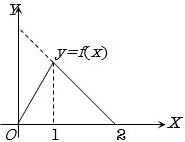
View full question & answer→MCQ 2391 Mark
$\mathop {\lim }\limits_{x \to 1} \frac{{\log x}}{{x - 1}} = $
Answera
(a) $\mathop {\lim }\limits_{x \to 1} \,\,\frac{{\log \,[(x - 1) + 1]}}{{x - 1}} = 1.$
Aliter : Apply $L-$ Hospital’s rule,
$\mathop {\lim }\limits_{x \to 1} \frac{{\log x}}{{x - 1}} = \mathop {\lim }\limits_{x \to 1} \frac{{\frac{1}{x}}}{1} = 1$
View full question & answer→MCQ 2401 Mark
If $\mathop {\lim }\limits_{x \to 2} \frac{{{x^n} - {2^n}}}{{x - 2}} = 80$, where $n$ is a positive integer, then $n = $
Answerb
(b) $\mathop {\lim }\limits_{x \to 2} \,\,\frac{{{x^n} - {2^n}}}{{x - 2}} = n\,.\,{2^{n - 1}}\,\, $
$\Rightarrow \,\,n.\,{2^{n - 1}} = 80\,\, \Rightarrow \,\,n = 5$.
View full question & answer→MCQ 2411 Mark
$\mathop {\lim }\limits_{x \to 0} \frac{{1 - \cos 2x}}{x} = $
Answera
(a)$\mathop {\lim }\limits_{x \to 0} \,\,\frac{{x\,.\,2\,{{\sin }^2}x}}{{{x^2}}} = 2.\mathop {\lim }\limits_{x \to 0} {\left( {\frac{{\sin x}}{x}} \right)^2} \cdot \mathop {\lim }\limits_{x \to 0} x = 0$.
View full question & answer→MCQ 2421 Mark
If $\mathop {\lim }\limits_{x \to 0} kx\,{\rm{cosec}}\,x = \mathop {\lim }\limits_{x \to 0} x\,{\rm{cosec}}\;kx$, then $k = $
- A
$1$
- B
$-1$
- ✓
$ \pm 1$
- D
$ \pm \,2$
AnswerCorrect option: C. $ \pm 1$
c
(c) $\mathop {\lim }\limits_{x \to 0} \,\,kx\cos ec\,x=\mathop {\lim }\limits_{x \to 0} \,\,x\cos ec\,\,kx$
$\Rightarrow \,\,k\,\,.\,\mathop {\lim }\limits_{x \to 0} \,\,\,\frac{x}{\sin x}=\frac{1}{k} \mathop {\lim }\limits_{x \to 0} \,\,\,\frac{kx}{\sin \,kx}$
$\Rightarrow \,\,k=\frac{1}{k}\,\,\Rightarrow \,\,k=\pm \,1$
View full question & answer→MCQ 2431 Mark
$\mathop {\lim }\limits_{x \to 0} \frac{{\log \cos x}}{x} = $
Answera
(a) $\mathop {\lim }\limits_{x \to 0} \,\,\frac{{\log \cos x}}{x} = \mathop {\lim }\limits_{x \to 0} \,\,\frac{{\log \,\left[ {1 - 2{{\sin }^2}\frac{x}{2}} \right]}}{x}$
$ = \mathop {\lim }\limits_{x \to 0} \,\,\frac{{ - \,\left[ {2\,{{\sin }^2}\frac{x}{2} + {{\left( {\frac{{2\,{{\sin }^2}\frac{x}{2}}}{2}} \right)}^2} + ......} \right]}}{x} = 0$
Aliter : Apply $L-$ Hospital’s rule,
$\mathop {\lim }\limits_{x \to 0} \,\frac{{\log \cos x}}{x} = \mathop {\lim }\limits_{x \to 0} \,\frac{{ - \tan x}}{1} = 0.$
View full question & answer→MCQ 2441 Mark
$\mathop {\lim }\limits_{x \to 0} \frac{{|x|}}{x} = $
Answerd
(d) Since $\mathop {\lim }\limits_{x \to 0 - } \,\,\frac{{|\,\,x\,\,|}}{x} = - 1$ and $\mathop {\lim }\limits_{x \to 0 + } \,\,\frac{{|\,\,x\,\,|}}{x} = 1,$
hence limit does not exist.
View full question & answer→MCQ 2451 Mark
$\mathop {\lim }\limits_{h \to 0} \frac{{\sqrt {x + h} - \sqrt x }}{h} = $
- ✓
$\frac{1}{{2\sqrt x }}$
- B
$\frac{1}{{\sqrt x }}$
- C
$2\sqrt x $
- D
$\sqrt x $
AnswerCorrect option: A. $\frac{1}{{2\sqrt x }}$
a
(a) $\mathop {\lim }\limits_{h \to 0} \,\,\frac{{\sqrt {x + h} - \sqrt x }}{h} = \mathop {\lim }\limits_{h \to 0} \,\,\frac{{{{(\sqrt {x + h} )}^2} - {{(\sqrt x )}^2}}}{{h\,(\sqrt {x + h} + \sqrt x )}} = \frac{1}{{2\sqrt x }}$.
Aliter : Apply $L-$ Hospital rule,
$\mathop {\lim }\limits_{h \to 0} \,\,\frac{{\sqrt {x + h} - \sqrt x }}{h} = \mathop {\lim }\limits_{h \to 0} \,\,\frac{1}{{2\sqrt {x + h} }} = \frac{1}{{2\sqrt x }}$.
View full question & answer→MCQ 2461 Mark
$\mathop {\lim }\limits_{x \to 0} \frac{{1 - \cos mx}}{{1 - \cos nx}} = $
AnswerCorrect option: C. $\frac{{{m^2}}}{{{n^2}}}$
c
(c) $\mathop {\lim }\limits_{x \to 0} \,\frac{{1 - \cos mx}}{{1 - \cos \,nx}} = \mathop {\lim }\limits_{x \to 0} \,\,\left\{ {\frac{{2\,{{\sin }^2}{\textstyle{{mx} \over 2}}}}{{2\,{{\sin }^2}{\textstyle{{nx} \over 2}}}}} \right\}$
$ = \mathop {\lim }\limits_{x \to 0} \,\left[ {{{\left\{ {\frac{{\sin {\textstyle{{mx} \over 2}}}}{{{\textstyle{{mx} \over 2}}}}} \right\}}^2}\,\,\,\frac{{{m^2}{x^2}}}{4}.\frac{1}{{{{\left\{ {\frac{{\sin {\textstyle{{nx} \over 2}}}}{{{\textstyle{{nx} \over 2}}}}} \right\}}^2}}}.\frac{4}{{{n^2}{x^2}}}} \right]$
$ = \frac{{{m^2}}}{{{n^2}}} \times 1 = \frac{{{m^2}}}{{{n^2}}}$.
Aliter : Apply $L$-Hospital’s rule,
$\mathop {\lim }\limits_{x \to 0} \frac{{1 - \cos mx}}{{1 - \cos nx}} = \mathop {\lim }\limits_{x \to 0} \frac{{m\sin mx}}{{n\sin nx}} $
$= \mathop {\lim }\limits_{x \to 0} \frac{{{m^2}\cos mx}}{{{n^2}\cos nx}} = \frac{{{m^2}}}{{{n^2}}}.$
View full question & answer→MCQ 2471 Mark
$\mathop {\lim }\limits_{x \to 0} \frac{{{e^{\sin x}} - 1}}{x} = $
Answera
(a) $\mathop {\lim }\limits_{x \to 0} \,\frac{{{e^{\sin x}} - 1}}{x} = \mathop {\lim }\limits_{x \to 0} \,\frac{{{e^{\sin x}} - 1}}{{\sin x}} \times \frac{{\sin x}}{x}$
$ = \mathop {\lim }\limits_{x \to 0} \,\frac{{{e^{\sin x}} - 1}}{{\sin x}} \times \mathop {\lim }\limits_{x \to 0} \,\frac{{\sin x}}{x} = 1 \times 1 = 1$.
Aliter : Apply $L-$ Hospital’s rule,
$\mathop {\lim }\limits_{x \to 0} \,\frac{{{e^{\sin x}} - 1}}{x} = \mathop {\lim }\limits_{x \to 0} \,\frac{{\cos x\,{e^{\sin x}}}}{1} = 1.\,{e^0} = 1.$
View full question & answer→MCQ 2481 Mark
$\mathop {\lim }\limits_{x \to \infty } \sqrt x (\sqrt {x + 5} - \sqrt x ) = $
Answerc
(c) $\mathop {\lim }\limits_{x \to \infty } \,\sqrt x \,(\sqrt {x + 5} - \sqrt x ) \times \frac{{(\sqrt {x + 5} + \sqrt x )}}{{(\sqrt {x + 5} + \sqrt x )}}$
$ = \mathop {\lim }\limits_{x \to \infty } \frac{{\sqrt x \,(5)}}{{\sqrt x \,\left( {\sqrt {1 + \frac{5}{x}} + 1} \right)}} = \frac{5}{2}$.
View full question & answer→MCQ 2491 Mark
$\mathop {\lim }\limits_{x \to 0} \frac{{\sqrt {1 + \sin x} - \sqrt {1 - \sin x} }}{x} = $
Answerb
(b) $\frac{\sqrt{1+\sin x}+\sqrt{1-\sin x}}{\sqrt{1+\sin x}+\sqrt{1-\sin x}}$
Apply $L-$ Hospital‘s rule,
$\mathop {\lim }\limits_{x \to 0} \frac{{\sqrt {1 + \sin x} - \sqrt {1 - \sin x} }}{x}$
$ = \mathop {\lim }\limits_{x \to 0} \,\,\frac{{\cos x}}{{2\sqrt {1 + \sin x} }} + \frac{{\cos x}}{{2\sqrt {1 - \sin x} }} = \frac{1}{2} + \frac{1}{2} = 1.$
View full question & answer→MCQ 2501 Mark
$\mathop {\lim }\limits_{x \to 0} \frac{{2{{\sin }^2}3x}}{{{x^2}}} = $
Answerc
(c)$\mathop {\lim }\limits_{x \to 0} \,\,\frac{{2 \times 9\,{{\sin }^2}3x}}{{{{(3x)}^2}}} = 18$
View full question & answer→