MCQ 511 Mark
Domain of the function $\log |{x^2} - 9|$ is
- A
$R$
- B
$R - [ - 3,\;3]$
- ✓
$R - \{ - 3,\;3\} $
- D
AnswerCorrect option: C. $R - \{ - 3,\;3\} $
c
(c) For $x = - 3,\,\,3,\,\,\,|\,\,{x^2} - 9\,\,|\, = 0$
Therefore $\log \,|{x^2} - 9|\,$ does not exist at $x = - \,3,\,\,3.$
Hence domain of function is $R - \left\{ { - \,3,\,\,3} \right\}.$
View full question & answer→MCQ 521 Mark
Domain of $f(x) = \log |\log x|$ is
AnswerCorrect option: C. $(0,\;1) \cup (1,\;\infty )$
c
(c) $f(x) = \log |\log x|$, $f(x)$ is defined if $|\log x| > 0$ and $x > 0$
$i.e.,$ if $x > 0$ and $x \ne 1$
==> $x \in (0,\,1) \cup (1,\,\infty ).$
View full question & answer→MCQ 531 Mark
If the domain of function $f(x) = {x^2} - 6x + 7$ is $( - \infty ,\;\infty )$, then the range of function is
- A
$( - \infty ,\;\infty )$
- ✓
$[ - 2,\;\infty )$
- C
$( - 2,\;3)$
- D
$( - \infty ,\; - 2)$
AnswerCorrect option: B. $[ - 2,\;\infty )$
b
(b) ${x^2} - 6x + 7 = {(x - 3)^2} - 2$
Obviously, minimum value is $-2$ and maximum $\infty $.
Hence range of function is $[-2, \infty].$
View full question & answer→MCQ 541 Mark
The domain of the function $f(x) = \sqrt {\log \frac{1}{{|\sin x|}}} $ is
- A
$R - \{ 2n\pi ,\;n \in I\} $
- ✓
$R - \{ n\pi ,\;n \in I\} $
- C
$R - \{ - \pi ,\;\pi \} $
- D
$( - \infty ,\;\infty )$
AnswerCorrect option: B. $R - \{ n\pi ,\;n \in I\} $
b
(b) $f(x) = \sqrt {\,\log \frac{1}{{|\sin x|}}} $
==> $3 + x > 0$==> $x \ne n\pi + {( - 1)^n}0$
==> $x \ne n\pi $. Domain of $f(x) = R - \{ n\pi ,\,\,n \in I\} $.
View full question & answer→MCQ 551 Mark
The domain of the function $f(x) = \log (\sqrt {x - 4} + \sqrt {6 - x} )$ is
- A
$[4,\infty )$
- B
$( - \infty ,\;6]$
- ✓
$[4,\;6]$
- D
AnswerCorrect option: C. $[4,\;6]$
c
(c) $f(x) = \log (\sqrt {x - 4} + \sqrt {6 - x} )$
==> $y = {x^x}\, \Rightarrow \,\,\,\log y = x\log x$ and $6 - x \ge 0$==>$x \ge 4$ and $x \le 6$
$\therefore $ Domain of $f(x)$ = $[4,\,\,6]$.
View full question & answer→MCQ 561 Mark
If $‘n’$ is an integer, the domain of the function $\sqrt {\sin 2x} $ is
- A
$\left[ {n\pi - \frac{\pi }{2},\;n\pi } \right]$
- ✓
$\left[ {n\pi ,\;n\pi + \frac{\pi }{2}} \right]$
- C
$[(2n - 1)\pi ,\;2n\pi ]$
- D
$[2n\pi ,\;(2n + 1)\pi ]$
AnswerCorrect option: B. $\left[ {n\pi ,\;n\pi + \frac{\pi }{2}} \right]$
b
(b) According to question, as $\sqrt {\sin 2x} $ can’t be negative.
So the option $(b)$ is correct
Domain of function $\sqrt {\sin 2x} $ is $[n\pi ,\,n\pi + \pi /2]$.
View full question & answer→MCQ 571 Mark
Domain of the function $f(x) = \frac{{x - 3}}{{(x - 1)\sqrt {{x^2} - 4} }}$ is
- A
$(1, 2)$
- ✓
$( - \infty ,\; - 2) \cup (2,\;\infty )$
- C
$( - \infty ,\; - 2) \cup (1,\;\infty )$
- D
$( - \infty ,\;\infty ) - \{ 1,\; \pm 2\} $
AnswerCorrect option: B. $( - \infty ,\; - 2) \cup (2,\;\infty )$
b
Obviously, here $|x|\,\, > \,\,2$ and $x \ne 1$
$i.e.,$ $x \in ( - \,\infty ,\, - \,2)\, \cup \,(2,\,\infty )$.
View full question & answer→MCQ 581 Mark
Domain of the function $\sqrt {\log \left\{ {(5x - {x^2})/6} \right\}} $ is
- A
$(2, 3)$
- ✓
$[2, 3]$
- C
$[1, 2]$
- D
$[1, 3]$
AnswerCorrect option: B. $[2, 3]$
b
(b) $\log \,\left\{ {\frac{{5x - {x^2}}}{6}} \right\}\, \ge 0\,\, \Rightarrow \,\frac{{5x - {x^2}}}{6} \ge 1$
or ${x^2} - 5x + 6 \le 0$ or $(x - 2)\,(x - 3) \le 0$.
Hence $2 \le x \le 3.$
View full question & answer→MCQ 591 Mark
Domain of the function $\sqrt {2 - x} - \frac{1}{{\sqrt {9 - {x^2}} }}$ is
- A
$(-3, 1)$
- B
$[-3, 1]$
- ✓
$(-3, 2]$
- D
$[-3, 1)$
AnswerCorrect option: C. $(-3, 2]$
c
(c) (i) $x \le 2$ (ii) $\sqrt {9 - {x^2}} > 0\,\, $
$\Rightarrow \,\,|\,\,x\,\,|\, < 3$ or $ - 3 < x < 3.$
Hence domain is $( - \,3,\,\,2].$
View full question & answer→MCQ 601 Mark
Domain of the function $\frac{{\sqrt {1 + x} - \sqrt {1 - x} }}{x}$ is
- A
$(-1, 1)$
- B
$(-1, 1)-{0}$
- C
$[-1, 1]$
- ✓
$[-1, 1]-{0}$
AnswerCorrect option: D. $[-1, 1]-{0}$
d
(d) $1 + x \ge 0\,\, \Rightarrow \,\,x \ge - 1$;
$1 - x \ge 0\,\, \Rightarrow \,\,x \le 1,\,\,x \ne 0$
Hence domain is $[ - 1,\,1] - \{ 0\} $.
View full question & answer→MCQ 611 Mark
The domain of the function $f(x) = \sqrt {x - {x^2}} + \sqrt {4 + x} + \sqrt {4 - x} $ is
- A
$[ - 4,\;\infty )$
- B
$[-4, 4]$
- C
$[0, 4]$
- ✓
$[0, 1]$
AnswerCorrect option: D. $[0, 1]$
d
(d) $f(x) = \sqrt {x - {x^2}} + \sqrt {4 + x} + \sqrt {4 - x} $
Clearly $f(x)$ is defined, if $4 + x \ge 0$ ==> $x \ge - 4$
$4 - x \ge 0$ ==> $x \le 4$
$x(1 - x) \ge 0$ ==> $x \ge 0$ and $x \le 1$
$\therefore$ Domain of $f = ( - \infty ,\,4] \cap [ - 4,\,\infty ) \cap [0,\,1]$$ = [0,\,1]$.
View full question & answer→MCQ 621 Mark
The domain of the function $f(x) = \frac{1}{1 + {e^x}} $ is $[-1, 1]$ then range of fanction ?
AnswerCorrect option: A. $\left( {\frac{1}{4},\;\frac{1}{3}} \right)$
a
(a) Clearly $ - 1 \le x \le 1$
But $2 < {e^x} < 3$ ==> $3 < ({e^x} + 1) < 4$
==> $\frac{1}{4} < \frac{1}{{1 + {e^x}}} < \frac{1}{3}$
$\therefore$ Range of $f(x) = \left( {\frac{1}{4},\,\frac{1}{3}} \right)$.
View full question & answer→MCQ 631 Mark
The largest possible set of real numbers which can be the domain of $f(x) = \sqrt {1 - \frac{1}{x}} $ is
- A
$(0,\;1) \cup (0,\;\infty )$
- B
$( - 1,\;0) \cup (1,\;\infty )$
- C
$( - \infty ,\; - 1) \cup (0,\;\infty )$
- ✓
$( - \infty ,\;0) \cup (1,\;\infty )$
AnswerCorrect option: D. $( - \infty ,\;0) \cup (1,\;\infty )$
d
(d) $1 - \frac{1}{x} > 0 \Rightarrow x > 1$. Also, $x \ne 0$.
$\because$ Required interval $ = ( - \infty ,\,0) \cup (1,\,\infty )$.
View full question & answer→MCQ 641 Mark
Domain of $f(x) = {({x^2} - 1)^{ - 1/2}}$ is
- ✓
$( - \infty ,\; - 1) \cup (1,\;\infty )$
- B
$( - \infty ,\; - 1] \cup (1,\;\infty )$
- C
$( - \infty ,\; - 1] \cup [1,\;\infty )$
- D
AnswerCorrect option: A. $( - \infty ,\; - 1) \cup (1,\;\infty )$
a
(a) Here $|x|\,\, > 1,$
therefore $x \in ( - \,\infty ,\, - 1)\, \cup \,(1,\,\,\infty ).$
View full question & answer→MCQ 651 Mark
The domain of the function $y = \frac{1}{{\sqrt {|x|\; - x} }}$ is
- ✓
$( - \infty ,\;0)$
- B
$( - \infty ,\;0]$
- C
$( - \infty ,\; - 1)$
- D
$( - \infty ,\;\infty )$
AnswerCorrect option: A. $( - \infty ,\;0)$
a
(a) For it must $|x| - x > 0$
$|x|\,\, > x$ but $|x|\,\, = x$ for $x $ positive and $|x|\,\, > x$ for $ x $ negative.
So, domain will be $( - \,\infty ,\,\,0)$.
View full question & answer→MCQ 661 Mark
The natural domain of the real valued function defined by $f(x) = \sqrt {{x^2} - 1} + \sqrt {{x^2} + 1} $ is
- A
$1 < x < \infty $
- B
$ - \infty < x < \infty $
- C
$ - \infty < x < - 1$
- ✓
$( - \infty ,\;\infty ) - ( - 1,\;1)$
AnswerCorrect option: D. $( - \infty ,\;\infty ) - ( - 1,\;1)$
d
(d) $f(x) = \sqrt {{x^2} - 1} + \sqrt {{x^2} + 1} \,\, \Rightarrow \,\,f(x) = {y_1} + {y_2}$
Domain of ${y_1} = \sqrt {{x^2} - 1} \, \Rightarrow \,\,{x^2} - 1 \ge 0\,\, \Rightarrow \,\,{x^2} \ge 1$
$x \in ( - \,\infty ,\,\,\infty ) - ( - 1,\,\,1)$ and Domain of ${y_2}$ is real number,
$\therefore $ Domain of $f(x) = ( - \infty ,\,\,\infty ) - ( - 1,\,\,1)$.
View full question & answer→MCQ 671 Mark
The domain of the function $f(x) = \exp (\sqrt {5x - 3 - 2{x^2}} )$ is
- A
$\left[ {1,\; - \frac{3}{2}} \right]$
- B
$\left[ {\frac{3}{2},\;\infty } \right]$
- C
$[ - \infty ,\;1]$
- ✓
$\left[ {1,\;\frac{3}{2}} \right]$
AnswerCorrect option: D. $\left[ {1,\;\frac{3}{2}} \right]$
d
(d) $f(x) = {e^{\sqrt {5x - 3 - 2{x^2}} }}$
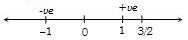
==>$5x - 3 - 2{x^2} \ge 0$ or $(x - 1)\left( {x - \frac{3}{2}} \right) \ge 0$
$\therefore$ $D \in \,[1,\,3/2]$.
View full question & answer→MCQ 681 Mark
If $f(x) = a\cos (bx + c) + d$, then range of $f(x)$ is
- A
$[d + a,\;d + 2a]$
- B
$[a - d,\;a + d]$
- C
$[d + a,\;a - d]$
- ✓
$[d - a,\;d + a]$
AnswerCorrect option: D. $[d - a,\;d + a]$
d
(d) $f(x) = a\cos (bx + c) + d…..(i)$
For minimum $\cos (bx + c) = - 1$
from $(i)$, $f(x) = - a + d = (d - a)$
For maximum $\cos (bx + c) = 1$
from $(i)$, $f(x) = a + d = (d + a)$
$\therefore$ Range of $f(x) = [d - a,\,\,d + a]$
View full question & answer→MCQ 691 Mark
The range of $f(x) = \cos x - \sin x$ is
- A
$( - 1,\;1)$
- B
$[ - 1,\,\;1)$
- C
$\left[ { - \frac{\pi }{2},\;\frac{\pi }{2}} \right]$
- ✓
$[ - \sqrt 2 ,\;\sqrt 2 ]$
AnswerCorrect option: D. $[ - \sqrt 2 ,\;\sqrt 2 ]$
d
(d) Since maximum and minimum values of $\cos x - \sin x$ are $\sqrt 2 $ and $ - \sqrt 2 $ respectively,
therefore range of $f(x)$ is $[ - \sqrt 2 ,\,\,\sqrt 2 ].$
View full question & answer→MCQ 701 Mark
If $f:R \to R$, then the range of the function $f(x) = \frac{{{x^2}}}{{{x^2} + 1}}$ is
- A
${R^- }$
- ✓
$[0,1)$
- C
$R$
- D
$R \times R$
AnswerCorrect option: B. $[0,1)$
b
(b) ${R^+ }$ $\{$as $y$ is always positive $\,\,x \in R\} $.
View full question & answer→MCQ 711 Mark
The range of $f(x) = \cos 2x - \sin 2x$ contains the set
- A
$[2, 4]$
- ✓
$[-1, 1]$
- C
$[-2, 2]$
- D
$[-4, 4]$
AnswerCorrect option: B. $[-1, 1]$
b
(b) $f(x) = \sqrt 2 \,\left[ {\sin \left( {\frac{\pi }{4} - 2x} \right)} \right]$
$\therefore \,\, - \sqrt 2 \le f(x) \le \sqrt 2 $ and $[ - 1,\,\,1]\, \subset \,[ - \sqrt 2 ,\sqrt 2 ]$.
View full question & answer→MCQ 721 Mark
Range of the function $\frac{1}{{2 - \sin 3x}}$ is
- A
$[1, 3]$
- ✓
$\left[ {\frac{1}{3},\,\,1} \right]$
- C
$(1, 3)$
- D
$\left( {\frac{1}{3},\;1} \right)$
AnswerCorrect option: B. $\left[ {\frac{1}{3},\,\,1} \right]$
b
(b) $f(x) = \frac{1}{{2 - \sin 3x}},\,\,\sin 3x \in [ - 1,\,\,1]$
Hence $f(x)$ lies in $\left[ {\frac{1}{3},\,\,1} \right]$.
View full question & answer→MCQ 731 Mark
Range of the function $f(x) = 9 - 7\sin x$ is
- A
$(2, 16)$
- ✓
$[2, 16]$
- C
$[-1, 1]$
- D
$(2, 16]$
AnswerCorrect option: B. $[2, 16]$
b
(b) $y = f(x) = 9 - 7\sin x.$ Range $ = [2,\,\,16].$
View full question & answer→MCQ 741 Mark
For $\theta > \frac{\pi }{3}$, the value of $f(\theta ) = {\sec ^2}\theta + {\cos ^2}\theta $ always lies in the interval
- A
$(0, 2)$
- B
$[0, 1]$
- C
$(1, 2)$
- ✓
$[2,\;\infty )$
AnswerCorrect option: D. $[2,\;\infty )$
d
(d) $ - 1 \le \cos \theta \le 1$ ==> $ = - \frac{1}{{{a^2}}}$
and ${\sec ^2}\theta \ge 1$ for $\theta > \frac{\pi }{3}$ , $\sec \theta \ge 2$
==> ${\sec ^2}\theta \ge 4$. Required interval $ = [2,\,\,\infty )$.
View full question & answer→MCQ 751 Mark
The Domain of function $f(x) = {\log _e}(x - [x])$ is
- ✓
$R-Z$
- B
$R$
- C
$(0, + \infty )$
- D
$Z$
Answera
(a) The domain of function ${\log _e}\left\{ {x - [x]} \right\}$ is $R-Z$,
because $[x]$ is a greatest integer whose value is equal to or less than zero.
View full question & answer→MCQ 761 Mark
The domain of the function $f(x) = \frac{1}{{{{\log }_{10}}(1 - x)}} + \sqrt {x + 2} $ is
- A
$( - 3,\; - 2.5) \cup ( - 2.5,\; - 2)$
- ✓
$( - 2,\;0) \cup (0,\;1)$
- C
$(0, 1)$
- D
AnswerCorrect option: B. $( - 2,\;0) \cup (0,\;1)$
b
(b) $x + 2 \ge 0$ $i.e.,$ $x \ge - 2{\rm{ or }} - 2 \le x$
$\because {\log _{10}}(1 - x) \ne 0$==> $1 - x \ne 1$==> $x \ne 0$
Again $1 - x > 0$ ==> $1 > x$ ==> $x < 1$
All these can be combined as $ - 2 \le x < 0$ and $0 < x < 1$.
View full question & answer→MCQ 771 Mark
If two sets $A$ and $B$ are having $99$ elements in common, then the number of elements common to each of the sets $A \times B$ and $B \times A$ are
- A
${2^{99}}$
- ✓
${99^2}$
- C
$100$
- D
$18$
AnswerCorrect option: B. ${99^2}$
b
(b) $n((A \times B) \cap (B \times A))$
$ = n((A \cap B) \times (B \cap A)) = n(A \cap B).n(B \cap A)$
$ = n(A \cap B).n(A \cap B) = (99)(99) = {99^2}$.
View full question & answer→MCQ 781 Mark
The solution set of $8x \equiv 6(\bmod 14),\,x \in Z$, are
- A
$[8] \cup [6]$
- B
$[8] \cup [14]$
- ✓
$[6] \cup [13]$
- D
$[8] \cup [6] \cup [13]$
AnswerCorrect option: C. $[6] \cup [13]$
c
(c) $8x - 6 = 14P,\,(x \in Z)$
==> $x = \frac{1}{8}[14P + 6]$, $(x \in Z)$
==> $x$ = $\frac{1}{4}(7P + 3)$
==> $x = 6, 13, 20, 27, 34, 41, 48,.….$
$\therefore $ Solution set $= {6, 20, 34, 48,...}$ $\cup$ ${13, 27, 41, ....} $= $[6] \cup [13]$,
where $[6], [13]$ are equivalence classes of $6$ and $13$ respectively.
View full question & answer→MCQ 791 Mark
If two sets $A$ and $B$ have $99$ elements in common, then the number of elements common to the sets $A \times B$ and $B \times A$ is equal to
- A
$2^{99}$
- ✓
$(99)^2$
- C
$100$
- D
$18$
AnswerCorrect option: B. $(99)^2$
View full question & answer→MCQ 801 Mark
Range of $f(x) = \frac{{{x^2} + 34x - 71}}{{{x^2} + 2x - 7}}$ is
AnswerCorrect option: B. $( - \infty ,\;5] \cup [9,\;\infty )$
b
(b) Let $\frac{{{x^2} + 34x - 71}}{{{x^2} + 2x - 7}} = y$
$ \Rightarrow \,\,{x^2}(1 - y) + 2\,(17 - y)\,x + (7y - 71) = 0$
For real value of $x,\,\,{B^2} - 4AC \ge 0$
$ \Rightarrow \,\,{y^2} - 14y + 45 \ge 0\,\, \Rightarrow y \ge 9,\,\,y \le 5$ .
View full question & answer→MCQ 811 Mark
If $x$ is real, then value of the expression $\frac{{{x^2} + 14x + 9}}{{{x^2} + 2x + 3}}$ lies between
- A
$5 $ and $ 4$
- B
$5$ and $-4$
- ✓
$-5$ and $4$
- D
AnswerCorrect option: C. $-5$ and $4$
c
(c) $\frac{{{x^2} + 14x + 9}}{{{x^2} + 2x + 3}} = y$
==> ${x^2} + 14x + 9 = {x^2}y + 2xy + 3y$
==> ${x^2}(y - 1) + 2x(y - 7) + (3y - 9) = 0$
Since $x$ is real, $\therefore$ $4{(y - 7)^2} - 4(3y - 9)(y - 1) > 0$
==> $4({y^2} + 49 - 14y) - 4(3{y^2} + 9 - 12y) > 0$
==> $4{y^2} + 196 - 56y - 12{y^2} - 36 + 48y > 0$
==> $8{y^2} + 8y - 160 < 0$
==> ${y^2} + y - 20 < 0$
==> $(y + 5)(y - 4) < 0$; $y$ lies between $-5$ and $4.$
View full question & answer→MCQ 821 Mark
The range of the function $f(x)=\frac{1}{\sqrt{x-[x]}}$ is
- ✓
$(1, \infty)$
- B
$\left( { - \infty ,\infty } \right)$
- C
$\;\left( {0,\infty } \right)$
- D
$\emptyset $
AnswerCorrect option: A. $(1, \infty)$
a
$f(x)=\frac{1}{\sqrt{x-|x|}}$
Domain of $f:$
We know that, $0 \leq \mathrm{x}-[\mathrm{x}]<1$ for all $\mathrm{x} \in \mathrm{R}$
and $x-[x]=0$ for $x \in Z$
$\mathrm{So}, 0<\mathrm{x}-[\mathrm{x}]<1$ for all $\mathrm{x} \in \mathrm{R}-\mathrm{Z}$
Hence, domain of $\mathrm{f}=\mathrm{R}-\mathrm{Z}$
Range of $f:$
We have,
$0<\mathrm{x}-[\mathrm{x}]<1 \text { for all } \mathrm{x} \in \mathrm{R}-\mathrm{Z}$
$\Rightarrow 0<\sqrt{\mathrm{x}-[\mathrm{x}]}<1$ for all $\mathrm{x} \in \mathrm{R}-\mathrm{Z}$
$\Rightarrow 1<\frac{1}{\sqrt{x-|x|}}<\infty$ for all $x \in R-Z$
$\Rightarrow 1<\mathrm{f}(\mathrm{x})<\infty$ for all $\mathrm{x} \in \mathrm{R}-\mathrm{Z}$
Hence, range of $\mathrm{f}=(1, \infty)$
View full question & answer→MCQ 831 Mark
Domain of definition of the function $f(x) = \frac{3}{{4 - {x^2}}} + {\log _{10}}({x^3} - x)$ is
- A
$(1, 2)$
- B
$( - 1,\;0) \cup (1,\;2)$
- C
$(1,\;2) \cup (2,\;\infty )$
- ✓
$( - 1,\;0) \cup (1,\;2) \cup (2,\;\infty )$
AnswerCorrect option: D. $( - 1,\;0) \cup (1,\;2) \cup (2,\;\infty )$
d
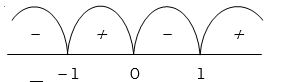
(d) $f(x) = \frac{3}{{4 - {x^2}}} + {\log _{10}}({x^3} - x)$. So, $4 - {x^2} \ne 0$
==> $x \ne \pm \sqrt 4 $ and ${x^3} - x > 0 \Rightarrow x({x^2} - 1) > 0$
==> $x > 0,\,x > 1$
$\therefore$ $D = ( - 1,\,0) \cup (1,\,\infty ) - \{ \sqrt 4 \} $
$i.e.,$ $D = ( - 1,\,0) \cup (1,\,2) \cup (2,\,\infty )$.
View full question & answer→MCQ 841 Mark
$A = \{1,2,3,4......100\}, B = \{51,52,53,...,180\}$, then number of elements in $(A \times B) \cap (B \times A)$ is
- A
$1800$
- B
$1600$
- ✓
$2500$
- D
$1500$
AnswerCorrect option: C. $2500$
c
$n(A \cap B)=50$
so total number of common elements in $(\mathrm{A} \times \mathrm{B})$
and $\mathrm{B} \times \mathrm{A} \Rightarrow \mathrm{n}((\mathrm{A} \times \mathrm{B}) \cap(\mathrm{B} \times \mathrm{A}))=2500$
View full question & answer→