MCQ 511 Mark
The equation to the sides of a triangle are $x - 3y = 0$, $4x + 3y = 5$ and $3x + y = 0$. The line $3x - 4y = 0$ passes through
- A
- B
- C
- ✓
The orthocentre of the triangle
AnswerCorrect option: D. The orthocentre of the triangle
d
(d) Two sides $x - 3y = 0$and $3x + y = 0$of the given triangle are perpendicular to each other. Therefore its orthocentre is the point of intersection of $x - 3y = 0$ and $3x + y = 0$ i.e, $(0, 0)$. Clearly satisfies $3x - 4y = 0$.
View full question & answer→MCQ 521 Mark
Two lines are drawn through $(3, 4)$, each of which makes angle of $45^\circ$ with the line $x - y = 2$, then area of the triangle formed by these lines is
- A
$9$
- ✓
$9\over2$
- C
$2$
- D
$2\over9$
AnswerCorrect option: B. $9\over2$
b
(b) The equation of lines are $y - {y_1} = \frac{{m \pm \tan \alpha }}{{1 \mp m\tan \alpha }}(x - {x_1})$
==> $y - 4 = \frac{{1 \pm \tan 45^\circ }}{{1 \mp \tan 45^\circ }}(x - {x_1})$
==> $y - 4 = \frac{{1 \pm 1}}{{1 \mp 1}}(x - 3)$ ==> $y = 4$ or $x = 3$
Hence, the lines which make the triangle are $x - y = 2,$ $x = 3$ and $y = 4$. The intersection points of these lines are $(6,\,4),\,(3,\,1)$ and $(3,\,4)$
$\Delta = \frac{1}{2}[6( - 3) + 3(0) + 3(3)]$ $ = \frac{9}{2}$.
View full question & answer→MCQ 531 Mark
A point moves so that square of its distance from the point $(3, -2)$ is numerically equal to its distance from the line $5x - 12y = 13$. The equation of the locus of the point is
- ✓
$13{x^2} + 13{y^2} - 83x + 64y + 182 = 0$
- B
${x^2} + {y^2} - 11x + 16y + 26 = 0$
- C
${x^2} + {y^2} - 11x + 16y = 0$
- D
AnswerCorrect option: A. $13{x^2} + 13{y^2} - 83x + 64y + 182 = 0$
a
(a) ${(h - 3)^2} + {(k + 2)^2} = \left| {\frac{{5h - 12k - 13}}{{\sqrt {25 + 144} }}} \right|$.
Replace $(h,k)$ by $(x,\,y)$, we get
$13{x^2} + 13{y^2} - 83x + 64y + 182 = 0$, which is the required equation of the locus of the point.
View full question & answer→MCQ 541 Mark
A point moves such that its distance from the point $(4,\,0)$is half that of its distance from the line $x = 16$. The locus of this point is
- ✓
$3{x^2} + 4{y^2} = 192$
- B
$4{x^2} + 3{y^2} = 192$
- C
${x^2} + {y^2} = 192$
- D
AnswerCorrect option: A. $3{x^2} + 4{y^2} = 192$
a
(a)$\sqrt {{{(h - 4)}^2} + {k^2}} = \frac{1}{2}\left( {\frac{{h - 16}}{{\sqrt {{1^2} + 0} }}} \right)$
Replace $(h,k)$ by $(x,\,y)$, we get $3{x^2} + 4{y^2} = 192.$
View full question & answer→MCQ 551 Mark
If $A$ is $(2, 5)$, $B$ is $(4, -11)$ and $ C$ lies on $9x + 7y + 4 = 0$, then the locus of the centroid of the $\Delta ABC$ is a straight line parallel to the straight line is
- A
$7x - 9y + 4 = 0$
- B
$9x - 7y - 4 = 0$
- ✓
$9x + 7y + 4 = 0$
- D
$7 + 9y + 4 = 0$
AnswerCorrect option: C. $9x + 7y + 4 = 0$
c
(c) According to question , ${x_1} = \frac{{2 + 4 + x}}{3} \Rightarrow x = 3{x_1} - 6$
${y_1} = \frac{{5 - 11 + y}}{3} \Rightarrow y = 3{y_1} + 6$
$\therefore $ $9(3{x_1} - 6) + 7(3{y_1} + 6) + 4 = 0$
Hence locus is $27x + 21y - 8 = 0$, which is parallel to $9x+7y+4 = 0.$
View full question & answer→MCQ 561 Mark
The medians $AD$ and $BE$ of a triangle with vertices $A\;(0,\;b),\;B\;(0,\;0)$ and $C\;(a,\;0)$ are perpendicular to each other, if
- A
$a = \sqrt 2 \;b$
- B
$a = - \sqrt 2 \;b$
- ✓
- D
Answerc
(c) From figure,
$\left( {\frac{{b/2}}{{a/2}}} \right){\rm{ }}\left( {\frac{b}{{ - a/2}}} \right) = - 1 $
$\Rightarrow {a^2} = 2{b^2}$
$\Rightarrow a = \pm \sqrt 2 b$.
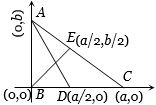
View full question & answer→MCQ 571 Mark
The equation of straight line passing through $( - a,\;0)$ and making the triangle with axes of area ‘$T$’ is
- A
$2Tx + {a^2}y + 2aT = 0$
- ✓
$2Tx - {a^2}y + 2aT = 0$
- C
$2Tx - {a^2}y - 2aT = 0$
- D
AnswerCorrect option: B. $2Tx - {a^2}y + 2aT = 0$
b
(b) If the line cuts off the axes at $A$ and $B$, then area of triangle is $\frac{1}{2} \times OA \times OB = T$
==> $\frac{1}{2}.a.OB = T \Rightarrow OB = \frac{{2T}}{a}$
Hence the equation of line is $\frac{x}{{ - a}} + \frac{y}{{2T/a}} = 1$
$ \Rightarrow 2Tx - {a^2}y + 2aT = 0$.
View full question & answer→MCQ 581 Mark
If the equation of base of an equilateral triangle is $2x - y = 1$ and the vertex is $(-1, 2)$, then the length of the side of the triangle is
- ✓
$\sqrt {\frac{{20}}{3}} $
- B
$\frac{2}{{\sqrt {15} }}$
- C
$\sqrt {\frac{8}{{15}}} $
- D
$\sqrt {\frac{{15}}{2}} $
AnswerCorrect option: A. $\sqrt {\frac{{20}}{3}} $
a
(a) $AD = \left| {\,\frac{{ - 2 - 2 - 1}}{{\sqrt {{{(2)}^2} + {{( - 1)}^2}} }}\,} \right| = \left| {\,\frac{{ - 5}}{{\sqrt 5 }}\,} \right| = \sqrt 5 $
$\tan {60^o}$ $ = \frac{{AD}}{{BD}} \Rightarrow \sqrt 3 = \frac{{\sqrt 5 }}{{BD}}$==> $BD = \sqrt {\frac{5}{3}} $
$\therefore $ $BC = 2BD = 2\sqrt {\frac{5}{3}} = \sqrt {\frac{{20}}{3}} $.
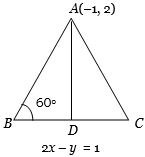
View full question & answer→MCQ 591 Mark
The sides $AB,BC,CD$ and $DA$ of a quadrilateral are $x + 2y = 3,\,x = 1,$ $x - 3y = 4,\,$ $\,5x + y + 12 = 0$ respectively. The angle between diagonals $AC$ and $BD$ is ......$^o$
- A
${45}$
- B
${60}$
- ✓
${90}$
- D
${30}$
AnswerCorrect option: C. ${90}$
c
(c) The four vertices on solving are $A( - 3,\,3)$, $B(1,\,1),$ $C(1,\, - 1)$ and $D( - 2, - 2)$.${m_1}$= slope of $AC = - 1$, ${m_2}$= slope of $BD = 1$; ${m_1}{m_2} = - 1$.
Hence the angle between diagonals $AC$ and $BD$ is $90^\circ $.
View full question & answer→MCQ 601 Mark
A line $L$ passes through the points $(1, 1)$ and $(2, 0)$ and another line $L'$ passes through $\left( {\frac{1}{2},0} \right)$ and perpendicular to $L$. Then the area of the triangle formed by the lines $L,L'$ and $y$- axis, is
- A
$15\over8$
- B
$25\over4$
- C
$25\over8$
- ✓
$25\over16$
AnswerCorrect option: D. $25\over16$
d
(d) Here $L \equiv x + y = 2$and $L' \equiv 2x - 2y = 1$.
Equation of $y$-axis is $x = 0$
Hence the vertices of the triangle are $A(0,\,2),B\left( {0, - \frac{1}{2}} \right)$ and $C\left( {\frac{5}{4},\frac{3}{4}} \right)$. Therefore, the area of the triangle is $\frac{1}{2}\left| {\,\begin{array}{*{20}{c}}0&2&1\\0&{ - \frac{1}{2}}&1\\{\frac{5}{4}}&{\frac{3}{4}}&1\end{array}\,} \right| = \frac{{25}}{{16}}$.
View full question & answer→MCQ 611 Mark
The diagonals of the parallelogram whose sides are $lx + my + n = 0,$ $lx + my + n' = 0$,$mx + ly + n = 0$, $mx + ly + n' = 0$ include an angle
AnswerCorrect option: B. $\frac{\pi }{2}$
b
(b) Since the distance between the parallel line $lx + my + n = 0$and $lx + my + n' = 0$ is same as the distance between parallel lines $mx + ly + n = 0$ and $mx + ly + n' = 0$. Therefore the parallelogram is a rhombus. Since the diagonals of a rhombus are at right angles, therefore the required angle is $\frac{\pi }{2}$.
View full question & answer→MCQ 621 Mark
The area of triangle formed by the lines $x + y - 3 = 0 , x - 3y + 9 = 0$ and $3x - 2y + 1= 0$
- A
$\frac{{10}}{7}\,$ sq. units
- ✓
$\frac{{16}}{7}\,$ sq. units
- C
$4$ sq. units
- D
$9$ sq. units
AnswerCorrect option: B. $\frac{{16}}{7}\,$ sq. units
b
To find $B$
$3 x-2 y=-1$ and $x+y=3$
solving above two equations we get $y=2$ and $x=1$
$B=(1,2)$
To find $C$
$3 x-2 y=-1$ and $x-3 y=-9$
solving above two equations we get $y=27 / 6$ and $x=15 / 7$
$C=\left(\frac{15}{7}, \frac{27}{6}\right)$
$s=\frac{\text {perimeteroftriangle}}{2}$
$a=A B=\sqrt{(1-0)^{2}+(2-3)^{2}}$
$=\sqrt{1+1}$
$=\sqrt{2}$
$b=B C=\sqrt{\left(\frac{15}{7}-1\right)^{2}+\left(\frac{26}{7}-2\right)^{2}}$
$=\sqrt{\left(\frac{8}{7}\right)^{2}+\left(\frac{12}{7}\right)^{2}}$
$\frac{4 \sqrt{13}}{7}$
$c=C A=\sqrt{\left(\frac{15}{7}-0\right)^{2}+\left(\frac{26}{7}-3\right)^{2}}$
$=\sqrt{\left(\frac{15}{7}\right)^{2}+\left(\frac{5}{7}\right)^{2}}$
$=\frac{5 \sqrt{10}}{7}$
$s=\frac{a+b+c}{2}$
$s=\frac{\sqrt{2}+\frac{4 \sqrt{13}}{7}+\frac{5 \sqrt{10}}{7}}{2}$
$s=\frac{14 \sqrt{2}+4 \sqrt{13}+5 \sqrt{10}}{14}$
$s-a=\frac{-7 \sqrt{2}+4 \sqrt{13}+5 \sqrt{10}}{14}$
$s-b=\frac{14 \sqrt{2}-4 \sqrt{13}+5 \sqrt{10}}{14}$
$s-c=\frac{14 \sqrt{2}+4 \sqrt{13}-5 \sqrt{10}}{14}$
$A=\sqrt{s(s-a)(s-b)(s-c)}$
$A=\sqrt{\left(\frac{-7 \sqrt{2}+4 \sqrt{13}+5 \sqrt{10}}{14}\right)\left(\frac{14 \sqrt{2}-4 \sqrt{13}+5 \sqrt{10}}{14}\right)\left(\frac{14 \sqrt{2}+4 \sqrt{13}-5 \sqrt{10}}{14}\right)}$
Multiplying and solving
$A=\frac{16}{7}$ sq unit
View full question & answer→MCQ 631 Mark
A straight line passing through $P(3, 1)$ meet the coordinates axes at $A$ and $B$. It is given that distance of this straight line from the origin $'O'$ is maximum. Area of triangle $OAB$ is equal to
AnswerCorrect option: A. $\frac{50}{3} sq. units$
a
Line $\mathrm{AB}$ will be farthest from the origin if $\mathrm{OP}$ is right angled to loine drawn $m_{O P}=\frac{1}{3} \Rightarrow m_{A B}=-3$
Thus, the equation of $A B$ is $(y-1)=-3(x-3)$ $\Rightarrow A=\left(\frac{10}{3}, 0\right), B=(0,10)$
$\Rightarrow \Delta O A B=\frac{1}{2}(O A)(O B)=\frac{1}{2} \times \frac{10}{3} \times 10=\frac{100}{6}=\frac{50}{3}$
View full question & answer→MCQ 641 Mark
The equation to the line bisecting the join of $(3, -4)$ and $(5, 2)$ and having its intercepts on the $x$-axis and the $y$-axis in the ratio $2 : 1$ is
- A
$x + y - 3 = 0$
- B
$2x - y = 9$
- ✓
$x + 2y = 2$
- D
$2x + y = 7$
AnswerCorrect option: C. $x + 2y = 2$
c
(c) Given equation of line having it intercepts on the $x$- axis and $y$-axis in the ratio $2:1$ i.e., $2a$ and $a$
$\frac{x}{{2a}} + \frac{y}{a} = 1 \Rightarrow x + 2y = 2a$.....$(i)$
According to question,
Line $(i)$ also passes through midpoint of $(3, - 4)$ and $(5,2)$ i.e., $(4, - 1)$.
$4 + 2( - 1) = 2a \Rightarrow a = 1$
Hence the equation of required line is, $x + 2y = 2$.
View full question & answer→MCQ 651 Mark
Equation of angle bisector between the lines $3x + 4y - 7 = 0$ and $12x + 5y + 17 = 0$are
- ✓
$\frac{{3x + 4y - 7}}{{\sqrt {25} }} = \pm \frac{{12x + 5y + 17}}{{\sqrt {169} }}$
- B
$\frac{{3x + 4y + 7}}{{\sqrt {25} }} = \frac{{12x + 5y + 17}}{{\sqrt {169} }}$
- C
$\frac{{3x + 4y + 7}}{{\sqrt {25} }} = \pm \frac{{12x + 5y + 17}}{{\sqrt {169} }}$
- D
AnswerCorrect option: A. $\frac{{3x + 4y - 7}}{{\sqrt {25} }} = \pm \frac{{12x + 5y + 17}}{{\sqrt {169} }}$
a
(a) By direct formulae $\frac{{{a_1}x + {b_1}y + {c_1}}}{{\sqrt {a_1^2 + b_1^2} }} = \pm \frac{{{a_2}x + {b_2}y + {c_2}}}{{\sqrt {a_2^2 + b_2^2} }}$
$\frac{{3x + 4y - 7}}{{\sqrt {{3^2} + {4^2}} }} = \pm \frac{{12x + 5y + 17}}{{\sqrt {{{(12)}^2} + {{(5)}^2}} }}$
$\frac{{3x + 4y - 7}}{5} = \pm \frac{{12x + 5y + 17}}{{13}}$.
View full question & answer→MCQ 661 Mark
The bisector of the acute angle formed between the lines $4x - 3y + 7 = 0$and $3x - 4y + 14 = 0$has the equation
- A
$x + y + 3 = 0$
- B
$x - y - 3 = 0$
- ✓
$x - y + 3 = 0$
- D
$3x + y - 7 = 0$
AnswerCorrect option: C. $x - y + 3 = 0$
c
(c)The equation of bisector of acute angle formed between the lines $4x - 3y + 7 = 0$ and $3x - 4y + 14 = 0$ is $\frac{{4x - 3y + 7}}{{\sqrt {16 + 9} }} = - \frac{{3x - 4y + 14}}{{\sqrt {16 + 9} }}$
==>$7x - 7y + 21 = 0$
==> $x - y + 3 = 0$.
View full question & answer→MCQ 671 Mark
The equation of bisectors of the angles between the lines $|x|\, = \,|y|$ are
AnswerCorrect option: C. $y = 0$ and $x = 0$
c
(c)The equation of lines are $x + y = 0$ and $x - y = 0$
$\therefore$ The equation of bisectors of the angles between these lines are $\frac{{x + y}}{{\sqrt {1 + 1} }} = \pm \frac{{x - y}}{{\sqrt {1 + 1} }}$ ==> $x + y = \pm (x - y)$
Taking + ve sign, we get $y = 0$
Taking -ve sign, we get $x = 0$
Hence the equation of bisectors are$x = 0,\,y = 0$.
View full question & answer→MCQ 681 Mark
The pedal points of a perpendicular drawn from origin on the line $3x + 4y - 5 = 0$, is
- A
$\left( {\frac{3}{5},2} \right)$
- ✓
$\left( {\frac{3}{5},\frac{4}{5}} \right)$
- C
$\left( { - \frac{3}{5}, - \frac{4}{5}} \right)$
- D
$\left( {\frac{{30}}{{17}},\frac{{19}}{{17}}} \right)$
AnswerCorrect option: B. $\left( {\frac{3}{5},\frac{4}{5}} \right)$
b
(b)$d = \frac{5}{{\sqrt {{3^2} + {4^2}} }} = 1$
Slope of perpendicular = $\frac{4}{3}$
==> $x = \pm 1.\cos \theta = \pm \frac{3}{5}$and $y = \pm 1.\sin \theta = \pm \frac{4}{5}$
Hence $\left( {\frac{3}{5},\frac{4}{5}} \right)$ lies on straight line.
View full question & answer→MCQ 691 Mark
If $u = {a_1}x + {b_1}y + {c_1} = 0,$ $v = {a_2}x + {b_2}y + {c_2} = 0$ and $\frac{{{a_1}}}{{{a_2}}} = \frac{{{b_1}}}{{{b_2}}} = \frac{{{c_1}}}{{{c_2}}},$ then the curve $u + kv = 0$is
AnswerCorrect option: A. The same straight line $u$
a
(a) $u = {a_1}x + {b_1}y + {c_1} = 0,v = {a_2}x + {b_2}y + {c_2} = 0$
and $\frac{{{a_1}}}{{{a_2}}} = \frac{{{b_1}}}{{{b_2}}} = \frac{{{c_1}}}{{{c_2}}} = c$ (Let)
==> ${a_2} = \frac{{{a_1}}}{c},{b_2} = \frac{{{b_1}}}{c},{c_2} = \frac{{{c_1}}}{c}$
Given that $u + kv = 0$
==> ${a_1}x + {b_1}y + {c_1} + k({a_2}x + {b_2}y + {c_2}) = 0$
==> ${a_1}x + {b_1}y + {c_1} + k\frac{{{a_1}}}{c}x + k\frac{{{b_1}}}{c}y + k\frac{{{c_1}}}{c} = 0$
==> ${a_1}x\left( {1 + \frac{k}{c}} \right) + {b_1}y\left( {1 + \frac{k}{c}} \right) + {c_1}\left( {1 + \frac{k}{c}} \right) = 0$
==> ${a_1}x + {b_1}y + {c_1} = 0 = u$.
View full question & answer→MCQ 701 Mark
If $a + b + c = 0$ and $p \ne 0,$ the lines $ax + (b + c)y = p,$ $bx + (c + a)y = p$ and $cx + (a + b)y = p$
Answera
(a) By the help of given condition of $a + b + c = 0$, the three lines reduce to $x - y = \frac{p}{a}$ or $\frac{p}{b}{\rm{or}}\frac{p}{c}(p \ne 0)$.
All these lines are parallel. Hence they do not intersect in finite plane.
View full question & answer→MCQ 711 Mark
The symmetry in curve ${x^3} + {y^3} = 3axy$ along
- A
$x$-axis
- B
$y$-axis
- ✓
Line $y = x$
- D
AnswerCorrect option: C. Line $y = x$
c
(c) By putting $y = x$or$x = y$, the equation remains unchanged. Hence it is symmetric to the line $y = x$.
View full question & answer→MCQ 721 Mark
A line passing through origin and is perpendicular to two given lines $2x + y + 6 = 0$ and $4x + 2y - 9 = 0$, then the ratio in which the origin divides this line is
- A
$1 : 2$
- B
$2 : 1$
- ✓
$4 : 3$
- D
$3 : 4$
AnswerCorrect option: C. $4 : 3$
c
(c) Equation of line Perpendicular to $2x + y + 6 = 0$ passes through $(0, 0)$ is $x - 2y = 0$
Now point of intersection of $x - 2y = 0$ and $2x + y + 6 = 0$is $\left( {\frac{{ - 12}}{5},\frac{{ - 6}}{5}} \right)$ and point of intersection of $x - 2y = 0$ and $4x + 2y - 9 = 0$ is $\left( {\frac{9}{5},\frac{9}{{10}}} \right)$.
Now say origin divide the line $x - 2y = 0$ in the ratio $\lambda :1$
$x = \frac{{\frac{9}{5}\lambda - \frac{{12}}{5}}}{{\lambda + 1}} = 0 \Rightarrow \frac{9}{5}\lambda = \frac{{12}}{5}$, $\therefore \lambda = \frac{4}{3}$
Thus origin divides the line $x = 2y$, in the ratio $4 : 3$.
View full question & answer→MCQ 731 Mark
If $2p$ is the length of perpendicular from the origin to the lines $\frac{x}{a} + \frac{y}{b} = 1$, then ${a^2},8{p^2},{b^2}$are in
AnswerCorrect option: C. $H. P.$
c
(c) We have $2p = \left| {\,\frac{{0 + 0 - 1}}{{\sqrt {\frac{1}{{{a^2}}} + \frac{1}{{{b^2}}}} }}\,} \right| \Rightarrow \frac{1}{{{a^2}}} + \frac{1}{{{b^2}}} = \frac{1}{{4{p^2}}}$
==> $\frac{1}{{{a^2}}} + \frac{1}{{{b^2}}} = \frac{2}{{8{p^2}}} \Rightarrow \frac{1}{{{a^2}}},\frac{1}{{8{p^2}}},\frac{1}{{{b^2}}}$are in A. P.
==> ${a^2},8{p^2},{p^2}$are in H.P .
View full question & answer→MCQ 741 Mark
If the straight line through the point $P(3,\,4)$ makes an angle $\frac{\pi }{6}$with the $x$-axis and meets the line $12x + 5y + 10 = 0$ at $Q$, then the length $PQ$ is
- ✓
$\frac{{132}}{{12\sqrt 3 + 5}}$
- B
$\frac{{132}}{{12\sqrt 3 - 5}}$
- C
$\frac{{132}}{{5\sqrt 3 + 12}}$
- D
$\frac{{132}}{{5\sqrt 3 - 12}}$
AnswerCorrect option: A. $\frac{{132}}{{12\sqrt 3 + 5}}$
a
(a) The equation of any line passing through the given point $P(3, 4)$ and making an angle $\frac{\pi }{6}$with $x$-axis is $\frac{{x - 3}}{{\cos {{30}^o}}} = \frac{{y - 4}}{{\sin {{30}^o}}} = r$ (say) ......$(i)$
Where $‘r$’ represents the distance of any point $Q$ on this line from the given point $P \,(3, 4)$.
The coordinates $(x, y)$ of any point $Q$ on line $(i)$ are $(3 + r\cos {30^o},4 + r\sin {30^o})\,\,{\rm{ }}i.e.,\,{\rm{ }}\left( {3 + \frac{{r\sqrt 3 }}{2},4 + \frac{r}{2}} \right)$
If the point lies on the line $12x + 5y + 10 = 0$, then
$12\left( {3 + \frac{{r\sqrt 3 }}{2}} \right) + 5\left( {4 + \frac{r}{2}} \right) + 10 = 0$
$\Rightarrow r = \frac{{132}}{{12\sqrt 3 + 5}}$.
View full question & answer→MCQ 751 Mark
Let $m, n$ be real numbers such that $0 \leq m \leq \sqrt{3}$ and $-\sqrt{3} \leq n \leq 0$. The minimum possible area of the region of the plane consisting of points $(x, y)$ satisfying in inequalities $y \geq 0, y-3 \leq m x$, $y -3 \leq nx$, is
- A
$0$
- B
$\frac{3 \sqrt{3}}{2}$
- ✓
$3 \sqrt{3}$
- D
$6 \sqrt{3}$
AnswerCorrect option: C. $3 \sqrt{3}$
c
(c)
$y = mx +3$,$m \in[0, \sqrt{3}]$
$y = nx +3$,$n \in[-\sqrt{3}, 0]$
min area $=$ are $(\Delta PAB )=\frac{1}{2} \times 2 \sqrt{3} \times 3=3 \sqrt{3}$
View full question & answer→MCQ 761 Mark
Let $P Q R$ be an acute-angled triangle in which $P Q < Q R$. From the vertex $Q$ draw the altitude $Q Q_1$, the angle bisector $Q Q_2$ and the median $Q Q_3$, with $Q_1, Q_2, Q_3$ lying on $P R$. Then,
- ✓
$P Q_1 < P Q_2 < P Q_3$
- B
$P Q_2 < P Q_1 < P Q_3$
- C
$P Q_1 < P Q_3 < P Q_2$
- D
$P Q_3 < P Q_1 < P Q_2$
AnswerCorrect option: A. $P Q_1 < P Q_2 < P Q_3$
a
(a)
Given, $P Q R$ is an acute angle triangle.
$\angle Q R P < \angle Q P R$
$P Q_3 =\frac{1}{2} P R$
$P Q_2: Q_2 R=r: p$
$P Q_2=\left(\frac{r}{r+p}\right) P R$
$r < p$
$P Q_2 < \frac{1}{2} P R$
Comparison between altitude and angle bisector
$\angle Q P Q_2+\angle P Q \cdot Q+\angle P Q Q_2=\angle R Q Q_2 +\angle Q Q_2 R+\angle Q R Q_2$
$\therefore \angle P Q Q_2=\angle R Q Q_2$
[ since, $Q Q_2$ is angle bisector of $\angle Q$ ]
$\angle Q P Q_2+\angle P Q_2 Q=\angle Q Q_2 R+\angle Q R Q_2$
$\therefore P Q$
Hence, $\angle Q Q_2 P<\angle Q Q_2 R$
But $\angle Q Q_2 P+\angle Q Q_2 R=180^{\circ}$
Hence, $\angle Q Q_2 P<90^{\circ}$ and $\angle Q Q_2 R>90^{\circ}$
$\because$ Foot from $Q$ to side $P R$ lie inside $\triangle P Q Q_2$
$P Q_1 < P Q_2 < P Q_3$
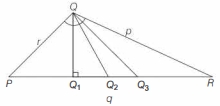
View full question & answer→MCQ 771 Mark
Let $O=(0,0)$ : let $A$ and $B$ be points respectively on $X$-axis and $Y$-axis such that $\angle O B A=60^{\circ}$. Let $D$ be a point in the first quadrant such that $A D$ is an equilateral triangle. Then, the slope of $D B$ is
- A
$\sqrt{3}$
- B
$\sqrt{2}$
- C
$\frac{1}{\sqrt{2}}$
- ✓
$\frac{1}{\sqrt{3}}$
AnswerCorrect option: D. $\frac{1}{\sqrt{3}}$
d
(d)
$\angle O B A=60^{\circ}$
$\angle O A B=30^{\circ}$
$O A D$ is an equilateral triangle.
$\therefore \quad \angle A O D=\angle O D A=\angle O A D=60^{\circ}$
$O A=A D=O D$
Let $B(0, e )$
$\therefore \quad A(\sqrt{3} a, 0)$
D $\left(\frac{\sqrt{3}}{2} a, \frac{3}{2} a\right)$
Slope of $B D=\frac{\frac{3}{2}-a}{\frac{\sqrt{3}}{2} a}=\frac{1}{\sqrt{3}}$
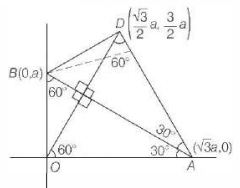
View full question & answer→MCQ 781 Mark
There are two candles of same length and same size. Both of them burn at uniform rate. The first one burns in $5\,hr$ and the second one burns in $3\,h$. Both the candles are lit together. After how many minutes the length of the first candle is $3$ times that of the other?
Answerd
(d)
We have, length and size of two candles are same. Let $L$ be the length of candles.
Given, first candle burns in $5 h$ and second candle burns in $3 h$.
In one hours length of candles are $\frac{L}{5}$ and $\frac{L}{3}$, respectively.
Let after time $t h$ the length of candles are $L_1$ and $L_2$
$\therefore \quad L_1=L-\frac{L}{5} t$ and $L_2=L-\frac{L}{3} t$
According to the problem,
$L_1=3 L_2$
$\therefore \quad L-\frac{L}{5} t=3\left(L-\frac{L}{3} t\right)$
$\Rightarrow 1-\frac{1}{5} t=3-t \Rightarrow t\left(1-\frac{1}{5}\right)=3-1$
$\Rightarrow \quad \frac{4 t}{5}=2 \Rightarrow t=\frac{5}{2} h$
$\Rightarrow \quad t=\frac{5}{2} \times 60=150\,min$
View full question & answer→MCQ 791 Mark
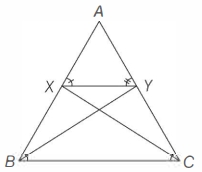
In a $\triangle A B C$, points $X$ and $Y$ are on $A B$ and $A C$, respectively, such that $X Y$ is parallel to $B C$. Which of the two following equalities always hold? (Here $[P Q R]$ denotes the area of $\triangle P Q R)$.
$I$. $[B C X]=[B C Y]$
$II$. $[A C X] \cdot[A B Y]=[A X Y] \cdot[A B C]$
- A
Neither $I$ nor $II$
- B
Only $I$
- C
Only $II$
- ✓
Both $I$ and $II$
AnswerCorrect option: D. Both $I$ and $II$
d
(d)
$A B C$ is a triangle points $X$ and $Y$ on $A B$ and $A C$ respectively.
$X Y$ is parallel to $B C$.
$I$. Area of $B C X:$ Area of $B C Y$
It is true because same base between same parallels.
$II$. Area of $\triangle A C X=\frac{1}{2}(A X)(A C) \sin A$
Area of $\triangle A B Y=\frac{1}{2}(A Y)(A B) \sin A$
$\therefore$ (Area of $\triangle A C X)$ (Area of $\triangle A B Y)$
$=\frac{1}{2}(A X)(A C) \sin A \times \frac{1}{2}(A Y)(A B) \sin A$
$=\frac{1}{2}(A X)(A Y) \sin A \times \frac{1}{2}(A B)(A C) \sin A$
$=(\text { Area of } \triangle A X Y) \text { (Area of } \triangle A B C)$
Hence,$I$ and $II$ both are true.
View full question & answer→MCQ 801 Mark
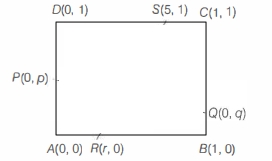
Let $A B C D$ be a square of side length $1$ . Let $P, Q, R, S$ be points in the interiors of the sides $A D, B C, A B, C D$ respectively, such that $P Q$ and $R S$ intersect at right angles. If $P Q=\frac{3 \sqrt{3}}{4}$, then $R S$ equals
- A
$\frac{2}{\sqrt{3}}$
- ✓
$\frac{3 \sqrt{3}}{4}$
- C
$\frac{\sqrt{2}+1}{2}$
- D
$4-2 \sqrt{2}$
AnswerCorrect option: B. $\frac{3 \sqrt{3}}{4}$
b
(b)
$A B C D$ is square
$A B=B C=C D=A D=1$
$P Q$ is perpendicular to $R S$
$\because$ Slope of $P Q \times$ Slope of $R S=-1$
$\therefore \quad q-p \times 1-0=-1$
$ \Rightarrow q-p =r-s $$ \Rightarrow (P Q)^2 =(1-0)^2+(q-p)^2 $
$\Rightarrow \quad(P Q)^2=(1-0)^2+(q-p)^2$
$\Rightarrow \quad\left(\frac{3 \sqrt{3}}{4}\right)^2=1+(q-p)^2$
$\Rightarrow \quad(q-p)^2=\frac{27}{16}-1=\frac{11}{16}$
$\Rightarrow \quad(r-s)^2=\frac{11}{16} \quad[\because q-p=r-s]$
$\Rightarrow \quad R S=\sqrt{(1-0)^2+(r-s)^2}$
$\Rightarrow \quad R S=\sqrt{1+\frac{11}{16}}$
$\therefore \quad R S=\sqrt{\frac{27}{16}}=\frac{3 \sqrt{3}}{4}$
View full question & answer→MCQ 811 Mark
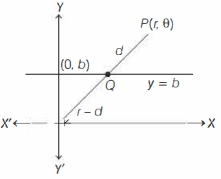
Let $b, d>0$. The locus of all points $P(r, \theta)$ for which the line $P$ (where, $O$ is the origin) cuts the line $r \sin \theta=b$ in $Q$ such that $P Q=d$ is
AnswerCorrect option: B. $(r \pm d) \sin \theta=b$
b
(b)
We have, $P \cdot(r, \theta)=(x, y)$
Equation of line $O P$ is
$y=x \tan \theta$
$O P$ cut the line $r \sin \theta=b$
i.e. $y=b$
Given $P Q=d$
$\therefore$ point $P$ is $y=b \pm d \sin \theta$
$\Rightarrow r \sin \theta=b \pm d \sin \theta \Rightarrow(r \pm d) \sin \theta=b$
Hence, locus of $P(r, \theta)$ is $(r \pm d) \sin \theta=b$
View full question & answer→MCQ 821 Mark
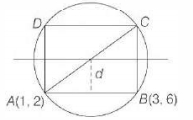
In a rectangle $A B C D$, the coordinates of $A$ and $B$ are $(1,2)$ and $(3,6)$ respectively and some diameter of the circumscribing circle of $A B C D$ has equation $2 x-y+4=0$. Then, the area of the rectangle is
- ✓
$16$
- B
$2 \sqrt{10}$
- C
$2 \sqrt{5}$
- D
$20$
Answera
$(a)$
Given,
$A B C D$ is a rectangle $A(1,2)$ and $B(3,6)$ equation of one of the diameter of circle circumscribing the rectangle is
$2 x-y+4=0 \text {. }$
Slope of diameter $=2$
and slope of line $A B=\frac{6-2}{3-1}=\frac{4}{2}=2$
$\therefore$ Side $A B$ is parallel to diameter of circle equation of line $A B$
$y-2=2(x-1) \Rightarrow 2 x-y=0$
Distance between diameter of circle and line $A B$
$d=\left|\frac{4}{\sqrt{2^2+1}}\right|=\frac{4}{\sqrt{5}}$
$\therefore \quad B C=2 d=\frac{8}{\sqrt{5}}$
Now, $\quad A B=\sqrt{(3-1)^2+(6-2)^2}$
$=\sqrt{4+16}=2 \sqrt{\overline{5}}$
Area of rectangle $=A B \times B C$
$=2 \sqrt{5} \times \frac{8}{\sqrt{5}}=16$
View full question & answer→MCQ 831 Mark
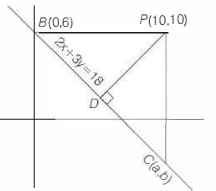
Let the line $2 x+3 y=18$ intersect the $Y$-axis at $B$. Suppose $C(\neq B)$, with coordinates $(a, b)$, is a point on the line such that $P B=P C$, where $P=(10,10)$. Then, $8 a+2 b$ equals
Answera
(a)
The line $2 x+3 y=18$
Cut the $Y$-axis at $B$
$\therefore \quad B=(0,6), C=(a, b)$
$\because P D$ is perpendicular bisector of line
segment $B C$
Equation of line $P D$ is perpendicular to $B C$.
$\therefore \quad 3 x-2 y=\lambda$ Since, $P D$ is passing through $P(10,10)$.
Since, $P D$ is passing through $F$ $\therefore \quad 30-20=\lambda \Rightarrow \lambda=10$
Equation of line $P D$ is $3 x-2 y=10$
Solving the equation $2 x+3 y=18$ and
$3 x-2 y=10$
we get $D\left(\frac{66}{13}, \frac{34}{13}\right)$
$D$ is mid-point of $B C$
$\therefore \frac{a+0}{2} =\frac{66}{13}, \frac{b+6}{2}=\frac{34}{13}$
$\Rightarrow \quad =\frac{132}{13}, b=\frac{-10}{13}$
$\therefore \quad 3 a+2 b =\frac{8 \times 132}{13}-\frac{20}{13}$
$= \frac{1056-20}{13}=\frac{1036}{13}$
View full question & answer→MCQ 841 Mark
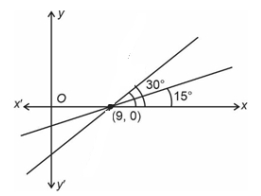
A line passing through the point $A(9,0)$ makes an angle of $30^{\circ}$ with the positive direction of $\mathrm{x}$-axis. If this line is rotated about $A$ through an angle of $15^{\circ}$ in the clockwise direction, then its equation in the new position is
- ✓
$\frac{y}{\sqrt{3}-2}+x=9$
- B
$\frac{x}{\sqrt{3}-2}+y=9$
- C
$\frac{x}{\sqrt{3}+2}+y=9$
- D
$\frac{y}{\sqrt{3}+2}+x=9$
AnswerCorrect option: A. $\frac{y}{\sqrt{3}-2}+x=9$
a
$\mathrm{Eq}^2: y-0=\tan 15^{\circ}(x-9) \Rightarrow y=(2-\sqrt{3})(x-9)$
View full question & answer→MCQ 851 Mark
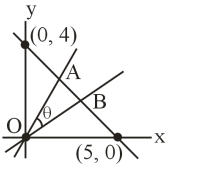
The portion of the line $4 x+5 y=20$ in the first quadrant is trisected by the lines $\mathrm{L}_1$ and $\mathrm{L}_2$ passing through the origin The tangent of an angle between the lines $\mathrm{L}_1$ and $\mathrm{L}_2$ is:
- A
$\frac{8}{5}$
- B
$\frac{25}{41}$
- C
$\frac{2}{5}$
- ✓
$\frac{30}{41}$
AnswerCorrect option: D. $\frac{30}{41}$
d
Co-ordinates of $A=\left(\frac{5}{3}, \frac{8}{3}\right)$
Co-ordinates of $\mathrm{B}=\left(\frac{10}{3}, \frac{4}{3}\right)$
Slope of $O A=m_1=\frac{8}{5}$
Slope of $O B=m_2=\frac{2}{5}$
$\tan \theta=\left|\frac{m_1-m_2}{1+m_1 m_2}\right| $
$ \tan \theta=\frac{\frac{6}{5}}{1+\frac{16}{25}}=\frac{30}{41} $
$\tan \theta=\frac{30}{41}$
View full question & answer→MCQ 861 Mark
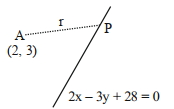
The distance of the point $(2,3)$ from the line $2 \mathrm{x}-$ $3 \mathrm{y}+28=0$, measured parallel to the line $\sqrt{3} \mathrm{x}-\mathrm{y}+1=0$, is equal to
- A
$4 \sqrt{2}$
- B
$6 \sqrt{3}$
- C
$3+4 \sqrt{2}$
- ✓
$4+6 \sqrt{3}$
AnswerCorrect option: D. $4+6 \sqrt{3}$
d
Writing $\mathrm{P}$ in terms of parametric co-ordinates $2+r$
$ \cos \theta, 3+\mathrm{r} \sin \theta \text { as } \tan \theta=\sqrt{3} $
$ \mathrm{P}\left(2+\frac{\mathrm{r}}{2}, 3+\frac{\sqrt{3} \mathrm{r}}{2}\right)$
$P$ must satisfy $2 \mathrm{x}-3 \mathrm{y}+28=0$
So, $2\left(2+\frac{\mathrm{r}}{2}\right)-3\left(3+\frac{\sqrt{3} \mathrm{r}}{2}\right)+28=0$
We find $\mathrm{r}=4+6 \sqrt{3}$
View full question & answer→MCQ 871 Mark
Let $A$ be the point of intersection of the lines $3 x+$ $2 y=14,5 x-y=6$ and $B$ be the point of intersection of the lines $4 x+3 y=8,6 x+y=5$ The distance of the point $P(5,-2)$ from the line $\mathrm{AB}$ is
- A
$\frac{13}{2}$
- B
$8$
- C
$\frac{5}{2}$
- ✓
$6$
Answerd
Solving lines $L_1(3 x+2 y=14)$ and $L_2(5 x-y=6)$ to get $A(2,4)$ and solving lines $L_3(4 x+3 y=8)$ and $L_4(6 x+y=5)$ to get $B\left(\frac{1}{2}, 2\right)$.
Finding Eqn. of $A B: 4 x-3 y+4=0$
Calculate distance $PM$
$\Rightarrow\left|\frac{4(5)-3(-2)+4}{5}\right|=6$
View full question & answer→MCQ 881 Mark
If the image of the point $(-4,5)$ in the line $x+2 y=2$ lies on the circle $(x+4)^2+(y-3)^2=r^2$, then $r$ is equal lo:
Answerb
Image of point $(-4,5)$
$\frac{\mathrm{x}-\mathrm{x}_1}{\mathrm{a}}=\frac{\mathrm{y}-\mathrm{y}_1}{\mathrm{~b}}=-2\left(\frac{\mathrm{ax_{1 } + \mathrm { by } _ { 1 } + \mathrm { c }}}{\mathrm{a}^2+\mathrm{b}^2}\right)$
Line : $x+2 y-2=0$
$ \frac{x+4}{1}=\frac{y-5}{2}=-2\left(\frac{-4+10-2}{1^2+2^2}\right) $
$ =\frac{-8}{5} $
$ \mathrm{x}=-4-\frac{8}{5}=-\frac{28}{5} $
$ y=-\frac{16}{5}+5=\frac{9}{5} $
Point lies on circle $(x+4)^2+(y-3)^2=r^2$
$ \frac{64}{25}+\left(\frac{9}{5}-3\right)^2=r^2 $
$ \frac{100}{25}=r^2, r=2$
View full question & answer→MCQ 891 Mark
In a $\triangle A B C$, suppose $y=x$ is the equation of the bisector of the angle $B$ and the equation of the side $A C$ is $2 x-y=2$. If $2 A B=B C$ and the point $A$ and $B$ are respectively $(4,6)$ and $(\alpha, \beta)$, then $\alpha+2 \beta$ is equal to
Answera
$ \mathrm{AD}: \mathrm{DC}=1: 2 $
$ \frac{4-\alpha}{6-\alpha}=\frac{10}{8} $
$ \alpha=\beta $
$ \alpha=14 \text { and } \beta=14$
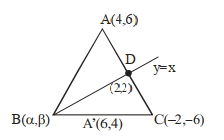
View full question & answer→MCQ 901 Mark
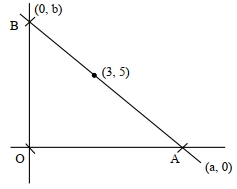
A variable line $\mathrm{L}$ passes through the point $(3,5)$ and intersects the positive coordinate axes at the points $\mathrm{A}$ and $\mathrm{B}$. The minimum area of the triangle $\mathrm{OAB}$, where $\mathrm{O}$ is the origin, is :
Answera
$ \frac{x}{a}+\frac{y}{b}=1 $
$ \frac{3}{a}+\frac{5}{b}=1 \Rightarrow b=\frac{5 a}{a-3}, a>3$
$Image$
$\mathrm{A}=\frac{1}{2} \mathrm{ab}=\frac{1}{2} \mathrm{a} \frac{5 \mathrm{a}}{(\mathrm{a}-3)}=\frac{5}{2} \cdot \frac{\mathrm{a}^2}{\mathrm{a}-3}$
$ =\frac{5}{2}\left(\frac{a^2-9+9}{a-3}\right) $
$ =\frac{5}{2}\left(a+3+\frac{9}{a-3}\right) $
$ =\frac{5}{2}\left(a-3+\frac{9}{a-3}+6\right) \geq 30$
View full question & answer→MCQ 911 Mark
Let a variable line of slope $m>0$ passing through the point $(4,-9)$ intersect the coordinate axes at the points $A$ and $B$. the minimum value of the sum of the distances of $\mathrm{A}$ and $\mathrm{B}$ from the origin is
Answera
equation of line is
$ y+9=m(x-4) $
$ \therefore \quad A=\left(\frac{9+4 m}{m}, 0\right) $
$ \quad B=(0,-9-4 m) $
$ \therefore \quad O A+O B=\frac{9+4 m}{m}+9+4 m$
$ \because \mathrm{m}>0 $
$ =13+\frac{9}{\mathrm{~m}}+4 \mathrm{~m} $
$ \because \frac{4 \mathrm{~m}+\frac{9}{\mathrm{~m}}}{2} \geq \sqrt{36} \Rightarrow 4 \mathrm{~m}+\frac{9}{\mathrm{~m}} \geq 12 $
$ \therefore \mathrm{OA}+\mathrm{OB} \geq 25$
View full question & answer→MCQ 921 Mark
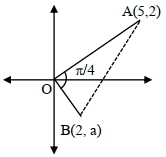
If the line segment joining the points $(5,2)$ and $(2, a)$ subtends an angle $\frac{\pi}{4}$ at the origin, then the absolute value of the product of all possible values of $a$ is:
Answerd
$Image$
$ \mathrm{m}_{\mathrm{OA}}=\frac{2}{5} $
$ \mathrm{~m}_{\mathrm{OB}}=\frac{\mathrm{a}}{2}$
$\tan \frac{\pi}{4}=\left|\frac{2}{5}-\frac{a}{2}\right|$
$1=\left|\frac{4-5 a}{10+2 a}\right|$
$4-5 \mathrm{a}= \pm(10+2 \mathrm{a}) $
$4-5 \mathrm{a}=10+2 \mathrm{a} $ $ 4-5 \mathrm{a}=-10-2 \mathrm{a} $
$\Rightarrow 7 \mathrm{a}+6=0 $ $ 3 \mathrm{a}=14 $
$\Rightarrow \mathrm{a}=-\frac{6}{7} $ $ \mathrm{a}=+\frac{14}{3}$
$-\frac{6}{7} \times \frac{14}{3}=-4$
View full question & answer→MCQ 931 Mark
If $x^2-y^2+2 h x y+2 g x+2 f y+c=0$ is the locus of a point, which moves such that it is always equidistant from the lines $x+2 y+7=0$ and $2 x-y$ $+8=0$, then the value of $\mathrm{g}+\mathrm{c}+\mathrm{h}-\mathrm{f}$ equals
Answera
Cocus of point $\mathrm{P}(\mathrm{x}, \mathrm{y})$ whose distance from
Gives
$\mathrm{X}+2 \mathrm{y}+7=0 \& 2 \mathrm{x}-\mathrm{y}+8=0$ are equal is
$\frac{x+2 y+7}{\sqrt{5}}= \pm \frac{2 x-y+8}{\sqrt{5}}$
$(x+2 y+7)^2-(2 x-y+8)^2=0$
Combined equation of lines
$(x-3 y+1)(3 x+y+15)=0$
$3 x^2-3 y^2-8 x y+18 x-44 y+15=0$
$x^2-y^2-\frac{8}{3}xy+6x-\frac{44}{3} y+5=0$
$x^2-y^2+2 h x y+2 g x 2+2 f y+c=0$
$h=\frac{4}{3}, g=3, f=-\frac{22}{3}, c=5$
$g+c+h-f=3+5-\frac{4}{3}+\frac{22}{3}=8+6=14$
View full question & answer→MCQ 941 Mark
Let $\alpha, \beta, \gamma, \delta \in \mathrm{Z}$ and let $\mathrm{A}(\alpha, \beta), \mathrm{B}(1,0), \mathrm{C}(\gamma, \delta)$ and $D(1,2)$ be the vertices of a parallelogram $\mathrm{ABCD}$. If $\mathrm{AB}=\sqrt{10}$ and the points $\mathrm{A}$ and $\mathrm{C}$ lie on the line $3 y=2 x+1$, then $2(\alpha+\beta+\gamma+\delta)$ is equal to
Answerd
Let $\mathrm{E}$ is mid point of diagonals
$\begin{array}{ll}\frac{\alpha+\gamma}{2}=\frac{1+1}{2} & \& \frac{\beta+\delta}{2}=\frac{2+0}{2} \\ \alpha+\gamma=2 & \beta+\delta=2 \\ 2(\alpha+\beta+\gamma+\delta)=2(2+2)=8\end{array}$
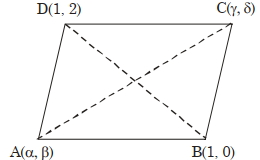
View full question & answer→MCQ 951 Mark
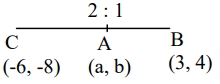
Let $A(a, b), B(3,4)$ and $(-6,-8)$ respectively denote the centroid, circumcentre and orthocentre of a triangle. Then, the distance of the point $P(2 a+3,7 b+5)$ from the line $2 x+3 y-4=0$ measured parallel to the line $x-2 y-1=0$ is
- A
$\frac{15 \sqrt{5}}{7}$
- B
$\frac{17 \sqrt{5}}{6}$
- ✓
$\frac{17 \sqrt{5}}{7}$
- D
$\frac{\sqrt{5}}{17}$
AnswerCorrect option: C. $\frac{17 \sqrt{5}}{7}$
c
$\mathrm{A}(\mathrm{a}, \mathrm{b}), \quad \mathrm{B}(3,4), \quad \mathrm{C}(-6,-8)$
$\Rightarrow \mathrm{a}=0, \mathrm{~b}=0 \quad \Rightarrow \mathrm{P}(3,5)$
Distance from $P$ measured along $x-2 y-1=0$
$\Rightarrow x=3+r \cos \theta, \quad y=5+r \sin \theta$
Where $ \tan \theta=\frac{1}{2} $
$ r(2 \cos \theta+3 \sin \theta)=-17 $
$ \Rightarrow r=\left|\frac{-17 \sqrt{5}}{7}\right|=\frac{17 \sqrt{5}}{7}$
View full question & answer→MCQ 961 Mark
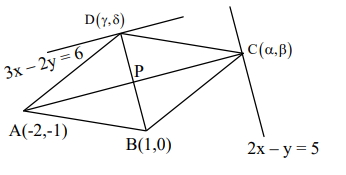
Let $\mathrm{A}(-2,-1), \mathrm{B}(1,0), \mathrm{C}(\alpha, \beta)$ and $\mathrm{D}(\gamma, \delta)$ be the vertices of a parallelogram $A B C D$. If the point $C$ lies on $2 x-y=5$ and the point $D$ lies on $3 x-2 y=6$, then the value of $|\alpha+\beta+\gamma+\delta|$ is equal to_____.
Answerc
$\mathrm{P} \equiv\left(\frac{\alpha-2}{2}, \frac{\beta-1}{2}\right) \equiv\left(\frac{\gamma+1}{2}, \frac{\delta}{2}\right) $
$ \frac{\alpha-2}{2}=\frac{\gamma+1}{2} \text { and } \frac{\beta-1}{2}=\frac{\delta}{2} $
$\Rightarrow \alpha-\gamma=3 \ldots . .(1), \beta-\delta=1 \ldots ....(2)$
Also, $(\gamma, \delta)$ lies on $3 x-2 y=6$
$3 \gamma-2 \delta=6$
and $(\alpha, \beta)$ lies on $2 x-y=5$
$\Rightarrow 2 \alpha-\beta=5 \text {......(4) }$
Solving $(1), (2), (3), (4)$
$\alpha=-3, \beta=-11, \gamma=-6, \delta=-12$
$|\alpha+\beta+\gamma+\delta|=32$
View full question & answer→MCQ 971 Mark
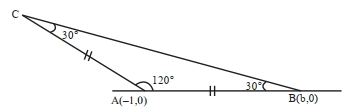
Let $A B C$ be an isosceles triangle in which $A$ is at $(-1,0), \angle A=\frac{2 \pi}{3}, A B=A C$ and $B$ is on the positive $\mathrm{x}$-axis. If $\mathrm{BC}=4 \sqrt{3}$ and the line $\mathrm{BC}$ intersects the line $y=x+3$ at $(\alpha, \beta)$, then $\frac{\beta^4}{\alpha^2}$ is :
Answerb
$\frac{\mathrm{c}}{\sin 30^{\circ}}=\frac{4 \sqrt{3}}{\sin 120^{\circ}}$ [By sine rule]
$2 c=8 \Rightarrow c=4$
$ \mathrm{AB}=|(\mathrm{b}+1)|=4 $
$ \mathrm{~b}=3, \mathrm{~m}_{\mathrm{AB}}=0 $
$ \mathrm{~m}_{\mathrm{BC}}=\frac{-1}{\sqrt{3}} $
$ B C:-y=\frac{-1}{\sqrt{3}}(x-3) $
$ \sqrt{3} \mathrm{y}+\mathrm{x}=3 $
$ \text { Point of intersection : } y=x+3, \sqrt{3} y+x=3 $
$ (\sqrt{3}+1) \mathrm{y}=6 $
$ \mathrm{y}=\frac{6}{\sqrt{3}+1} $
$ x=\frac{6}{\sqrt{3}+1}-3 $
$ =\frac{6-3 \sqrt{3}-3}{\sqrt{3}+1} $
$ =3 \frac{(1-\sqrt{3})}{(1+\sqrt{3})}=\frac{-6}{(1+\sqrt{3})^2} $
$ \frac{\beta^4}{\alpha^2}=36 $
View full question & answer→MCQ 981 Mark
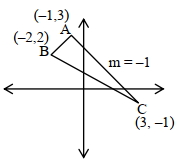
The vertices of a triangle are $\mathrm{A}(-1,3), \mathrm{B}(-2,2)$ and $\mathrm{C}(3,-1)$. $A$ new triangle is formed by shifting the sides of the triangle by one unit inwards. Then the equation of the side of the new triangle nearest to origin is :
AnswerCorrect option: C. $x+y-(2-\sqrt{2})=0$
c
$Image$
equation of $\mathrm{AC} \rightarrow \mathrm{x}+\mathrm{y}=2$
equation of line parallel to $\mathrm{AC} \mathrm{x}+\mathrm{y}=\mathrm{d}$
$ \left|\frac{\mathrm{d}-2}{\sqrt{2}}\right|=1 $
$ \mathrm{~d}=2-\sqrt{2}$
$\mathrm{eq}^{\mathrm{n}}$ of new required line
$x+y=2-\sqrt{2}$
View full question & answer→MCQ 991 Mark
Consider a triangle $\mathrm{ABC}$ having the vertices $\mathrm{A}(1,2), \mathrm{B}(\alpha, \beta)$ and $\mathrm{C}(\gamma, \delta)$ and angles $\angle \mathrm{ABC}=\frac{\pi}{6}$ and $\angle \mathrm{BAC}=\frac{2 \pi}{3}$. If the points $\mathrm{B}$ and $\mathrm{C}$ lie on the line $\mathrm{y}=\mathrm{x}+4$, then $\alpha^2+\gamma^2$ is equal to....................
Answerd
Equation of line passes through point $\mathrm{A}(1,2)$ which makes angle $\frac{\pi}{6}$ from $y=x+4$ is
$ \mathrm{y}-2=\frac{1 \pm \tan \frac{\pi}{6}}{1 \mp \tan \frac{\pi}{6}}(\mathrm{x}-1) $
$ \mathrm{y}-2=\frac{\sqrt{3} \pm 1}{\sqrt{3} \mp 1}(\mathrm{x}-1)$
$\oplus$
$y-2=(2+\sqrt{3})(x-1) $
solve with $ y=x+4 $
$x+2=(2+\sqrt{3}) x-2-\sqrt{3} $
$x=\frac{4+\sqrt{3}}{1+\sqrt{3}}$
$\Theta$
$y-2=(2-\sqrt{3})(x-1)$
solve with $\mathrm{y}=\mathrm{x}+4$
$x+2=(2-\sqrt{3}) x-2+\sqrt{3} $
$x=\frac{4-\sqrt{3}}{1-\sqrt{3}}$
$ \alpha^2+\gamma^2=\left(\frac{4+\sqrt{3}}{1+\sqrt{3}}\right)^2+\left(\frac{4-\sqrt{3}}{1-\sqrt{3}}\right)^2 $
$ \alpha^2+\gamma^2=14$
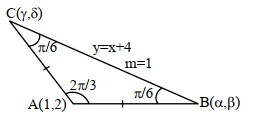
View full question & answer→MCQ 1001 Mark
If the locus of the point, whose distances from the point $(2,1)$ and $(1,3)$ are in the ratio $5: 4$, is $a x^2+b y^2+c x y+d x+e y+170=0$, then the value of $\mathrm{a}^2+2 \mathrm{~b}+3 \mathrm{c}+4 \mathrm{~d}+\mathrm{e}$ is equal to:
Answerc
$ \text { let } P(x, y) $
$ \frac{(x-2)^2+(y-1)^2}{(x-1)^2+(y-3)^2}=\frac{25}{16} $
$ 9 x^2+9 y^2+14 x-118 y+170=0 $
$ a^2+2 b+3 c+4 d+e $
$ =81+18+0+56-118 $
$ =155-118 $
$ =37$
View full question & answer→