MCQ 11 Mark
A body of mass $m$ is rotating in a vertical circle of radius $'r\ '$ with critical speed. The difference in its $K.E.$ at the top and the bottom is $.............$
- ✓
$\text{2mgr}$
- B
$\text{4mgr}$
- C
$\text{6mgr}$
- D
$\text{3mgr}$
AnswerCorrect option: A. $\text{2mgr}$
The change of kinetic energy will be equet to the change in potential energy.
$\triangle\text{KE}=\triangle\text{PE}=\text{mg}(\text{h}_1-\text{h}_2)$
Since radious $r,$
$h_1- h_2= r$
View full question & answer→MCQ 21 Mark
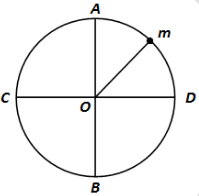
A small sphere is attached to a cord and rotates in a vertical circle about a point Or. If the average speed of the sphere is increased, the cord is most likely to break at the orientation when the mass is at:
- ✓
Bottom point $B$
- B
Top point $A$
- C
Point $D$
- D
Point $C$
AnswerCorrect option: A. Bottom point $B$
Tension in the cord is maximum $($for a given average speed of rotation$)$ when the mass, $m,$ is at the bottom points $B,$ as the gravitational force is in the downward direction and tension of the cord is directly opposing it.
View full question & answer→MCQ 31 Mark
A stationary particle explodes into two particles of masses $m_1$ and $m_2$, which move in opposite directions with velocities $v_1$ and $v_2$. The ratio of their kinetic energies $\frac{\text{E}_1}{\text{E}_2}$ is:
- ✓
$\frac{\text{m}_2}{\text{m}_1}$
- B
$\frac{\text{m}_1}{\text{m}_2}$
- C
$1$
- D
$\frac{\text{m}_1\text{v}_2}{\text{m}_2\text{v}_1}$
AnswerCorrect option: A. $\frac{\text{m}_2}{\text{m}_1}$
According to the principle of conservation of linear momentum,
$\text{m}_1\text{v}_1-\text{m}_2\text{v}_2=0$
$\therefore\frac{\text{m}_1}{\text{m}_2}=\frac{\text{v}_2}{\text{v}_1}$
$\frac{\text{E}_1}{\text{E}_2}=\frac{\frac{1}{2}\text{m}_1\text{v}_1^2}{\frac{1}{2}\text{m}_2\text{v}_2^2}$
$=\frac{\text{m}_1}{\text{m}_1}\Big(\frac{\text{v}_1}{\text{v}_2}\Big)^2$
$=\frac{\text{m}_1}{\text{m}_2}\Big(\frac{\text{m}_2}{\text{m}_1}\Big)^2$
$=\frac{\text{E}_1}{\text{E}_2}=\frac{\text{m}_2}{\text{m}_1}$
View full question & answer→MCQ 41 Mark
The work done by all the forces $($external and internal$)$ on a system equals the change in:
View full question & answer→MCQ 51 Mark
The water stored in a reservoir possesses:
AnswerPotential energy is the energy possessed due to the relative position of one body with respect to other.
Kinetic energy is the energy possessed due to the motion of the body.
Water stored in the reservoir is at rest, so no kinetic energy but it is at some height with respect to some level below the water surface, so it contains potential energy.
View full question & answer→MCQ 61 Mark
An electron and a proton are moving under the influence of mutual forces. In calculating the change in the kinetic energy of the system during motion, one ignores the magnetic force of one on another. This is because:
- A
The two magnetic forces are equal and opposite, so they produce no net effect.
- ✓
The magnetic forces do no work on each particle.
- C
The magnetic forces do equal and opposite (but non-zero) work on each particle.
- D
The magenetic forces are necessarily negligible.
AnswerCorrect option: B. The magnetic forces do no work on each particle.
Key concept: To calculate the change in kinetic energy of the system during motion we have to apply work energy, theorem. According to this theorem, Net work done $=$ Final kinetic energy $-$ Initial kinetic energy of the object The above statement shows the connection between work and kinetic energy as:
“The work done by the net force acting on an object is equal to the change in the kinetic energy of that object”.
Net work done $(IF)$ on a particle equals change in kinetic energy of the particle.
$\sum\text{W}=\text{K}_2-\text{K}_1$
According to the problem as the electron and proton are moving under the influence of mutual forces, the magnetic forces will be perpendicular to their motion, hence, it acts as a centripetal force for the particle. In this way the particle performs the uniform circular morion, this implies speed will remain constant.
So, there is no change in kinetic energy of the particle.
Hence no work is done by these forces.
$\vec{\text{F}_\text{m}}=\text{q}(\vec{\text{v}}\times\vec{\text{B}})\cdot\text{F}_\text{m}$
$($magnetic force$)$ will be perpendicular to both $B$ and $v,$ where $B$ is the external magnetic field and $v$ is the velocity of particle.
That is why one ignores the magnetic force of one particle on another.
View full question & answer→MCQ 71 Mark
In a hydroelectric power station, the water is flowing at $2\ ms^{-1}$ in the river which is $100m$ wide and $5m$ deep. The maximum power output from the river is:
- A
$1.5MW.$
- ✓
$2MW.$
- C
$2.5MW.$
- D
$3MW.$
AnswerCorrect option: B. $2MW.$
View full question & answer→MCQ 81 Mark
What is the ratio of kinetic energy of a particle at the bottom to the kinetic energy at the top when it just loops a vertical loop of radius $r?$
- ✓
$5 : 1$
- B
$2 : 3$
- C
$5 : 2$
- D
$7 : 2$
AnswerCorrect option: A. $5 : 1$
View full question & answer→MCQ 91 Mark
In the elastic collision of heavy vehicle moving with a velocity $10\ ms^{-1}$ and a small stone at rest, the stone will fly away with a velocity equal to:
- A
$40\ ms^{-1}$
- ✓
$20\ ms^{-1}$
- C
$10\ ms^{-1}$
- D
$5\ ms^{-1}$
AnswerCorrect option: B. $20\ ms^{-1}$
In the elastic collision between a heavy object and a very light object at rest, the velocity of particles after collision is.
for heavy particle, in$_1 =$ in the$_1 />$ for light particle, in $= 2$ in the$_1$−in the$_2/>$
since, in the$_2 = 0$ hence,
in$_2 = 2$ in the$_1$
Therefore, the stone will fly away with a velocity equal to
in$_1= 2$ in the$_1= 2(10) = 20\ ms^{-1}$
View full question & answer→MCQ 101 Mark
A particle of mass $1g$ moving with a velocity $\text{v}_1=3\hat{\text{i}}-2\hat{\text{j}}\text{ms}^{-1}$ experiences a perfectly elastic collision with another particle of mass $2g$ and velocity $\text{v}_2=4\hat{\text{j}}-6\hat{\text{k}}\text{ms}^{-1}$. The velocity of the particle is:
- A
$23\ ms ^{-1}$
- ✓
$4.6\ ms^{-1}$
- C
$9.2\ ms^{-1}$
- D
$6\ ms^{-1}$
AnswerCorrect option: B. $4.6\ ms^{-1}$
View full question & answer→MCQ 111 Mark
A force of $16N$ is distributed uniformly on one surface of a cube of edge $8\ cm.$ The pressure on this surface is:
- A
$3500Pa$
- ✓
$2500Pa$
- C
$4500Pa$
- D
$5500Pa$
AnswerCorrect option: B. $2500Pa$
$F = 16N$
$A =8 \times 8 \times 10^{-4}m^2$
$\text{P}=\frac{\text{F}}{\text{A}}$
$=\frac{16}{64 \times10^{-4}}$
$=\frac{1000}{4}$
$=2500\text{Pa}$
View full question & answer→MCQ 121 Mark
In which case does the potential energy decrease?
- A
On compressing the spring.
- B
- C
On moving a body against gravitational pull.
- ✓
On the raising of an air bubble in water.
AnswerCorrect option: D. On the raising of an air bubble in water.
$P.E.$ decreases when an air bubble rises in water. Because work is done by upthrust.
View full question & answer→MCQ 131 Mark
A bulled of mass $a$ and velocity $b$ is fired into a large block of mass $c$. The final velocity of the system is:
- A
$\frac{\text{c}}{\text{a}+\text{b}}.\text{b}$
- ✓
$\frac{\text{ab}}{\text{a}+\text{c}}$
- C
$\frac{(\text{a}+\text{b})}{\text{c}}.\text{a}$
- D
$\frac{(\text{a}+\text{c})}{\text{a}}.\text{b}$
AnswerCorrect option: B. $\frac{\text{ab}}{\text{a}+\text{c}}$
View full question & answer→MCQ 141 Mark
A man does a given amount of work in $10s.$ Another man does the same amount of work in $20s.$ The ratio of the output power of the first man to that of second man is
- A
$1$
- B
$1 : 2$
- ✓
$2 : 1$
- D
$3 : 1$
AnswerCorrect option: C. $2 : 1$
Since, $\text{P}=\frac{\text{W}}{\text{t}}$
So, if $W$ is constant, than $\text{P}\propto\frac{1}{\text{t}}$
i.e. $\frac{\text{P}_1}{\text{P}_2}=\frac{\text{t}_2}{\text{t}_1}=\frac{20}{10}$
$\Rightarrow\frac{\text{P}_1}{\text{P}_2}=\frac{2}{1}$
$P_1 : P_2$
$= 2 : 1$
View full question & answer→MCQ 151 Mark
A ball of mass $m$ moving with a velocity $v$ collides with an identical ball at rest. After collision, the first ball comes to rest. The speed of the other ball is:
- A
$\frac{\text{v}}{2}$
- B
$2v$
- ✓
$v$
- D
AnswerAs the masses of two balls are equal, their velocities are exchanged.
As first ball comes to rest, speed of other ball $= v.$
View full question & answer→MCQ 161 Mark
Two bodies of masses $m$ and $4m$ are moving with equal kinetic energy. The ratio of their linear momenta is:
- A
$1 : 4$
- B
$4 : 1$
- ✓
$1 : 2$
- D
$1 : 1$
AnswerCorrect option: C. $1 : 2$
View full question & answer→MCQ 171 Mark
Two bodies of masses $m$ and $4m$ are moving with equal linear momentum. The ratio of their kinetic energies is:
- A
$1 : 4$
- ✓
$4 : 1$
- C
$1 : 1$
- D
$1 : 2$
AnswerCorrect option: B. $4 : 1$
View full question & answer→MCQ 181 Mark
Two weights of $5\ kg$ and $10\ kg$ are placed on a horizontal table of height $1.5m.$ Which will have more potential energy?
- A
$5\ kg$
- ✓
$10\ kg$
- C
Both will have equal energy
- D
AnswerCorrect option: B. $10\ kg$
We know that, $\text{P.E = mgh}$
So, It is directly proportional to height and mass.
Since both the weights are at the same height,
so the weight with a larger mass will have more potential energy.
Since $10\ kg$ object has a larger mass than a $5$ medical history
So, the potential energy of a $10\ kg$ mass will be greater.
View full question & answer→MCQ 191 Mark
A boy is swinging in a swing. If he stands the time period will
- A
First decreases, then increase.
- ✓
- C
- D
AnswerAs the child stand up the effective length of pendulum decreases due to the reason that center of gravity rises up.
According to $\text{T}=2\text{s}\sqrt{\Big(\frac{1}{\text{g}}}\Big)$
View full question & answer→MCQ 201 Mark
A raised hammer possesses:
AnswerCorrect option: B. $P.E.$
A raised hammer possesses $P.E$ Energy possessed by a body by virtue of its position is called as potential energy.
Similarly is the case when a hammer is raised. A raised hammer possesses potential energy by virtue of its height above ground level.
View full question & answer→MCQ 211 Mark
You lift a suitcase from the floor and keep it on the table. The work done by you on the suitcase depends on:
- A
The path taken by the suitcase.
- B
- ✓
The weight of the suitcase.
- D
The time taken by you in doing so.
AnswerCorrect option: C. The weight of the suitcase.
The work done by a person in lifting an object is stored as its potential energy mgh.
Hence, work done depends on the weight of the object mg.
View full question & answer→MCQ 221 Mark
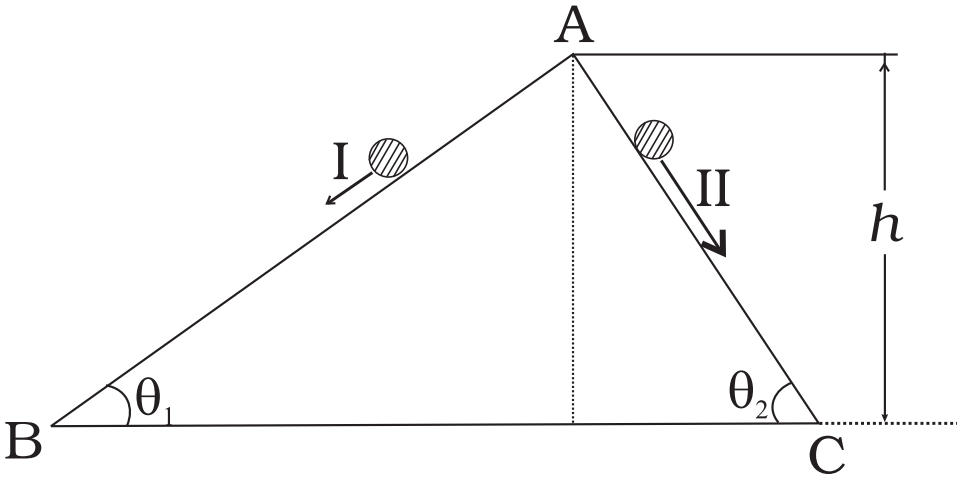
Two inclined frictionless tracks, one gradual and the other steep meet at A from where two stones are allowed to slide down from rest, one on each track as shown in which of the following statement is correct?
- A
Both the stones reach the bottom at the same time but not with the same speed.
- B
Both the stones reach the bottom with the same speed and stone $I$ reaches the bottom earlier than stone $II.$
- ✓
Both the stones reach the bottom with the same speed and stone $II$ reaches the bottom earlier than stone $I.$
- D
Both the stones reach the bottom at different times and with different speeds.
AnswerCorrect option: C. Both the stones reach the bottom with the same speed and stone $II$ reaches the bottom earlier than stone $I.$
As shown in diagram $AB$ and $AC$ are two smooth planes inclined to the angle $\theta_1$ and $\theta_2$ respectively. As friction is absent here,
hence, mechanical energy will be conserved.
As both the tracks having common height $h,$ From conservation of mechanical energy,
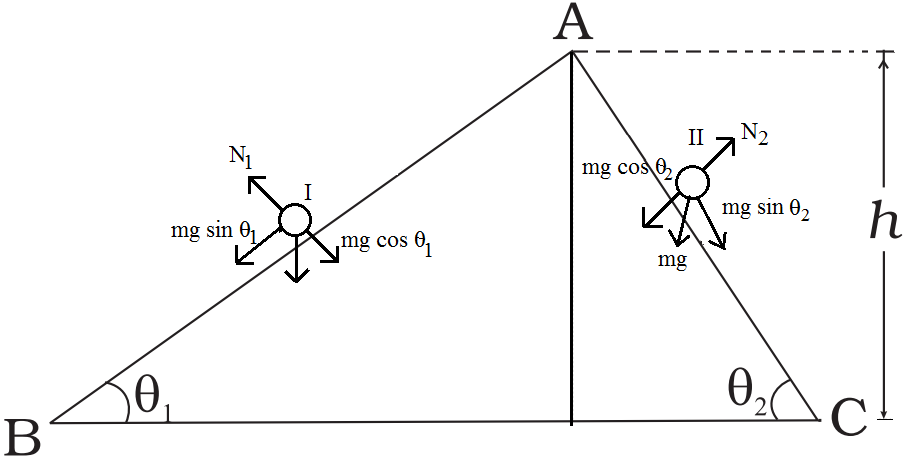
$\frac{1}{2}\text{mv}^2=\text{mgh} ($for both tracks $I$ and $II)$
$\text{v}=\sqrt{2\text{gh}}$
Hence, speed is same for both stones. For stone $I\, a_1 =$ acceleration along inclines plane $=\text{g}\sin\theta_1$
Similarly, for stone $II,\ \text{a}_2=\text{g}\sin\theta_2$ as $\theta_2>\theta_1$
hence, $\text{a}_2>\text{a}_1$
And both length for track $II$ is also less,
hence stone $II$ reaches earkier than stone $I.$ View full question & answer→MCQ 231 Mark
Consider two observers moving with respect to each other at a speed $v$ along a straight line. They observe a bock of mass $m$ moving a distancel on a rough surface. The following quantities will be same as observed by the two observers.
- A
Kinetic energy of the block at time t.
- B
- C
Total work done on the block.
- ✓
Acceleration of the block.
AnswerCorrect option: D. Acceleration of the block.
Acceleration of the block will be the same to both the observers. The respective kinetic energies of the observers are different, because the block appears to be moving with different velocities to both the observers. Work done by the friction and the total work done on the block are also different to the observers.
View full question & answer→MCQ 241 Mark
In which form, the energy is stored in a fuel?
AnswerChemical energy is energy stored in the bonds of atoms and molecules. Batteries, biomass, petroleum, natural gas, and coal are examples of chemical energy. Chemical energy is converted to thermal energy when people burn wood in a fireplace or burn gasoline in a car's engine.
View full question & answer→MCQ 251 Mark
A ball of mass $3\ kg$ collides with a wall with velocity $10m/ \sec$ at an angle of $30^\circ$ with the wall and after collision reflects at the same angle with the same speed. The change in momentum of ball in $\text{MKS}$ unit is:
Answer$\triangle\text{p=2mvcos}60^\circ=\text{min}$
$=2\times 3\times 10\times 21$
$=30\frac{\text{kgm}}{\text{s}}$
View full question & answer→MCQ 261 Mark
Equal masses $($meach$)$ are attached at the two ends of a string passing over two pulleys. Another mass is attached at the centre of the string. In order that there is no sag in the string, this mass should be:
- A
$m$
- B
$\frac{\text{m}}{2}$
- C
$2m$
- ✓
View full question & answer→MCQ 271 Mark
A block of mass $m$ slides down a smooth vertical circular track. During the motion, the block is in:
AnswerThe net force on the block is not zero, therefore the block will not be in any given equilibrium.
View full question & answer→MCQ 281 Mark
A boy is whirling a stone tied at one end such that the stone is in uniform circular motion. Which of the following statement is correct?
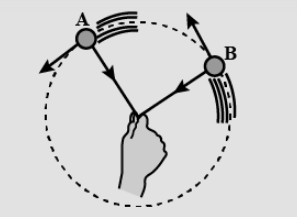
AnswerCorrect option: B. The speed of stone at $A$ is equal to the speed of stone at $B.$
In uniform circular motion speed is constant while velocity being a vector quantity is constantly changing as its direction keeps changing. Centripetal force acts inwards towards the center to counterbalance the centrifugal force acting outwards from the center.
View full question & answer→MCQ 291 Mark
One end of a light spring constant k is fixed to a wall and the other end is tied to a block placed on a smooth horizontal surface. In a displacement, the work done by the spring $\frac{1}{2\text{kx}^2}.$
The possible cases are:
- A
The spring was initially compressed by a distance X and was finally in its natural length.
- B
It was initially in its natural length and finally in a compressed position.
- C
It was initially stretched by a distance x and finally was in its natural length.
- ✓
AnswerExplanation:
As work is done by the spring, therefore, there are only two possibilities: the spring was initially compressed by a distance x and has come to its natural length or the spring was initially stretched by distance x and finally comes to its natural length.
View full question & answer→MCQ 301 Mark
A proton is kept at rest. A positively charged particle is released from rest at a distance $d$ in its field. Consider two experiments one in which the charged particle is also a proton and in another, a positron. In the same time $t,$ the work done on the two moving charged particles is:
- A
Same as the same force law is involved in the two experiments.
- B
Less for the case of a positron, as the positron moves away more rapidly and the force on it weakens.
- ✓
More for the case of a positron, as the positron moves away a larger distance.
- D
Same as the work done by charged particle on the stationary proton.
AnswerCorrect option: C. More for the case of a positron, as the positron moves away a larger distance.
Positron because their charges are same.
As the mass of positron is much lesser than proton,
$(1/1840$ times$)$ it moves away through much larger distance compared to proton.
Change in their momentum will be same.
So, velocity of lighter particle will be greater than that of a heavier particle.
So, positron is moved through a larger distance.
As work done $=$ force $\times$ distance.
As forces are same in case of proton and positron but distance moved by positron is larger,
hence, work done will be more.
View full question & answer→MCQ 311 Mark
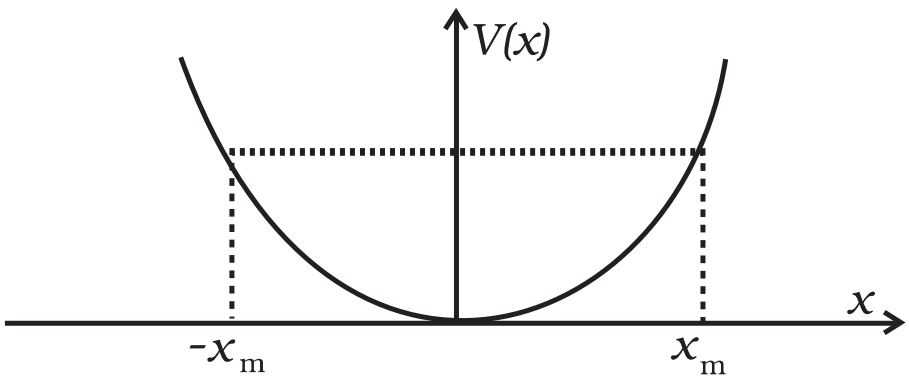
The potential energy function for a particle executing linear $\text{SHM}$ is given by $\text{v(x)}=\frac{1}{2}\text{kx}^2$ where $k$ is the force constant of the oscillator. For $k = 0.5N/ m,$ the graph of $V(x)$ versus $x$ is shown in the figure. A particle of total energy $E$ turns back when it reaches $\text{x}=\pm\text{x}_\text{m}.$ If $V$ and $K$ indicate the $P.E$. and $K.E.,$ respectively of the particle at $x = +xm,$ then which of the following is correct?
- A
$V = 0, K = E$
- ✓
$V = E, K = 0$
- C
$V < E, K = 0$
- D
$V = 0, K < E$
AnswerCorrect option: B. $V = E, K = 0$
Key concept: Energy Graph for a Spring: If the mass attached with spring performs simple harmonic motion about its mean position then its potential energy at any position $(x)$ can be given by,
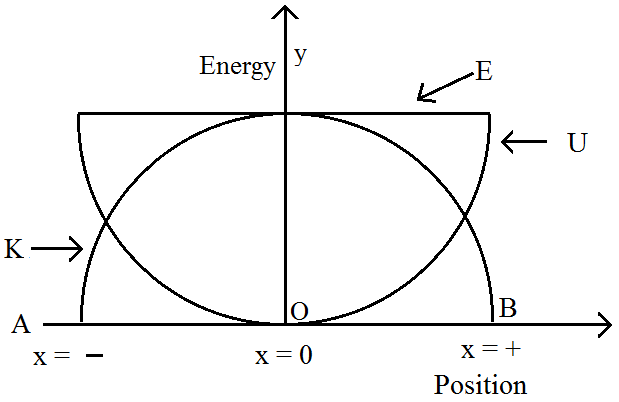
Now kinetic energy at any position $\text{K}=\text{E}-\text{U}=\frac{1}{2}\text{Ka}^2-\frac{1}{2}\text{Kx}^2$
$\text{K}=\frac{1}{2}(\text{a}^2-\text{x}^2)\ ....(\text{i})$
From the above formula, we can cheak that
$\text{U}_\text{max}=\frac{1}{2}\text{Ka}^2$
At extreme $x=\pm\text{a}\big]$ and $U_{min} = 0 [$At mean $x = 0]$
$\text{K}_\text{max}=\frac{1}{2}\text{Ka}^2 [$At mean $x = 0]$ and $K_{min} = 0 \big[$ At extreme $x=\pm\text{a}\big]$
$\text{E}=\frac{1}{2}\text{ka}^2=$ constant$($at all positions$)$
Because velocity of mass $= 0 [$at extreme position$]$
$\therefore\ \text{K}=\frac{1}{2}\text{mv}^2=0$
It means kinetic energy changes parabolically w.r.t. position but total energy remain always constant irrespective to the position of mass.
Total energy is $\text{E = PE + KE,}$ which remains constant.
According to the question, when paraticle is at $x = xm,$
i.e., at extreme position $\ce{x = xm \Rightarrow KE = 0}$
Hence, total energy will be
$\text{E}=\text{PE}+0=\text{PE}$
$\Rightarrow\text{V}\text{(x}_\text{m})=\frac{1}{2}\text{kx}^2_\text{m}$
Hence option $(b)$ is correct.
$\text{V = E, K = 0}$ View full question & answer→MCQ 321 Mark
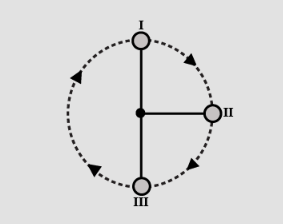
Which of the following statements is true?
- ✓
The tension in the string is greater at points $III$ than at point $I$
- B
The tension in the string is greater at points $I$ than at point $III$
- C
The tension at point $I$ is equal to the tension at point $III$
- D
The tension in the string is greatest at point $II$
AnswerCorrect option: A. The tension in the string is greater at points $III$ than at point $I$
When the bob is swinging in vertical circle the centripetal force and the pseudo force varies.
Centripetal force causes the tension in the string.
Let centripetal force be $C,$ pseudo force be $P$ and weight of bob be In.
At position $1, C = P − In$
At position $2, C = In$
At position $3, C = P + In$
As $C$ at position $3$ is greatest, the tension in the string is greatest at this position.
View full question & answer→MCQ 331 Mark
Which one of the following types of energy is possessed by a body when placed at a certain height?
AnswerWhen a body is placed at a certain height, the body possesses potential energy.
$P.$ And, $\text{uh. = mgH}$
$m;$ the mass of the object
$g;$ acceleration due to gravity
$H;$ height gained by object
View full question & answer→MCQ 341 Mark
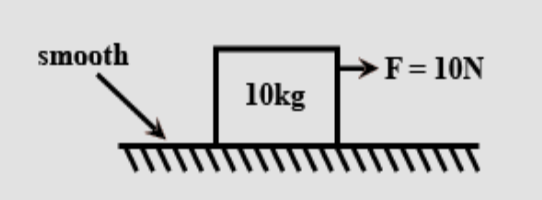
Force shown acts for $2$ seconds. Find out work done by force $F$ on $10\ kg$ in $3$ seconds.
AnswerWork done,
$In = Fd$
Displacement d is given by,
$\text{d}=\frac{1}{2}\text{at}^2$
$F = ma$
$10 = 10a, a = 1\ m/ s^2$
$\text{d}=\frac{1}{2}(1)(2)^2=2\text{m}$
$In = 10 \times 2 = 20D$
View full question & answer→MCQ 351 Mark
The total work done on a particle is equal to the change in its kinetic energy:
- ✓
- B
Only if the forces acting on it are conservative.
- C
Only if gravitational force alone acts on it.
- D
Only if elastic force alone acts on it.
AnswerAccording to the work$-$energy theorem, the total work done on a particle is equal to the change in kinetic energy of the particle.
View full question & answer→MCQ 361 Mark
When a massive body suffers an elastic collision with a stationary light body, then massive body approximately comes to rest and light body-
- ✓
Acquires velocity greater than initial velocity of massive body.
- B
Sticks to the massive body and remains at rest.
- C
Acquires half the initial velocity of the massive body
- D
Remains at rest but does not stick to the massive body.
AnswerCorrect option: A. Acquires velocity greater than initial velocity of massive body.
View full question & answer→MCQ 371 Mark
A long spring is stretched by $2\ cm.$ Its potential energy is $V.$ If the spring is stretched by $10\ cm,$ its potential energy would be:
- A
$\frac{\text{v}}{25}$
- B
$\frac{\text{v}}{5}$
- C
$5V$
- ✓
$25V$
AnswerPotential energy $\propto\text{x}^2$ When $\times$ becomes $5$ times, $P.E.$ becomes $25$ times.
View full question & answer→MCQ 381 Mark
Two bodies $P$ and $Q$ of equal masses are kept at heights $x$ and $4x$ respectively. What will be the ratio of their potential energies?
- A
$1 : 8$
- B
$4 : 1$
- ✓
$1 : 4$
- D
$8 : 1$
AnswerCorrect option: C. $1 : 4$
Potential energy $P = mgh$
Given, $h_1= x ; h_2 = 4x$
Since, the masses are same,
then$\frac{\text{P}_1}{\text{P}_2}=\frac{\text{h}_1}{\text{h}_2}=\frac{\text{x}}{4\text{x}}=1:4$
View full question & answer→MCQ 391 Mark
The $K.E.$ of a body becomes $4$ times its initial value. The new linear momentum will be:
- A
- B
Four times the initial value.
- ✓
- D
Eight times the initial value.
Answer$\text{K.E}=\frac{\text{p}^2}{2\text{m}}$
When $K.E.$ becomes $4$ times, $\text{p}^2$ is $4$ times.
Therefore, $p$ becomes $2$ times.
View full question & answer→MCQ 401 Mark
If the linear momentum is increased by $50\%,$ then $K.E.$ will be increased by:
- A
$50\%$
- B
$100\%$
- ✓
$125\%$
- D
$25\%$
AnswerCorrect option: C. $125\%$
View full question & answer→MCQ 411 Mark
A sphere, a cube and a thin circular plate; all are of the same material and same mass and all of them are initially heated to same high temperature. Then:
- A
Plate will cool fastest and cube the slowest.
- B
Sphere will cool fastest and cube the slowest.
- ✓
Plate will cool fastest and sphere the slowest.
- D
Cube will cool fastest and plate the slowest.
AnswerCorrect option: C. Plate will cool fastest and sphere the slowest.
The surface area of sphere $ < $ surface area of the cube for the given same mass and same density.
The rate of cooling $\alpha$ area of contact with surroundings.
The plate will cool faster than the sphere.
View full question & answer→MCQ 421 Mark
The kinetic energy of a particle continuously increases with time:
- A
The resultant force on the particle must be parallel to the velocity at all instants.
- B
The resultant force on the particle must be at an angle less than 90° all the time.
- C
The magnitude of its linear momentum is increasing continuously.
- ✓
AnswerExplanation:
As K.E. of particle is increasing continuously with time magnitude of its linear momentum must be increasing continuously $\big(\therefore\text{E}=\frac{\text{p}^2}{2\text{m}}\big).$ For this resultant force on the particle must be at an angle less than 90° all the time.
View full question & answer→MCQ 431 Mark
A mass is performing vertical circular motion $($see figure$)$. If the average velocity of the particle is increased, then at which point is the maximum breaking possibility of the string:
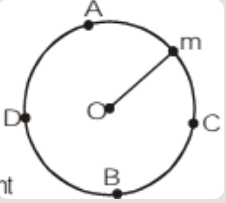
AnswerTension at any point in vertical motion is given by:
$\text{T}=\frac{\text{min}^2}{1}+\text{mgcos}\theta$
where $I =$ angular displacement from lowest point,
$l =$ length of string
$m =$ mass of string
It is clear that tension at the lowest point $(B)$ is greatest than at other points $(A, C, D).$ If we increase average velocity, tension will increase at lowest point, therefore at point $B,$ string has maximum possibility of break.
View full question & answer→MCQ 441 Mark
The kinetic energy force on the particle continuously increases with time.
AnswerCorrect option: D. The magnitude of its linear momentum is increasing continuously.
Kinetic energy of a particle is directly proportional to the square of its velocity. The resultant force on the particle must be at an angle less than $90^\circ$ with the velocity all the time so that the velocity or kinetic energy of the particle keeps on increasing.
The kinetic energy is also directly proportional to the square of its momentum, therefore it continuously increases with the increase in momentum of the particle.
View full question & answer→MCQ 451 Mark
A body is falling freely under the action of gravity alone in vacuum. Which of the following quantities remain constant during the fall?
AnswerAs the body is falling freely under gravity, the potential energy decreases continuously and kinetic energy increases continuously as all the conservative forces are doing work.
So, total mechanical energy $\text{(PE + KE)}$ of the body will be constant.
Let us discuss this in detail:
In the given diagram an object is dropped from$-$a height $H$ from ground.
At point $A$ total mechanical energy will be $\text{EA = K.E + P.E}$
$\text{E}_\text{A}=\frac{1}{2}\text{mv}^2+\text{mgH}$
As velocity will be zero at $A$, so its kinetic energy will be zero.
$\text{E}_\text{A}=\text{mgH}$
Velocity at point $B$ will be, $\text{v}_\text{B}=\sqrt{2\text{gh}}$
So, energy at point $B$ will be $\text{E}_\text{B}=\text{KE}+\text{PE}$
$\text{E}_\text{B}=\frac{1}{2}\text{m}(2\text{gh})+\text{mg}(\text{H}-\text{h})$
$\text{E}_\text{B}=\text{mgh}+\text{mgH}-\text{mgh}$
$\text{E}_\text{B}=\text{mgH}$
Now, velocity at point $C$ will be $\text{v}_\text{c}=\sqrt{2\text{gh}}$
So, energy at point will be $\text{E}_\text{c}=\text{KE}+\text{PE}$
$\text{E}_\text{c}=\frac{1}{2}\text{m}(2\text{gH})+\text{mg}(0)$
$\text{E}_\text{c}=\text{mgH}$
So, total mechanical energy will remain same $($if we neglect the air friction$).$
View full question & answer→MCQ 461 Mark
Which of the following does not have potential energy ?
- A
- ✓
Water in a flowing river.
- C
- D
AnswerCorrect option: B. Water in a flowing river.
Potential energy is the energy that is stored in an object due to its position above the ground surface and when the object is in motion then it has kinetic energy. Water in a flowing river has kinetic energy.
View full question & answer→MCQ 471 Mark
No work is done by a force on an object if:
- A
The object is stationary but the point of application of the force moves on the object.
- B
The object moves in such a way that the point of application of the force remains fixed.
- C
The force is always perpendicular to its velocity.
- ✓
Answer$\text{W}=\text{Fs}=\cos\theta=0$, when either $s = 0$ or $\theta=90^\circ$
i.e., when object is stationary but the point of application of the force moves on the object or object moves in such a way that point of application of force remains fixed; or force is at $90^\circ$ to the acceleration.
View full question & answer→MCQ 481 Mark
A particle is acted upon by a force of constant magnitude which is always perpendicular to the velocity of the particle. The motion of the particle takes place in a plane. It follows that:
- A
Its velocity is constant.
- B
Its acceleration is constant.
- C
Its kinetic energy is constant.
- ✓
It moves in a circular path.
AnswerCorrect option: D. It moves in a circular path.
When the force on a particle is always perpendicular to its velocity,
the work done by the force on the particle is zero,
as the angle between the force and velocity is $90^\circ .$
So, kinetic energy of the particle will remain constant.
The force acting perpendicular to the velocity of the particle provides centripetal acceleration that causes the particle to move in a circular path.
View full question & answer→MCQ 491 Mark
A body is moving unidirectionally under the influence of a source of constant power. Its displacement in time $t$ is proportional to:
- A
$\text{t}^{\frac{1}{2}}$
- B
$\text{t}$
- ✓
$\text{t}^\frac{3}{2}$
- D
$\text{t}^2$
AnswerCorrect option: C. $\text{t}^\frac{3}{2}$
As power, $P =$ force $\times$ veclocity
$\text{P}=\big[\text{MLT}^{-2}\big]\big[\text{LT}^{-1}\big]=\big[\text{ML}^2\text{T}^{-3}\big]$
As, $\text{P}=\big[\text{ML}^2\text{T}^{-3}\big]$
$=$ Constant
$\therefore\text{ L}^2\text{T}^3=\text{Constant}$
Or, $\frac{\text{L}^2}{\text{T}^3}=\text{Constant}$
$\therefore\text{ L}^2\propto\text{T}^3$
Or, $\text{L}\propto \text{T}^{\frac{3}{2}}$
Hence, right choice is $(iii) \text{t}^{\frac{3}{2}}$
View full question & answer→MCQ 501 Mark
A body of mass $'M'$ collides against a wall with a velocity $v$ and retraces its path with the same speed. the change in momentum is $............. ($take initial direction of velocity as positive$)$
AnswerTaking $+ x$ direction to be positive, and assuming ball was travelling in $+ x$ direction initially.
$\text{Pi = Mv}$
After collision ball will move in $- x$ direction
$\text{Pf = − Mv}$
Change in momentum:
$\triangle \text{P = Pi − Pf}$
$\triangle \text{P = Mv + Mv = 2Mv}$
View full question & answer→