Questions

4 Marks Question

🎯

Test yourself on this topic

19 questions · timed · auto-graded

Question 14 Marks
What do you understand by High Altitude Training in sports? What is the impact of high altitude training on athletes? Write in detail.
Answer
  1. Sports training carried out at an altitude of 8000 to 10000ft/ 2000 - 2500mts.
Impact of high altitude training
  1. Increase erythroprotein hormone.
  2. Increase in RBC count and size.
  3. Increase VO2 max.
  4. Increase in lung capacity.
  5. Inactive alveoli become active.
  6. More capillarisation takes place.
  7. Lactic acid tolerance in body increases.
  8. Ability of athletes to push harder and apply more power during workout increases.
  9. Athlete after training in high altitude gets competitive advantage when at sea level.
  10. Due to changed physiological condition Change last for 10-20 days (short term impact).
View full question & answer
Question 24 Marks
Explain ‘weight training’ as one of the oldest methods for development of strength. Describe its advantages and disadvantages.
Answer
Weight Training are those exercise which are designed to strengthen specific muscles by causing them to overcome a fixed resistance, usually in the form of bar–bells or dumb-bells.
Advantages of Weight Training:
  1. Help in getting good shape.
  2. Increase in muscle strength.
  3. Increase in bone strength.
  4. Better appearance and correct body posture.
  5. Reduces stress and tension.
  6. Best means of providing fitness.
Disadvantage of Weight Training:
  1. Risk of Injuries.
  2. Less flexibility.
  3. Risk of doing in early age.
View full question & answer
Question 34 Marks
Participation in physical activity for a longer duration maintains functional fitness among aged population. Justify.
Answer
  1. Changes in Sensory Organs.
  2. Changes in Skin.
  3. Changes in sleep.
  4. Changes in bone density.
  5. Changes in Metabolism.
  6. Changes in brain and nervous system/brain ageing.
  7. Heart and blood circulation.
  8. Change in body composition.
  9. Slow down loss of muscle mass.
  10. Reduces age-related diseases.
  11. Improves muscular strength.
  12. Enhances lung capacity.
  13. Improves flexibility.
  14. Decreases stress and tensions.
View full question & answer
Question 44 Marks
Differentiate between 1:1 and 1:2 ratio interval training, with suitable examples.
Answer
1:1 means load and the rest is equal. e.g. 1-minute exercise followed by 1 minute of rest.
Similarly 1:2 means that the period of rest is double of the load. e.g. 1-minute exercise followed by 2 minutes of rest.
The slow and extensive interval training methods can be given by using 1:1 and 1:2.
Fast or intensive interval training methods can be given by using 1:1 and 1:2.
Student is required to explain the relationship between load and rest, with suitable examples from their respective games and sports.
View full question & answer
Question 54 Marks
Weight training is one of the oldest methods for development of strength. What are its advantages and disadvantages?
Answer
Advantages of weight training:
  1. Helps in getting good shape.
  2. Providing best fitness.
  3. Helpful in enhancing performance.
  4. To develop strength.
  5. Increases bone density.
Disadvantages of weight training:
  1. Risk of injuries.
  2. Less flexibility.
  3. Expensive.
View full question & answer
Question 64 Marks
What is endurance? Explain the various methods for its development.
Answer
Endurance training is the act of exercising to increase endurance. The term endurance training generally refers to training the aerobic system as opposed to anaerobic. The need for endurance, in sports, is often predicated as the need of cardiovascular and simple muscular endurance, but the issue of endurance is far more complex. Endurance can be divided into two categories including general endurance and specific endurance. It can be shown that endurance in sport is closely tied to the execution of skill and technique. A well-conditioned athlete can be defined as, the athlete who executes his or her technique consistently and effectively with the least effort. Every method has its own characteristic effect for development of specific preconditions. Some methods can have similar impact on the athlete’s adaptation provided we use it under similar conditions. The training methods for aerobic or anaerobic endurance development can be divided into several groups:
  • Uninterrupted Methods.
  • Intermittent methods.
  • Fartlek.
Uninterrupted Methods: These methods include continuous method and method of alternating intensity.
Continuous method means load with constant level of intensity or speed. The load lasts usually for longer than $30$ minutes (up to several hours). This method is used to develop basic (general) endurance, mixed aerobic-anaerobic metabolism, or to maintain the level of reached endurance adaption. Uninterrupted method of alternating intensity: During Uninterrupted load of alternating intensity, the athlete alternates, regularly or irregularly, different intensity and length of sections. Load intensity can very from low to very high. The number, length and intensity of sections are usually planned. Intermittent Methods: This group includes interval methods and repetition methods. The main difference between these methods is the condition of the athlete before starting the next unit. During interval training, another repetition starts with insufficient recovery of the athlete. During repetition training, another unit starts only with relate recovery after a longer pause between units. Interval Method: Interval training contains several load units of high intensity (from submaximal to maximal). As a rule, we distinguish between short, medium and long interval methods according to the time-period of load. The interval method is not suitable for children, and it can be applied to the youth training only with great care. Children are not ready for anaerobic load of longer duration, and the youth are only developing this ability. The incorporation of intervals into youth training can lead to very steep rise in performance development in relatively short time, which is followed by stagnation or decrease in performance or can lead to the overtraining. Repetition Method: This type of training involves repetitions of several legs. The intensity of a repeated leg is most often at the competition pace level but it can also be submaximal speed or also slightly faster for a given distance. This training is not directly connected to development of $VO_{2max}$ it is related to improving or maintaining race pace which is different for milers and 10 – kilometre runners.
View full question & answer
Question 84 Marks
What is the difference between Running and Walking? Explain mechanical Analysis of ‘Running’.
Answer
Running Walking
Running is process in which both feet are in the air at one point of time. Walking is a process in which atleast one foot remains in contact with the ground.
Double swing phase. Single swing phase.
Movement in the limbs is faster. Movement in the limbs is slower.
Range of motion is greater. Range of motion is less.
Duration of swing phase is longer. Duration of stance phase is longer.
Mechanical analysis of running:
  1. Stance phase:
  • Initial contact stage.
  • Absorption stage.
  • Mid stance stage.
  • Propulsive stage.
  1. Swing phase.
View full question & answer
Question 94 Marks
What is movement speed? Explain the methods to develop speed endurance.
Answer
Movement speed is the time taken between the initiation of movement and the completion of the movement. It depends upon techniques, explosive strength, flexibility and coordinative abilities. It plays a vital role in boxing, gymnastics, swimming; throws and jumps etc. Where the minimum time is taken to complete the movement.
To develop the speed endurance we will have to work more on pace races because pace races means running the whole distance at a constant speed. Generally, 800 meters and above races are included in pace races. As a matter of fact, an athlete’s can run a distance of 300 meters at full speed but, in longer races such as 800 meters or above races he must conserve his energy by reducing his speed. For example, if there is a runner of 800 meter race his best time is 1 minute 40 second, so, he should run first 400 m in 49 seconds and next 400m in 51 seconds.
View full question & answer
Question 104 Marks
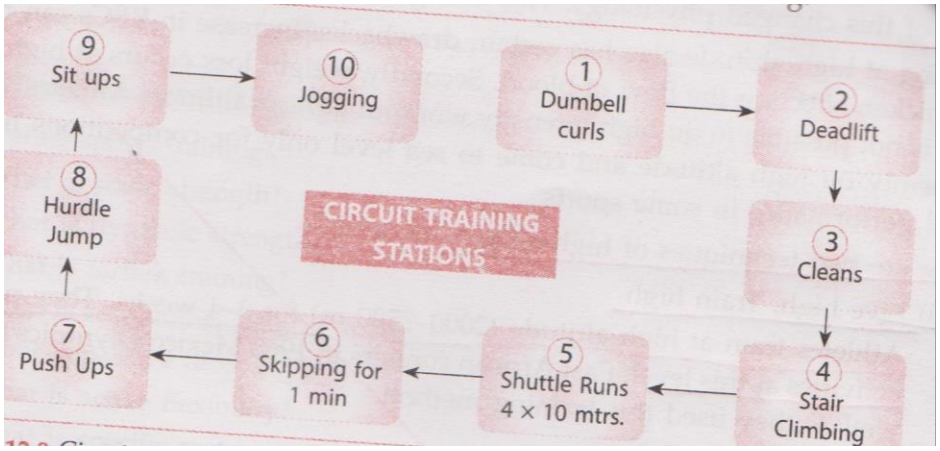
What is circuit training? Draw a diagram of 10 stations to improve general fitness. How can load be increased in circuit training?
Answer
Circuit training is the training method in which exercise of various kinds are performed with or without apparatus with given dosage.
How to increase the load in circuit training?
  1. Number of repetition can be increased per exercise.
  2. Frequency can be increased.
  3. Additional load can be increased.
  4. Interval between exercises can be reduced.
  5. Number of rounds can be increased.
View full question & answer
Question 114 Marks
What do you understand by Coordinative ability? Discuss about different types of coordinative abilities.
Answer
Coordinative abilities are those abilities which enable an individual to do various related activities accurately and efficiently. Coordinative abilities mainly depend on the central Nervous System.
Types:
  1. Orientation ability.
  2. Coupling ability.
  3. Reaction ability:
  • Simple reaction ability
  • Complex reaction Ability
  1. Balance Ability.
  2. Rhythm ability.
  3. Adaptation ability.
  4. Differentiation ability.
View full question & answer
Question 124 Marks
Write in detail about strength improving methods–Isometric, Isotonic and Isokinetic.
Answer
Strength is the capacity of the whole body or parts of to exert force. There are two types of strength–Dynamic & Static strength. Following methods are used to improve strength:
  1. Isometric Exercise: Means where we do these exercises work is done cannot be observed. In these exercises, work is performed but it is not seen directly. In these exercises a group of muscles carry out tension against the other group of muscles. For example: Pushing against the sturdy wall, we will not be able to move it from its place. So, we should not consider it as work. Our muscle exert force, while pushing wall, but we see that work is not done. When we do exercise expenditure of energy is usual phenomenon. Some time body temperature may increase while performing these exercises. Muscles may feel a slight tremor if exercise is done for a prolonged time. Regular performing these exercises muscle size and shape can be changed.
  2. Isotonic Exercise: Isotonic exercises are those exercises in which movement can be seen directly. Work is done in these exercises. The lengthening and shortening of muscle can be called eccentric contraction and concentric contraction accordingly.
Examples are: callisthenic exercises, running and jumping on the spot, lifting of weights or exercise with medicine ball. These exercise can be done with or without equipment.
  1. Iso-kinetic exercise: In Iso-kinetic exercise contraction of muscle apply maximum forces throughout the complete range of movements. According to individual’s capacity, the speed of contraction can be adjusted. The Iso-kinetic excise can be used effectively for the development of strength.
View full question & answer
Question 134 Marks
What is endurance? How endurance can be developed through fartlek method?
Answer
Endurance is the ability to sustain an activity. Barrow and McGee, define endurance as the result of a physiologic capacity of the individual to sustain movement over a period of time.
Fartlek Training Method: It is such a training method that blends continuous training with interval training. This training method lays emphasis on both aerobic and anaerobic systems. In this method, pace or speed is not pre-planned and thus it is left to the discretion of individual.
View full question & answer
Question 144 Marks
Dynamic strength is divided into three parts. Write a brief note on each of them.
Answer
Dynamic strength can be divided into three parts:
  1. Maximum Strength: It is the ability to work against maximum resistance. Maximum strength is not used in majority of sports. It is usually used in those sports where very heavy resistances are to be tackled, e.g., weightlifting, shot-put, hammer throw, discus throw, javelin throw.
  2. Explosive Strength: Explosive strength can be defined as the ability to overcome resistance with high speed. In fact, it is a combination of strength and speed abilities.
  3. Strength Endurance: It is the combination of strength and endurance abilities. Strength endurance can be defined as the ability to overcome resistance or to act against resistance under conditions of fatigue.
View full question & answer
Question 154 Marks
Briefly explain different types of coordinative abilities.
Answer
The types of coordinative abilities are mentioned below:
  1. Orientation Ability: It is the ability to determine the position of the body and its parts in time and space in relation to gravity, moving objects like ball, opponent, partner, playing field, etc. This ability depends on functional capacity of sensory organs like eyes, kinesthetic sense organs, etc.
  2. Coupling Ability: Coupling ability is the ability to combine the movements of different body parts for performing perfect sports movements
  3. Balance Ability: Balance ability is the ability to maintain balance during the complete body movements and to regain balance quickly after the balance-disturbing movements.
View full question & answer
Question 164 Marks
Discuss the types of endurance according to the duration of activity'
Answer
  1. Speed Endurance: Speed endurance is the ability to resist fatigue in activities Iasting up to 45 seconds.
  2. Short Term Endurance: Short term endurance is needed to resist fatigue in sports activities lasting from about 45 seconds to 2 minutes.
  3. Middle Term Endurance: The middle term endurance is needed for such sports activities which last from 2 to 11 minutes.
  4. Long Term Endurance: Long term endurance is needed in such sports activities which last for more than 11 minutes. The sports activities such as 5000m, 10,000 m cross country and marathon races require such type of endurance.
View full question & answer
Question 174 Marks
What is circuit training? Discuss the advantages of circuit training?
Answer
"Circuit training is the training method in which certain exercises of various kinds are performed" with or without apparatus, with given dosage.
Advantages of Circuit Training:
  1. Circuit training can be performed indoors or outdoors. In rainy season, this training can be done in rooms.
  2. The equipment for exercises can be provided easily.
  3. It is easy to learn. A trainee can learn to train himself.
  4. Trainee is able to gain good result in a short period.
  5. It is an interesting method of training.
View full question & answer
Question 184 Marks
What do you mean by speed? Elucidate the methods of improving speed.
Answer
Capacity of an individual to perform Successive movement of the same pattern at a fast rate."
  1. Acceleration Runs: Acceleration runs are usually adopted to develop speed, specially in attaining maximum speed from stationary position. It should be kept in mind that the technique of any event should be learnt in the beginning. Only then, we should switch over to acceleration runs.
  2. Pace Runs or Races: Pace races mean running the whole distance of a race at a constant speed. In pace races, an athlete runs the race with uniform speed. Generally, 800m and above races are included in pace races. As a matter of fact, an athlete can run a distance of 300m at fuII speed. So, in longer races such as 800m or above races he/ she must conserve his energy by reducing his speed.
View full question & answer
Question 194 Marks
Define endurance and discuss any two methods of improving endurance.
Answer
Endurance is the ability to sustain an activity.
Methods:
  1. Continuous Training Method
Continuous training is one of the best methods for improving endurance. In this method of training, an exercise is performed for a long duration without any break.

Advantages:
  • It increases glycogen in muscles and liver.
  • It increases the number and size of mitochondria.
  • It also increases the efficiency of heart and lungs.
  • It improves willpower and makes the individual well-determined under the condition of fatigue.
  • It makes the individual self-disciplined and self-confident.
  1. Interval Training Method
It is a training of heart, through endurance training. If you run, your heart beats at a faster rate.

Advantages:
  • More workout can be performed in a short duration.
  • It is more beneficial for respiratory and circulatory systems and they can be trained both at the same time.
  • The progress of the athlete can be measured easily'
Disadvantages:
  • Top performance comes before competition and cannot remain up to the competition time.
  • There are more chances of injuries.
  • Regular training can lead to heart diseases.
View full question & answer
4 Marks Question - Physical Education STD 12 Commerce Questions - Vidyadip