Question 12 Marks
A cell culture in a biology lab currently holds 1 million cells. The cells have a constant continuous birth rate of 1.5% and death rate of 0.5% per hour. Cells are extracted from the culture for an experiment at the rate of 5000 per hour. How many cells will be in the culture 10 hours from now?
AnswerLet p be the population, and let t be the number of hours from now. Births, deaths and extraction respectively contribute 0.015p, - 0.005p and-5000 to $\frac{d p}{d t}$. So we have $\frac{d p}{d t}$ = 0.015p - 0.005p - 5000 = 0.01p - 5000
The general solution to this differential equation is $p(t)= C e^{0.0 1 t}+\frac{5000}{0.01}$
$=C e^{0.01 t}+500000$
Since p = 1000000 when t = 0 we have C = 500000, so
$p(t)=500000 e^{0.01 t}+500000.$
Substituting t = 10 the population in 10 hours will be $500000 e^{0.1}=1052585$
View full question & answer→Question 22 Marks
There are 1000 birds on an island. They breed with a constant growth rate of 10% per year. How many birds will be on the island after seven year.
AnswerLet x be the number of the birds on the island after 1 year with continuous growth rate k = 10% = 0.1 C = 1000
$\frac{d x}{d t}=1 \cdot x$
We have
Solving the diff. eq
$x(t)=C e^{0.1 t}$
$x(t)=1000 e^{0.1 t}$
t = 7 $x(t)=1000 e^{07}$
= 2010
View full question & answer→Question 32 Marks
A radioactive Substance has a half-life of 16 years. 4g, how much will be left 810 year fro now?
Answer$Q=4 e^{-k t}$
$k=\frac{\log _2}{1620}$
Since, $Q=4 e^{-\left(t \frac{\log _2}{1620}\right)}$
therefore the mass left 810 year will be
$Q(810)=4 e^{(-810 \log 2 / 1620)}$
$=4 e^{(-\log 2 / 2)}$
$=2 \sqrt{5} g$
View full question & answer→Question 42 Marks
If $ 150 is deposited in a bank that pays (5 1/2)% annual interect compound continuously, Find the value of account after 10 year.
AnswerGiven,
$k=51 / 2 \%=0.55$
C = 150
Since, $Q(t)=C e^{k t}$
then, $Q(t)=150 e^{055 t}$
After 10 year the value of the account is
$Q(10)=150 e^{53}=\$ 259.99$
View full question & answer→Question 52 Marks
Solve the differential equation : $\log \left(\frac{d y}{d x}\right)=2 x-3 y$
AnswerGiven, $\log \left(\frac{d y}{d x}\right)=2 x-3 y$
$\Rightarrow \quad \frac{d y}{d x}=e^{2 x-3 y}$
$\Rightarrow \quad \frac{d y}{d x}=\frac{e^{2 x}}{e^{3 y}}$
$\Rightarrow \quad e^{3 y} d y=e^{2 x} d x$
Integrating both sides, we get
$\int e^{3 y} d y=\int e^{2 x} d x$
$\Rightarrow \frac{e^{3 y}}{3}=\frac{e^{2 x}}{2}+C$
is the required solution.
View full question & answer→Question 62 Marks
Solve the differential equation $\frac{d y}{d x}=1-x y+y-x$
AnswerGiven, $\frac{d y}{d x}=1-x y+y-x$
= 1 + y - x(1 + y)
$\Rightarrow \quad \frac{d y}{d x}=(1+y)(1-x)$
$\frac{d y}{1+y}=(1-x) d x$
Integrating both sides we get
$\int \frac{d y}{1+y}=\int(1-x) d x$
$\log (1+y)=x-\frac{x^2}{2}+c$
View full question & answer→Question 72 Marks
Find the solution of $\frac{d y}{d x}=2^{y-x}$
AnswerGiven that,$\frac{d y}{d x}=2^{y-x}$
$\Rightarrow \quad \frac{d y}{d x}=\frac{2^y}{2^x}$ $\left[\because a^{m-n}=\frac{a^m}{a^n}\right]$
$\Rightarrow \quad \frac{d y}{2^y}=\frac{d y}{2^x}$
On integrating both sides,we get
$\int 2^{-y} d y=\int 2^{-x} d x$
$\Rightarrow \quad \frac{-2^{-y}}{\log 2}=\frac{-2^{-x}}{\log 2}+C$
$\begin{array}{l}\Rightarrow-2^{-y}+2^{-x}=+C \log 2 \\ \Rightarrow \quad 2^{-x}-2^{-y}=-C \log 2\end{array}$
$\Rightarrow \quad 2^{-x}-2^{-y}=k \quad[$ where, $k=+C \log 2]$
View full question & answer→Question 82 Marks
Find the general solution of the differential equation $x y \frac{d y}{d x}=(x+2)(y+2)$
Answer$\frac{y}{y+2} d y=\frac{(x+2)}{x} d x$ or
$\int\left(1-\frac{2}{y+2}\right) d y=\int\left(1+\frac{2}{x}\right) d x$
$y-2 \log |y+2|=x+2 \log |x|+C$
View full question & answer→Question 92 Marks
Form the differential equation of all circles which is touching the X-axis at the origin.
Answer$(x-0)^2+(y-r)^2=r^2$
$\Rightarrow x^2+y^2=2 r y$ ... (i)
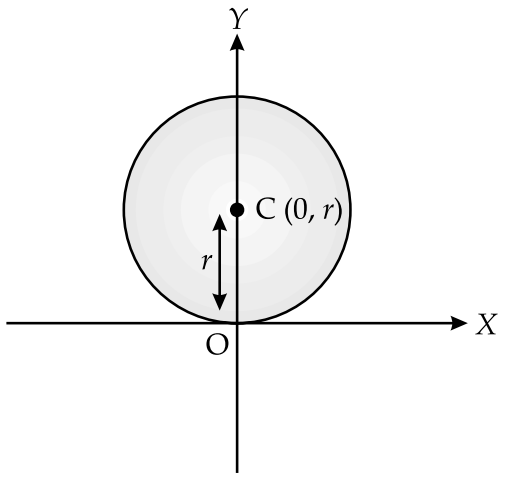
Differentiating both sides w.r.t. x, we get
$2 x+2 y y^{\prime}=2 r y$
$\Rightarrow \quad r=\frac{x+y y^{\prime}}{y^{\prime}}$ ...(ii)
Substituting r from (ii) in (i), we get
$\left(x^2+y^2\right) y^{\prime}=2 y\left(x+y y^{\prime}\right)$ View full question & answer→Question 102 Marks
Verify that $a x^2+b y^2=1$ is a solution of differential equation $x\left(y y_2+y_1^2\right)=y y_1$.
Answer$a x^2+b y^2=1$ or $2 a x+2 b y y_1=0$
or, $a x+b y y_1=0$ .... (i)
or, $a+b\left[y y_2+y_1^2\right]=0$ or $a=-b\left[y y_2+y_1^2\right]$
Substituting this value, for a in the equation (i), we get
$-b\left[y y_2+y_1^2\right] x+b y y_1=0$
or, $x\left[y y_2+y_1^2\right]=y y_1$.
Hence verified
View full question & answer→Question 112 Marks
Form the differential equation representing the family of curves $y=a e^{b x+5}$ where 'a' and 'b' are arbitrary constants
Answer
$\begin{array}{l}\frac{d y}{d x}=b a e^{b x+5} \\ \frac{d y}{d x}=b y\end{array}$
$\Rightarrow \quad \frac{d^2 y}{d x^2}=b \frac{d y}{d x}$
$\therefore$ The differential equation is: $y \frac{d^2 y}{d x^2}=\left(\frac{d y}{d x}\right)^2$.
View full question & answer→Question 122 Marks
Find the differential equation of the family of curves $y=A e^{2 x}+B e^{-2 x}$ where A and B are arbitrary constants.
AnswerDifferentiating $y=A e^{2 x}+B e^{-2 x}$, we get
$\frac{d y}{d x}=2 A e^{2 x}-2 B e^{-2 x}$
Differentiate again to get,
$\frac{d^2 y}{d x^2}=4 A e^{2 x}+4 B e^{-2 x}=4 y$ or $\frac{d^2 y}{d x^2}-4 y=0$.
View full question & answer→Question 132 Marks
From the differential equation of equation y = a cos 2x + b sin 2x where a and b are constants.
Answer$y=a \cos 2 x+b \sin 2 x$
or $\frac{d y}{d x}=-2 a \sin 2 x+2 b \cos 2 x$
or $\frac{d y}{d x}=2[-a \sin 2 x+b \cos 2 x]$
or $\frac{d^2 y}{d x^2}=-4[a \cos 2 x+b \sin 2 x]=-4 y$
$\frac{d^2 y}{d x^2}+4 y=0$
View full question & answer→Question 142 Marks
Form the differential equation representing the family of curves $y=e^{2 x}(a+b x)$where 'a' and 'b' are arbitrary constants.
Answer$y=e^{2 x}(a+b x)$ ....(i)
Differentiating both sides w.r.t. x we get
$\frac{d y}{d x}=e^{2 x}(b)+(a+b x) 2 e^{2 x}$
$=b e^{2 x}+2 y$
$\frac{d y}{d x}-2 y=b e^{2 x}$ .....(ii)
Differentiating again,
$\begin{array}{l}\frac{d^2 y}{d x^2}-2 \frac{d y}{d x}=2 b e^{2 x} \\ \frac{d^2 y}{d x^2}-2 \frac{d y}{d x}=2\left(\frac{d y}{d x}-2 y\right)\end{array}$
$\frac{d^2 y}{d x^2}-4 \frac{d y}{d x}+4 y=0$
View full question & answer→Question 152 Marks
Find the differential equation of the family of curves $y^2=4 a x$.
AnswerDifferential both sides w.r.t. x, we get
$2 y \frac{d y}{d x}=4 a$
Eliminating 4a, we get
$y^2=2 y \frac{d y}{d x} x$
or, $2 x y \frac{d y}{d x}-y^2=0$
View full question & answer→Question 162 Marks
Find the general solution of the differential equation $\frac{d y}{d x}=e^{x+y}$
AnswerGiven differential equation is
$\frac{d y}{d x}=e^{x+y}$
$\Rightarrow \quad \frac{d y}{d x}=e^x e^y$
$\Rightarrow \quad \frac{d y}{e^y}=\left(e^x\right) d x$
$\Rightarrow \quad\left(e^{-y}\right) d y=\left(e^x\right) d x$
Integrating both sides, we get
$\int\left(e^{-y}\right) d y=\int\left(e^x\right) d x$
$\Rightarrow \quad-e^{-y}=e^x+c^{\prime}$
$\Rightarrow \quad e^{-y}=-e^x+c[$ where $c=-\dot{c}$
View full question & answer→Question 172 Marks
Write the solution of the differential equation $\frac{d y}{d x}=2^{-y}$
AnswerGiven differential equation is
$\frac{d y}{d x}=2^{-y}$
On separating the variables, we get
$2^y d y=d x$
On integrating both sides, we get c
$\int 2^y d y=\int d x$
or $\frac{2^y}{\log 2}=x+C_1$
or $2^y=x \log 2+C_1 \log 2$
$\therefore 2^y=x \log 2+C$, where $C=C_1 \log 2$
View full question & answer→Question 182 Marks
Find the solution of the differential equation $\frac{d y}{d x}=x^3 e^{-2 y}$.
Answer$\int \frac{d y}{e^{-2 y}}=\int x^3 d x$
$\int e^{2 y} d y=\int x^3 d x$
or, $\frac{e^{2 y}}{2}=\frac{x^4}{4}+C$
or, $\frac{1}{2} e^{2 y}=\frac{x^4}{4}+C$
$2 e^{2 y}=x^4+C_1 \quad$ where $\left(C_1=4 C\right)$
View full question & answer→Question 192 Marks
Find the differential equation of the family of concentric circles $x^2+y^2=a^2$
AnswerGiven equation : $x^2+y^2=a^2$
Differentiate w.r.t. $x$, we get
$2 x+2 y \frac{d y}{d x}=0$
$\Rightarrow \quad x+y \frac{d y}{d x}=0$
View full question & answer→Question 202 Marks
Find the sum of the order and the degree of the following differential equations: $\frac{d^2 y}{d x^2}+\sqrt[3]{\frac{d y}{d x}}+(1+x)=0$
AnswerHere, $\left\{\frac{d^2 y}{d x^2}+(1+x)\right\}^3=-\frac{d y}{d x}$
Thus, order is 2 and degree is 3. So, the sum is 5
View full question & answer→Question 212 Marks
If m and n are the order and degree, respectively of the differential equation $y\left(\frac{d y}{d x}\right)^3+x^3\left(\frac{d^2 y}{d x^2}\right)^2-x y$= sin x , then write the value of m + n
Answerm + n = 4
$\because \quad m=2$ (second order derivative)
$\therefore \quad n=2$
View full question & answer→Question 222 Marks
Find the differential equation representing the family of curves $V=\frac{A}{r}+B$, where A and B are arbitrary constants.
AnswerOn differentiating the given equation, we
$\frac{d V}{d r}=-\frac{A}{r^2}$
$r^2 \frac{d V}{d r}=- A$
Differentiating again, we get
$r^2 \frac{d^2 V}{d r^2}+2 r \frac{d V}{d r}=0$
View full question & answer→Question 232 Marks
Find the differential equation of the family of lines passing through the origin.
AnswerGeneral equation of family of lines passing through origin is
$y=m x \quad \Rightarrow \quad m=\frac{y}{x}$
$\frac{d y}{d x}=m$
$\frac{d y}{d x}=\frac{y}{x}$
$x \frac{d y}{d x}-y=0$
View full question & answer→Question 242 Marks
Write the differential equation obtained by eliminating the arbitrary constant Cin the equation representing the family of curves xy = C cos x
AnswerOn differentiating the given equation, we get
$x \frac{d y}{d x}+y=-C \sin x$
Eliminating Cusing above equation, we get
$x \frac{d y}{d x}+y+x y \tan x=0$
View full question & answer→Question 252 Marks
Find the order and degree (if defined) of the differential equation. $\frac{d^2 y}{d x^2}+x\left(\frac{d y}{d x}\right)^2=2 x^2 \log \left(\frac{d^2 y}{d x^2}\right)$
AnswerGiven differential equation is $\frac{d^2 y}{d x^2}+x\left(\frac{d y}{d x}\right)^2=2 x^2 \log \left(\frac{d^2 y}{d x^2}\right)$
The highest order derivative present in the differential equation is $\frac{d^2 y}{d x^2}$, So it is of order 2
Clearly, the differential equation is not expressible as polynomial in $\frac{d^2 y}{d x^2}$ So, its degree is not defined.
Hence, Order = 2
Degree is not defined.
View full question & answer→Question 262 Marks
Find the order and the degree of the differential equation $x^2 \frac{d^2 y}{d x^2}=\left\{1+\left(\frac{d y}{d x}\right)^2\right\}^4$
AnswerGiven, differential equation is
$x^2 \frac{d^2 y}{d x^2}=\left\{1+\left(\frac{d y}{d x}\right)^2\right\}^4$
The highest order derivative occurs in the given differential equation is $\frac{d^2 y}{d x^2}$
Hence, order of differential equation = 2
Also, the power of highest order derivative is 1.
Hence, degree of differential equation is 1.
View full question & answer→Question 272 Marks
Write the order and the degree of the following differential equation: $x^3\left(\frac{d^2 y}{d x^2}\right)^2+x\left(\frac{d y}{d x}\right)^4=0$
AnswerGiven, $x^3\left(\frac{d^2 y}{d x^2}\right)^2+x\left(\frac{d y}{d x}\right)^4=0$
The highest order derivative is $\left(\frac{d^2 y}{d x^2}\right)$,
hence the order of given differential equation is 2 .
Also, the power of the highest order derivative is 2 ,
hence the degree of differential equation is 2 .
Therefore,
Order $=2$ and Degree $=2$
View full question & answer→Question 282 Marks
Write the sum of the order and degree of the differential equation $1+\left(\frac{d y}{d x}\right)^4=7\left(\frac{d^2 y}{d x^2}\right)^3$.
AnswerDegree of the given differential equation = 3
Order of the given differential equation = 2
Hence, the sum of order and degree = 2 + 3 = 5
View full question & answer→Question 292 Marks
Write the order of the differential equation: $\log \left(\frac{d^2 y}{d x^2}\right)=\left(\frac{d y}{d x}\right)^3+x$
AnswerThe highest order derivative is $\frac{d^2 y}{d x^2}$.Thus, the order of given differential equation is 2.
View full question & answer→