Question
Write the differential equation obtained by eliminating the arbitrary constant Cin the equation representing the family of curves xy = C  cos x

Answer

On differentiating the given equation, we get
$x \frac{d y}{d x}+y=-C \sin x$
Eliminating Cusing above equation, we get
$x \frac{d y}{d x}+y+x y \tan x=0$

Need a full question paper?

Generate a complete, print-ready paper with questions like this in minutes — across 16+ boards, with answer keys.
Start Generating Free

Similar questions

Find $\varphi(n)$ for $n =3$
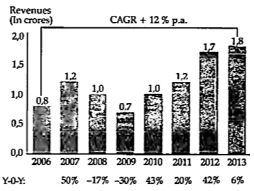
An interviewer gives the following graph on a client's sales in the last 7 years to candidate and said find the CAGR. Given that $\left(\frac{9}{4}\right)^{\frac{1}{7}}=1.1228$.
Image
Find the effective rate of return equivalent to a nominal rate of $6\%$ per annum compounded
i. quarterly
ii. continuously.$\left(\right.$Given $(1.015)^4=1.06136$ and $\left.e ^{0.06}=1.06183\right)$
From the differential equation of equation y = a cos 2x + b sin 2x where a and b are constants.
If $A$ and $B$ are matrices of order $3$ and $|A|=5$ $|B|=3$, then find $|3 A B|.$
Find $\varphi(12)$
$
12=2^2 \times 3
$
A firm is selling 100 units at a price of ₹ 250/unit. However, to sell 110 units, they need to cut the price down to 240/unit. What is the level of marginal revenue at this higher level of sales?
In what ratio water must be added in milk costing ₹ 60 per litre, so that the resulting mixture would be of worth ₹ 50 per litre?
Calculate the probability density function of normal distribution using the following data. $x=3, \mu=4$ and $\sigma=2.$