Questions

3 Marks Question

🎯

Test yourself on this topic

15 questions · timed · auto-graded

Question 13 Marks
If the demand curve is given by $D(x)=50-0.06 x^2$. Find the surplus or profit of the consumers if the level of sale amounts to twenty units.
Answer
As the number of units is 20 ,its price rises up $=D(20)$ $=50-0.06 \times 20^2=26$.
The profit of consumer's:
$\begin{aligned} C S & =\int_0^{Q_e} D(x) d x-Q_e \cdot P_e \\ & =\int_0^{20}\left(50-0.06 x^2\right) d x-20.26 \\ & =50[x]_0^{20}-0.06\left[\frac{x^3}{3}\right]_0^{20}-520 \\ & =50(20-0)-0.06\left[\frac{20^3}{3}-0\right]-520\end{aligned}$
$\begin{array}{l}=50(20)-0.06\left[\frac{20^3}{3}\right]-520 \\ =1000-160-520 \\ =1000-680 \\ =320\end{array}$
The consumer gain is ₹ 320 , if the level of sales is twenty units.
View full question & answer
Question 23 Marks
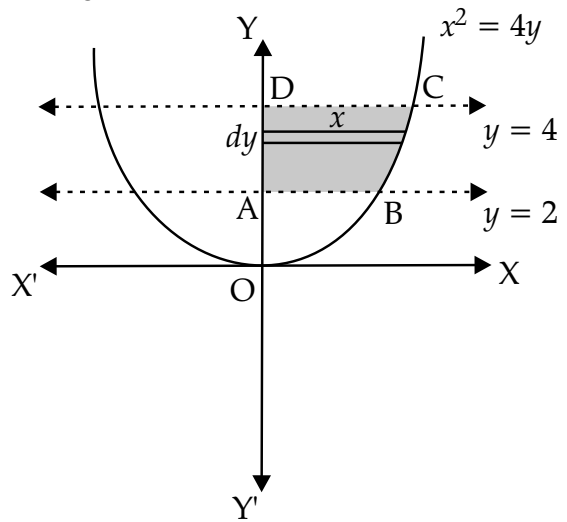
Find the area of the region bounded by $x^2=4 y$ y = 2 x = 4 and the Y-axis in the first quadrant.
Answer

Image
The area of the region bounded by the curve, $x^2=4 y$, $y=2$ and $y=4$, and the $y$-axis is the area ABCD.
Area of $A B C D=\int_2^4 x d y=\int_2^4 2 \sqrt{y} d y$
$\begin{array}{l}=2\left[\frac{y^{\frac{3}{2}}}{\frac{3}{2}}\right]_2^4 \\ =\frac{4}{3}\left[(4)^{\frac{3}{2}}-(2)^{\frac{3}{2}}\right] \\ =\frac{4}{3}[8-2 \sqrt{2}] \\ =\left(\frac{32-8 \sqrt{2}}{3}\right) \text { units }^2\end{array}$
View full question & answer
Question 33 Marks
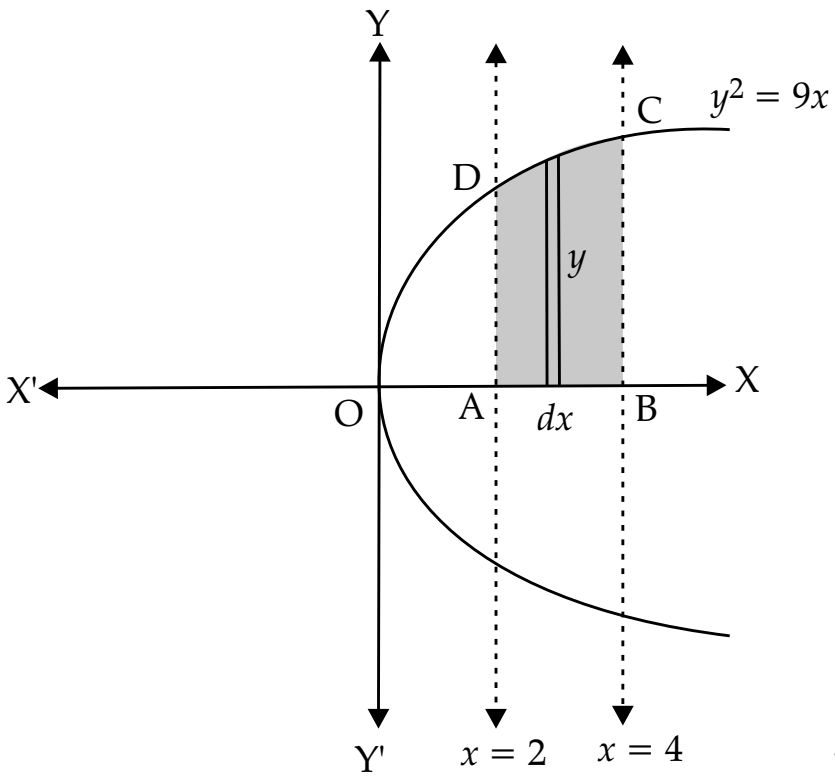
Find the area of the region bounded by $y^2=9 x$ x = 2 x = 4 and the X-axis in the first quadrant.
Answer

Image

The area of the region bounded by the curve $y^2=9 x$ x = 2 and x = 4 and the X-axis is the area ABCD.
Area of $A B C D=\int_2^4 y d x=\int_2^4 3 \sqrt{x} d x$
$\begin{array}{l}=3\left[\frac{x^{\frac{3}{2}}}{\frac{3}{2}}\right]_2^4 \\ =2\left[x^{\frac{3}{2}}\right]_2^4 \\ =2\left[(4)^{\frac{3}{2}}-(2)^{\frac{3}{2}}\right] \\ =2[8-2 \sqrt{2}] \\ =(16-4 \sqrt{2}) \text { units }^2\end{array}$
View full question & answer
Question 43 Marks
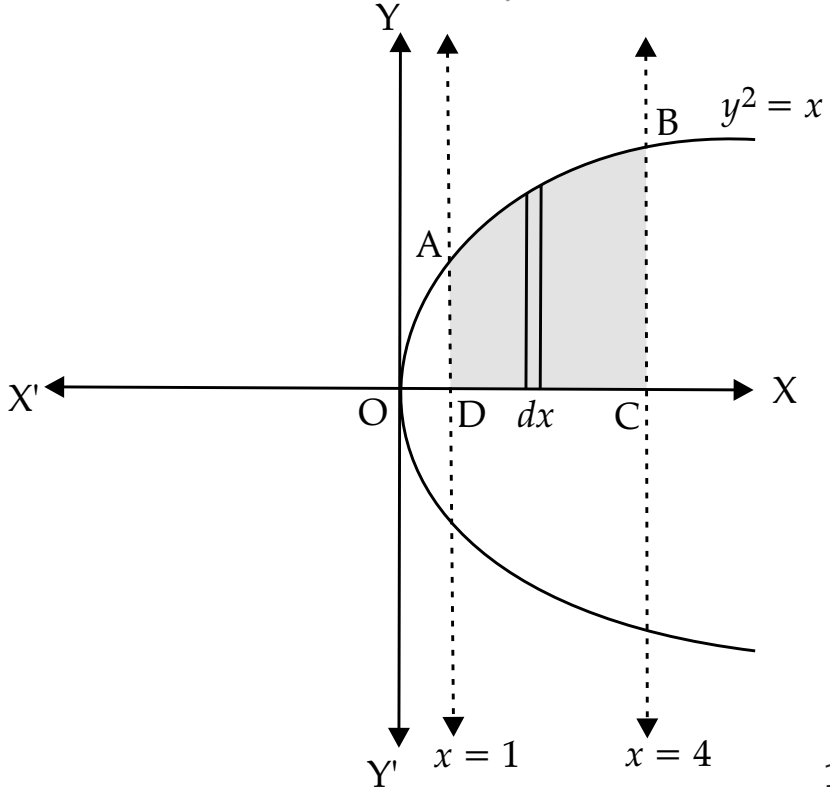
Find the area of the region bounded by the curve $y^2=x$ and the lines x = 1 x = 4 and the X-axis.
Answer

Image

The area of the region bounded by the curve, $y^2=x$,the lines x = 1 and x = 4 and the x-axis is the area ABCD.
Area of $A B C D=\int_1^4 y d x=\int_1^4 \sqrt{x} d x$
$\begin{array}{l}=\left[\frac{x^{\frac{3}{2}}}{\frac{3}{2}}\right]_1^4 \\ =\frac{2}{3}\left[(4)^{\frac{3}{2}}-(1)^{\frac{3}{2}}\right] \\ =\frac{2}{3}[8-1] \\ =\frac{14}{3} \text { units }^2\end{array}$
View full question & answer
Question 53 Marks
Evaluate: $\int_a^b \frac{\log x}{x} d x$
Answer
Let $I=\int_a^b \frac{\log x}{x} d x$
Put $\log x=t \Rightarrow \frac{1}{x} d x=d t$
When $x=a$, then $t=\log a$
When $x=b$, then $t=\log b$
$\therefore \quad I=\int_{\log a}^{\log b} t d t$
$=\left[\frac{t^2}{2}\right]_{\log a}^{\log b}$
$=\frac{1}{2}\left[(\log b)^2-(\log a)^2\right]$
$I=\frac{1}{2}[(\log b+\log a)(\log b-\log a)]$
$I=\frac{1}{2}\left[\log a b \cdot \log \frac{b}{a}\right]$
$[\because \log m+\log n=\log m n$and $\left.\log m-\log n=\log \frac{m}{n}\right]$
$I=\frac{1}{2} \log a b \cdot \log \frac{b}{a}$.
View full question & answer
Question 63 Marks
Evaluate: $\int_{-3}^3|x+2| d x$
Answer
We have $|x+2|=\left\{\begin{array}{ll}(x+2) & \text { if } x+2 \geq 0 \\ -(x+2) & \text { if } x+2 \leq 0\end{array}\right.$
$=\left\{\begin{array}{ccc}(x+2) & \text { if } & x \geq-2 \\ -(x+2) & \text { if } & x \leq-2\end{array}\right.$
$\therefore \int_{-3}^3|x+2| d x=\int_{-3}^{-2}-(x+2) d x+\int_{-2}^3(x+2) d x$
$=-\left[\frac{x^2}{2}+2 x\right]_{-3}^{-2}+\left[\frac{x^2}{2}+2 x\right]_{-2}^3$
$=-\left[2-4-\frac{9}{2}-2(-3)\right]+\left[\frac{9}{2}+6-2+4\right]$
$=-\left[4-\frac{9}{2}\right]+\left[\frac{9}{2}+8\right]=4+2 \times \frac{9}{2}$
$=4+9$
$=13$
View full question & answer
Question 73 Marks
Evaluate: $\int_1^2 \frac{\sqrt{x}}{\sqrt{3-x}+\sqrt{x}} d x$
Answer

Let $I=\int_1^2 \frac{\sqrt{x}}{\sqrt{3-x}+\sqrt{x}} d x$
Using properties,
$\int_a^b f(x) d x=\int_a^b f(a+b-x) d x$
$I=\int_1^2 \frac{\sqrt{3-x}}{\sqrt{3-(3-x)}+\sqrt{3-x}} d x$
$I=\int_1^2 \frac{\sqrt{3-x}}{\sqrt{x}+\sqrt{3-x}} d x$
Adding eqs. (i) and (ii),
$2 I=\int_1^2 \frac{\sqrt{x}+\sqrt{3-x}}{\sqrt{x}+\sqrt{3-x}} d x=\int_1^2 d x$
$=[x]_1^2=2-1=1$
$\therefore \quad I=\frac{1}{2}$
View full question & answer
Question 83 Marks
Evaluate: $\int_0^1 \log \left(\frac{1}{x}-1\right) d x$
Answer

Let $\begin{aligned} I & =\int_0^1 \log \left(\frac{1}{x}-1\right) d x \\ & =\int_0^1 \log \left(\frac{1-x}{x}\right) d x\end{aligned}$
Using property,
$\int_0^a f(x) d x=\int_0^a f(a-x) d x$, we have
$I=\int_0^1 \log \left[\frac{1-(1-x)}{1-x}\right] d x$
$=\int_0^1 \log \left(\frac{x}{1-x}\right) d x$
$=\int_0^1 \log \left(\frac{1-x}{x}\right)^{-1} d x$
$=\int_0^1(-1) \log \left(\frac{1-x}{x}\right) d x$
$I=-\int_0^1 \log \left(\frac{1-x}{x}\right) d$
$I=-I$
$2 I=0$
$\therefore \quad I=0$
$\therefore \int_0^1 \log \left(\frac{1}{x}-1\right) d x=0$
View full question & answer
Question 93 Marks
Evaluate: $\int_{-1}^2\left|x^3-x\right| d x$
Answer

$\begin{array}{l}\because \int_{-1}^2\left|x^3-x\right| d x \\ =\int_{-1}^0\left(x^3-x\right) d x-\int_0^1\left(x^3-x\right) d x+\int_1^2\left(x^3-x\right) d x \\ =\left[\frac{x^4}{4}-\frac{x^2}{2}\right]_{-1}^0-\left[\frac{x^4}{4}-\frac{x^2}{2}\right]_0^1+\left[\frac{x^4}{4}-\frac{x^2}{2}\right]_1^2 \\ =\left[(0-0)-\left(\frac{1}{4}-\frac{1}{2}\right)\right]-\left[\left(\frac{1}{4}-\frac{1}{2}\right)-(0-0)\right]\end{array}$
$=\frac{1}{4}+\frac{1}{4}+2+\frac{1}{4}=\frac{11}{4}$
View full question & answer
Question 103 Marks
Evaluate: $\int_1^3\left|x^2-2 x\right| d x$
Answer
Consider $I=\int_1^3\left|x^2-2 x\right| d x$
$\left|x^2-2 x\right|=\left\{\begin{array}{ccc}-\left(x^2-2 x\right) & \text { where } & 1 \leq x<2 \\ \left(x^2-2 x\right) & \text { where } & 2 \leq x \leq 3\end{array}\right.$
$\begin{array}{l}I=\int_1^2\left|x^2-2 x\right| d x+\int_2^3\left|x^2-2 x\right| d x \\ I=\int_1^2-\left(x^2-2 x\right) d x+\int_2^3\left(x^2-2 x\right) d x \\ I=-\left[\frac{x^3}{3}-x^2\right]_1^2+\left[\frac{x^3}{3}-x^2\right]_2^3 \\ I=-\left[\frac{8}{3}-4-\frac{1}{3}+1\right]+\left[9-9-\frac{8}{3}+4\right]\end{array}$
$\begin{aligned} & =-\frac{7}{3}+3-\frac{8}{3}+4 \\ I & =7-5=2\end{aligned}$
View full question & answer
Question 113 Marks
Evaluate: $\int_0^1 \frac{x e^x}{(1+x)^2} d x$
Answer

$\begin{aligned} I & =\int_0^1 \frac{x e^x}{(1+x)^2} d x \\ & =\int_0^1 \frac{(x+1)-1}{(1+x)^2} \cdot e^x d x \\ & =\int_0^1\left[\frac{(x+1) e^x}{(x+1)^2}-\frac{e^x}{(x+1)^2}\right] d x \\ & =\int_0^1 e^x\left[\frac{1}{1+x}-\frac{1}{(1+x)^2}\right] d x \\ & =\left[e^x \frac{1}{1+x}\right]_0^1 \\ & {\left[\because \int e^x\left[f(x)+f^{\prime}(x)\right] d x=e^x f(x)+c\right] } \\ & =\frac{e^1}{1+1}-\frac{e^0}{1+0}=\frac{e}{2}-1\end{aligned}$
$\therefore \quad I=\frac{e}{2}-1$
View full question & answer
Question 123 Marks
Find: $\int \frac{(2 x-5) e^{2 x}}{(2 x-3)^3} d x$
Answer
Let, 2x = t
$\begin{aligned} I & =\frac{1}{2} \int \frac{(t-5)}{(t-3)^3} e^t d t \\ & =\frac{1}{2} \int\left[\frac{1}{(t-3)^2}-\frac{2}{(t-3)^3}\right] e^t d t \\ & =\frac{1}{2} \frac{1}{(t-3)^2} e^{\prime}+C \\ & =\frac{1}{2} \frac{1}{(2 x-3)^2} e^{2 x}+C\end{aligned}$
View full question & answer
Question 133 Marks
Evaluate: $\int \frac{d x}{x\left(x^5+3\right)}$
Answer
Let $I=\int \frac{d x}{x\left(x^5+3\right)}=\int \frac{x^4}{x^5\left(x^5+3\right)} d x$
Put $x^5=t \Rightarrow 5 x^4 d x=d t \Rightarrow x^4 d x=\frac{1}{5} d t$
$\therefore \quad I=\frac{1}{5} \int \frac{d t}{t(t+3)}$
Now, $\frac{1}{t(t+3)}=\frac{A}{t}+\frac{B}{t+3}$
$\Rightarrow \quad 1=A(1+3)+B t$
Equating the coefficients of t and constant terms, we get
A + B = 0 and 3A = 1
$\Rightarrow \quad A=\frac{1}{3}$ and $B=-\frac{1}{3}$
$\therefore \quad \frac{1}{t(t+3)}=\frac{1}{3 t}-\frac{1}{3(t+3)}$
$\therefore \quad I=\frac{1}{5} \cdot \frac{1}{3} \int\left(\frac{1}{t}-\frac{1}{t+3}\right) d t$
$\begin{array}{l}=\frac{1}{15}(\log |t|-\log |t+3|) \\ =\frac{1}{15} \log \left|\frac{t}{t+3}\right|+C \\ =\frac{1}{15} \log \left|\frac{x^5}{x^5+3}\right|+C\end{array}$
View full question & answer
Question 143 Marks
Evaluate: $\int \frac{x^3}{x^4+3 x^2+2} d x$
Answer
Put $x^2=t \Rightarrow 2 x d x=d t \Rightarrow x d x=\frac{1}{2} d t$
$\int \frac{x^3}{x^4+3 x^2+2} d x=\frac{1}{2} \int \frac{t d t}{t^2+3 t+2}$
Now, $\frac{t}{t^2+3 t+2}=\frac{t}{(t+2)(t+1)}$
$=\frac{A}{(t+2)}+\frac{B}{(t+1)}$
$\Rightarrow \quad t=A(t+1)+B(t+2)$
Equating the coefficients of t and constant terms, we get
A + B = 1
$\Rightarrow \quad A=2$ and $B=-1$
$\therefore \quad \int \frac{x^3}{x^4+3 x^2+2} d x=\frac{1}{2} \int\left(\frac{2}{t+2}-\frac{1}{t+1}\right) d t$
$=\frac{1}{2} 2 \log |t+2|-\frac{1}{2} \log |t+1|+C$
$=\log \left|x^2+2\right|-\frac{1}{2} \log \left|x^2+1\right|+C$
View full question & answer
Question 153 Marks
Evaluate: $\int \frac{2 x+1}{(x+1)(x-2)} d x$
Answer
Let $\frac{2 x+1}{(x+1)(x-2)}=\frac{A}{x+1}+\frac{B}{(x-2)}$
$\Rightarrow \quad 2 x+1=A(x-2)+B(x+1)$
Equating the coefficients of x and constant term on both sides, we get
A + B = 2 and - 2A + B = 1
Solving these equations, we get $A=\frac{1}{3}$ and $B=\frac{5}{3}$
$\therefore \quad \frac{2 x+1}{(x+1)(x-2)}=\frac{1 / 3}{(x+1)}+\frac{5 / 3}{(x-2)}$
$\Rightarrow \quad \int \frac{2 x+1}{(x+1)(x-2)} d x=\frac{1}{3} \int \frac{d x}{x+1}+\frac{5}{3} \int \frac{d x}{x-2}$
$=\frac{1}{2} \log |x+1|+\frac{5}{3} \log |x-2|+C$
View full question & answer
3 Marks Question - Applied Maths STD 12 Science Questions - Vidyadip