Questions

5 Marks Questions

🎯

Test yourself on this topic

13 questions · timed · auto-graded

Question 15 Marks
The demand and supply function of an article are $D(q)=1000-0.4 q^2$ and $S(q)=42 q$. Find the consumer's surplus and producer's surplus at equilibrium price.
Answer
Given,
$D(q)=1000-0.4 q^2$ and $S(q)=42 q$
At equilibrium D(q) = S(q)
$1000-0.4 q^2=42 q$
or $0.4 q^2+42 q-1000=0$
or $4 q^2+420 q-10000=0$
or $q^2+105 q-2500=0$
or, (q + 125)(q - 20) = 0
q = - 125 or 20
The value of q cannot be negative, q = 20
When $q=Q_e=20$
$D(20)=1000-0.4(20)^2$
$=1000-0.4 \times 400$
$=1000-160=840=P_e$
Consumer's surplus is given by
$C S=\int_0^Q D(q) d q-Q_s \cdot P_e$
$\begin{array}{l}=\int_0^{20}\left(1000-0.4 q^2\right) d q-20 \times 840 \\ =1000[x]_0^{20}-0.4\left[\frac{q^3}{3}\right]_0^{20}-16800 \\ =1000(20-0)-0.4\left(\frac{20^3}{3}-0\right)-16800 \\ =1000 \times 20-0.4 \times \frac{8000}{3}-16800\end{array}$
= 20000 - 1066.666 - 16800
=20000-17866.666
= 2133.334
= 2133 units
Producer's surplus is given by
$\begin{aligned} P S & =Q_e \cdot P_e-\int_0^{Q_t} S(x) d x \\ & =20 \times 840-\int_0^{20} 42 q d q \\ & =16800-42\left[\frac{q^2}{2}\right]_0^{30} \\ & =16800-42\left(\frac{20^2}{2}-0\right) \\ & =16800-21 \times 400 \\ & =16800-8400 \\ & =8400 \text { units }\end{aligned}$
Hence, at equilibrium price, (i) the consumer's surplus is 2133 units and (ii) the producer's surplus is 8400 units.
View full question & answer
Question 25 Marks
The demand and supply function of a commodity are $P_d=18-2 x-x^2$ and $P_s=2 x-3$. Find the consumer's surplus and producer's surplus at equilibrium price .
View full question & answer
Question 35 Marks
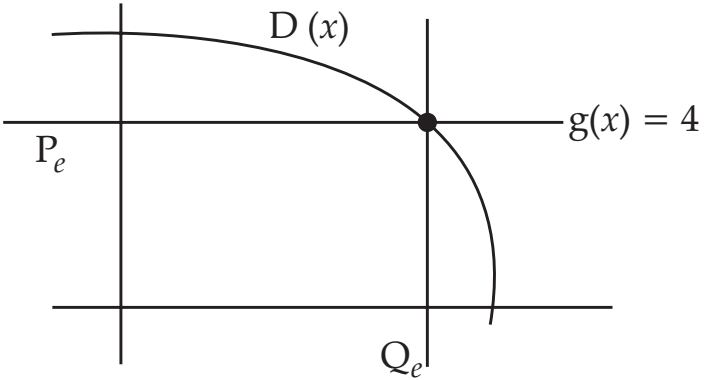
Suppose the demand for the certain product is given by $p=-0.01 x^2-0.1 x+6$, where $p$ is the unit price given in rupees and x is the quantity demanded per month given in the units of 1000. The unit market price for the product is ₹ 4 per unit
(a) Find the quantity demanded at the given price.
(b) Find the consumer's surplus if the market price for the product is ₹ 4 per unit.
Answer
(a) First we find the point of intersection of demand curve and market price for the product i.e., (D, g).

Image

Since, p is the unit price so we put p = 4 in demand curve,
$p=-0.01 x^2-0.1 x+6$
i.e $4=-0.01 x^2-0.1 x+6$
$\begin{array}{lr}\Rightarrow & 0.01 x^2+0.1 x-2=0 \\ \Rightarrow & x^2+10 x-200=0 \\ \Rightarrow & (x+20)(x-10)=0\end{array}$
$\Rightarrow \quad x=10$ (Neglecting $x=-20$ )
So,(D, g) = (10, 4)
Hence, the quantity demanded at the given price $(Q, P)=(1000,4)$

(b) Consumer's surplus is given by
$CS =\int_0^{Q_e} D(x) d x-Q_e \cdot P_e$
Here, $D(x)=-0.01 x^2-0.1 x+6$
$Q_e=10$
$P_e=p=4$
Thus,
$\operatorname{CS}=\int_0^{10}\left(-0.01 x^2-0.1 x+6\right) d x-10 \times 4$
$=-0.01\left[\frac{x^3}{3}\right]_0^{10}-0.1\left[\frac{x^2}{2}\right]_0^{10}+6[x]_0^{10}-40$
$=\frac{-0.01}{3}\left(10^3-0\right)-\frac{0.1}{2}\left(10^2-0\right)$+6(10-0)-40
$=\frac{-10}{3}-\frac{10}{2}+60-40$
= - 3.33333 - 5 + 20 = 11.6667
For 1000 units, $11.6667 \times 1000=11666.7=11667$
View full question & answer
Question 45 Marks
Evaluate: $\int_{-1}^2\left|x^3-3 x^2+2 x\right| d x$
Answer
The given definite integral
$=\int_{-1}^2|x(x-1)(x-2)| d x$
$=\int_{-1}^0|x(x-1)(x-2)| d x+\int_0^1|x(x-1)(x-2)| d x$$+\int_1^2|x(x-1)(x-2)| d x$
$=-\int_{-1}^0\left(x^3-3 x^2+2 x\right) d x+\int_0^1\left(x^3-3 x^2+2 x\right) d x$$-\int_1^2\left(x^3-3 x^2+2 x\right) d x$
$=-\left[\frac{x^4}{4}-x^3+x^2\right]_{-1}^0+\left[\frac{x^4}{4}-x^3+x^2\right]_0^1$$-\left[\frac{x^4}{4}-x^3+x^2\right]_1^2$
$=\frac{9}{4}+\frac{1}{4}+\frac{1}{4}=\frac{11}{4}$
View full question & answer
Question 55 Marks
$\int_1^4\{|x-1|+|x-2|+|x-4|\} d x$
Answer
$I=\int_1^4\{|x-1|+|x-2|+|x-4|\} d x$
$=\int_1^4(x-1) d x-\int_1^2(x-2) d x+\int_2^4(x-2) d x$$-\int_1^4(x-4) d x$
$\left.\left.\left.\left.=\frac{(x-1)^2}{2}\right]_1^4-\frac{(x-2)^2}{2}\right]_1^2+\frac{(x-2)^2}{2}\right]_2^4-\frac{(x-4)^2}{2}\right]_1^4$
$=\frac{9}{2}+\frac{1}{2}+2+\frac{9}{2}=11 \frac{1}{2}$ or $\frac{23}{2}$

View full question & answer
Question 65 Marks
Evaluate: $\int_{-1}^1 \frac{x+|x|+1}{x^2+2|x|+1} \cdot d x$
Answer
$I=\int_{-1}^1 \frac{x+|x|+1}{x^2+2|x|+1} d x$
$=\int_{-1}^1 \frac{x}{x^2+2|x|+1} d x+\int_{-1}^1 \frac{|x|+1}{x^2+2|x|+1} d x$
$=I_1+I_2$ (Say) ....(i)
Now, $I_1=\int_{-1}^1 \frac{x}{x^2+2|x|+1} d x$
Let, $f(x)=\frac{x}{x^2+2|x|+1} d x$
$f(-x)=\frac{-x}{(-x)^2+2|-x|+1}$
$=\frac{-x}{x^2+2|x|+1}=-f(x)$
$\because f(x)$ is odd function.
Hence, $\quad I_1=0$ .....(ii)
Also, $I_2=\int_{-1}^1 \frac{|x|+1}{x^2+2|x|+1} d x$
Let, $g(x)=\frac{|x|+1}{x^2+2|x|+1}$
$\Rightarrow \quad g(-x)=\frac{|-x|+1}{(-x)^2+2|-x|+1}$
$g(-x)=\frac{|x|+1}{x^2+2|x|+1}=g(x)$"
$\because g(x)$ is even function
$\therefore \quad I_2=2 \int_0^1 \frac{x+1}{x^2+2 x+1} d x$
$=2 \int_0^1 \frac{1}{x+1} d x$
$=2[\ln |x+1|]_0^1=2[\ln 2-\ln 1]$
$I_2=2 \ln 2$
From (i), (ii) and (iii), we get
$I=2 \ln 2$
View full question & answer
Question 75 Marks
Evaluate: $\int \frac{2 x}{\left(x^2+1\right)\left(x^2+2\right)^2} d x$
Answer
Put $x^2=t$
$\Rightarrow \quad 2 x d x=d t$
$\therefore \int \frac{2 x}{\left(x^2+1\right)\left(x^2+2\right)^2} d x=\int \frac{1}{(t+1)(t+2)^2} d t$
Let, $\quad \frac{1}{(t+1)(t+2)^2}=\frac{A}{t+1}+\frac{B}{t+2}+\frac{C}{(t+2)^2}$
$\begin{array}{l}\Rightarrow 1=A(t+2)^2+B(t+1)(t+2)+C(t+1) \\ \Rightarrow 1=A\left(t^2+4 t+4\right)+B\left(t^2+3 t+2\right)+C(t+2)\end{array}$
Equating the coefficients of $t^2, t$ and constant terms, we get
$A+B=0$,
$4 A+3 B+C=0$,
and $\quad 4 A+2 B+C=1$
Solving these equations for $A, B$ and $C$, we get $A=1$, $B=1, C=1$
$\therefore \quad \frac{1}{(t+1)(t+2)^2}=\frac{1}{t+1}-\frac{1}{t+2}-\frac{1}{(t+2)^2}$
$\therefore \int \frac{2 x}{\left(x^2+1\right)\left(x^2+2\right)^2} d x$
$=\int \frac{1}{t+1} d x-\int \frac{1}{t+2} d t-\int \frac{1}{(t+2)^2} d t$
$=\log |t+1|-\log |t+2|-\frac{(t+2)^{-1}}{-1}+C$
$=\log \left(x^2+1\right)-\log \left(x^2+2\right)+\frac{1}{x^2+2}+C$"
$=\log \frac{x^2+1}{x^2+2}+\frac{1}{x^2+2}+C$
View full question & answer
Question 85 Marks
Evaluate: $\int \frac{2 x+3}{(2-x)\left(x^2+3\right)} d x$
Answer
Let, $\frac{2 x+3}{(2-x)\left(x^2+3\right)}=\frac{A}{2-x}+\frac{B x+C}{x^2+3}$
$\Rightarrow 2 x+3=A\left(x^2+3\right)+(B x+C)(2-x)$
$\Rightarrow 2 x+3=A\left(x^2+3\right)+B\left(2 x-x^2\right)+C(2-x)$
Equating coefficients of $x^2, x$ and constant terms, we get
A - B = 0
and 2B + 2C = 3
Solving the equations, we get A = 1, B = 1 and C = 0
$\therefore \quad \frac{2 x+3}{(2-x)\left(x^2+3\right)}=\frac{1}{2-x}+\frac{x}{x^2+3}$
$\Rightarrow \int \frac{2 x+3}{(2-x)\left(x^2+3\right)} d x=\int \frac{1}{2-x} d x+\int \frac{x}{x^2+3} d x$
$=\int \frac{1}{2-x} d x+\frac{1}{2} \int \frac{2 x}{x^2+3} d x$
$=\frac{\log |2-x|}{-1}+\frac{1}{2} \log \left(x^2+3\right)+C$
$=-\log |2-x|+\frac{1}{2} \log \left(x^2+3\right)+C$
View full question & answer
Question 95 Marks
Evaluate: $\int \frac{3 x-2}{(x+1)^2(x+3)} d x$
Answer
Let, $\frac{3 x-2}{(x+1)^2(x+3)}=\frac{A}{x+1}+\frac{B}{(x+1)^2}+\frac{C}{x+3}$
$\begin{array}{l}\Rightarrow 3 x-2=A(x+1)(x+3)+B(x+3)+C(x+1)^2 \\ \Rightarrow 3 x-2=A\left(x^2+4 x+3\right)+B(x+3)+\left(x^2+2 x+1\right)\end{array}$
Equating coefficients of $x^2, x$ and constant terms, we get
A + C = 0
4A + B + 2C = 3
and 3A + 3B + C = -2
Solving these equations, we get $A=\frac{11}{4}, B=\frac{-5}{2}$ and $C=\frac{-11}{4}$
$\therefore \quad \frac{3 x-2}{(x+1)^2(x+3)}=\frac{\frac{11}{4}}{x+1}-\frac{\frac{5}{2}}{(x+1)^2}-\frac{\frac{11}{4}}{x+3}$
$\Rightarrow \int \frac{3 x-2}{(x+1)^2(x+3)} d x=\frac{11}{4} \int \frac{d x}{x+1}$$-\frac{5}{2} \int \frac{1}{(x+1)^2} d x-\frac{11}{4} \int \frac{d x}{x+3}$
$=\frac{11}{4} \log |x+1|-\frac{5}{2} \cdot \frac{(x+1)^{-1}}{-1}$$-\frac{11}{4} \log |x+3|+C$
$=\frac{11}{4} \log \left|\frac{x+1}{x+3}\right|+\frac{5}{2(x+1)}+C_1$


View full question & answer
Question 105 Marks
Evaluate: $\int \frac{2 x-1}{(x-1)(x+2)(x-3)} d x$
Answer
Let $\frac{2 x-1}{(x-1)(x+2)(x+3)}=\frac{A}{(x-1)}+\frac{B}{(x+2)}+\frac{C}{(x+3)}$
$\Rightarrow 2 x-1=A(x+2)(x-3)+B(x-1)(x-3)$$+C(x-1)(x+2)$
$\Rightarrow 2 x-1=A\left(x^2-x-6\right)+B\left(x^2-4 x+3\right)$$+C\left(x^2+x-2\right)$
Equating the coefficients of $x^2, x$ and constant terms, we get
$A+B+C=0$,
and $-A-4 B+C=2$
Solving these equations, we get
$A=-\frac{1}{6}, B=-\frac{1}{3}$ and $C=\frac{1}{2}$
$\therefore \quad \frac{2 x-3}{(x-1)(x+2)(x+3)}=\frac{-\frac{1}{6}}{x-1}+\frac{-\frac{1}{3}}{x+2}+\frac{\frac{1}{2}}{x-3} $
$\Rightarrow \int \frac{2 x-1}{(x-1)(x+2)(x+3)} d x=-\frac{1}{6} \int \frac{1}{x-1} d x$$-\frac{1}{3} \int \frac{1}{x+2} d x+\frac{1}{2} \int \frac{1}{x-3} d x$
$=-\frac{1}{6} \log |x-1|-\frac{1}{3} \log |x+2|+\frac{1}{2}|\log x-3|+C \quad $
View full question & answer
Question 115 Marks
Evaluate: $\int \frac{3 x+1}{\left(x^3-x^2-x+1\right)} d x$
Answer
Let, $I=\int \frac{3 x+1}{\left(x^3-x^2-x+1\right)} d x$
$\Rightarrow \quad I=\int \frac{3 x+1}{(x-1)^2(x+1)} d x$
Resolving the integrand into partial fractions.
$\frac{3 x+1}{(x-1)^2(x+1)}=\frac{A}{x-1}+\frac{B}{(x-1)^2}+\frac{C}{x+1}$ ....(i)
$\begin{aligned} 3 x+1 & =A(x-1)(x+1)+B(x+1)+C(x-1)^2 \\ \Rightarrow 3 x+1 & =x^2(A+C)+x(B-2 C)+(-A+B+C) \\ \Rightarrow A+C & =0, B-2 C=3,-A+B+C=1\end{aligned}$
On solving we get $A=\frac{1}{2}, B=2, C=-\frac{1}{2}$
From (i)
$\int \frac{3 x+1}{\left(x^3-x^2-x+1\right)} d x$
$\begin{aligned} I & =\int\left(\frac{1}{2(x-1)}+\frac{2}{(x-1)^2}+\frac{1}{2} \frac{-1}{x+1}\right) d x \\ & =\frac{1}{2} \log |x-1|-\frac{2}{x-1}-\frac{1}{2} \log |x+1|+C \\ & =\frac{1}{2} \log \left(\frac{x-1}{x+1}\right)-\frac{2}{x-1}+C\end{aligned}$
View full question & answer
Question 135 Marks
Find: $\int \frac{\sqrt{x^2+1}\left\{\log \left(x^2+1\right)-2 \log x\right\}}{x^4} d x$
Answer
Let $I=\int \frac{\sqrt{x^2+1}\left\{\log \left(x^2+1\right)-2 \log x\right\}}{x^4} d x$
$=\int \sqrt{1+\frac{1}{x^2}}\left(\log \left(1+\frac{1}{x^2}\right)\right) \frac{1}{x^3} d x$
Let, $\quad 1+\frac{1}{x^2}=t^2$
or, $\frac{-2}{x^3} d x=2 t d t$
or, $\frac{1}{x^3} d x=-t d t$
$\begin{array}{l}=-\int t(2 \log t) t d t \\ =-2 \int \log t \cdot t^2 d t \\ =-2 \log t \cdot \frac{t^3}{3}+\int 2 \frac{1}{t} \cdot \frac{t^3}{3} d t\end{array}$
$\begin{array}{l}=-\frac{2}{3} \log t \cdot t^3+\frac{2}{9} t^3+C \\ =-\frac{2}{3} t^3\left(\log t-\frac{1}{3}\right)+C \\ =-\frac{2}{3}\left(1+\frac{1}{x^2}\right)^{3 / 2} \\ \quad\left(\log \left(1+\frac{1}{x^2}\right)-\frac{1}{3}\right)+C\end{array}$
View full question & answer
5 Marks Questions - Applied Maths STD 12 Science Questions - Vidyadip