Questions

Case study (4 Marks)

🎯

Test yourself on this topic

5 questions · timed · auto-graded

Question 14 Marks
A fruit grower can use two types of fertilizer in his garden, brand P and brand Q. The amounts (in kg) of nitrogen, Phosphoric acid, potash, and chlorine in a bag of each brand are given in the table. Tests indicate that the garden needs at least 240 kg of phosphoric acid, at least 270 kg of potash and at most 310 kg of chlorine.
kg per bag
Brand PBrand Q
Nitrogen33.5
Phosphoric acid12
Potash11.5
Chlorine1.52
Q. 1. The objective function to minimise the amount of nitrogen added to garden ?
(A) Maximise Z = 3x + 4y
(B) Maximise Z = 3x + 3.5y
(C) Maximise Z = 4x + 3.5y
(D) Maximise Z = 3x + 4y
Q. 2. If the grower wants to minimise the amount of nitrogen added to the garden, how many bags of brand P should be used?
(A) 40 (B) 50 (C) 100 (D) 60
Q. 3. If the grower wants to minimise the amount of nitrogen added to the garden, how many bag of brand Q should be used ?
(A) 40 (B) 50(C) 100 (D) 60
Q. 4. What is the minimum amount of nitrogen added
(A) 595 kg (B) 550 kg (C) 400 kg (D) 470 kg
Answer
Ans. 1. (B) Maximise Z = 3x + 3.5y
Ans. 2. (A) 40
Ans. 3. (C) 100
Ans. 4. (D) 470 kg
View full question & answer
Question 24 Marks
Answer
Ans. 1. (B) Maximise Z = 22x + 18y
Ans. 2. (D) 20
Ans. 3. (A) $x+y \geq 20$
Ans. 4. (B) (8, 12)
View full question & answer
Question 34 Marks
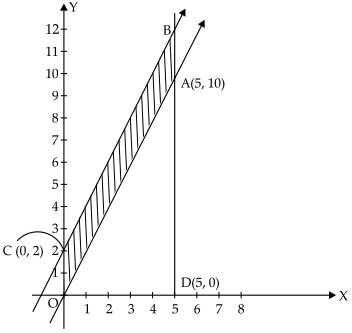
The feasible region for an LPP is shown in the following figure. The CB is parallel to OA.
Image
Q. 1. The equation of line OA is
(A) x - 2y = 0 (B) y - 2x = 0 (C) x + 2y = 0 (D) 2x + y = 0
Q. 2. The equation of line BC is
(A) y - 2x = 2 (B) x - y = 2 (C) 2y - x = 2 (D) x + 2y = 2
Q. 3. The co-ordinates of the point B are
(A) (5,7) (B) (7,5) (C) (5, 12) (D) (12, 5)
Q. 4. The constraints for the L.P.P. are
(A) $y \geq 2 x, y-2 x \leq 2, x \leq 5, x \geq 0, y \geq 0$
(B) $y \leq 2 x, y-2 x \leq 2, x \leq 5, x \geq 0, y \geq 0$
(C) $y \geq 2 x, y-2 x \geq 2, x \leq 5, x \geq 0, y \geq 0$
(D) $y \leq 2 x, y-2 x \geq 2, x \leq 5, x \geq 0, y \geq 0$
Answer
Ans. 1. (B) y - 2x = 0
Explanation: The point A(5, 10) lies on the equation y - 2x = 0 therefore the equation of line OA is y - 2x = 0.
Ans. 2. (A) y - 2x = 2
Explanation: Point on line BC i.e., C(0,2) lies on the equation y - 2x = 2 therefore equation of line BC is y - 2x = 2.
Ans. 3. (C) (5, 12)
Explanation: Point B is the intersection point of line BC and BD.
So, substituting x = 5 in y - 2x = 2
we get y = 12
Thus, required coordinates are (5, 12).
Ans. 4. (A) $y \geq 2 x, y-2 x \leq 2, x \leq 5, x \geq 0, y \geq 0$
Explanation: The required constrains for L.P.P. are
$\begin{array}{l}y \geq 2 x \\ y-2 x \leq 2 \\ x \leq 5 \\ x \geq 0, y \geq 0\end{array}$
View full question & answer
Question 44 Marks
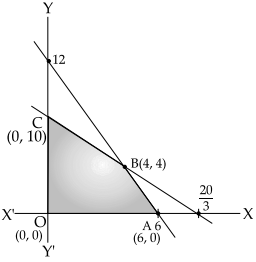
A cottage industry manufactures pedestal lamps and wooden shades, each requiring the use of a grinding/cutting machine and a sprayer. It takes 2 hours on grinding/cutting machine and 3 hours on the sprayer to manufacture a pedestal lamp. It takes 1 hour on the grinding/cutting machine and 2 hours on the sprayer to manufacture a shade. On any day, the sprayer is available for at the most 20 hours and the grinding/cutting machine for at the most 12 hours. The profit from the sale of a lamp is ₹ 25 and that from a shade is ₹15.
If x is the number of lamps and y is the number of shades manufactured. Assuming that the manufacturer can sell all the lamps and shades that he produces.
Q. 1. In order to maximize the profit, which of the flowing objective function is correct:
(A) Max. z = 25x + 15y
(B) Min. Z = 25x + 15y
(C) Max. z = 25x - 15y
(D) Max. z = 15x + 25y
Q. 2. Which of the following constraint are related to the given LPP?
(A) $2 x+y \geq 12 ; 3 x+2 y \leq 20$
(B) $2 x+y \leq 12 ; 3 x+2 y \leq 20$
(C) $2 x-y \geq 12 ; 3 x+2 y \leq 20$
(D) $2 x+y \leq 12 ; 3 x-2 y \leq 20$
Q. 3. The non-negative constraints associative to the given LPP are:
(A) $x \geq 0, y \geq 1$
(B) $x \geq 1, y \geq 0$
(C) $x \geq 0, y \geq 0$
(D) $x \geq 1, y \geq 1$
Q. 4. Which of the following is not the vertices of feasible region:
(A) (6,4) (B) (0,0) (C) (6,0) (D) (4, 4)
View full question & answer
Question 54 Marks
Answer
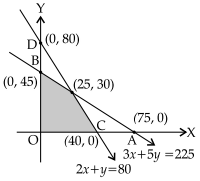
Ans. 1. (A) 3x + 5y = 225
Explanation: From the given graph OA = 75 and OB = 45.
The equation of line AB is $\frac{x}{75}+\frac{y}{45}=1$
i.e., 3x + 5y = 225
Ans. 2. (B) 2x + y = 80
Explanation: From the given graph OC = 40 and OD = 80
The equation of line CD is $\frac{x}{40}+\frac{y}{80}=1$
i.e., 2x + y = 80
Ans. 3. (A) (25, 30)
Explanation: On solving the equations of lines AB and CD, we get the coordinates of point E
i.e., (25, 30).
Ans. 4. (A) $3 x+5 y \leq 225,2 x+y \leq 80, x \geq 0, y \geq 0$
Explanation: Let the manufacturer produces x number of model X and y number of model Y bikes. Model X takes 6 man-hours to make per unit and model Y takes 10 man-hours to make per unit. There is total of 450 man-hours available per week.
$\therefore \quad 6 x+10 y \leq 450$
$3 x+5 y \leq 225$...(i)
For models X and Y, handling and marketing costs are ₹2,000 and ₹1,000, respectively, total funds available for these purposes are ₹80,000 per week.
$\therefore \quad 2,000 x+1,000 y \leq 80,000$
$2 x+y \leq 80$...(ii)
Also $x \geq 0, y \geq 0$
Alternate Solution: As (0, 0) lies in the region 3x + 5y <= 225 and also (0, 0) lies in the region 2x + y <= 80 therefore the constraints for the L.P.P. are:
$3 x+5 y \leq 225,2 x+y \leq 80, x \geq 0, y \geq 0$
Ans.5. (B) (25, 30)
Explanation: The objective function for given L.P.P. is
Z = 1000x + 500y
From the shaded feasible region, it is clear that coordinates of corner points are (0, 0), (40, 0), (25, 30) and (0, 45).
Corner pointsValue of Z = 1000x + 500y
(0, 0)0
(40, 0)40,000← Maximum
(25, 30)25,000 + 15,000 = 40,000 ←Maximum
(0, 45)22,500
So, the manufacturer should produce 25 bikes of model X and 30 bikes of model Y to get a maximum profit of ₹40,000.
View full question & answer
Case study (4 Marks) - Applied Maths STD 12 Science Questions - Vidyadip