Question types

Linear Programming question types

38 questions across 5 question groups — pick any mix to generate a Applied Maths paper with step-by-step answer keys.

38
Questions
5
Question groups
5
Question types
Sample Questions

Linear Programming questions

One sample from each question group in this chapter. Select any group above to see the full set with answer keys.

Q 1MCQ1 Mark
Which of the following is a vertex of the positive region bounded by the inequalities,
$2 x+3 y \leq 6$ and $5 x+3 y \leq 15$
  • A
    (0,2)
  • B
    (0,0)
  • C
    (3,0)
  • D
    All of these
View full solution
Q 2MCQ1 Mark
The intermediate solutions of constraints must be checked by substituting them back into
  • A
    Objective function
  • Constraint equations
  • C
    Not required
  • D
    None of the above

Answer: B.

View full solution
Q 3MCQ1 Mark
The optimal value of the objective function is attained at the points
  • A
    on X-axis
  • B
    on Y-axis
  • which are corner points of the feasible region
  • D
    None of the above

Answer: C.

View full solution
Q 4MCQ1 Mark
Objective function of an LPP is
  • A
    a constant
  • a function to be optimized
  • C
    a relation between the variables
  • D
    None of the above

Answer: B.

View full solution
Q 5MCQ1 Mark
Feasible region in the set of points which satisfy
  • A
    The objective functions
  • B
    Some the given constraints
  • All of the given constraints
  • D
    None of the above

Answer: C.

View full solution
Let R be the feasible region (convex polygon) for a linear programming problem and let Z = ax + by be the objective function. When Z has an optimal value (maximum or minimum), where the variables x and y are subject to constraints described by linear inequalities, this optimal value must occur at a corner points (vertex) of the feasible region.
Q. 1. Solve the following LPP graphically:
Max. Z = 2x + 3y
subject to $\begin{aligned} x+y & \leq 4 \\ x & \geq 0, y \geq 0\end{aligned}$
Q. 2. Draw the graph of given LPP and find the corner points of feasible region.
Minimize Z = 200x + 500y
Subject to constraints:
$\begin{aligned} x+2 y & \geq 10 \\ 3 x+4 y & \leq 24 \\ x & \geq 0, y \geq 0\end{aligned}$
View full solution
View full solution
The sum of two positive integers is atmost 5. The difference between two times of second number and first number is at most 4. If first number is x and second number is y, then for maximizing the product of these two numbers, formulate LPP
View full solution
A firm has to transport at least 1200 packages daily using large vans which carry 200 packages each and small vans which can take 80 packages each. The cost for engaging each large van is ₹ 400 and each small van is ₹ 200. Not more than ₹ 3,000 is to be spent daily on the job and the number of large vans cannot exceed the number of small vans. Formulate this problem as a LPP given that the objective is to minimize cost.
View full solution
Q 113 Marks Question3 Marks
Solve the following LPP graphically:
Maximize Z = 1000x + 600y
subject to the constraints
$\begin{aligned} x+y & \leq 200 \\ x & \geq 20 \\ y-4 x & \geq 0 \\ x, y & \geq 0\end{aligned}$
View full solution
Q 123 Marks Question3 Marks
Solve the following linear programming problem graphically:
Minimize: Z = 3x + 9y
When: $x+3 y \leq 60$
$\begin{aligned} x+y & \geq 10 \\ x & \leq y \\ x & \geq 0, y \geq 0\end{aligned}$
View full solution
Q 133 Marks Question3 Marks
Solve the following linear programming problem graphically:
Minimize: Z = 6x + 3y
Subject to the constraints: $\left\{\begin{array}{c}4 x+y \geq 80 \\ x+5 y \geq 115 \\ 3 x+2 y \leq 150 \\ x \geq 0, y \geq 0\end{array}\right.$
View full solution
Q 143 Marks Question3 Marks
Solve the following LPP graphically:
Maximize z = 4x + y
Subject to following constraints
$\begin{aligned} x+y & \leq 50 \\ 3 x+y & \leq 90 \\ x & \geq 10 \\ x, y & \geq 0\end{aligned}$
View full solution
Q 153 Marks Question3 Marks
Solve the following LPP graphically:
Minimize Z = 5x + 10y
Subject to $x+2 y \leq 120$
Constraints $\begin{aligned} x+y & \geq 60 \\ x-2 y & \geq 0\end{aligned}$
and $x, y \geq 0$
View full solution
A company produces soft drinks that have a contract which requires that a minimum of 80 units of chemical A and 60 units of the chemical B go into each bottle of the drink. The chemicals are available in prepared mix packets from two different suppliers. Supplier S had a packet of mix of 4 units of A and 2 units of B that costs ₹10. The supplier T has a packet of mix of 1 unit of A and 1 unit of B that costs ₹4. How many packets of mixes from S and T should the company purchase to honour the contract requirement and yet maintain the minimum cost? Make a LPP and solve graphically.
View full solution
A dealer in rural area wishes to purchase a number of sewing machines. He has only ₹5760 to invest and has space for at most 20 items of storage. An electronic sewing machine cost him ₹360 and a manually operated sewing machine ₹240. He can sell an electronic sewing machine at a profit of ₹22 and a manually operated sewing machine at a profit of ₹18. Assuming that he can sell all the items that he can buy, how should he invest his money in order to maximize his profit? Make it as a LPP and solve it graphically
View full solution
A manufacturer produces two types of steel trunks. He has two machines, A and B. The first type of trunk requires 3 hours on machine A and 3 hours on machine B. The second type requires 3 hours on machine A and 2 hours on machine B. Machines A and B can work at most for 18 hours and 15 hours per day respectively. He earns a profit of ₹ 30 per trunk on the first type of trunk and ₹ 25 per trunk on the second type. Formulate a Linear Programming Problem to find out how many trunks of each type he must make each day to maximize his profit.
View full solution
A new cereal, formed of a mixture of bran and rice, contains at least 88 grams of protein and at least 36 milligram of iron. Knowing that bran contains 80 gram of protein and 40 milligram of iron per kilogram, and that of rice contains 100 gram of protein and 30 milligrams of iron per kilogram, find the minimum cost of producing a kilogram of this new cereal if bran costs ₹28 per kilogram and rice costs ₹25 per kilogram.
View full solution
A company produces two types of items, P and Q. Manufacturing of both items requires the metals gold and copper. Each unit of item P requires 3 gms of gold and 1 gm of copper while that of item Q requires 1 gm of gold and 2 gm of copper. The company has 9 gm of gold and 8 gm of copper in its store. If each unit of item P makes a profit of ₹50 and each unit of item Q makes a profit of ₹60, determine the number of units of each item that the company should produce to maximize profit. What is the maximum profit?
View full solution
A fruit grower can use two types of fertilizer in his garden, brand P and brand Q. The amounts (in kg) of nitrogen, Phosphoric acid, potash, and chlorine in a bag of each brand are given in the table. Tests indicate that the garden needs at least 240 kg of phosphoric acid, at least 270 kg of potash and at most 310 kg of chlorine.
kg per bag
Brand PBrand Q
Nitrogen33.5
Phosphoric acid12
Potash11.5
Chlorine1.52
Q. 1. The objective function to minimise the amount of nitrogen added to garden ?
(A) Maximise Z = 3x + 4y
(B) Maximise Z = 3x + 3.5y
(C) Maximise Z = 4x + 3.5y
(D) Maximise Z = 3x + 4y
Q. 2. If the grower wants to minimise the amount of nitrogen added to the garden, how many bags of brand P should be used?
(A) 40 (B) 50 (C) 100 (D) 60
Q. 3. If the grower wants to minimise the amount of nitrogen added to the garden, how many bag of brand Q should be used ?
(A) 40 (B) 50(C) 100 (D) 60
Q. 4. What is the minimum amount of nitrogen added
(A) 595 kg (B) 550 kg (C) 400 kg (D) 470 kg
View full solution
View full solution
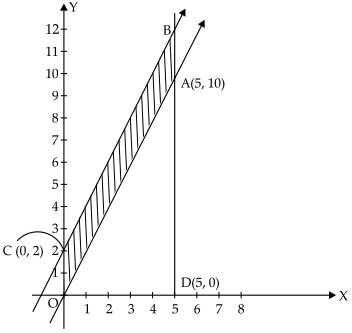
The feasible region for an LPP is shown in the following figure. The CB is parallel to OA.
Image
Q. 1. The equation of line OA is
(A) x - 2y = 0 (B) y - 2x = 0 (C) x + 2y = 0 (D) 2x + y = 0
Q. 2. The equation of line BC is
(A) y - 2x = 2 (B) x - y = 2 (C) 2y - x = 2 (D) x + 2y = 2
Q. 3. The co-ordinates of the point B are
(A) (5,7) (B) (7,5) (C) (5, 12) (D) (12, 5)
Q. 4. The constraints for the L.P.P. are
(A) $y \geq 2 x, y-2 x \leq 2, x \leq 5, x \geq 0, y \geq 0$
(B) $y \leq 2 x, y-2 x \leq 2, x \leq 5, x \geq 0, y \geq 0$
(C) $y \geq 2 x, y-2 x \geq 2, x \leq 5, x \geq 0, y \geq 0$
(D) $y \leq 2 x, y-2 x \geq 2, x \leq 5, x \geq 0, y \geq 0$
View full solution
A cottage industry manufactures pedestal lamps and wooden shades, each requiring the use of a grinding/cutting machine and a sprayer. It takes 2 hours on grinding/cutting machine and 3 hours on the sprayer to manufacture a pedestal lamp. It takes 1 hour on the grinding/cutting machine and 2 hours on the sprayer to manufacture a shade. On any day, the sprayer is available for at the most 20 hours and the grinding/cutting machine for at the most 12 hours. The profit from the sale of a lamp is ₹ 25 and that from a shade is ₹15.
If x is the number of lamps and y is the number of shades manufactured. Assuming that the manufacturer can sell all the lamps and shades that he produces.
Q. 1. In order to maximize the profit, which of the flowing objective function is correct:
(A) Max. z = 25x + 15y
(B) Min. Z = 25x + 15y
(C) Max. z = 25x - 15y
(D) Max. z = 15x + 25y
Q. 2. Which of the following constraint are related to the given LPP?
(A) $2 x+y \geq 12 ; 3 x+2 y \leq 20$
(B) $2 x+y \leq 12 ; 3 x+2 y \leq 20$
(C) $2 x-y \geq 12 ; 3 x+2 y \leq 20$
(D) $2 x+y \leq 12 ; 3 x-2 y \leq 20$
Q. 3. The non-negative constraints associative to the given LPP are:
(A) $x \geq 0, y \geq 1$
(B) $x \geq 1, y \geq 0$
(C) $x \geq 0, y \geq 0$
(D) $x \geq 1, y \geq 1$
Q. 4. Which of the following is not the vertices of feasible region:
(A) (6,4) (B) (0,0) (C) (6,0) (D) (4, 4)
View full solution
View full solution

Generate a Linear Programming paper free

Pick question groups from the list above, set marks and difficulty, and export a branded PDF with step-by-step answer keys. First 3 chapters free — no signup.
Download App