Questions

2 Marks Questions

🎯

Test yourself on this topic

7 questions · timed · auto-graded

Question 12 Marks
In what ratio water must be added in milk costing ₹ 60 per litre, so that resulting mixture would be worth ₹ 50 per litre?
Answer
Cost of water (c) = ₹ 0
Cost of milk (d) = ₹ 60 per litre
Cost of resulting mixture (m) =₹ 50 per litre
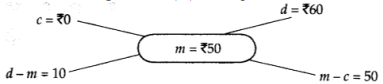
Image
So, $\frac{\text { quantity of water }}{\text { quantity of milk }}=\frac{10}{50}=\frac{1}{5}$.
Hence, the required ratio is 1 : 5.

View full question & answer
Question 22 Marks
Find the effective rate of return which is equivalent to a stated rate of 8% compounded quarterly.[Use $(1.02)^4=1.0824$
Answer
Here, r = 8% p.a., p = 4 quarters
So, effective rate (per rupee) $=\left(1+\frac{8}{400}\right)^4-1=(1.02)^4-1$
= 1.0824 - 1 = 0.0824
Hence, the effective rate = 0.0824*100% = 8.24%.
View full question & answer
Question 32 Marks
Mr. Bharti wishes to purchase a flat for ₹ 6000000 with a down payment of ₹ 1000000 and balance in equal monthly payments for 20 years. If bank charges 7.5 % p.a. compounded monthly, calculate the EMI. (Given$\left.(1.00625)^{240}=4.4608\right)$
Answer
Cost of flat = ₹ 6000000, cash payment ₹ 1000000
So, balance = ₹ 6000000 - ₹ 1000000 = ₹ 5000000
Given $P =₹ 5000000, n =12 \times 20=240$ months, $i =\frac{7.5}{1200}=0.00625$
$\therefore EMI =\frac{5000000 \times 0.00625 \times(1.00625)^{240}}{(1.00625)^{240}-1}$
$=\frac{5000000 \times 0.00625 \times 4.4608}{3.4608}=₹ 40279.70$
View full question & answer
Question 42 Marks
Evaluate the definite integral:
$\int_1^3 \frac{\sqrt[3]{x}}{\sqrt[3]{x}+\sqrt[3]{4-x}} d x$
Answer
Let $I =\int_1^3 \frac{\sqrt[3]{x}}{\sqrt[3]{x}+\sqrt[3]{4-x}} d x \ldots(1)$
Then by using $\int_a^b f(x) d x=\int_a^b f(a+b-x) d x$, we get
$I=\int_1^3 \frac{\sqrt[3]{1+3-x}}{\sqrt[3]{1+3-x}+\sqrt[3]{4-(1+3-x)}} d x$
\[
\Rightarrow I=\int_1^3 \frac{\sqrt[3]{4-x}}{\sqrt[3]{4-x}+\sqrt[3]{x}} d x \ldots(2)
\]
On adding (1) and (2), we get
$2 I =\int_1^3 \frac{\sqrt[3]{x}+\sqrt[3]{4-x}}{\sqrt[3]{x}+\sqrt[3]{4-x}} d x=\int_1^3 1 d x=[x]_1^3$
$\Rightarrow 2 I =3-1 \Rightarrow 2 I =2 \Rightarrow I =1$
View full question & answer
Question 52 Marks
If money is worth 5% compare the present value of a perpetuity of ₹2,000 payable at the end of each year with that of an ordinary annuity of ₹2,000 per year for 100 years. $\left(\right.$ Given $\left.(1.05)^{-100}=0.0076\right)$
Answer
Let P be the present value of a perpetuity of ₹ 2,000 payable at the end of each year when money is worth 5%. It is given that
$i =\frac{5}{100}=0.05$ and $R =2,000$
$\therefore P =₹\frac{R}{i} \Rightarrow P = ₹\frac{2,000}{0.05}= 40,000$
Let $P _1$ be the present value of an ordinary annuity of ₹ 2,000 per year for 100 years. Then,
$P _1= R \left\{\frac{1-(1-i)^{-n}}{i}\right\}$
We have, R = 2,000, $i =\frac{5}{100}=0.05$ and $n =100$
$\therefore P_1=₹ 2,000\left\{\frac{1-(1.05)^{-100}}{0.05}\right\}=₹ 2,000\left(\frac{1-0.0076}{0.05}\right)=₹ \frac{2,000 \times 0.9924}{0.05}=₹ 39,696$
We observe that the present value of the perpetuity is more than that of ordinary annuity.
View full question & answer
Question 62 Marks
Find the amount to which ₹12,000 will accumulate at the effective rate of 3% for 10 years, 4% for 4 years and 5% for 2 years.
Answer
The effective rate is the actual rate compounded annually. Therefore, the required sum S is given by
$S=12000\left(1+\frac{3}{100}\right)^{10}\left(1+\frac{4}{100}\right)^4\left(1+\frac{5}{100}\right)^2$
$\Rightarrow S=12000(1.03)^{10}(1.04)^4(1.05)^2$
$\Rightarrow S =12000(1.34391638)(1.16985856)(1.1025)=20800.10$
Hence, the amount is ₹20,800.10

View full question & answer
Question 72 Marks
Image
Answer
Computation of trend values
 YearProduction (Thousand tonnes)3 - yearly moving totals3 - yearly moving averages$Y_c$Short term fluctuations $\left( Y - Y _{ c }\right)$
 200821-- -
 2009226622 0
 2010237023.33 -0.33
 2011257224 1
 2012247123.67 0.33
 2013227123.67 -1.67
 2014257324.33 0.67
 2015267826 0
 20162779- 0.67
 201726-- -
View full question & answer
2 Marks Questions - Applied Maths STD 12 Science Questions - Vidyadip