Questions

5 Marks Questions

🎯

Test yourself on this topic

15 questions · timed · auto-graded

Question 15 Marks
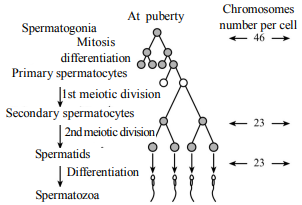
Explain spermatogenesis.
View full question & answer
Question 25 Marks
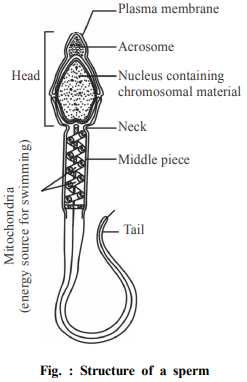
Write the function of following parts of sperm :
(i) head
(ii) middle piece
(iii) tail
Answer
(i) Function of the Head : The sperm head contains an elongated haploid nucleus, the anterior portion of which is covered by a cap-like structure, acrosome. The acrosome is filled with enzymes that help in fertilisation of the ovum.
(ii) Function of Middle Piece : The middle piece possesses numerous mitochondria, which produce energy for the movement of tail that facilitate sperm motility essential
for fertilization.
(iii) Function of Tail : Movement of the tail helps the sperm to swim into the female reproductive tract.
View full question & answer
Question 35 Marks
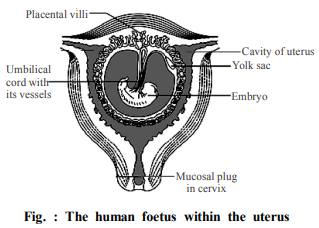
What is placenta? Draw well labelled diagram of human embryo showing placenta in uterus and also write its four functions.
Answer
Placenta : After implantation, finger like projections appear on the trophoblast called chorionic villi which are surrounded by the uterine tissue and maternal blood. The chorionic villi and uterine tissue become interdigitated with each other and jointly form a structural and functional unit between developing embryo (foetus) and maternal body called Placenta.
Image

1. The placenta facilitates the supply of oxygen and nutrients to the embryo and also removal of $CO _2$ and excretory/waste materials produced by the embryo.
2. The placenta is connected to the embryo through an umbilical cord which helps in the transport of substances to and from the embryo.
3. Placenta also acts as an endocrine tissues and produces hormones like hCG (human chorionic gonadotropin), hPL (human placental lactogen), estrogens and progestrone which are essential for supporting the foetal growth, metabolic changes in the mother and
maintenance of pregnancy.
4. Relaxin secreted from placenta at the end of gestation period helps in parturition by relaxing pubic symphysis. 
View full question & answer
Question 45 Marks
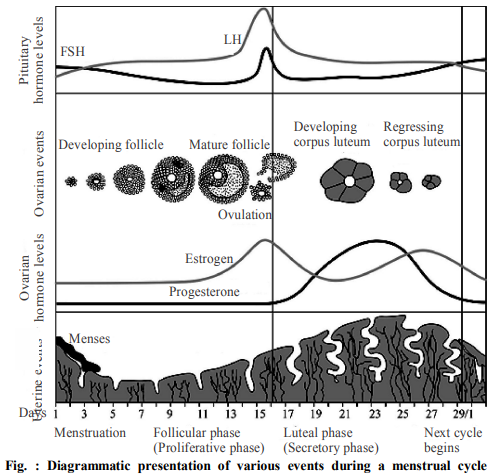
What is menstrual cycle. Explain its various events with the help of diagram.###Describe in detail the various stages of menstrual cycle with the help of diagram.###Write a detail note on different stages of menstrual cycle and also sketch out these stages of
menstrual cycle by graphical diagram.###Define sexual reproduction. Explain the process of menstrual cycle.
Answer
Menstrual Cycle : The reproductive cycle in the female primates is called menstrual cycle. In human females, menstrual cycle completes in 28 days. The first menstruation begins at puberty and is called Menarche.
During this cycle, bleeding occurs once through vaginal passage. This cycle ceases at the age of about 40-50 years in human females and cessation of menstrual cycle is known as menopause. In pregnant women, menstrual cycle is stopped temporarily. Menstrual cycle is studied under following four phases :
(1) Menstrual Phase : The cycle starts with menstrual phase and extends from 1st to 4th day of the cycle. It lasts for 3-5 days. The menstrual flow results due to breakdown of endometrial lining of the uterous and its blood vessels which comes out through vagina. The menstrual flow begins to come out due to sudden decrease in level of progestrone and estrogens in the blood.
(2) Follicular Phase : It is also called pre-ovulatory phase as it comes before ovulatory phase. It follows the menstrual phase and lasts for about 8-10 days. It involves following changes :
(i) The level of FSH increases in blood that stimulates the uterine endometrium and blood vessels to be repaired.
(ii) There also occurs repair of damaged mucous membrane of fallopian tube and uterine glands.
(iii) Uterine endometrium becomes thick, more vascular and glandular, preparing itself for implantation. Estrogen is secreted in profuse amount.
Image

(3) Ovulatory Phase : During 14th day of cycle, Graafian follicle releases ovum as secondary oocyte by bursting of ovary, when graafian follicle comes in contact of ovary’s surface. This is called ovulation. It occurs due
to high level of LH in females. Body temperature of human female also rises during this phase.
(4) Luteal Phase : It is also called premenstrual phase which extends from 15-28 days of menstrual cycle. After ovulation, ruptured graafian follicle grows rapidly under influence of LH and develops into corpus luteum. Corpus luteum acts as temporary endocrine gland that secrete estrogen and progesterone hormone in high amount. These hormones prepare the uterus to implant the fertilized ovum. If fertilization does not occur, corpus luteum, also called yellow gland, degenerates gradually and its residue exists as spot called corpus albicans. Level of estrogen and progestron decline, and regenerated thick endometrium begins to degenerate again which onsets the menstrual cycle. 
View full question & answer
Question 65 Marks
(a) Draw the diagram of human sperm and label the cellular component. Also mention the functions of three components.
(b) Where does the head of sperm remain embedded in spermatogenesis.
Answer
self
View full question & answer
Question 85 Marks
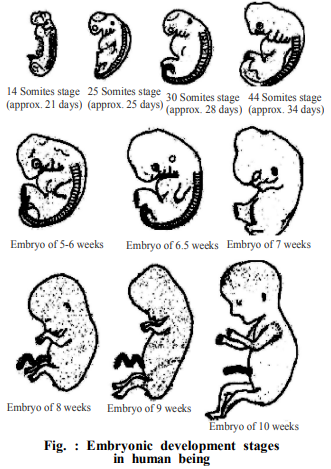
Describe briefly about embryonic stages in human being.
Answer
Summary of embryonic development stages in human being :
1 day Fertilization, diameter of fertilized egg is about 0.15 mm.
2 days Two cell stage.
3 days 16 celled stage, Morula.
4 days Entry of blastocyst into uterine lumen.
7-8 days Partial Embedding of Blastocyst into endometrium of uterus implantation.
12 days Implantation completed. Formation of embryonic disc, extraembryonic membrane like Amnion, Chorion and Yolk sac etc.
14 days Formation of primitive streak.
18 days Formation of 3-5 pairs of somites.
19 days Formation of neural groove, neural plate, notochordal plate and 6-8 pairs of somites.
24 days Determination of cephalic and caudal parts, formation of 21-23 pairs of somites and heart.
28 days Imitation of heart beat, complete formation of nasal tube, three pairs of visceral arch, 30-31 pairs of somites as blood islands.
32 days Formation of 30-39 pairs of somites.
7 weeks Jaw, fingers, external ear begin to visible CR Length (crown rump-length) of Embryo becomes 19-20 mm.
8 weeks Embryo or foetus fully surrounded by Amnion. Fingers and toes distinctly visible.
All the organs have been formed and growing. By the end of 8th week Embryo takes shape of human and is now called foetus with CR length 28-30 mm.
5 months Blood formation in bone marrow begins, decidua capsularis fused with parietalis hair begin to grow.
9 months Placenta attains maximum size. Nails grow on fingers and foetus becomes ready to take birth in next 10 days.
Image
A – 14 somite stage (about 21 days)
B – 25 somite stage (about 25 days)
C – 30 somite stage (about 28 days)
D – 44 somite stage (about 34 days)
E – 5-6 week embryo
F – 6-5 week embryo stage
G – 7 week embryo stage
H – 8 week embryo stage
I – 9 week embryo stage
J – 10 week embryo stage
The above mentioned time period is approximate time period. Sometimes some babies take birth before their gestation time due to some unknown reasons. 

View full question & answer
Question 95 Marks
Write difference between Spermatogenesis and Oogenesis.
Answer
Differences between Spermatogenesis and Oogenesis :
SpermatogenesisOogenesis
1. It occurs in testis of human males1. It occurs in ovaries of human females.
2. It is continuous process which continues whole life.2. It is stopped after a definite age.
3. All the spermatogonia take part in formation of sperm.3. Only one follicle cell develops as oocyte while other several follicle cells degenerate in growth phase.
4. Both the maturation division completed in testis.4. The 2nd maturation division completes outside the ovary in female.
5. Growth phase is of short duration and involves lesser growth.5. Growth phase is of longer duration and involves more growth.
6. Four spermatids are formed from one primary spermatocyte in this process.6. Only one ootid and 3 polar bodies are formed from one primary oocyte.
7. Each spermatid is transformed into sperms by metamorphosis.7. No metamorphasis occurs during this phase.
8. Ovulation like process does not occur.8. Ovulation occurs.
9. Sperms are spindle shaped and motile9. Ovum is oval shaped and non-motile.
View full question & answer
Question 125 Marks
What do you understand by Parturition? Discuss the parturition and lactation process in human.
Answer
self
View full question & answer
Question 155 Marks
Describe the structure of human sperm.###Describe the structure of sperm with suitable diagram. Also define supermatogenesis.
Answer
Structure of Sperm :
The shape of sperm varies from species to species e.g. spherical in bonyfish, spindle shaped in human, hook shaped in rats, spiral shaped in birds and amoeboid in Ascaris etc.
A typical sperm consists of following parts :
(1) Head : In human, it is flattened and almond shaped. Its shape depends upon shape of nucleus. Head consists of two structures :
(a) Nucleus : It forms major part of sperm’s head. It is formed by condensation of nuclear chromatin i.e. DNA and contains 23 chromosomes of this. There are 22 autosomes and one sex chromosome, either X or Y.
(b) Acrosome : It is small cap like pointed structure present at the tip of nucleus. It is formed by vesicles of golgi bodies of spermatids and contains lysosomal enzymes i.e. sperm lysin secreted during penetration of ovum by sperm. Sperm lysin includes nyaluronidase, acid phosphatase and a crosin.
Image
(2) Neck : It is the smallest part of sperm formed of two centrioles arranged at right angle to each other. Proximal centriole lies in a depression in the posterior surface of the nucleus and induces cleavage after fertilization whereas distal centriole is along longitudinal axis of the sperm and gives rise to axoneme of the sperm tail.
(3) Middle Piece : It is also called powerhouse of sperm. It lies behind neck and extends upto ring centriole. It is formed by mitochondrial spiral, nebenkern around
axoneme and provide energy for the movement of sperm. The posterior part of head and complete middle piece is surrounded by their layer of cytoplasm called Manchette. Middle piece also has a pair of ring-centrioles with unknown function.
(4) Tail : It is the longest fibrillar part of sperm which assists the sperm to move. Spermatogenesis : The process of formation of motile, spindle shaped sperms from primary germ cells in the seminiferous tubules of testis in male, is called spermatogenesis.

View full question & answer
5 Marks Questions - Biology STD 12 Science Questions - Vidyadip