Questions

5 Marks Questions

🎯

Test yourself on this topic

6 questions · timed · auto-graded

Question 15 Marks
For the selection of recombinants, insertional inactivation of the antibiotic marker has been superseded by insertional inactivation of a marker gene coding for a chromogenic substrate. Give reasons.
Answer
Selection of recombinants due to inactivation of antibiotics is a laborious process as it requires:
i. a vector with two antibiotic resistance marker.
ii. preparation of two kinds of media plate with one antibiotic each.
→ Transformed cells are first plated on that antibiotic plate which has not been insertional inactivated (ampicillin) and incubated overnight for growth of transformants. For the selection of recombinants, these transformants are Replica plated on second antibiotic (tetracycline) plate (which got inactivated due to insertion of a gene). Non-recombinants grow on both the plates (one carrying ampicillin and the other carrying tetracycline) while recombinants will grow only on ampicillin plate.
→ This entire exercise is laborious and takes more time (two overnight incubation) as well. However, if we choose the second option (insertional inactivation of a marker that produces colour in the presence of a chromogenic compound), we can distinguish between the recombinants and nonsubstrate recombinants on a single medium plate (containing one antibiotic and the chromogenic compound) after overnight growth.
View full question & answer
Question 25 Marks
Explain the process of transcription in prokaryotes.
Answer
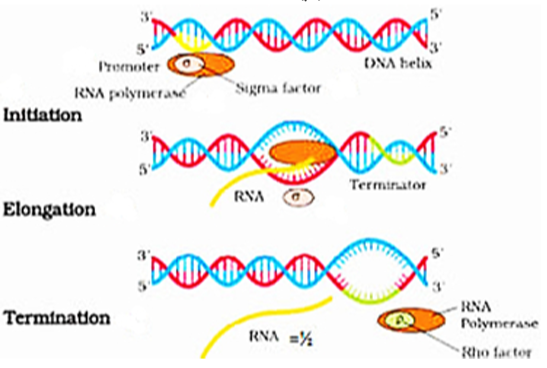
Process of transcription in Prokaryotes are as follows
DNA-dependent RNA polymerase that catalyses the process of transcription, three steps: initiation, elongation, and termination, Initiation: RNA polymerase binds to promoter, associated with initiation-factor (8) at 5' end of DNA,
Elongation: nucleoside phosphates serve as substrate following the rule of complementarity, RNA polymerase help in opening the helix and continuous elongation,
Termination: Terminator factor $(\rho)$, nascent RNA falls off along with RNA polymerase
Image
View full question & answer
Question 35 Marks
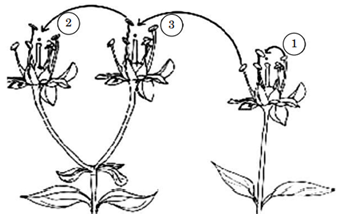
Study the diagram given below showing the modes of pollination. Answer the questions that follow.
Image
i. The given diagram shows three methods of pollen transfer in plants. What are the technical terms used for pollen transfer methods 1, 2 and 3?
ii. How do the following plants achieve pollination successfully?
1. Water lily
2. Vallisneria
iii. Flowering plants have developed many devices to avoid inbreeding depression. Explain one hereditary and one physiological device which helps plants to achieve this target.
Answer
i. The three method of pollen transfer in plant are
1. Autogamy
2. Geitonogamy
3. Xenogamy
ii. 1. Water lily: achieve successfully pollination by insects/wind.
2. Vallisneria: Female flowers on long stalks reach water surface male flowers or pollen released on water and carried by water current to female flowers to achieve pollination.
iii. Genetic: Self-incompatibility/prevents self-pollen (same flower or other flowers of same plant) from fertilizing the ovules by inhibiting pollen germination, pollen tube growth in pistil.
Physiological: Pollen release and stigma receptivity are not synchronized, either pollen matures earlier and stigma later or pollen matures later than stigma.
View full question & answer
Question 45 Marks
Recombinant DNA (rDNA) is a technology that uses enzymes to cut and paste together DNA sequences of interest. The recombined DNA sequences can be placed into vehicles called vectors that ferry the DNA into a suitable host cell where it can be copied or expressed.
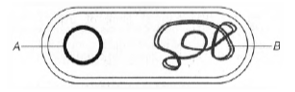
i. A bacterial cell is shown in the figure given below. Label the part 'A' and 'B'. Also, mention the use of part A in rDNA technology.
Image
ii. Suppose a linear DNA fragment and a plasmid has three restriction sites for EcoRI. How many fragments will be produced from linear DNA and plasmid, respectively?
Answer
i. In the above bacterial cell, i.e. A is plasmid B is chromosomal DNA. The plasmid is used as a vector in rDNA technology.
ii. If the enzyme EcoRl acts on both linear DNA and plasmid DNA, each having three recognition sites, the restriction enzyme will generate 3 fragments from plasmid DNA (as it is circular) and 4 fragments from linear DNA.
View full question & answer
Question 55 Marks
Define an operon. Giving an example, explain an Inducible operon.
Answer
A functioning unit of genomic DNA containing a cluster of genes under the control of a single promoter is called an operon. An operon is generally transcribed into polycistronic mRNA. A single mRNA which codes for more than one protein is called polycistronic mRNA. An operon is made up of 3 basic DNA components:
i. Promoter: A nucleotide sequence that enables a gene to be transcribed is called a promoter. It is recognized by RNA polymerase, which then initiates transcription.
ii. Operator: A segment of DNA to which a repressor binds is called the operator.
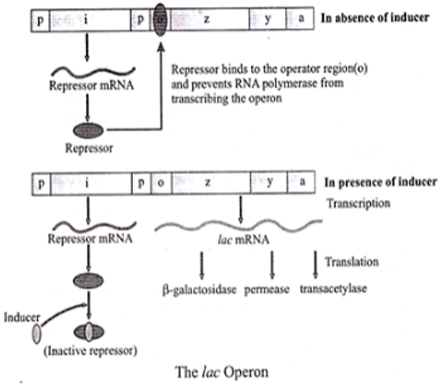
iii. Structural genes: The genes that are co-regulated by the operon are called structural genes. Inducible Operon: When the operon is regulated by an inducer, it is called an inducible operon. An inducer can switch on or off the operon. Lac operon is an example of an inducible operon. Lactose is a substrate of enzyme beta-galactosidase and is the inducer of the lac operon.

Image
The given diagram shows the working of the lac operon. In the absence of an inducer, the repressor binds to the operator region and prevents transcription.
In the presence of an inducer, repressor becomes inactive. This allows transcription in the operator region which results in the release of mRNA. Subsequently, mRNA promotes translation and protein synthesis is accomplished
View full question & answer
Question 65 Marks
Draw a labelled diagram of the sectional view of a mature pollen grain of angiosperms. Explain the function of any two of its parts.
View full question & answer
5 Marks Questions - Biology STD 12 Science Questions - Vidyadip