MCQ 511 Mark
If the change in the value of ' $g$ ' at a height $h$ above the surface of the earth is the same as at a depth $x$ below it, then (both $x$ and $h$ being much smaller than the radius of the earth)
- A
$x=h$
- ✓
$x=2 h$
- C
$x=\frac{h}{2}$
- D
$x=h^2$
AnswerCorrect option: B. $x=2 h$
The value of $g$ at the height $h$ from the surface of earth$g^{\prime}=g\left(1-\frac{2 h}{R}\right)$
The value of $g$ at depth $x$ below the surface of earth$g^{\prime}=g\left(1-\frac{x}{R}\right)$
These two are given equal, hence $\left(1-\frac{2 h}{R}\right)=\left(1-\frac{x}{R}\right)$
On solving, we get $x=2 h$
View full question & answer→MCQ 521 Mark
An earth satellite of mass $m$ revolves in a circular orbit at a height $h$ from the surface of the earth. $R$ is the radius of the earth and $g$ is acceleration due to gravity at the surface of the earth. The velocity of the satellite in the orbit is given by
AnswerCorrect option: D. $\sqrt{\frac{g R^2}{R+h}}$
(d) $v_0=\sqrt{\frac{G M}{r}}=\sqrt{\frac{g R^2}{R+h}}$
View full question & answer→MCQ 531 Mark
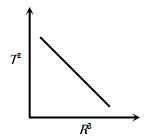
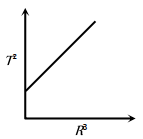
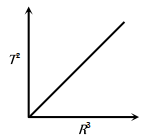
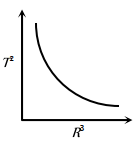
Which of the following graphs represents the motion of a planet moving about the sun
AnswerKepler's law $T^2 \propto R^3$
View full question & answer→MCQ 541 Mark
If a satellite is orbiting the earth very close to its surface, then the orbital velocity mainly depends on
- A
The mass of the satellite only
- ✓
The radius of the earth only
- C
- D
The mass of the earth only
AnswerCorrect option: B. The radius of the earth only
(b) $v_0=\sqrt{g R}$
View full question & answer→MCQ 551 Mark
A satellite revolves around the earth in an elliptical orbit. Its speed
- A
Is the same at all points in the orbit
- ✓
Is greatest when it is closest to the earth
- C
Is greatest when it is farthest from the earth
- D
Goes on increasing or decreasing continuously depending upon the mass of the satellite
AnswerCorrect option: B. Is greatest when it is closest to the earth
View full question & answer→MCQ 561 Mark
The escape velocity of a sphere of mass $m$ from earth having mass $M$ and radius $R$ is given by
AnswerCorrect option: A. $\sqrt{\frac{2 G M}{R}}$
(a) Escape velocity does not depend on the mass of the projectile
View full question & answer→MCQ 571 Mark
The escape velocity from the earth is about $11 \mathrm{~km} /$ second. The escape velocity from a planet having twice the radius and the same mean density as the earth, is
- ✓
$22 \mathrm{~km} / \mathrm{sec}$
- B
$11 \mathrm{~km} / \mathrm{sec}$
- C
$5.5 \mathrm{~km} / \mathrm{sec}$
- D
$15.5 \mathrm{~km} / \mathrm{sec}$
AnswerCorrect option: A. $22 \mathrm{~km} / \mathrm{sec}$
(a)$v_e=\sqrt{\frac{2 G M}{R}}=R \sqrt{\frac{8}{3} \pi G \rho} \therefore v_e \propto R$ if $\rho=$ constantSince the planet having double radius in comparison to earth therefore the escape velocity becomes twice i.e. $22 km / s$.
View full question & answer→MCQ 581 Mark
Weightlessness experienced while orbiting the earth in space-ship, is the result of
MCQ 591 Mark
If there were a smaller gravitational effect, which of the following forces do you think would alter in some respect
Answer(b) As it depends on the weight of the body.
View full question & answer→MCQ 601 Mark
If a body describes a circular motion under inverse square field, the time taken to complete one revolution $\mathrm{T}$ is related to the radius of the circular orbit as
- A
$T \propto r$
- B
$T \propto r^2$
- ✓
$T^2 \propto r^3$
- D
$T \propto r^4$
AnswerCorrect option: C. $T^2 \propto r^3$
View full question & answer→MCQ 611 Mark
If $g$ is the acceleration due to gravity at the earth's surface and $r$ is the radius of the earth, the escape velocity for the body to escape out of earth's gravitational field is
- A
$g r$
- ✓
$\sqrt{2 g r}$
- C
$g / r$
- D
$r / g$
AnswerCorrect option: B. $\sqrt{2 g r}$
View full question & answer→MCQ 621 Mark
The distance of neptune and saturn from sun are nearly $10^{13}$ and $10^{12}$ meters respectively. Assuming that they move in circular orbits, their periodic times will be in the ratio
- A
$\sqrt{10}$
- B
$100$
- ✓
$10 \sqrt{10}$
- D
$1 / \sqrt{10}$
AnswerCorrect option: C. $10 \sqrt{10}$
$\frac{T_1}{T_2}=\left(\frac{R_1}{R_2}\right)^{3 / 2}=\left(\frac{10^{13}}{10^{12}}\right)^{3 / 2}=(1000)^{1 / 2}=10 \sqrt{10}$
View full question & answer→MCQ 631 Mark
An iron ball and a wooden ball of the same radius are released from a height ' $h$ ' in vacuum. The time taken by both of them to reach the ground is
Answer(b) Time of decent $t=\sqrt{\frac{2 h}{g}}$. In vacuum no other force works except gravity so time period will be exactly equal.
View full question & answer→MCQ 641 Mark
The correct answer to above question is based on
- ✓
Acceleration due to gravity in vacuum is same irrespective of size and mass of the body
- B
Acceleration due to gravity in vacuum depends on the mass of the body
- C
There is no acceleration due to gravity in vacuum
- D
In vacuum there is resistance offered to the motion of the body and this resistance depends on the mass of the body
AnswerCorrect option: A. Acceleration due to gravity in vacuum is same irrespective of size and mass of the body
View full question & answer→MCQ 651 Mark
$v_e$ and $v_p$ denotes the escape velocity from the earth and another planet having twice the radius and the same mean density as the earth. Then
- A
$v_e=v_p$
- ✓
$v_e=v_p / 2$
- C
$v_e=2 v_p$
- D
$v_e=v_p / 4$
AnswerCorrect option: B. $v_e=v_p / 2$
(b) $v_e=\sqrt{\frac{2 G M}{R}}=R \sqrt{\frac{8}{3} \pi G \rho}$If mean density is constant then $v_e \propto R$$\frac{v_e}{v_p}=\frac{R_e}{R_p}=\frac{1}{2} \Rightarrow v_e=\frac{v_p}{2}$
View full question & answer→MCQ 661 Mark
The period of a satellite in a circular orbit around a planet is independent of
- A
- B
- ✓
The mass of the satellite
- D
All the three parameters , and
AnswerCorrect option: C. The mass of the satellite
View full question & answer→MCQ 671 Mark
The eccentricity of earth's orbit is $0.0167.$ The ratio of its maximum speed in its orbit to its minimum speed is
- A
$2.507$
- ✓
$1.033$
- C
$8.324$
- D
$1$
AnswerCorrect option: B. $1.033$
$\frac{v_{\max }}{v_{\min }}=\frac{1+e}{1-e}=\frac{1+0.0167}{1-0.0167}=1.033$
View full question & answer→MCQ 681 Mark
The mass and diameter of a planet have twice the value of the corresponding parameters of earth. Acceleration due to gravity on the surface of the planet is
- A
$9.8 \mathrm{~m} / \mathrm{sec}^2$
- ✓
$4.9 \mathrm{~m} / \mathrm{sec}^2$
- C
$980 \mathrm{~m} / \mathrm{sec}^2$
- D
$19.6 \mathrm{~m} / \mathrm{sec}^2$
AnswerCorrect option: B. $4.9 \mathrm{~m} / \mathrm{sec}^2$
$g=\sqrt{\frac{G M}{R^2}} $
$g \propto \sqrt{\frac{M}{R^2}}$
$\frac{g^{\prime}}{g}=\frac{M^{\prime}}{M}\left(\frac{R}{R^{\prime}}\right)^2=\left(\frac{2 M}{M}\right)\left(\frac{R}{2 R}\right)^2=\frac{1}{2} $
$\Longrightarrow g^{\prime}=\frac{g}{2}=\frac{9.8}{2}=4.9 m / s ^2$
View full question & answer→MCQ 691 Mark
An astronaut orbiting the earth in a circular orbit $120 \mathrm{~km}$ above the surface of earth, gently drops a spoon out of space-ship. The spoon will
- A
Fall vertically down to the earth
- B
- ✓
Will move along with space-ship
- D
Will move in an irregular way then fall down to earth
AnswerCorrect option: C. Will move along with space-ship
(c) The velocity of the spoon will be equal to the orbital velocity when dropped out of the space-ship.
View full question & answer→MCQ 701 Mark
Consider a satellite going round the earth in an orbit. Which of the following statements is wrong
- A
lt is a freely falling body
- ✓
lt suffers no acceleration
- C
It is moving with a constant speed
- D
Its angular momentum remains constant
AnswerCorrect option: B. lt suffers no acceleration
(b) Centripetal acceleration works on it.
View full question & answer→MCQ 711 Mark
The escape velocity from the surface of earth is $V_e$. The escape velocity from the surface of a planet whose mass and radius are 3 times those of the earth will be
- ✓
$V_e$
- B
$3 V_e$
- C
$9 V_e$
- D
$27 V_e$
Answer(a) $v_e=\sqrt{\frac{2 G M}{R}} \therefore v_e \propto \sqrt{\frac{M}{R}}$If mass and radius of the planet are three times than that of earth then escape velocity will be same.
View full question & answer→MCQ 721 Mark
The mass of the earth is $81$ times that of the moon and the radius of the earth is $3.5$ times that of the moon.The ratio of the escape velocity on the surface of earth to that on the surface of moon will be
- A
$0.2$
- B
$2.57$
- ✓
$4.81$
- D
$0.39$
AnswerCorrect option: C. $4.81$
Escape velocity $v_e=\sqrt{\frac{2 G M}{R}}$
$\therefore \frac{v_e}{v_m}=\sqrt{\frac{M_e R_m}{M_m R_e}}=\sqrt{\frac{81}{3.5}}=4.81$
View full question & answer→MCQ 731 Mark
Where can a geostationary satellite be installed
AnswerCorrect option: A. Over any city on the equator
View full question & answer→MCQ 741 Mark
What does not change in the field of central force
AnswerFor central force, torque is zero.
$\because \tau=\frac{d L}{d t}=0 \Rightarrow L=\mathrm{constant}$
i.e. Angular momentum is constant.
View full question & answer→MCQ 751 Mark
If $V, R$ and $g$ denote respectively the escape velocity from the surface of the earth radius of the earth, and acceleration due to gravity, then the correct equation is
AnswerCorrect option: D. $V=\sqrt{2 g R}$
View full question & answer→MCQ 761 Mark
Acceleration due to gravity on moon is $1 / 6$ of the acceleration due to gravity on earth. If the ratio of densities of earth $\left(\rho_e\right)$ and moon $\left(\rho_m\right)$ is $\left(\frac{\rho_e}{\rho_m}\right)=\frac{5}{3}$ then radius of moon $R$ in terms of $R$ will be
AnswerCorrect option: A. $\frac{5}{18} R_e$
$ g=\frac{4}{3} \pi G \rho R \Rightarrow g \propto \rho R \Rightarrow \frac{g_e}{g_m}=\frac{\rho_e}{\rho_m} \times \frac{R_e}{R_m} $
$ \Rightarrow \frac{6}{1}=\frac{5}{3} \times \frac{R_e}{R_m} \Rightarrow R_m=\frac{5}{18} R_e$
View full question & answer→MCQ 771 Mark
Given radius of Earth ' $R$ ' and length of a day ' $T$ ' the height of a geostationary satellite is [G-Gravitational Constant, M-Mass of Earth]
- A
$\left(\frac{4 \pi^2 G M}{T^2}\right)^{1 / 3}$
- B
$\left(\frac{4 \pi G M}{R^2}\right)^{1 / 3}-R$
- ✓
$\left(\frac{G M T^2}{4 \pi^2}\right)^{1 / 3}-R$
- D
$\left(\frac{G M T^2}{4 \pi^2}\right)^{1 / 3}+R$
AnswerCorrect option: C. $\left(\frac{G M T^2}{4 \pi^2}\right)^{1 / 3}-R$
$ T=2 \pi \sqrt{\frac{r^3}{G M}} $
$\Rightarrow T^2=\frac{4 \pi^2}{G M}(R+h)^3$
$ \Rightarrow R+h=\left[\frac{G M T^2}{4 \pi^2}\right]^{1 / 3}$
$\Rightarrow h=\left[\frac{G M T^2}{4 \pi^2}\right]^{\frac{1}{3}}-R $
View full question & answer→MCQ 781 Mark
Periodic time of a satellite revolving above Earth's surface at a height equal to $R$, radius of Earth, is [ $g$ is acceleration due to gravity at Earth's surface]
- A
$2 \pi \sqrt{\frac{2 R}{g}}$
- ✓
$4 \sqrt{2} \pi \sqrt{\frac{R}{g}}$
- C
$2 \pi \sqrt{\frac{R}{g}}$
- D
$8 \pi \sqrt{\frac{R}{g}}$
AnswerCorrect option: B. $4 \sqrt{2} \pi \sqrt{\frac{R}{g}}$
(b) $T=2 \pi \sqrt{\frac{(R+h)^3}{g R^2}}=2 \pi \sqrt{\frac{(2 R)^3}{g R^2}}=4 \sqrt{2 \pi} \sqrt{\frac{R}{g}}$
View full question & answer→MCQ 791 Mark
A body of mass $m \mathrm{~kg}$. starts falling from a point $2 R$ above the Earth's surface. Its kinetic energy when it has fallen to a point ' $R$ ' above the Earth's surface [ $R$-Radius of Earth, $M$-Mass of Earth, $G$ Gravitational Constant]
- A
$\frac{1}{2} \frac{G M m}{R}$
- ✓
$\frac{1}{6} \frac{G M m}{R}$
- C
$\frac{2}{3} \frac{G M m}{R}$
- D
$\frac{1}{3} \frac{G M m}{R}$
AnswerCorrect option: B. $\frac{1}{6} \frac{G M m}{R}$
$ \text { Potential energy } U=\frac{-G M m}{r}=-\frac{G M m}{R+h}$
$ U_{\text {initial }}=-\frac{G M m}{3 R} \text { and } U_{\text {final }}=-\frac{-G M m}{2 R} $
$ \text { Loss in } P E=\text { gain in } K E=\frac{G M m}{2 R}-\frac{G M m}{3 R}=\frac{G M m}{6 R}$
View full question & answer→MCQ 801 Mark
Escape velocity of a body of $1 \mathrm{~kg}$ mass on a planet is $100 \mathrm{~m} / \mathrm{sec}$. Gravitational Potential energy of the body at the Planet is
- ✓
$-5000 \mathrm{~J}$
- B
$-1000 \mathrm{~J}$
- C
$-2400 \mathrm{~J}$
- D
$5000 \mathrm{~J}$
AnswerCorrect option: A. $-5000 \mathrm{~J}$
$v_e=\sqrt{\frac{2 G M}{R}}=100 \Rightarrow \frac{G M}{R}=5000$
Potential energy $U=-\frac{G M m}{R}=-5000 J$
View full question & answer→MCQ 811 Mark
If the radius of a planet is $R$ and its density is $\rho$, the escape velocity from its surface will be
- A
$v_e \propto \rho R$
- ✓
$v_e \propto \sqrt{\rho} R$
- C
$v_e \propto \frac{\sqrt{\rho}}{R}$
- D
$v_e \propto \frac{1}{\sqrt{\rho} R}$
AnswerCorrect option: B. $v_e \propto \sqrt{\rho} R$
(b) $v_e=R \sqrt{\frac{8}{3} G \pi \rho} \therefore v_e \propto R \sqrt{\rho}$
View full question & answer→MCQ 821 Mark
At what distance from the centre of the earth, the value of acceleration due to gravity $g$ will be half that on the surface ( $R=$ radius of earth)
- A
$2 R$
- B
$R$
- C
$1.414 R$
- ✓
$0.414 R$
AnswerCorrect option: D. $0.414 R$
$g^{\prime}=g\left(\frac{R}{R+h}\right)^2 \Rightarrow \frac{1} {\sqrt{2}}=\frac{R}{R+h} $
$\Rightarrow R+h=\sqrt{2} R \Rightarrow h=(\sqrt{2}-1) R=0.414\ R$
View full question & answer→MCQ 831 Mark
The periodic time of a communication satellite is
MCQ 841 Mark
The depth $d$ at which the value of acceleration due to gravity becomes $\frac{1}{n}$ times the value at the surface, is $[\mathrm{R}=$ radius of the earth]
AnswerCorrect option: B. $R\left(\frac{n-1}{n}\right)$
$g^{\prime}=g\left(1-\frac{d}{R}\right) \Rightarrow \frac{g}{n}=g\left(1-\frac{d}{R}\right)$
$ \Rightarrow d=\left(\frac{n-1}{n}\right) R$
View full question & answer→MCQ 851 Mark
$R$ is the radius of the earth and $\omega$ is its angular velocity and $g_p$ is the value of $g$ at the poles. The effective value of $g$ at the latitude $\lambda=60^{\circ}$ will be equal to
- ✓
$g_p-\frac{1}{4} R \omega^2$
- B
$g_p-\frac{3}{4} R \omega^2$
- C
$g_p-R \omega^2$
- D
$g_p+\frac{1}{4} R \omega^2$
AnswerCorrect option: A. $g_p-\frac{1}{4} R \omega^2$
(a) $g=g_p-R \omega^2 \cos ^2 \lambda=g_p-\omega^2 R \cos ^2 60^{\circ}=g_p-\frac{1}{4} R \omega^2$
View full question & answer→MCQ 861 Mark
A satellite of mass $m$ is circulating around the earth with constant angular velocity. If radius of the orbit is $R_0$ and mass of the earth $M$, the angular momentum about the centre of the earth is
AnswerCorrect option: A. $m \sqrt{G M R_0}$
(a) Angular momentum $=$ Mass $\times$ Orbital velocity $\times$ Radius$=m \times\left(\sqrt{\frac{G M}{R_0}}\right) \times R_0=m \sqrt{G M R_0}$
View full question & answer→MCQ 871 Mark
Escape velocity on a planet is $v_e$. If radius of the planet remains same and mass becomes 4 times, the escape velocity becomes
- A
$4 v_e$
- ✓
$2 v_e$
- C
$v_e$
- D
$\frac{1}{2} v_e$
AnswerCorrect option: B. $2 v_e$
(b) $v_e=\sqrt{\frac{2 G M}{R}} \Rightarrow v_e \propto \sqrt{M}$ if $R=$ constantIf the mass of the planet becomes four times then escape velocity will become 2 times.
View full question & answer→MCQ 881 Mark
Choose the correct statement from the following: The radius of the orbit of a geostationary satellite depends upon
- A
Mass of the satellite, its time period and the gravitational constant
- B
Mass of the satellite, mass of the earth and the gravitational constant
- C
Mass of the earth, mass of the satellite, time period of the satellite and the gravitational constant
- ✓
Mass of the earth, time period of the satellite and the gravitational constant
AnswerCorrect option: D. Mass of the earth, time period of the satellite and the gravitational constant
(d) $T=2 \pi \sqrt{\frac{r^3}{G M}} \Rightarrow r^3=\frac{G M T^2}{4 \pi^2} \Rightarrow r=\left[\frac{G M T^2}{4 \pi^2}\right]^{1 / 3}$
View full question & answer→MCQ 891 Mark
The escape velocity of an object from the earth depends upon the mass of the earth $(M)$, its mean density $(\rho)$, its radius $(R)$ and the gravitational constant $(G)$. Thus the formula for escape velocity is
- ✓
$v=R \sqrt{\frac{8 \pi}{3} G \rho}$
- B
$v=\sqrt{2 G M R}$
- C
$v=M \sqrt{\frac{8 \pi}{3} G R}$
- D
$v=\sqrt{\frac{2 G M}{R^2}}$
AnswerCorrect option: A. $v=R \sqrt{\frac{8 \pi}{3} G \rho}$
View full question & answer→MCQ 901 Mark
The mass of the earth is $6.00 \times 10^{24} \mathrm{~kg}$ and that of the moon is $7.40 \times 10^{22} \mathrm{~kg}$. The constant of gravitation $G=6.67 \times 10^{-11} \mathrm{~N}-\mathrm{m}^2 / \mathrm{kg}^2$. The potential energy of the system is $-7.79 \times 10^{28}$ joules. The mean distance between the earth and moon is
- ✓
$3.80 \times 10^8$ metres
- B
$3.37 \times 10^6$ metres
- C
$7.60 \times 10^4$ metres
- D
$1.90 \times 10^2$ metres
AnswerCorrect option: A. $3.80 \times 10^8$ metres
$ U=-\frac{G M m}{r}$
$ \Rightarrow 7.79 \times 10^{28} =\frac{6.67\times 10^{-11} \times 7.4 \times 10^{22} \times 6 \times 10^{24}}{r} $
$ \Rightarrow r=3.8 \times 10^8 m$
View full question & answer→MCQ 911 Mark
The value of $g$ on the earth's surface is $980 \mathrm{~cm} / \mathrm{sec}^2$. Its value at a height of $64 \mathrm{~km}$ from the earth's surface is (Radius of the earth $R=6400$ kilometers)
- ✓
$960.40 \mathrm{~cm} / \mathrm{sec}^2$
- B
$984.90 \mathrm{~cm} / \mathrm{sec}^2$
- C
$982.45 \mathrm{~cm} / \mathrm{sec}^2$
- D
$977.55 \mathrm{~cm} / \mathrm{sec}^2$
AnswerCorrect option: A. $960.40 \mathrm{~cm} / \mathrm{sec}^2$
(a) $\frac{g^{\prime}}{g}=\left(\frac{R}{R+h}\right)^2=\left(\frac{6400}{6400+64}\right)^2 \Rightarrow g^{\prime}=960.40 cm / s ^2$
View full question & answer→MCQ 921 Mark
The rotation period of an earth satellite close to the surface of the earth is $83$ minutes. The time period of another earth satellite in an orbit at a distance of three earth radii from its surface will be
AnswerCorrect option: C. $664$ minutes
For first satellite $r_1=R$ and $T_1=83$ minuteFor second satellite $r_2=4 R$
$T_2=T_1\left(\frac{r_2}{r_1}\right)^{3 / 2}=T_1(4)^{3 / 2}=8 T_1=8 \times 83=664 \text { minutes }$
View full question & answer→MCQ 931 Mark
Spot the wrong statement : The acceleration due to gravity ' $g$ ' decreases if
- A
We go down from the surface of the earth towards its centre
- B
We go up from the surface of the earth
- ✓
We go from the equator towards the poles on the surface of the earth
- D
The rotational velocity of the earth is increased
AnswerCorrect option: C. We go from the equator towards the poles on the surface of the earth
(c) Value of $g$ decreases when we go from poles to equator.
View full question & answer→MCQ 941 Mark
The mass of the earth is $81$ times that of the moon and the radius of the earth is $3.5$ times that of the moon. The ratio of the acceleration due to gravity at the surface of the moon to that at the surface of the earth is
AnswerCorrect option: A. $0.15$
(a) $\quad g=\frac{G M}{R^2} \quad\left(\right.$ Given $\left.M_e=81 M_m, R_e=3.5 R_m\right)$
Substituting the above values, $\frac{g_m}{g_e}=0.15$
View full question & answer→MCQ 951 Mark
Select the correct statement from the following
- A
The orbital velocity of a satellite increases with the radius of the orbit
- B
Escape velocity of a particle from the surface of the earth depends on the speed with which it is fired
- C
The time period of a satellite does not depend on the radius of the orbit
- ✓
The orbital velocity is inversely proportional to the square root of the radius of the orbit
AnswerCorrect option: D. The orbital velocity is inversely proportional to the square root of the radius of the orbit
(d) $v_0=\sqrt{\frac{G M}{r}}$
View full question & answer→MCQ 961 Mark
A spherical planet far out in space has a mass $M_0$ and diameter $D_0$. A particle of mass $m$ falling freely near the surface of this planet will experience an acceleration due to gravity which is equal to
- A
$G M_0 / D_0^2$
- B
$4 m G M_0 / D_0^2$
- ✓
$4 G M_0 / D_0^2$
- D
$G m M_0 / D_0^2$
AnswerCorrect option: C. $4 G M_0 / D_0^2$
(c) $g=\frac{G M}{R^2}=\frac{G M_0}{\left(D_0 / 2\right)^2}=\frac{4 G M_0}{D_0^2}$
View full question & answer→MCQ 971 Mark
A planet moves around the sun. At a given point $P$, it is closest from the sun at a distance $d_1$ and has a speed $v_1$. At another point $Q$, when it is farthest from the sun at a distance $d_2$, its speed will be
AnswerCorrect option: C. $\frac{d_1 v_1}{d_2}$
(c) Angular momentum remains constant$m v_1 d_1=m v_2 d_2 \Rightarrow v_2=\frac{v_1 d_1}{d_2}$
View full question & answer→MCQ 981 Mark
The radius of the earth is $6400 \mathrm{~km}$ and $g=10 \mathrm{~m} / \mathrm{sec}^2$. In order that a body of $5 \mathrm{~kg}$ weighs zero at the equator, the angular speed of the earth is
- A
$1 / 80 \ \mathrm{radian} / \mathrm{sec}$
- B
$1 / 400\ \mathrm{radian} / \mathrm{sec}$
- ✓
$1 / 800\ \mathrm{radian} / \mathrm{sec}$
- D
$1 /1600\ \mathrm{radian} / \mathrm{sec}$
AnswerCorrect option: C. $1 / 800\ \mathrm{radian} / \mathrm{sec}$
(c) For the condition of weightlessness at equator
$\omega=\sqrt{\frac{g}{R}} \therefore \omega=\sqrt{\frac{1}{640 \times 10^3}}=\frac{1}{800}\ rad / s$
View full question & answer→MCQ 991 Mark
If both the mass and the radius of the earth decrease by $1 \%$, the value of the acceleration due to gravity will
- A
Decrease by $1 \%$
- ✓
Increase by $1 \%$
- C
Increase by $2 \%$
- D
AnswerCorrect option: B. Increase by $1 \%$
(b) As $g=\frac{G M}{R^2}$ therefore $1 \%$ decrease in mass will decreases the value of $g$ by $1 \%$. But $1 \%$ decrease in radius will increase the value of $g$ by $2 \%$.As a whole value of $g$ increase by $1 \%$.
View full question & answer→MCQ 1001 Mark
The orbital angular momentum of a satellite revolving at a distance $r$ from the centre is $L$. If the distance is increased to $16 r$, then the new angular momentum will be
- A
$16 \mathrm{~L}$
- B
$64 L$
- C
$\frac{L}{4}$
- ✓
$4 L$
View full question & answer→