Questions

M.C.Q (1 Marks)

🎯

Test yourself on this topic

18 questions · timed · auto-graded

MCQ 11 Mark
The straight line $\frac{x-2}{3}=\frac{y-3}{1}=\frac{z+1}{0}$ is
  • A
    parallel to the y-axis
  • perpendicular to the z-axis
  • C
    parallel to the x-axis
  • D
    parallel to the z-axis
Answer
Correct option: B.
perpendicular to the z-axis
(b) perpendicular to the $z$-axis
Explanation: It is perpendicular to z-axis.
Given, direction ratios of the line : $a_1=3, a_2=1, a_3=0$ & direction ratios of $z$-axis is $b_1=0, b_2=0, b_3=1$. Now, $a _1 a _2+ b _1 b_2+ c _1 c _2=3.0+1.0+0.1=0$ which implies that line is perpendicular to z -axis.
View full question & answer
MCQ 21 Mark
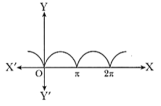
Let $f ( x )=|\sin x | ; 0 \leq x \leq 2 \pi$ then
  • A
    f(x) is discontinuous at 3 points
  • B
    f(x) is differentiable function at infinite number of points
  • C
    f(x) is non-differentiable at 3 points and continuous everywhere
  • D
    f(x) is discontinuous everywhere
View full question & answer
MCQ 31 Mark
If the angle between $\vec{a}$ and $\vec{b}$ is $\frac{\pi}{3}$ and $|\vec{a} \times \vec{b}|=3 \sqrt{3}$, then the value of $\vec{a} \cdot \vec{b}$ is
  • A
    $\frac{1}{3}$
  • B
    $\frac{1}{9}$
  • C
    9
  • 3
Answer
Correct option: D.
3
(d) 3
Explanation: 3
View full question & answer
MCQ 41 Mark
The general solution of the $D E\ x^2 \frac{d y}{d x}=x^2+x y+y^2$ is
  • $\tan ^{-1} \frac{y}{x}=\log x+C$
  • B
    $\tan ^{-1} \frac{y}{x}=\log y+C$
  • C
    $\tan ^{-1} \frac{x}{y}=\log x+C$
  • D
    $\tan ^{-1} \frac{y}{x}=\log x+C$
Answer
Correct option: A.
$\tan ^{-1} \frac{y}{x}=\log x+C$
We have,
$x^2 \frac{d y}{d z}=x^2+x y+y^2$
$\frac{d y}{d x}=1+\frac{y}{x}+\frac{y^2}{x^2}$
Let $y = vx$
$\frac{d y}{d x}=v+x \frac{d v}{d x}$
$1+v+v^2=v+x \frac{d v}{d x}$
$1+v^2=x \frac{d v}{d x}$
$\frac{d x}{x}=\frac{d v}{v^2+1}$
On integrating on both sides,
we obtain $\log x=\tan ^{-1} v+C$
$\tan ^{-1} \frac{y}{x}=\log x+c$
View full question & answer
MCQ 51 Mark
If $A$ and $B$ are independent events, then $P(\bar{A} / \bar{B})= ?$
  • A
    $1- P ( A / \bar{B})$
  • $1 - P(A)$
  • C
    $1 - P(B)$
  • D
    $- P (\bar{A} / B )$
Answer
Correct option: B.
$1 - P(A)$
$P(\overline{A} / \overline{ B })$
$=\frac{P(\bar{A} \cap \bar{B})}{P(\bar{B})}$
$=\frac{P(\bar{A}) P(\bar{B})}{1-P(B)}$
$=1- P ( A )$
View full question & answer
MCQ 61 Mark
The area of the triangle, whose vertices are $(3, 8), (-4, 2)$ and $(5, 1),$ is
  • A
    $60$ sq. units
  • $\frac{61}{2}$ sq. units
  • C
    $61$ sq. units
  • D
    $30$ sq. units
Answer
Correct option: B.
$\frac{61}{2}$ sq. units
The area of triangle is given by
$\Delta=\frac{1}{2}\left|\begin{array}{rrr}3 & 8 & 1 \\ -4 & 2 & 1 \\ 5 & 1 & 1\end{array}\right|$
$=\frac{1}{2}[3(2-1)-8(-4-5)+1(-4-10)]$
$=\frac{1}{2}(3+72-14)=\frac{61}{2} \text { sq. units }$
View full question & answer
MCQ 71 Mark
If $\overrightarrow{ a }+\overrightarrow{ b }=\hat{ i }$ and $\overrightarrow{ a }=2 \hat{ i }-2 \hat{ j }+2 \hat{ k }$, then $|\overrightarrow{ b }|$ equals:
  • A
    $\sqrt{14}$
  • B
    $\sqrt{17}$
  • C
    $\sqrt{12}$
  • 3
Answer
Correct option: D.
3
(d) 3
Explanation: 3
View full question & answer
MCQ 81 Mark
A point out of following points lie in plane represented by
  • A
    $(4, 3)$
  • $(0, 3)$
  • C
    $(0,5)$
  • D
    $(3, 3)$
Answer
Correct option: B.
$(0, 3)$
$(0, 3)$ satisfy the equation $2 x+3 y \leq 12$
$2 \times 0+3 \times 3 \leq 12$
$9 \leq 12$
But $(3,3),(4,3),(0,5)$ does not satisfy $2 x+3 y \leq 12$
View full question & answer
MCQ 91 Mark
If I is a unit matrix, then 3I will be
  • A
    A null matrix
  • B
    A unit matrix
  • C
    A triangular matrix
  • A scalar matrix
Answer
Correct option: D.
A scalar matrix
(d) A scalar matrix
Explanation: A scalar matrix
View full question & answer
MCQ 101 Mark
$\int_0^\pi \frac{1}{1+\sin x} dx$ equals
  • $2$
  • B
    $\frac{3}{2}$
  • C
    $\frac{1}{2}$
  • D
    $0$
Answer
Correct option: A.
$2$
$\int_0^\pi \frac{1}{1+\sin x} d x$
$=\int_0^\pi \frac{1}{1+\sin x} \times \frac{1-\sin x}{1-\sin x} d x$
$=\int_0^\pi \frac{1-\sin x}{1-\sin ^2 x} d x$
$=\int_0^\pi \frac{1-\sin x}{\cos ^2 x} d x$
$=\int_0^\pi\left(\sec ^2 x-\sec x \tan x\right) d x$
$=[\tan x-\sec x]_0^\pi$
$=0+1-0+1$
$=2 $
View full question & answer
MCQ 111 Mark
If the vectors $3 \hat{i}+\lambda \hat{j}+\hat{k}$ and $2 \hat{i}-\hat{j}+8 \hat{k}$ are perpendicular, then $\lambda$ is equal to
  • A
    $7$
  • B
    $-14$
  • C
    $1/7$
  • $14$
Answer
Correct option: D.
$14$
given vectors $3 \hat{i}+\lambda \hat{j}+\hat{k}$ and $2 \hat{i}-\hat{j}+8 \hat{k}$ are perpendicular to each other
$ \Longrightarrow(3 \hat{i}+\lambda \hat{j}+\hat{k}) \cdot(2 \hat{i}-\hat{j}+8 \hat{k})=0$
$\Longrightarrow 6-\lambda+8=0$
$\Longrightarrow \lambda=14$
View full question & answer
MCQ 121 Mark
Which of the following is a convex set?
  • A
    $\left\{(x, y): y^2 \geq x\right\}$
  • B
    $\left\{(x, y): x^2+y^2 \geq 1\right\}$
  • $\{(x, y): x \geq 2, y \leq 4\}$
  • D
    $\left.\{x, y): 3 x^2+4 y^2 \geq 5\right\}$
Answer
Correct option: C.
$\{(x, y): x \geq 2, y \leq 4\}$
(c) $\{(x, y): x \geq 2, y \leq 4\}$
Explanation: $\{(x, y): x \geq 2, y \leq 4\}$is the region between two parallel lines, so any line segment joining any two points in it lies in it. Hence, it is a convex set.
View full question & answer
MCQ 131 Mark
What are the order and degree respectively of the differential equation whose solution is $y=c x+c^2-3 c^{3 / 2}+2$ where $c$ is a parameter?
  • A
    $1,3$
  • $1,4$
  • C
    $2, 2$
  • D
    $1, 2$
Answer
Correct option: B.
$1,4$
Given, $y=c x+c^2-3 c^{3 / 2}+2....(i)$
On differentiating both sides $w.r.t. x,$ we get
$\frac{d y}{d x}= C ...(ii)$ From Eqs. $(i)$ and $(ii),$ we have
$ y=\frac{d y}{d x} \times x+\left(\frac{d y}{d x}\right)^2-3\left(\frac{d y}{d x}\right)^{3 / 2}+2$
$\Rightarrow y-x \frac{d y}{d x}-\left(\frac{d y}{d x}\right)^2-2=-3\left(\frac{d y}{d x}\right)^{3 / 2}$
$\Rightarrow\left[y-x\left(\frac{d y}{d x}\right)-\left(\frac{d y}{d x}\right)^2-2\right]^2=9\left(\frac{d y}{d x}\right)^3 $
Hence, order is $1$ and degree is $4.$
View full question & answer
MCQ 141 Mark
The equation of a line passing through point (2, -1, 0) and parallel to the line $\frac{ x }{1}=\frac{ y -1}{2}=\frac{2- z }{2}$ is:
  • A
    $\frac{x+2}{1}=\frac{y-1}{2}=\frac{z}{2}$
  • B
    $\frac{x+2}{1}=\frac{y-1}{2}=\frac{z}{-2}$
  • $\frac{x-2}{1}=\frac{y+1}{2}=\frac{z}{-2}$
  • D
    $\frac{x-2}{1}=\frac{y-1}{2}=\frac{z}{2}$
Answer
Correct option: C.
$\frac{x-2}{1}=\frac{y+1}{2}=\frac{z}{-2}$
(c) $\frac{ x -2}{1}=\frac{ y +1}{2}=\frac{ z }{-2}$
Explanation: $\frac{x-2}{1}=\frac{y+1}{2}=\frac{z}{-2}$
View full question & answer
MCQ 151 Mark
If $x = a \sec \theta, y = b \tan \theta$ then $\frac{d y}{d x}= ?$
  • A
    $\frac{b}{a} \sec \theta$
  • B
    $\frac{b}{a} \tan \theta$
  • $\frac{b}{a} \operatorname{cosec} \theta$
  • D
    $\frac{b}{a} \cot \theta$
Answer
Correct option: C.
$\frac{b}{a} \operatorname{cosec} \theta$
$x = a \sec \theta$, we get
$\therefore \frac{d x}{d \theta}=\operatorname{a \sec} \theta \cdot \tan \theta$
$\therefore \frac{d \theta}{d x}=\frac{1}{a \sec \theta \cdot \tan \theta}$
$y=b \tan \theta \cdot we \text { get }$
$\therefore \frac{d y}{d \theta}=b \cdot \sec ^2 \theta$
$\Rightarrow \frac{d y}{d x}=\frac{d y}{d \theta} \times \frac{d \theta}{d x}$
$\Rightarrow \frac{d y}{d x}=b \cdot \sec ^2 \theta \times \frac{1}{a \sec \theta \cdot \tan \theta}$
$\Rightarrow \frac{d y}{d x}=\frac{b \sec \theta}{a \tan \theta}$
$\Rightarrow \frac{dy}{dx}=\frac{b \cdot \frac{1}{\cos \theta}}{a \cdot \frac{\sin \theta}{\cos \theta}}$
$\Rightarrow \frac{d y}{d x}=\frac{b}{a} \operatorname{cosec} \theta $
View full question & answer
MCQ 161 Mark
For any $2-$rowed square matrix $A,$ if $A \cdot(\operatorname{adj} A)=\left[\begin{array}{ll}8 & 0 \\ 0 & 8\end{array}\right]$ then the value of $| A |$ is
  • $8$
  • B
    $4$
  • C
    $0$
  • D
    $64$
Answer
Correct option: A.
$8$
$(\operatorname{adj} A)=\left(\begin{array}{ll} 8 & 0 \\ 0 & 8 \end{array}\right) \\ =8\left(\begin{array}{ll} 1 & 0 \\0 & 1\end{array}\right) \\=|A| I \\|A|=8$
View full question & answer
MCQ 171 Mark
If $A=\left[\begin{array}{rr}2 & -1 \\ 1 & 3\end{array}\right]$, then $A ^{-1}= ?$
  • $\left[\begin{array}{cc}\frac{3}{7} & \frac{1}{7} \\ \frac{-1}{7} & \frac{2}{7}\end{array}\right]$
  • B
    $\left[\begin{array}{cc}\frac{3}{7} & \frac{-1}{7} \\ \frac{1}{7} & \frac{2}{7}\end{array}\right]$
  • C
    $\left[\begin{array}{ll}\frac{1}{5} & \frac{2}{7} \\ \frac{1}{7} & \frac{3}{7}\end{array}\right]$
  • D
    $\left[\begin{array}{ll}\frac{1}{3} & \frac{1}{7} \\ \frac{1}{7} & \frac{2}{7}\end{array}\right]$
Answer
Correct option: A.
$\left[\begin{array}{cc}\frac{3}{7} & \frac{1}{7} \\ \frac{-1}{7} & \frac{2}{7}\end{array}\right]$
$A^{-1}=\frac{1}{|A|} \text{adj } A \ldots (i)$
$ |A|=3 \times 2-(1) \times(-1)$
$=7$
$C_{11}=3, C_{12}=-1$
$C_{21}=1, C_{22}=2$
Co$-$factor matrix $A=\left(\begin{array}{ll}2 & 1 \\ 4 & 3\end{array}\right)$
$\text{Adj } A=\left(\begin{array}{ll}3 & -1 \\ 1 & 2\end{array}\right)^{\prime}$
$=\left(\begin{array}{cc}3 & 1 \\-1 & 2\end{array}\right)$
Putting in $1$
$\begin{array}{l} A^{-1}=\frac{1}{|7|}\left(\begin{array}{cc}3 & 1 \\-1 & 2\end{array}\right) \\ =\left(\begin{array}{cc} \frac{3}{7} & \frac{1}{7} \\ \frac{-1}{7} & \frac{2}{7} \end{array}\right) \end{array}$
View full question & answer
MCQ 181 Mark
A matrix $A=\left[a_{i j}\right]_{3 \times 3}$ is defined by $a_{i j}=\left\{\begin{array}{cc}2 i+3 j & , \quad i<j \\ 5 & , \quad i=j \\ 3 i-2 j & , \quad i>j\end{array}\right.$
The number of elements in A which are more than 5 , is 4 :
  • A
    5
  • B
    6
  • 4
  • D
    3
Answer
Correct option: C.
4
(c) 4
Explanation: Here, A $=\left[\begin{array}{ccc}5 & 8 & 11 \\ 4 & 5 & 13 \\ 7 & 5 & 5\end{array}\right]$
Thus, number of elements more than 5 , is 4 .
View full question & answer
M.C.Q (1 Marks) - Mathematics STD 12 Science Questions - Vidyadip