Sample QuestionsModel Paper 2 questions
One sample from each question group in this chapter. Select any group above to see the full set with answer keys.
The straight line $\frac{x-2}{3}=\frac{y-3}{1}=\frac{z+1}{0}$ is
- A
- ✓
perpendicular to the z-axis
- C
- D
Answer: B.
View full solution →Let $f ( x )=|\sin x | ; 0 \leq x \leq 2 \pi$ then
- A
f(x) is discontinuous at 3 points
- B
f(x) is differentiable function at infinite number of points
- C
f(x) is non-differentiable at 3 points and continuous everywhere
- D
f(x) is discontinuous everywhere
View full solution →If the angle between $\vec{a}$ and $\vec{b}$ is $\frac{\pi}{3}$ and $|\vec{a} \times \vec{b}|=3 \sqrt{3}$, then the value of $\vec{a} \cdot \vec{b}$ is
- A
$\frac{1}{3}$
- B
$\frac{1}{9}$
- C
- ✓
Answer: D.
View full solution →The general solution of the $D E\ x^2 \frac{d y}{d x}=x^2+x y+y^2$ is
- ✓
$\tan ^{-1} \frac{y}{x}=\log x+C$
- B
$\tan ^{-1} \frac{y}{x}=\log y+C$
- C
$\tan ^{-1} \frac{x}{y}=\log x+C$
- D
$\tan ^{-1} \frac{y}{x}=\log x+C$
Answer: A.
View full solution →If $A$ and $B$ are independent events, then $P(\bar{A} / \bar{B})= ?$
- A
$1- P ( A / \bar{B})$
- ✓
$1 - P(A)$
- C
$1 - P(B)$
- D
$- P (\bar{A} / B )$
Answer: B.
View full solution →Assertion (A): The function $f(x)=x^2+b x+c$ where b and c are real constants, describes onto mapping.
Reason (R): Let $A=\{1, 2, 3, \ldots, n \}$ and $B =\{ a , b \}$. Then, the number of surjections from A into B is $2^{ n }-2$.
- A
Both A and R are true and R is the correct explanation of A.
- B
Both A and R are true but R is not the correct explanation of A.
- C
A is true but R is false.
- ✓
A is false but R is true.
Answer: D.
View full solution →Assertion $(A):$ The absolute maximum value of the function $2 x^3-24 x$ in the interval $[1, 3]$ is $89.$
Reason $(R):$ The absolute maximum value of the function can be obtained from the value of the function at critical points and at boundary points.
- A
Both $A$ and $R$ are true and $R$ is the correct explanation of $A$
- B
Both $A$ and $R$ are true but $R$ is not the correct explanation of $A.$
- C
$A$ is true but $R$ is false.
- ✓
$A$ is false but $R$ is true.
Answer: D.
View full solution →Prove that the function $f$ given by $f(x)=x^2-x+1$ is neither strictly increasing nor strictly decreasing on $(-1,1)$.
View full solution →Integrate the function $e^x(\sin x+\cos x)$
View full solution →Find the intervals in which the function $f$ given by $f(x)=4 x^3-6 x^2-72 x+30$ is
$i.$ increasing
$ii.$ decreasing.
View full solution →Determine whether $f(x)=-\frac{\pi}{2}+ \sin x$ is increasing or decreasing on $\left(-\frac{\pi}{3}, \frac{\pi}{3}\right)$
View full solution →The volume of a spherical balloon is increasing at the rate of $25 \ cm^3 / \sec$. Find the rate of change of its surface area at the instant when radius is $5 \ cm.$
View full solution →If $x \sqrt{1+y}+y \sqrt{1+x}=0$ and $x \neq y$, prove that $\frac{d y}{d x}=-\frac{1}{(x+1)^2}$.
View full solution →Solve graphically the following linear programming problem:
Maximise $z = 6x + 3y,$
Subject to the constraints:
$4 x+y \geq 80$
$3 x+2 y \leq 150$
$x+5 y \geq 115$
$x > 0, y \geq 0$
View full solution →Minimise $Z = 3x + 5y$ subject to the constraints:
$x+2 y \geqslant 10$
$x+y \geqslant 6$
$3 x+y \geqslant 8$
$x, y \geqslant 0$
View full solution →Solve the differential equation: $\left( x ^3+ x ^2+ x +1\right) \frac{d y}{d x}=2 x ^2+ x$
View full solution →Solve: $2 y e ^{ x / y } d x+\left(y-2 x e ^{ x / y }\right) dy =0$
View full solution →Find the shortest distance between the lines $\vec{r}=(\hat{i}+2 \hat{j}+3 \hat{k})+\lambda(\hat{i}-3 \hat{j}+2 \hat{k})$ and $\vec{r}=(4 \hat{i}+5 \hat{j}+6 \hat{k})+\mu(2 \hat{i}+3 \hat{j}+\hat{k})$
View full solution →Find the perpendicular distance of the point $(1, 0, 0)$ from the line $\frac{x-1}{2}=\frac{y+1}{-3}=\frac{z+10}{8}$. Also, find the coordinates of the foot of the perpendicular and the equation of the perpendicular.
View full solution →Solve the system of the following equations: (Using matrices):
$\frac{2}{x}+\frac{3}{y}+\frac{10}{z}=4 ; \frac{4}{x}-\frac{6}{y}+\frac{5}{z}=1 ; \frac{6}{x}+\frac{9}{y}-\frac{20}{z}=2$
View full solution →Let $R$ be a relation on $N \times N$ defined by $(a, b) R(c,d) \Leftrightarrow a + d = b + c$ for all $( a , b ),( c , d ) \in N \times N .$ Show tha is an equivalence relation.
View full solution →Show that the function $f : R \rightarrow R$ defined by $f(x)=\frac{x}{x^2+1}, \forall x \in R$ is neither one$-$one nor onto.
View full solution →Read the following text carefully and answer the questions that follow:
In a street two lamp posts are $600$ feet apart. The light intensity at a distance d from the first $($stronger$)$ lamp post.$\frac{1000}{d^2}$ the light intensity at distance d from the second $($weaker$)$ lamp post is $\frac{125}{d^2} \ ($in both cases the light intensity is inversely proportional to the square of the distance to the light source$)$. The combined light intensity is the sum of the two light intensities coming from both lamp posts.

$i$. If $l(x)$ denotes the combined light intensity, then find the value of $x$ so that $I(x)$ is minimum.
$ii$. Find the darkest spot between the two lights.
$iii$. If you are in between the lamp posts, at distance $x$ feet from the stronger light, then write the combined light intensity coming from both lamp posts as function of $x$.
OR
Find the minimum combined light intensity? View full solution →Read the following text carefully and answer the questions that follow:
A plane started from airport $O$ with a velocity of $120 \ m/s$ towards east. Air is blowing at a velocity of $50 \ m/s$ towards the north As shown in the figure.
The plane travelled $1 \ hr$ in $OA$ direction with the resultant velocity. From $A$ and $B$ travelled $1 \ hr$ with keeping velocity of $120 \ m/s$ and finally landed at $B.$
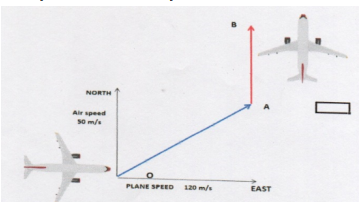
$i.$ What is the resultant velocity from $O$ to $A$?
$ii.$ What is the direction of travel of plane $O$ to $A$ with east?
$iii.$ What is the total displacement from $O$ to $A$?
$OR$
What is the resultant velocity from $A$ to $B$? View full solution →Read the following text carefully and answer the questions that follow:
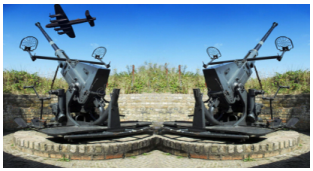
There are two antiaircraft guns, named as $ A $ and $B$. The probabilities that the shell fired from them hits an airplane are $0.3$ and $0.2$ respectively. Both of them fired one shell at an airplane at the same time.
$i$. What is the probability that the shell fired from exactly one of them hit the plane?
$ii$. If it is known that the shell fired from exactly one of them hit the plane, then what is the probability that it was fired from $B$?
$iii$. What is the probability that the shell was fired from $A$?
OR
How many hypotheses are possible before the trial, with the guns operating independently? Write the conditions of these hypotheses. View full solution →