MCQ 511 Mark
Binding energy per nucleon plot against the mass number for stable nuclei is shown in the figure. Which curve is correct
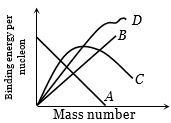
Answerc
(c)
View full question & answer→MCQ 521 Mark
How much work must be done to pull apart the electron and the proton that make up the Hydrogen atom, if the atom is initially in the state with $n = 2$
- A
$13.6 \times 1.6 \times {10^{ - 19}}J$
- ✓
$3.4 \times 1.6 \times {10^{ - 19}}J$
- C
$1.51 \times 1.6 \times {10^{ - 19}}J$
- D
$0$
AnswerCorrect option: B. $3.4 \times 1.6 \times {10^{ - 19}}J$
b
(b)The electrostatic $P.E.$ is zero when the electron and proton are far apart from each other. Work done in pulling electron and proton far away from each other
$W = {E_f} - {E_i} = 0 - {E_i} = - \left( { - \frac{{13.6}}{{{n^2}}}eV} \right)$
$ \Rightarrow W = \frac{{13.6}}{{{{(2)}^2}}} \times 1.6 \times {10^{ - 19}}J$
$= 3.4 \times 1.6 \times 10^{-19}J.$
View full question & answer→MCQ 531 Mark
Consider the nuclear reaction
$X^{200} \rightarrow A^{110} + B^{90}$
If the binding energy per nucleon for $X, A$ and $B$ is $7.4 \,MeV, 8.2\, MeV$ and $8.2\, MeV$ respectively, what is the energy released ? ......... $MeV$
Answerb
Total energy of $X=2 \omega \times 7.4 \mathrm{MeV}$
Total energy of $A=110 \times 8.2 \mathrm{MeV}$
Total energy of $B=90 \times 78.2 \mathrm{MMeV}$
So, $2 \omega \times 7.4=(110 \times 8.2)+(90 \times 8.2)$
Hence - energy $=-2 \omega \times 7.4+(110 \times 8.2)+(90 \times 8.2)$
$=160 \mathrm{MeV}$
View full question & answer→MCQ 541 Mark
The binding energy per nucleon for $C^{12}$ is $7.68\, MeV$ and that for $C^{13}$ is $7.5\, MeV.$ The energy required to remove a neutron from $C^{13}$ is ......... $MeV$
- ✓
$5.34$
- B
$5.5$
- C
$9.5$
- D
$9.34$
AnswerCorrect option: A. $5.34$
a
$C^{13}+$ energy $\rightarrow C^{12}+n$
Energy required to remove one neutron = Difference in total binding energy $=13 \times 7.5-12 \times 7.68 \mathrm{MeV}$
$=5.34 M e V$
View full question & answer→MCQ 551 Mark
The binding energies of nuclei $X$ and $Y$ are $E_1$ and $E_2$ respectively. Two atoms of $X$ fuse to give one atom of $Y$ and an energy $Q$ is released. Then :
- A
$Q = 2E_1-E_2$
- ✓
$Q = E_2-2E_1$
- C
$Q = 2E_1 + E_2$
- D
$Q = 2E_2 + E_1$
AnswerCorrect option: B. $Q = E_2-2E_1$
b
Given that two atoms of $X$ fuse to give one atom of $Y$.
Final energy $=E_2$
Initial energy $=2 E _1$ (two atoms of $X$ )
Hence, difference in binding energies is $=E_2-2 E_1$
Given that $Q$ is released.
Hence, $E _2-2 E _1= Q$
View full question & answer→MCQ 561 Mark
The rest mass of the deuteron , ${}_1^2H ,$ is equivalent to an energy of $1876 \,MeV,$ the rest mass of a proton is equivalent to $939\, MeV$ and that of a neutron to $940\, MeV.$ A deuteron may disintegrate to a proton and a neutron if it :
- A
emits a $\gamma -$ ray photon of energy $2\, MeV$
- B
captures a $\gamma -$ ray photon of energy $2\, MeV$
- C
emits a $\gamma -$ ray photon of energy $3\, MeV$
- ✓
captures a $\gamma -$ ray photon of energy $3\, MeV$
AnswerCorrect option: D. captures a $\gamma -$ ray photon of energy $3\, MeV$
d
DEUTRON
$_{1} H^{2}=n+p$
Total energy of deutron $=1476 \mathrm{MeV}$ Energy of neutron $+$ proton $=940+939=1879 \mathrm{MeV}$
Energy required to disintegrate Deutron $=3 M e V$
View full question & answer→MCQ 571 Mark
In an $\alpha -$ decay the Kinetic energy of $\alpha$ particle is $48 \,MeV$ and $Q-$ value of the reaction is $50 \,MeV.$ The mass number of the mother nucleus is : (Assume that daughter nucleus is in ground state)
Answerb
Kinetic energy $K . E=48 \mathrm{MeV}$
Qvalue $Q=50$
we know that,
The kinetic energy is
$E=\frac{A-4}{A} \times Q \ldots \ldots(I)$
Now, put the value in equation $(I)$
$48 A=(A-4) 50$
$48 A-50 A=-200$
$2 A=200$
$A=100$
Hence, The mass number of the mother nucleus is $100$
View full question & answer→MCQ 581 Mark
A nuclear reactor generates power by fission of ${}_{92}{U^{235}}$ into two equal fragments of ${}_{46}{U^{116}}$ with the emission of two $\gamma -$rays of $5.2 \ MeV$ each and three neutrons.The average binding energies per nucleons of ${}_{92}{U^{235}}$and ${}_{46}{U^{116}}$ are $7.2\ MeV$ and $8.2\ MeV$ respectively. The usable energy released per fission event is ......... $MeV$
Answera
$_{92} \mathrm{U}^{232} \rightarrow 2 \times_{46} \mathrm{Pd}^{116}+2_{0} \mathrm{n}^{1}$
$B.E.$ $1692 \quad 1902.4$
energy of two $\gamma$ -rays photons $=2 \times 5.2=10.4 \mathrm{\,MeV}$
$\therefore$ usable energy per fission
${=(210.4-10.4) \mathrm{\,MeV}} $
${=200 \mathrm{\,MeV}}$
View full question & answer→MCQ 591 Mark
The energy released by the fission of a single uranium nucleus is $200 \,MeV$. The number of fissions of uranium nucleus per second required to produce $16\, MW$ of power is
(Assume efficiency of the reactor is $50\%$)
- A
$2 \times 10^6$
- B
$2.5 \times 10^6$
- C
$5 \times 10^6$
- ✓
$1 \times 10^{18}$
AnswerCorrect option: D. $1 \times 10^{18}$
d
Required power $=16 \times 2$
$=32 \mathrm{\,MW}=32 \times 10^{6} \mathrm{\,W}$
Hence number of fission of Uranium nuclei per second
$=\frac{32 \times 10^{6}}{200 \times 1.6 \times 10^{-13}}=1 \times 10^{18}$
View full question & answer→MCQ 601 Mark
A nucleus of mass $M + \Delta m$ is at rest and decays into two daughter nuclei of mass $ \frac {M}{4}$&$\frac{3M}{4}$ each. Speed of light is $c.$ The speed of daughter nucleus of mass $\frac{M}{4}$ is
- A
$c\sqrt {\frac{{\Delta m}}{{M + \Delta m}}}$
- B
$c\frac{{\Delta m}}{{M + \Delta m}}$
- C
$c\sqrt {\frac{{2\Delta m}}{M}}$
- ✓
$c\sqrt {\frac{{6\Delta m}}{M}}$
AnswerCorrect option: D. $c\sqrt {\frac{{6\Delta m}}{M}}$
d
Conservation of angular momentum
$\frac{m}{4} v_{1}=\frac{3 m}{4} v_{2}$
$\Delta \mathrm{m} \mathrm{C}^{2}=\frac{1}{2} \frac{\mathrm{m}}{4} \mathrm{v}_{1}^{2}+\frac{1}{2} \times \frac{3 \mathrm{m}}{4} \mathrm{v}_{2}^{2}$
$\mathrm{v}_{1}=\sqrt{\frac{6 \Delta \mathrm{m}}{\mathrm{M}}}$
View full question & answer→MCQ 611 Mark
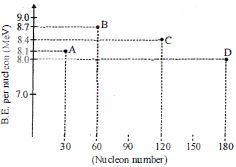
The positions of four different nuclei in the binding energy curve are shown in figure. The process that might not proceed spontaneously is
- A
$C \to 2B$
- B
$D \to B+C$
- ✓
$B \to 2A$
- D
AnswerCorrect option: C. $B \to 2A$
c
For sponteneous process $Q$ value must be positive.
$⇒$ Final product must be more stable than initial reactants .
View full question & answer→MCQ 621 Mark
Binding energy per nucleon of a fixed nucleus $X^A$ is $8\ MeV$ . It absorbs a neutron moving with kinetic energy $2\ MeV$ and converts into $Y$ , emitting two photon of energy $1\ MeV$ and $4\ MeV$ respectively one after the other. The binding energy of per nucleon of $Y$ (in $MeV$ ) is
- A
$\frac{{\left( {8A - 7} \right)}}{{\left( {A + 1} \right)}}$
- ✓
$\frac{{\left( {8A + 3} \right)}}{{\left( {A + 1} \right)}}$
- C
$\frac{{\left( {8A + 7} \right)}}{{\left( {A + 1} \right)}}$
- D
$\frac{{\left( {8A - 3} \right)}}{{\left( {A + 1} \right)}}$
AnswerCorrect option: B. $\frac{{\left( {8A + 3} \right)}}{{\left( {A + 1} \right)}}$
b
$\mathrm{n}+\mathrm{x}=\mathrm{Y}+\mathrm{hf}+\mathrm{hf'}$
$(A+1) B E-8 A=3$
$\mathrm{BE}=\frac{8 \mathrm{A}+3}{\mathrm{A}+1}$
View full question & answer→MCQ 631 Mark
A nucleus with mass number $220$ initially at rest emits an $\alpha -$ particle. If the $Q$ value of reaction is $7.8\ MeV$ and subsequently after the emission of $\alpha -$ particle, a photon of energy $1.2\ MeV$ is also emitted. The kinetic energy of $\alpha -$ particle is ? .......... $MeV$
- ✓
$6.48$
- B
$7.6$
- C
$0.14$
- D
$0.12$
AnswerCorrect option: A. $6.48$
a
$\mathrm{Q}-\mathrm{E}_{\text {photon }}=7.8-1.2=6.6 \mathrm{\,MeV}$
$\mathrm{KE}_{\alpha-\text { particle }}=(6.6)\left(\frac{216}{200}\right)=6.48 \mathrm{\,MeV}$
View full question & answer→MCQ 641 Mark
What is the energy released in process $3{\,_2}H{e^4} \to {\,_6}{C^{12}}\,?$ ............. $MeV$ (Mass of $_2H{e^4} = 4.002604\,\,amu,$ mass of $C^{12} = 12\ amu)$
- ✓
$7.27$
- B
$9.38$
- C
$6.09$
- D
$10.9$
AnswerCorrect option: A. $7.27$
a
${3_2}{\rm{H}}{{\rm{e}}^4} \to {\,_6}{{\rm{C}}^{12}}$
$\mathrm{Q}=\left(3 \times \mathrm{M}_{\mathrm{He}}-\mathrm{M}_{\mathrm{C}}\right) \times \mathrm{c}^{2}$
$\mathrm{Q}=7.27 \mathrm{\,MeV}$
View full question & answer→MCQ 651 Mark
After absorbing a slowly moving neutron of mass $m_N$ (momentum $\sim 0$ ) a nucleus of mass $M$ breaks into two nuclei of masses $m_1$ and $5m_1\,(6m_1 = M + m_N)$ . If the de-Broglie wavelength of the nucleus with mass $m_1$ is $\lambda $ , then de Broglie wavelength of the other nucleus will be
- A
$25\,\lambda $
- B
$5\,\lambda $
- C
$\frac {\lambda }{5}$
- ✓
$\lambda $
AnswerCorrect option: D. $\lambda $
d
Momentum should be conserved.
As initial momentum was zero so final should also be zero.
so $p_{1}+p_{2}=0$ or $p_{1}=-p_{2}$ i.e. both have same values$........(1)$
where $p_{1}$ is momentum of $m_{1}$ and $p_{2}$ is that of $m_{2}$
The deBroglie wavelength is given by $\lambda=\frac{h}{p}$
As both mass have same momentum, $, p_{1}=-p_{2}$
so same values of wavelength. So answer is $\lambda$
View full question & answer→MCQ 661 Mark
The binding energy of deuteron $_1^2H\,\,$ is $\,\,1.112\,\,MeV$ per nucleon and an $\alpha- $ particle $_2^4He$ has a binding energy of $7.047\,\,MeV$ per nucleon. Then in the fusion reaction ${}_1^2H\, + \,{}_1^2H\, \to \,{}_2^4He\, + \,Q,$ the energy $Q$ released is ........... $MeV$
AnswerCorrect option: C. $23.8$
c
Energy released $Q = [B.E.]_{final} -[B.E.]_{Initial}$
View full question & answer→MCQ 671 Mark
In a fission reaction ${}_{92}^{236}U \to {}^{117}X + {}^{117}Y + n + n$ , the binding energy per nucleon of $X$ and $Y$ is $8.5\,MeV$ whereas of $^{236}U$ is $7.6\,MeV$ . The total energy liberated will be about
- A
$200\,KeV$
- B
$2\,MeV$
- ✓
$200\,MeV$
- D
$2000\,MeV$
AnswerCorrect option: C. $200\,MeV$
c
$\Delta E = 8.5 \times 234 - 7.6 \times 236 = 195.4\,MeV \approx 200\,MeV$
View full question & answer→MCQ 681 Mark
The binding energy of deuteron $_1^2H$ is $1.112\, MeV$ per nucleon and an $\alpha -$ Particle $_2^4He$ has a binding energy of $7. 047\, MeV$ per nucleon. Then in the fusion reaction $_1^2H + _1^2H \to _2^4He + Q,$ the energy $Q$ released is ........ $MeV$
AnswerCorrect option: C. $23.8$
c
Energy equivalent to $_{1} \mathrm{H}^{2}=2 \times 1.112$
$=2.224 \mathrm{\,MeV}$
Energy equivalent to $_{2} \mathrm{He}^{4}=4 \times 7.047$ $=28.188 \mathrm{\,MeV}$
From the equation, energy released $=28.188-2 \times 2.224=23.74 \mathrm{\,MeV} \approx 24 \mathrm{\,MeV}$
View full question & answer→MCQ 691 Mark
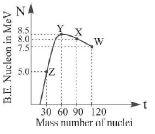
Binding energy per nucleon versus mass number curve for nuclei is shown in the figure. $W, X, Y$ and $Z$ are four nuclei indicated on the curve. The process that would release energy is
- A
$Y \to 2Z$
- B
$W \to X + Z$
- ✓
$W \to 2Y$
- D
$X \to Y + Z$
AnswerCorrect option: C. $W \to 2Y$
c
Energy is released in a process when total binding energy $(BE)$ of products is more than the reactants. By calculations we can see that this happens in option $(c)$
Given $W = 2Y$
$BE$ of reactants $= 120 \times 7.5 = 900\, MeV$
$BE$ of products $= 2 \times (60 \times 8.5) = 1020\, MeV$
View full question & answer→MCQ 701 Mark
Consider the nuclear reaction $X ^{200} \rightarrow A ^{110}+ B ^{90}$
If the binding energy per nucleon for $X , A$ and $B$ is $7.4 MeV , 8.2 MeV$ and $8.2 MeV$ respectively, then the amount of the energy released is .......... $MeV$
Answerb
(b)
Initial $BE =7.4 \times 200 \,MeV$
Final BE $=8.2 \times 110+8.2 \times 90 \,MeV$
$\therefore$ Energy release $=$ Final $-$ Initial
$=(8.2-7.4) \times 200=0.8 \times 200$
$=160 \,MeV$
View full question & answer→MCQ 711 Mark
Which of the alternatives gives correct match of Column-$I$ with Column-$II$?
| Column-$I$ |
Column-$II$ |
| $a.$ Binding energy per nucleon for ${ }^{56} Fe$ |
$(i)$ $5.5 \,M eV$ |
| $b.$ Energy of $\alpha$-particle in Geiger Marsden experiment |
$(ii)$ $200 \,M eV$ |
| $c.$ Energy of photon of visible light |
$(iii)$ $8.75 \,M eV$ |
| $d.$ Energy released in fission of a uranium nucleus |
$(iv)$ $2 \,eV$ |
- A
$a(i), b(iii), c(iv), d(ii)$
- B
$a(iii), b(i), c(ii), d(iv)$
- ✓
$a(iii), b(i), c(iv), d(ii)$
- D
$a(i), b(iv), c(ii), d(iii)$
AnswerCorrect option: C. $a(iii), b(i), c(iv), d(ii)$
View full question & answer→MCQ 721 Mark
For the nuclear fusion reaction ${ }_1^2 H +{ }_1^3 H \rightarrow{ }_2^4 He +{ }_0^1 n$ temperature to which gases must be heated is $3.7 \times 10^9 \,K$. Potential energy between two nuclei is closest to ........ $J$ (Boltzmann's constant $k=1.38 \times 10^{-23} \,J / K$ )
- A
$-10^{-10}$
- B
$-10^{-12}$
- C
$-10^{-14}$
- ✓
$-10^{-16}$
AnswerCorrect option: D. $-10^{-16}$
d
(d)
$KE$ of nuclei $=\frac{3}{2} k t=7.659 \times 10^{-14}$
(for fusion)
Potential energy between nuclei must be much less than the initiating $KE$ so that the nuclei have enough $KE$ for reaction to take place.
View full question & answer→MCQ 731 Mark
The number of neutrons released when $_{92}{U^{235}}$ undergoes fission by absorbing $_0{n^1}$ and ${(_{56}}B{a^{144}}{ + _{36}}K{r^{89}})$ are formed, is
Answerd
(d) $_{92}{U^{235}}{ + _0}{n^1}{ \to _{92}}{U^{236}}$ and
$_{92}{U^{236}}{ \to _{56}}B{a^{144}}{ + _{36}}K{r^{89}} + {3_0}{n^1} + Q$.
View full question & answer→MCQ 741 Mark
If the energy released in the fission of one nucleus is $200\, MeV$. Then the number of nuclei required per second in a power plant of $16\, kW$ will be
- A
$0.5 \times {10^{14}}$
- B
$0.5 \times {10^{12}}$
- C
$5 \times {10^{12}}$
- ✓
$5 \times {10^{14}}$
AnswerCorrect option: D. $5 \times {10^{14}}$
d
(d) Energy released in the fission of one nucleus $= 200 \,MeV$
$ = 200 \times {10^6} \times 1.6 \times {10^{ - 19}}J = 3.2 \times {10^{ - 11}}J$
$P = 16\,KW = 16 \times {10^3}Watt$
Now, number of nuclei required per second
$n = \frac{P}{E} = \frac{{16 \times {{10}^3}}}{{3.2 \times {{10}^{ - 11}}}} = 5 \times {10^{14}}$.
View full question & answer→MCQ 751 Mark
To generate a power of $3.2\, mega\, watt$, the number of fissions of ${U^{235}}$ per minute is
(Energy released per fission $= 200\,MeV, 1\,eV = 1.6 \times {10^{ - 19}}J)$
- ✓
$6 \times {10^{18}}$
- B
$6 \times {10^{17}}$
- C
${10^{17}}$
- D
$6 \times {10^{16}}$
AnswerCorrect option: A. $6 \times {10^{18}}$
a
(a) Number of fissions per second
$ = \frac{{Power\;output}}{{Energy\;released\;per\;fission}}$
$ = \frac{{3.2 \times {{10}^6}}}{{200 \times {{10}^6} \times 1.6 \times {{10}^{ - 19}}}} = 1 \times {10^{17}}$
$ \Rightarrow $ Number of fission per minute $ = 60 \times {10^{17}} = 6 \times {10^{18}}$
View full question & answer→MCQ 761 Mark
The nuclear reaction $^2H{ + ^2}H \to {\,^4}He$ (mass of deuteron $= 2.0141 \,a.m.u.$ and mass of $He = 4.0024 \,a.m.u.$) is
- ✓
Fusion reaction releasing $24 \,MeV$ energy
- B
Fusion reaction absorbing $24\, MeV $ energy
- C
Fission reaction releasing $0.0258 \,MeV$ energy
- D
Fission reaction absorbing $0.0258\, MeV$ energy
AnswerCorrect option: A. Fusion reaction releasing $24 \,MeV$ energy
a
(a)Total mass of reactants
$ = (2.0141) \times 2 = 4.0282\;amu$
Total mass of products $ = 4.0024\;amu$
Mass defect $ = 4.0282\;amu - 4.0024\;amu$
$ = 0.0258\;amu$
$\therefore $Energy released$E = 931 \times 0.0258 = 24\;MeV$
View full question & answer→MCQ 771 Mark
An atomic power nuclear reactor can deliver $300\, MW$. The energy released due to fission of each nucleus of uranium atom ${U^{238}}$ is $170\, MeV$. The number of uranium atoms fissioned per hour will be
- A
$30 \times {10^{25}}$
- ✓
$4 \times {10^{22}}$
- C
$10 \times {10^{20}}$
- D
$5 \times {10^{15}}$
AnswerCorrect option: B. $4 \times {10^{22}}$
b
(b) $P = \frac{{nE}}{t}$
$ \Rightarrow 300 \times {10^6}$$ = \frac{{n \times 170 \times {{10}^6} \times 1.6 \times {{10}^{ - 19}}}}{t}$
Number of atoms per sec $\frac{n}{t} = 1.102 \times {10^{19}}$
Number of atoms per hour $= 1.02 × 1019 ×3600$
$= 3.97 × 10^{22}.$
View full question & answer→MCQ 781 Mark
Nuclear reactions are given as $(i)$ ${(n,\;p)_{15}}{p^{32}}$ $(ii)$ ${(p,\;\alpha )_8}{O^{16}}$ $(iii)$ $_7{N^{14}}$ $( p)$ $_6{C^{14}}$ missing particle or nuclide (in $box$ ) in these reactions are respectively
- ✓
$S^{32}, F^{19}$, $_0{n^1}$
- B
$F^{19}, S^{32}$, $_0{n^1}$
- C
$Be^9, F^{19}$, $_0{n^1}$
- D
AnswerCorrect option: A. $S^{32}, F^{19}$, $_0{n^1}$
a
(a) $(i)$ $_{16}{S^{32}}{ + _0}{n^1}{ \to _{15}}{p^{32}}{ + _1}{H^1}$
$(ii)$ $_9{F^{19}}{ + _1}{H^1}{ \to _2}H{e^4}{ + _8}{O^{16}}$
$(iii)$ $_7{N^{14}}{ + _0}{n^1}{ \to _6}{C^{14}}{ + _1}{H^1}$
View full question & answer→MCQ 791 Mark
Nuclear reaction are given as
$(i)\, \square$$ (n, p) _{15} p^{32}$
$(ii)\, \square (p, \alpha){_8}O^{16}$
$(iii)\, _7 N^{14} (\square \,\, p) _6 C^{14}$
missing particle or nuclide (in box $\square$) in these reactions are respectively
- ✓
$S^{32}, F^{19}, {_0}n^1$
- B
$F^{19}, S^{32}, {_0}n^1$
- C
$Be^9, F^{19}, {_0}n^1$
- D
AnswerCorrect option: A. $S^{32}, F^{19}, {_0}n^1$
View full question & answer→MCQ 801 Mark
Which reaction is not part of proton-proton cycle
- A
$_1H^1 + \,_1H^1 \to \, _1H^2 + \beta ^+ + v + Q$
- ✓
$_1H^2 + \,_1H^2 \to \, _2He^3 + \,_0n^1 + Q$
- C
$_1H^2 +\, _1H^1 \to \, _2He^3 + Q$
- D
$_2He^3 + \,_2He^3 \to \, _2He^4 + 2(_1H^1) + Q$
AnswerCorrect option: B. $_1H^2 + \,_1H^2 \to \, _2He^3 + \,_0n^1 + Q$
View full question & answer→MCQ 811 Mark
In nuclear reaction $_2H{e^4}{ + _z}{X^A}{ \to _{z + 2}}{Y^{A + 3}} + A,\;A$ denotes
Answerd
(d) The given equation is $_2H{e^4}{ + _z}{X^A}{ \to _{z + 2}}{Y^{A + 3}} + A$
Applying charge and mass conservation
$4 + A = A + 3 + x \Rightarrow x = 1$
==> $2 + z = z + 2 + n \Rightarrow n = 0$
Hence $A$ is a neutron.
View full question & answer→MCQ 821 Mark
Which of the following statement is true
- A
$_{78}P{t^{192}}$ has $78$ neutrons
- B
$_{84}P{o^{214}}{ \to _{82}}P{b^{210}} + {\beta ^ - }$
- ✓
$_{92}{U^{238}}{ \to _{90}}T{h^{234}}{ + _2}H{e^4}$
- D
$_{90}T{h^{234}}{ \to _{91}}P{a^{234}}{ + _2}H{e^4}$
AnswerCorrect option: C. $_{92}{U^{238}}{ \to _{90}}T{h^{234}}{ + _2}H{e^4}$
c
${ }_{78} Pt ^{192}$ has 78 protons.
${ }_{92} U ^{238} \rightarrow{ }_{90} Th ^{234}+{ }_2 He ^4$
View full question & answer→MCQ 831 Mark
A nucleus of $_{84}^{210}Po$ originally at rest emits $\alpha$ particle with speed $v$. What will be the recoil speed of the daughter nucleus
- ✓
$\frac{{4v}}{{206}} $
- B
$\frac{{4v}}{{214}} $
- C
$\frac{{v}}{{206}} $
- D
$\frac{{v}}{{214}} $
AnswerCorrect option: A. $\frac{{4v}}{{206}} $
a
(a) $_{84}P{o^{210}}{ \to _{82}}{X^{206}}{ + _2}H{e^4}$
Using conservation of linear moments
$206\,v' + 4v = 0 \Rightarrow v' = - \frac{{4v}}{{(206)}}$
$ \Rightarrow \,|v'|\, = \frac{{4v}}{{206}}$
View full question & answer→MCQ 841 Mark
A radioactive nucleus undergoes a series of decay according to the scheme
$A\xrightarrow{\alpha }{{A}_{1}}\xrightarrow{\beta }{{A}_{2}}\xrightarrow{\alpha }{{A}_{3}}\xrightarrow{\gamma }{{A}_{4}}$
If the mass number and atomic number of $A$ are $180$ and $72$ respectively, then what are these number for $A_4$
- ✓
$172$ and $69$
- B
$174$ and $70$
- C
$176$ and $69$
- D
$176$ and $70$
AnswerCorrect option: A. $172$ and $69$
a
(a) $_{72}{{A}^{180}}\xrightarrow{\alpha }{{\,}_{70}}{{A}_{1}}^{176}\xrightarrow{\beta }{{\,}_{71}}{{A}_{2}}^{176}$
$\xrightarrow{\alpha }{{\,}_{69}}{{A}_{3}}^{172} \xrightarrow{\gamma }{{\,}_{69}}{{A}_{4}}^{172}$
View full question & answer→MCQ 851 Mark
Atomic mass number of an element thorium is $232$ and its atomic number is $90$. The end product of this radioactive element is an isotope of lead (atomic mass $208$ and atomic number $82$). The number of alpha and beta particles emitted is
- A
$\alpha = 3,\;\beta = 3$
- ✓
$\alpha = 6,\;\beta = 4$
- C
$\alpha = 6,\;\beta = 0$
- D
$\alpha = 4,\;\beta = 6$
AnswerCorrect option: B. $\alpha = 6,\;\beta = 4$
b
(b) ${n_\alpha } = \frac{{A - A'}}{4} = \frac{{232 - 208}}{4} = 6$
and ${n_\beta } = (2{n_\alpha } - Z + Z') = (2 \times 6 - 90 + 82) = 4$
View full question & answer→MCQ 861 Mark
Three $\alpha - $ particles and one $\beta - $ particle decaying takes place in series from an isotope $_{88}R{a^{238}}$. Finally the isotope obtained will be
- A
$_{84}{X^{220}}$
- B
$_{86}{X^{222}}$
- C
$_{83}{X^{224}}$
- ✓
$_{83}{X^{215}}$
AnswerCorrect option: D. $_{83}{X^{215}}$
d
(c) By using ${n_\alpha } = \frac{{A - A'}}{4}$ and ${n_\beta } = 2{n_\alpha } - Z + Z'$
==> $A' = A - 4{n_\alpha } = 236 - 4 \times 3 = 224$
and $Z' = ({n_\beta } - 2{n_\alpha } + Z) = (1 - 2 \times 3 + 88) = 83$
View full question & answer→MCQ 871 Mark
In the given nuclear reaction $A, B, C, D, E$ represents
$_{92}{U^{238}}{\xrightarrow{\alpha }_B}T{h^A}{\xrightarrow{\beta }_D}P{a^C}{\xrightarrow{E}_{92}}{U^{234}}$
- ✓
$A = 234, B = 90, C = 234, D = 91, E = \beta $
- B
$A = 234, B = 90, C = 238, D = 94, E = \alpha $
- C
$A = 238, B = 93, C = 234, D = 91, E = \beta $
- D
$A = 234, B = 90, C = 234, D = 93, E = \alpha $
AnswerCorrect option: A. $A = 234, B = 90, C = 234, D = 91, E = \beta $
a
(a) $_{92}{{U}^{238}}\xrightarrow{\alpha }{{\,}_{90}}T{{h}^{234}}\,\xrightarrow{\beta }{{\,}_{91}}P{{a}^{234}}$$\xrightarrow{E{{(}_{-1}}{{\beta }^{o}})}{{\,}_{92}}{{U}^{234}}$
View full question & answer→MCQ 881 Mark
A radioactive element $_{90}{X^{238}}$ decay into $_{83}{Y^{222}}$. The number of $\beta - $ particles emitted are
Answerd
(d) Number of $\alpha - $particles emitted $ = \frac{{238 - 222}}{4} = 4$
This decreases atomic number to $90 - 4 \times 2 = 82$
Since atomic number of $_{83}{Y^{222}}$ is $83,$
this is possible if one $\beta - $ particle is emitted.
View full question & answer→MCQ 891 Mark
Consider the following two statements
$A.$ Energy spectrum of $\alpha-$ particles emitted in radioactive decay is discrete
$B.$ Energy spectrum of $ \beta -$ particles emitted in radioactive decay is continuous
AnswerCorrect option: B. Only $B$ is correct
View full question & answer→MCQ 901 Mark
A nucleus of an element $_{84}{X^{202}}$ emits an $\alpha-$ particle first, a $\beta-$ particle next and then a gamma photon. The final nucleus formed has an atomic number
Answerc
(c) $_{84}{{X}^{202}}{{\xrightarrow{\alpha -}}_{82}}{{Y}^{198}}{{+}_{2}}H{{e}^{4}}$ and
$_{82}{{Y}^{198}}{{\xrightarrow{\beta -\text{decay}}}_{83}}{{Z}^{198}}{{+}_{-1}}{{\beta }^{0}}$
View full question & answer→MCQ 911 Mark
An atomic nucleus $_{90}T{h^{232}}$ emits several $\alpha$ and $\beta$ radiations and finally reduces to $_{82}P{b^{208}}$. It must have emitted
- A
$4 \alpha \,and \,2 \beta$
- B
$8 \alpha \,and \,24 \beta$
- ✓
$6 \alpha \,and \,4 \beta$
- D
$4 \alpha \,and \,16 \beta$
AnswerCorrect option: C. $6 \alpha \,and \,4 \beta$
c
(b) ${n_\alpha } = \frac{{A - A'}}{4} = \frac{{232 - 208}}{4} = 6$
${n_\beta } = 2{n_\alpha } - Z + Z' = 2 \times 6 - 90 + 82 = 4$
View full question & answer→MCQ 921 Mark
In the given nuclear reaction, how many $\beta$ and $\alpha$ particles are emitted $_{92}{X^{235}} \to {\;_{82}}{Y^{207}}$
- A
$3 \alpha$ particles and $2 \beta$ particle
- B
$4 \alpha$ particles and $3 \beta$ particle
- C
$6 \alpha$ particles and $4 \beta$ particle
- ✓
$7 \alpha$ particles and $4 \beta$ particle
AnswerCorrect option: D. $7 \alpha$ particles and $4 \beta$ particle
d
(d) ${n_\alpha } = \frac{{A - A'}}{4} = \frac{{235 - 207}}{4} = 7$
${n_\beta } = (2{n_\alpha } - Z + Z') = (2 \times 7 - 92 + 82) = 4$
View full question & answer→MCQ 931 Mark
A radioactive nucleus with $Z$ protons and $N$ neutrons emits an $\alpha - $ particle, $2\beta$- particles and $2$ gamma rays. The number of protons and neutrons in the nucleus left after the decay respectively, are
- A
$Z -3, N -1$
- B
$Z -2, N -2$
- C
$Z -1, N -3$
- ✓
$Z, N -4$
AnswerCorrect option: D. $Z, N -4$
d
(d) With emission of an $\alpha $ particle ${(_2}H{e^4})$ mass number decreases by $4 $ unit and atomic number decrease by $2$ units and with emission of $2{\beta ^{ - 1}}$ particle atomic number increases by $2$ units.
So $ Z$ will remain same and $N$ will become $N - 4.$
View full question & answer→MCQ 941 Mark
In the disintegration series
$_{92}^{238}U\xrightarrow{\alpha }x\xrightarrow{\beta }_Z^AY$
The value of $Z$ and $A$ respectively will be
- A
$92, 236$
- B
$88, 230$
- C
$90, 234$
- ✓
$91, 234$
AnswerCorrect option: D. $91, 234$
d
(d) $_{92}{U^{238}}{ \to _2}H{e^4}{ + _{90}}{X^{234}}{ \to _{ - 1}}{e^0}{ + _{91}}{U^{234}}$
Hence, $A = 234, Z = 91$
View full question & answer→MCQ 951 Mark
When $_{90}T{h^{228}}$ transforms to $_{83}B{i^{212}}$, then the number of the emitted $\alpha$- and $\alpha$- particles is, respectively
- A
$8\,\alpha ,\,7\beta $
- B
$4\,\alpha ,\,7\beta $
- C
$4\,\alpha ,\,4\beta $
- ✓
$4\,\alpha ,\,1\beta $
AnswerCorrect option: D. $4\,\alpha ,\,1\beta $
d
(d) ${n_\alpha } = \frac{{228 - 212}}{4} = 4$ and ${n_\beta } = 2 \times 4 - 90 + 83 = 1$
View full question & answer→MCQ 961 Mark
$_{90}^{232}Th$ an isotope of thorium decays in ten stages emitting six $\alpha$-particles and four $\beta$-particles in all. The end product of the decay is
- A
$_{82}^{206}Pb$
- B
$_{82}^{209}Pb$
- ✓
$_{82}^{208}Pb$
- D
$_{83}^{209}Br$
AnswerCorrect option: C. $_{82}^{208}Pb$
c
(c) New mass number $A' = A - 4{n_\alpha }$
$ = 232 - 4 \times 6 = 208$
atomic number$Z' = Z + {n_\beta } - 2{n_\alpha }$
$ = 90 + 4 - 2 \times 6 = 82$
View full question & answer→MCQ 971 Mark
$_{86}{A^{222}}{ \to _{84}}{B^{210}}$. In this reaction how many $\alpha $ and $\beta $ particles are emitted
- A
$6\alpha ,\,3\beta $
- ✓
$3\alpha ,\,4\beta $
- C
$4\alpha ,\,3\beta $
- D
$3\alpha ,\,6\beta $
AnswerCorrect option: B. $3\alpha ,\,4\beta $
b
(b)By using ${n_\alpha } = \frac{{A - A'}}{4}$ and ${n_\beta } = 2{n_\alpha } - Z + Z'$
View full question & answer→MCQ 981 Mark
${ }_{92} U^{235}$ nucleus absorbs a neutron and disintegrates into ${ }_{54} X e^{139} ,{ }_{38} Sr ^{94}$ and $X$. What will be the product $X$ ?
- ✓
$3 -$ neutron
- B
$2-$ neutron
- C
$\alpha-$ particles
- D
$\beta-$ particles
AnswerCorrect option: A. $3 -$ neutron
a
$_{{\text{92}}}{U^{235}}{ + _0}{n^1}{ \to _{54}}X{e^{139}}{ + _{38}}S{r^{94}} + X$
$X ={3_0}{n^1}$
View full question & answer→MCQ 991 Mark
A nucleus $_Z{X^A}$ emits $3 \alpha$ - particles and $5 \beta$ particle. The ratio of total neutrons and protons in the final nucleus is
- A
$\frac{{A - Z - 12}}{{Z - 6}}$
- B
$\frac{{A - Z}}{{Z - 1}}$
- C
$\frac{{A - Z - 11}}{{Z - 6}}$
- ✓
$\frac{{A - Z - 11}}{{Z - 1}}$
AnswerCorrect option: D. $\frac{{A - Z - 11}}{{Z - 1}}$
d
$_{\text{Z}}^{\text{A}}X \to _{Z - 1}^{A - 12}Y + 3\alpha + 5\beta $
Number of protons $= Z - 1,$
Number of neutrons $= (A - 12) - (Z - 1) = A - Z- 11$
$\therefore \frac{N}{P} = \frac{{{\text{A - Z - 11}}}}{{{\text{Z - 1}}}}$
View full question & answer→MCQ 1001 Mark
A nucleus $_Z{X^A}$ emits $9 \alpha$ - particles and $5 \beta$ particle. The ratio of total protons and neutrons in the final nucleus is
- ✓
$\frac{{Z - 13}}{{(A - Z - 23)}}$
- B
$\frac{{(Z - 18)}}{{(A - 36)}}$
- C
$\frac{{(Z - 13)}}{{(A - 36)}}$
- D
$\frac{{(Z - 13)}}{{(A - Z - 13)}}$
AnswerCorrect option: A. $\frac{{Z - 13}}{{(A - Z - 23)}}$
a
(a) $_Z{X^A}\,\xrightarrow{{9\alpha }}{\,_{Z - 18}}{X^{A - 36}}\xrightarrow{{5\beta }}{\,_{Z - 13}}{X^{A - 36}}$
Number of protons $= (Z = 13)$
Number of neutrons $= (A -36) -(Z -13) = (A -Z -23)$
$\therefore$ $\frac{P}{N} = \frac{{(Z - 13)}}{{(A - Z - 23)}}$
View full question & answer→