MCQ 1011 Mark
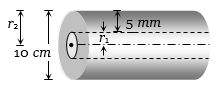
Length of a hollow tube is $5\,m$, it’s outer diameter is $10\, cm$ and thickness of it’s wall is $5\, mm$. If resistivity of the material of the tube is $1.7 \times 10^{-8} \,\Omega m$ then resistance of tube will be
- ✓
$5.6 \times 10^{-5} \,\Omega$
- B
$2 \times 10^{-5}\,\Omega$
- C
$4 \times 10^{-5} \,\Omega$
- D
AnswerCorrect option: A. $5.6 \times 10^{-5} \,\Omega$
a
(a) By using $R = \rho .\frac{l}{A};$ here $A = \pi (r_2^2 - r_1^2)$
Outer radius $r_2 = 5\,cm$
Inner radius $r_1 = 5 -0.5 = 4.5\, cm$
So $R = 1.7 \times {10^{ - 8}} \times \frac{5}{{\pi \{ {{(5 \times {{10}^{ - 2}})}^2} - {{(4.5 \times {{10}^{ - 2}})}^2}\} }}$
$ = 5.6 \times {10^{ - 5}}\,\Omega $
View full question & answer→MCQ 1021 Mark
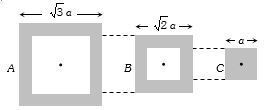
Following figure shows cross-sections through three long conductors of the same length and material, with square cross-section of edge lengths as shown. Conductor $B$ will fit snugly within conductor $A$, and conductor $C$ will fit snugly within conductor $B$. Relationship between their end to end resistance is
- ✓
$R_A = R_B = R_C$
- B
$R_A > R_B > R_C$
- C
$R_A < R_B < R_C$
- D
Information is not sufficient
AnswerCorrect option: A. $R_A = R_B = R_C$
a
(a) All the conductors have equal lengths. Area of cross-section of $A$ is $\{ {(\sqrt 3 \,a)^2} - {(\sqrt 2 \,a)^2}\} = {a^2}$
Similarly area of cross-section of $B=$ Area of cross-section of $C = a^2$
Hence according to formula $R = \rho \frac{l}{A};$ resistances of all the conductors are equal i.e.$ R_A = R_B = R_C$
View full question & answer→MCQ 1031 Mark
The $V-i$ graph for a conductor makes an angle $\theta $ with $V-$ axis. Here $ V$ denotes the voltage and $i$ denotes current. The resistance of conductor is given by
- A
$\sin \theta $
- B
$\cos \theta $
- C
$\tan \theta $
- ✓
$\cot \theta $
AnswerCorrect option: D. $\cot \theta $
d
At an instant approach the student will choose $\tan\,\theta$ will be the right answer. But it is to be seen here the curve makes the angle $\theta$ with the $V-$ axis. So it makes an angle $(90 -\theta)$ with the $i-$ axis.
So resistance $=$ slope $= \tan \,(90 -\theta) = \cot\,\theta$.
View full question & answer→MCQ 1041 Mark
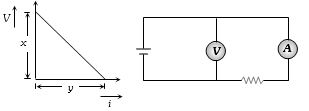
In an experiment, a graph was plotted of the potential difference $V$ between the terminals of a cell against the circuit current $i$ by varying load rheostat. Internal conductance of the cell is given by
- A
$xy$
- ✓
$\frac{y}{x}$
- C
$\frac{x}{y}$
- D
$(x -y)$
AnswerCorrect option: B. $\frac{y}{x}$
b
(b) Here internal resistance is given by the slope of graph i.e. $\frac{x}{y}$. But conductance $ = \frac{1}{{{\rm{Resistance }}}} = \frac{y}{x}$
View full question & answer→MCQ 1051 Mark
Two wires '$A$' and '$B$' of the same material have their lengths in the ratio $1 : 2$ and radii in the ratio $2 : 1$. The two wires are connected in parallel across a battery. The ratio of the heat produced in '$A$' to the heat produced in '$B$' for the same time is
Answerd
(d) ${R_1} = \rho \frac{{{l_1}}}{{{A_1}}}$ and ${R_2} = \rho \frac{{{l_2}}}{{{A_2}}}$$ \Rightarrow $$\,\frac{{{R_1}}}{{{R_2}}} = \frac{{{l_1}}}{{{l_2}}}.\frac{{{A_2}}}{{{A_1}}} = \frac{{{l_1}}}{{{l_2}}}{\left( {\frac{{{r_2}}}{{{r_1}}}} \right)^2}$
Given $\frac{{{l_1}}}{{{l_2}}} = \frac{1}{2}$ and $\frac{{{r_1}}}{{{r_2}}} = \frac{2}{1}$ or $\frac{{{r_2}}}{{{r_1}}} = \frac{1}{2}$$ \Rightarrow $ $\frac{{{R_1}}}{{{R_2}}} = \frac{1}{8}$
$\therefore $ Ratio of heats $\frac{{{H_1}}}{{{H_2}}} = \frac{{{V^2}/{R_1}}}{{{V^2}/{R_2}}} = \frac{{{R_2}}}{{{R_1}}} = \frac{8}{1}$
View full question & answer→MCQ 1061 Mark
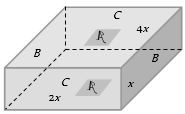
In figure shows a rectangular block with dimensions $x,\, 2x$ and $4x$. Electrical contacts can be made to the block between opposite pairs of faces (for example, between the faces labelled $A-A, B-B$ and $C-C$). Between which two faces would the maximum electrical resistance be obtained ($A-A$ : Top and bottom faces, $B-B$ : Left and right faces, $C-C$ : Front and rear faces)
Answerc
Let $\rho $ is the resistivity of the material
Resistance for contact $A-A$
${R_{AA}} = \rho \frac{x}{{2x \times 4x}} = \frac{\rho }{{8x}}$
Similar for contacts $B-B$ and $C-C$ are respectively
${R_{BB}} = \rho .\frac{{2x}}{{x \times 4x}} = \frac{\rho }{{2x}} = \frac{{4\rho }}{{8x}}$
and ${R_{CC}} = \rho \frac{{4x}}{{x \times 2x}} = \frac{{2\rho }}{x} = \frac{{16\rho }}{{8x}}$
It is clear maximum resistance will be for contact $C-C$.
View full question & answer→MCQ 1071 Mark
A cylindrical metal wire of length $l$ and cross sections area $S$, has resistance $R$, conductance $G$, conductivity $\sigma$ and resistivity $\rho$. Which one of the following expressions for $\sigma$ is valid
- ✓
$\frac{{GR}}{\rho }$
- B
$\frac{{\rho R}}{G}$
- C
$\frac{{GS}}{l}$
- D
$\frac{{Rl}}{S}$
AnswerCorrect option: A. $\frac{{GR}}{\rho }$
a
Conductivity $\sigma = \frac{1}{\rho }$ .... $(i)$
and conductance $G = \frac{1}{R}$
$ \Rightarrow \,\,GR = 1$ ..... $(ii)$
From equation $(i)$ and $(ii)$ $\sigma = \frac{{GR}}{\rho }$
View full question & answer→MCQ 1081 Mark
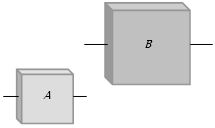
$A$ and $B$ are two square plates of same metal and same thickness but length of $B$ is twice that of $A$. Ratio of resistances of $A$ and $B$ is
- A
$4 : 1$
- B
$1 : 4$
- ✓
$1 : 1$
- D
$1 : 2$
AnswerCorrect option: C. $1 : 1$
c
(c) ${R_A} = \frac{{\rho l}}{{l \times t}} = \frac{\rho }{t}$ and ${R_B} = \frac{{\rho \times 2l}}{{2l \times t}} = \frac{\rho }{t}$ i.e. $\frac{{{R_A}}}{{{R_B}}} = 1:1$
View full question & answer→MCQ 1091 Mark
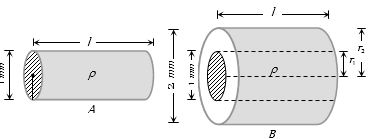
Two conductors are made of the same material and have the same length. Conductor $A$ is a solid wire of diameter $1.0\, mm$. Conductor $B$ is a hollow tube of outside diameter $2.0\, mm$ and inside diameter $1.0\, mm$. The resistance ratio $R_A/R_B$ will be
Answerc
For conductor $A$, ${R_A} = \frac{{\rho \,l}}{{\pi r_1^2}}$,
For conductor $B$, ${R_B} = \frac{{\rho \,l}}{{\pi (r_2^2 - r_1^2)}}$
$ \Rightarrow $ $\frac{{{R_A}}}{{{R_B}}} = \frac{{r_2^2 - r_1^2}}{{r_1^2}} = {\left( {\frac{{{r_2}}}{{{r_1}}}} \right)^2} - 1 = {\left( {\frac{{{d_2}}}{{{d_1}}}} \right)^2} - 1 = {\left( {\frac{2}{1}} \right)^2} - 1 = 3$
View full question & answer→MCQ 1101 Mark
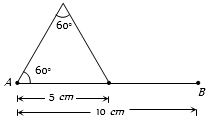
A wire has resistance of $24\,\Omega$ is bent in the following shape. The effective resistance between $A$ and $B$ is .............. $\Omega$
- A
$24 $
- ✓
$10$
- C
$\frac{{16}}{3}$
- D
Answerb
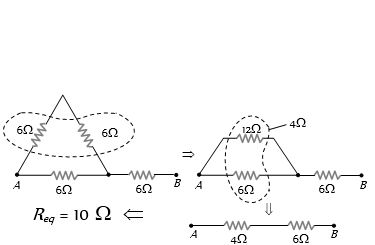
(b) Given resistance of each part will be
View full question & answer→MCQ 1111 Mark
$A$ brass disc and a carbon disc of same radius are assembled alternatively to make a cylindrical conductor. The resistance of the cylinder is independent of the temperature. The ratio of thickness of the brass disc to that of the carbon disc is [$\alpha$ is temperature coefficient of resistance and Neglect linear expansion ]
- ✓
$\left| {\frac{{{\alpha _C}{\rho _C}}}{{{\alpha _B}{\rho _B}}}} \right|$
- B
$\left| {\frac{{{\alpha _C}{\rho _B}}}{{{\alpha _B}{\rho _C}}}} \right|$
- C
$\left| {\frac{{{\alpha _B}{\rho _C}}}{{{\alpha _C}{\rho _B}}}} \right|$
- D
$\left| {\frac{{{\alpha _B}{\rho _B}}}{{{\alpha _C}{\rho _C}}}} \right|$
AnswerCorrect option: A. $\left| {\frac{{{\alpha _C}{\rho _C}}}{{{\alpha _B}{\rho _B}}}} \right|$
a
Given the resistance is independent of temperature.
Hence,
$\frac{\rho_{B} l_{B}}{A}\left(\alpha_{B} \Delta T\right)=\frac{\rho_{C} l_{C}}{A}\left(\alpha_{C} \Delta T\right)$
$\therefore \frac{l_{B}}{l_{C}}=\frac{\rho_{C} \alpha_{C}}{\rho_{B} \alpha_{B}}$
View full question & answer→MCQ 1121 Mark
Which of the following wiring diagrams could be used to experimentally determine $R$ using ohm's law? Assume an ideal voltmeter and an ideal ammeter.
Answerb
Ohm's law states that current through the conductor between two points is directly proportional to the potential difference across the two points.
Which can be represented by circuit diagram as below.
View full question & answer→MCQ 1131 Mark
Read the following statements carefully :
$Y :$ The resistivity of a semiconductor decreases with increases of temperature.
$Z :$ In a conducting solid, the rate of collision between free electrons and ions increases with increase of temperature.
Select the correct statement from the following :
- A
$Y$ is true but $Z$ is false
- B
$Y$ is false but $Z$ is true.
- ✓
Both $Y$ and $Z$ are true.
- D
$Y$ is true and $Z$ is the correct reason for $Y.$
AnswerCorrect option: C. Both $Y$ and $Z$ are true.
c
The conductivity of a semiconductor increases with increases in temperature
i.e. the resistivity decreases with increases in temperature.
In a conducting solid, the collisions become more frequent with increase of temperature.
View full question & answer→MCQ 1141 Mark
As the temperature of a conductor increases, its resistivity and conductivity change. The ratio of resistivity to conductivity
- ✓
- B
- C
- D
may increase or decrease depending on the actual temperature.
Answera
The resistivity of a conductor is given by
$\rho=\frac{m}{n e^{2} \tau}$
where, $m$ is mass of an electron, $e$ is charge on electron, $n$ is number of free electrons per unit volume in conductor and $\tau$ is relaxation time.
$\Rightarrow \rho \propto \frac{1}{\tau}$$.............(1)$
Also, the conductivity is reciprocal of resistivity i.e.
$\sigma=\frac{1}{\rho}$$...............(2)$
$\Rightarrow \sigma \propto \tau$$............(3)……….$ from $(1)$ and $(2)$
$\frac{\rho}{\sigma} \propto \frac{1}{\tau^{2}} ........$ from $(1)$ and $(3)$
When temperature increases relaxation time will decrease and hence, ratio of resistivity and conductivity will increase.
View full question & answer→MCQ 1151 Mark
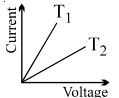
The current in a metallic conductor is plotted against voltage at two different temperatures $T_1$ and $T_2$. Which is correct
- A
$T_1 > T_2$
- ✓
$T_1 < T_2$
- C
$T_1 = T_2$
- D
AnswerCorrect option: B. $T_1 < T_2$
b
According to Ohm's law $R=\frac{V}{I}$
Where $R=$ resistance $V=$ Voltage $I=$ Current
Also $R$ is directly proportional to temperature $T$ and inversely proportional to the slope.
$\therefore$ from the above example
$R_{1} \propto T_{1}$ and $R_{2} \propto T_{2}$
but from given figure $R_{1} < R_{2}$
$\therefore T_{1} < T_{2}$
View full question & answer→MCQ 1161 Mark
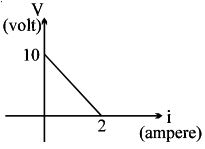
$A$ battery of $\mathrm{emf}$ $E$ and internal resistance $r$ is connected across a resistance $R$. Resistance $R$ can be adjusted to any value greater than or equal to zero. Agraph is plotted between the current $(i)$ passing through the resistance and potential difference $(V) $ across it. Select the correct alternative $(s)$.
- ✓
internal resistance of battery is $5\,\Omega$
- B
emf of the battery is $20\,V$
- C
maximum current which can be taken from the battery is $4\,A$
- D
$V- i$ graph can never be a straight line as shown in figure.
AnswerCorrect option: A. internal resistance of battery is $5\,\Omega$
View full question & answer→MCQ 1171 Mark
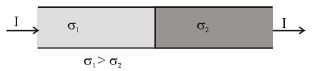
Current $I$ is flowing through the two materials having electrical conductivities $\sigma_1$ and $\sigma_2$ respectively $(\sigma_1 > \sigma_2 )$ as shown in the figure. The total amount of charge at the junction of the materials is
- ✓
$I \in_0 (1/ \sigma_2 - 1/\sigma_1)$
- B
$\frac{{I{ \in _0}(1/{\sigma _2} - 1/{\sigma _1})}}{4}$
- C
$4I \in_0 (1/\sigma_2 - 1/\sigma_1 ) $
- D
AnswerCorrect option: A. $I \in_0 (1/ \sigma_2 - 1/\sigma_1)$
a
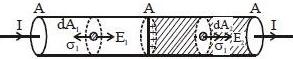
$\oint \overrightarrow{\mathrm{E}} \cdot \overrightarrow{\mathrm{dA}}=\frac{q_{\mathrm{in}}}{\varepsilon_{0}}$
$\mathrm{E}_{2} \mathrm{A}-\mathrm{E}_{1} \mathrm{A}=\frac{\mathrm{q}_{\mathrm{in}}}{\varepsilon_{0}}$
$\mathrm{JA}\left(\frac{1}{\sigma_{2}}-\frac{1}{\sigma_{1}}\right)=\frac{\mathrm{q}_{\mathrm{in}}}{\varepsilon_{0}}$
${\varepsilon _0}I\left( {\frac{1}{{{\sigma _2}}} - \frac{1}{{{\sigma _1}}}} \right) = {q_{{\rm{in}}}}$
View full question & answer→MCQ 1181 Mark
An electric current flows along an insulated strip $PQ$ of a metallic conductor. The current density in the strip varies as shown in graph of figure. Which one of the following statements could explain this variation ?
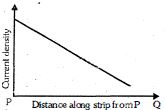
AnswerCorrect option: A. The strip is narrower at $P$ than at $Q$
a
The current density at $\mathrm{P}$ is higher than at $\mathrm{Q}$ For the same current flowing through the metallic conductor $\mathrm{PQ},$ the cross sectional area at $\mathrm{P}$ is narrower than at $\mathrm{Q}$.
The resistance per unit length $\mathrm{r}$ is given by $x=\rho \frac{1}{A}$
where $\rho$ is the resistivity and $\mathrm{A}$ is the cross-sectional area of the conductor $\mathrm{PQ}$.
Thus, $\mathrm{r}$ is inversely proportional to the cross-sectional area $\mathrm{A}$ of the conductor.
View full question & answer→MCQ 1191 Mark
Resistance of rod is calculated by measuring its length with help of meter scale of least count $1\ mm$ . Its radius is measured with help of screw gauge having $50$ division on circular scale and pitch is of $1\ mm$ . Resistivity of material is exact. Length of the wire is found to be $20\ cm$ and diameter of wire is $4\ mm$ . Find the percentage error in calculation of resistance ............... $\%$
Answera
$\mathrm{R}=\frac{\rho \ell}{\mathrm{A}}$
$\frac{1 \Delta \mathrm{R}}{\mathrm{R}}=\frac{1 \Delta \ell}{\ell}+\frac{2 \Delta \mathrm{r}}{\mathrm{r}}+\frac{\Delta \rho}{\rho}$
Maximum error is least count of an instrument
$\therefore \quad 1.5 \%$
View full question & answer→MCQ 1201 Mark
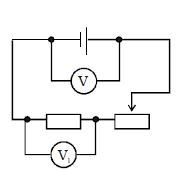
If the rheostat slider were to move from the extreme right to the far left, How will the reading of voltmeter $V_1$ change?
- A
First increase and then decrease
- B
First decrease and then increase
- ✓
- D
Answerc
$R \downarrow \,\, \Rightarrow \,\,i \uparrow \,\, \Rightarrow \,\,{v_1} \downarrow $
View full question & answer→MCQ 1211 Mark
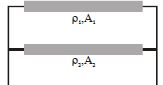
Two conductors of same length are connected in parallel as shown in figure. Their cross-sectional areas $A_1$ and $A_2$ and their resistivities are ${\rho _1}$ and ${\rho _2}$ respectively. The equivalent resistivity of this combination is
- A
$\frac{{{\rho _1}{\rho _2}\left( {{A_1} - {A_2}} \right)}}{{{A_1}{\rho _2} + {A_2}{\rho _1}}}$
- B
$\frac{{{\rho _1}{\rho _2}\left( {{A_1} + {A_2}} \right)}}{{{A_1}{\rho _1} + {A_2}{\rho _2}}}$
- C
$\frac{{{\rho _1}{\rho _2}\left( {{A_1} - {A_2}} \right)}}{{{A_1}{\rho _1} + {A_2}{\rho _2}}}$
- ✓
$\frac{{{\rho _1}{\rho _2}\left( {{A_1} + {A_2}} \right)}}{{{A_1}{\rho _2} + {A_2}{\rho _1}}}$
AnswerCorrect option: D. $\frac{{{\rho _1}{\rho _2}\left( {{A_1} + {A_2}} \right)}}{{{A_1}{\rho _2} + {A_2}{\rho _1}}}$
d
$\frac{1}{\mathrm{R}_{\mathrm{p}}}=\frac{1}{\mathrm{R}_{1}}+\frac{1}{\mathrm{R}_{2}}$
$\frac{\mathrm{A}_{1}+\mathrm{A}_{2}}{\rho_{\mathrm{eq}} \ell}=\frac{\mathrm{A}_{1}}{\rho_{1} \ell}+\frac{\mathrm{A}_{2}}{\rho_{2} \ell}$
$\rho_{\mathrm{eq}}=\frac{\rho_{1} \rho_{2}\left(\mathrm{A}_{1}+\mathrm{A}_{2}\right)}{\rho_{2} \mathrm{A}_{1}+\rho_{1} \mathrm{A}_{2}}$
View full question & answer→MCQ 1221 Mark
Two wires $A$ and $B$ made of same material and having their lengths in the ratio $6 : 1$ are connected in series. The potential difference across the wires are $3\,V$ and $2\,V$ respectively. If $r_A$ and $r_B$ are the radii of $A$ and $B$ respectively, then $\frac{{{r_B}}}{{{r_A}}}$ is
- A
$\frac{1}{4}$
- ✓
$\frac{1}{2}$
- C
$1$
- D
$2$
AnswerCorrect option: B. $\frac{1}{2}$
b
$\therefore \quad V \propto R$
$\frac{V_{A}}{V_{B}}=\frac{R_{A}}{R_{B}}=\frac{\ell_{A} / r_{A}^{2}}{\ell_{B} / r_{B}^{2}}$
$\Rightarrow \frac{\mathrm{r}_{\mathrm{B}}}{\mathrm{r}_{\mathrm{A}}}=\sqrt{\frac{\mathrm{V}_{\mathrm{A}} \ell_{\mathrm{B}}}{\mathrm{V}_{\mathrm{B}} \ell_{\mathrm{A}}}}=\frac{1}{2}$
View full question & answer→MCQ 1231 Mark
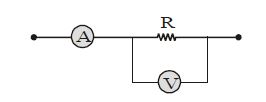
In the circuit shown the readings of ammeter and voltmeter are $4\,\, A$ and $20\,\, V$ respectively. The meters are non ideal, then $R$ is
- A
$ 5\,\, \Omega $
- B
less than $ 5\,\, \Omega $
- ✓
greater than $ 5\,\, \Omega $
- D
between $ 4\,\, \Omega $ and $ 5\,\, \Omega $
AnswerCorrect option: C. greater than $ 5\,\, \Omega $
c
Measured value of $R\, = \,\frac{V}{I} = \frac{{20}}{4}\, = 5\,\Omega $ But current in $R$ will actually be less than $I,$ so $R$ should be greater than $5\,\Omega $
View full question & answer→MCQ 1241 Mark
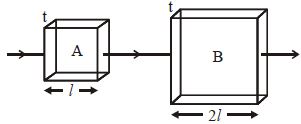
Two square metal plates $A$ and $B$ are of the same thickness and material. The side of $B$ is twice that of $A$. These are connected as shown in series. If the resistances of $A$ and $B$ are denoted by $R_A$ and $R_B,$ then $(R_A/R_B)$ is
- A
$\frac {1}{2}$
- B
$\frac {2}{1}$
- ✓
$\frac {1}{1}$
- D
$\frac {4}{1}$
AnswerCorrect option: C. $\frac {1}{1}$
c
$R_{A}=\rho \frac{\ell}{A}=\rho \frac{\ell}{\ell \times t} \quad R_{B}=\rho \frac{2 \ell}{2 \ell \times t}=\rho \frac{\ell}{\ell t}$
$\Rightarrow \mathrm{R}_{\mathrm{A}}=\mathrm{R}_{\mathrm{B}}$
View full question & answer→MCQ 1251 Mark
Which among the following is true
- A
An alloy of very low resistivity is used to verify ohm's law
- B
$\vec E = \rho \vec J$ is the statement of ohm's law ($E \to $ electric field, $J \to $ current density)
- C
$V = IR$ can be applied to all material ($V$ is $P.d.$ across material $R$ is resistance and $I$ is current through material)
- ✓
View full question & answer→MCQ 1261 Mark
Temperature coefficient at $0\,^oC$ is $0.00125\,^oC^{-1}$. At a temperature of $25\,^oC$ its resistance is $1\,\Omega $. Find the temperature at which resistance is $1.2\,\Omega $
- A
$1225\, K$
- ✓
$190\,^oC$
- C
$260\,^oC$
- D
$185\, K$
AnswerCorrect option: B. $190\,^oC$
View full question & answer→MCQ 1271 Mark
The temperature coefficient of resistance of tungsten is $4.5 \times 10^{-3}{ }^{\circ} C ^{-1}$ and that of germanium is $-5 \times 10^{-2}{ }^{\circ} C ^{-1}$. A tungsten wire of resistance $100 \,\Omega$ is connected in series with a germanium wire of resistance $R$. The value of $R$ for which the resistance of combination does not change with temperature is .......... $\Omega$
- ✓
$9$
- B
$1111$
- C
$0.9$
- D
$111.1$
Answera
(a)
$R_1 \alpha_1+R_2 \alpha_2=0$
$(100)\left(4.5 \times 10^{-3}\right)=R\left(5 \times 10^{-2}\right)$
$0.9 \times 10=R$
$R=9 r$
View full question & answer→MCQ 1281 Mark
A carbon resistor has colour strips as violet, yellow brown and golden. The resistance is .............. $\Omega$
Answerb
Using standard colour codes
Violet $= 7$, yellow $= 4$, brown $= 1$ and gold $= 5\,\ %$ (tolerance)
So $R = 74 \times {10^1} \,\pm 5\% $ $ = 740\, \pm 5\% $
So its value will be nearest to $741\,\Omega $.
View full question & answer→MCQ 1291 Mark
An ideal gas mixture filled inside a balloon expands according to the relation $PV^{2/3} =$ constant. The temperature inside the balloon is
Answera
$\mathrm{PV}^{2 / 3}=\mathrm{const}$
$\Rightarrow \frac{n R T}{V} v^{2 /3}=$ const.
$\Rightarrow T V^{-1 / 3}=$ const.
$\Rightarrow T=$ conts. $\times V^{1 / 3}$
$\therefore$ On increasing volume, temperature increase
View full question & answer→MCQ 1301 Mark
Give colors of the ring in sequence marked on a resistance of $56 \ k\Omega$ with tolerance $\pm 5\%$
- ✓
Green, Blue, Orange, Golden
- B
Blue, Green, Orange, Golden
- C
Orange, Blue, Green, Silver
- D
Red, Yellow, Orange, Silver
AnswerCorrect option: A. Green, Blue, Orange, Golden
a
For normal incidence path difference between ray $1$ and ray $2$ is $2 \mu_{1}$ t
For minimum thickness increment $2 \mu_{1} \Delta \mathrm{t}=\frac{\lambda}{2}$
$\Rightarrow\left(t_{2}-t_{1}\right)=\frac{\lambda}{4 \mu_{1}}=\frac{9.6 \times 10^{-7}}{4 \times 1.2}=2 \times 10^{-7} \mathrm{\,m}$
$56 \mathrm{\,k} \Omega \pm 5 \%=56 \times 10^{3}\, \Omega \pm 5 \%$
Sequence : Green, Blue, Orange, Golden
View full question & answer→MCQ 1311 Mark
Carbon resistor has resistance specified by three bands having colour red, yellow and black. If this resistor is cut into two pieces of equal length then the new colour code of each one will be (Neglect tolerance of $4^{th}$ band)
Answera
$\mathrm{R}_{\mathrm{L}}=24 \times 10^{\circ}\, \Omega$
$\mathrm{R}_{\mathrm{f}}=\frac{\mathrm{R}_{\mathrm{i}}}{2}=12 \times 10^{\circ}\, \Omega$
View full question & answer→MCQ 1321 Mark
Carbon resistor has resistance specified by three bands having colours red, yellow and black. If the resistor is remolded to make a resistor twice of previous length, the new colour code will be
Answera
$\mathrm{R}_{i}=24 \times 10^{0}=24\, \Omega$
After molding $\mathrm{R}_{f}=4 \mathrm{R}_{i}=96\, \Omega$
View full question & answer→MCQ 1331 Mark
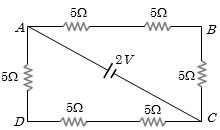
The potential difference between points $A$ and $B$ of adjoining figure is
- A
$\frac{2}{3}\,V$
- B
$\frac{8}{9}\,V$
- ✓
$\frac{4}{3}\,V$
- D
$2\,V$
AnswerCorrect option: C. $\frac{4}{3}\,V$
c
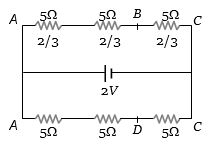
The given circuit can be redrawn as follows
For identical resistances, potential difference distributes equally among all. Hence potential difference across each resistance is $\frac{2}{3}\,V,$ and potential difference between $A$ and $B$ is $\frac{4}{3}\,V.$
View full question & answer→MCQ 1341 Mark
A wire of resistance $R$ is divided in $10$ equal parts. These parts are connected in parallel, the equivalent resistance of such connection will be
- ✓
$0.01\, R$
- B
$0.1\, R$
- C
$10\, R$
- D
$100\, R$
AnswerCorrect option: A. $0.01\, R$
a
(a) Each part will have a resistance $r = R/10$
Let equivalent resistance be ${r_{R,}}$
then $\frac{1}{{{r_R}}} = \frac{1}{r} + \frac{1}{r} + \frac{1}{r}$ ........... $10\;{\rm{times}}$
$\therefore \frac{1}{{{r_R}}} = \frac{{10}}{r} = \frac{{10}}{{R/10}} = \frac{{100}}{R} \Rightarrow {r_R} = \frac{R}{{100}} = 0.01\,R$
View full question & answer→MCQ 1351 Mark
Three resistances of one ohm each are connected in parallel. Such connection is again connected with $\frac{2}{3}\,\Omega $ resistor in series. The resultant resistance will be ........... $\Omega$
- A
$\frac{5}{3}$
- B
$1.5$
- ✓
$1$
- D
$\frac{2}{3}$
Answerc
(c) Resistance of $1\, ohm$ group $ = \frac{R}{n} = \frac{1}{3}\,\Omega $
This is in series with $\frac{2}{3}\,\Omega $ resistor.
$\therefore $Total resistance $ = \frac{2}{3} + \frac{1}{3} = \frac{3}{3}\,\Omega = 1\,\Omega $
View full question & answer→MCQ 1361 Mark
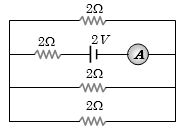
The reading of the ammeter as per figure shown is
- A
$\frac{1}{8}\,A$
- ✓
$\frac{3}{4}\,A$
- C
$\frac{1}{2}\,A$
- D
$2\, A$
AnswerCorrect option: B. $\frac{3}{4}\,A$
b
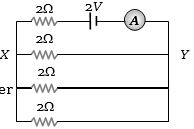
Resistance across $XY$ $ = \frac{2}{3}\,\Omega $
Total resistance
$ = 2 + \frac{2}{3} = \frac{8}{3}\,\Omega $
Current through ammeter
$ = \frac{2}{{8/3}} = \frac{6}{8} = \frac{3}{4}\,A$
View full question & answer→MCQ 1371 Mark
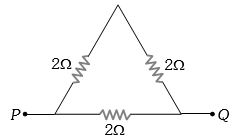
Three resistors each of $2\, ohm$ are connected together in a triangular shape. The resistance between any two vertices will be
- ✓
$4/3\, ohm$
- B
$3/4\, ohm$
- C
$3\, ohm$
- D
$6\, ohm$
AnswerCorrect option: A. $4/3\, ohm$
a
Equivalent resistance of the combination
$ = \frac{{(2 + 2) \times 2}}{{2 + 2 + 2}} = \frac{8}{6} = \frac{4}{3}\, \Omega $
View full question & answer→MCQ 1381 Mark
There are $n$ similar conductors each of resistance $R$. The resultant resistance comes out to be $x$ when connected in parallel. If they are connected in series, the resistance comes out to be
- A
$x/{n^2}$
- ✓
${n^2}x$
- C
$x/n$
- D
$nx$
AnswerCorrect option: B. ${n^2}x$
b
(b)In parallel, $x = \frac{R}{n}$ $R = nx$
In series, $R + R + R$ .... $n$ times $=$ $nR = n (nx) = n^2x$
View full question & answer→MCQ 1391 Mark
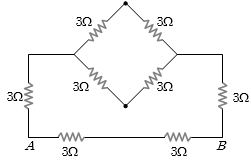
Equivalent resistance between $A$ and $B$ will be ............ $ohm$
Answerd
The circuit reduces to
${R_{AB}} = \frac{{9 \times 6}}{{9 + 6}} = \frac{{9 \times 6}}{{15}} = \frac{{18}}{5} = 3.6\, \Omega $
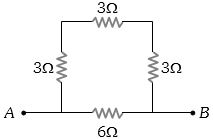
View full question & answer→MCQ 1401 Mark
The effective resistance between the points $A$ and $B$ in the figure is ............. $\Omega$
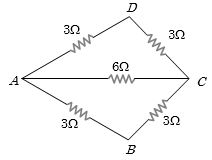
Answerb
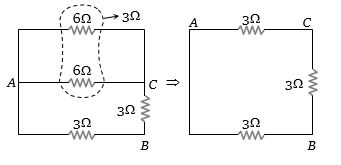
Given circuit is equivalent to
So the equivalent resistance between points $A$ and $B$ is equal to $R = \frac{{6 \times 3}}{{6 + 3}} = 2\, \Omega $
View full question & answer→MCQ 1411 Mark
Two resistances are joined in parallel whose resultant is $\frac{6}{8}\,ohm$. One of the resistance wire is broken and the effective resistance becomes $2\,\Omega $. Then the resistance in ohm of the wire that got broken was
Answerc
If resistances are ${R_1}$ and ${R_2}$ then $\frac{{{R_1}{R_2}}}{{{R_1} + {R_2}}} = \frac{6}{8}$ …..$(i)$
Suppose ${R_2}$ is broken then ${R_1} = 2\, \Omega $ ….. $ (ii)$
On solving equations $(i)$ and $(ii) $ we get ${R_2} = 6/5\,\Omega $
View full question & answer→MCQ 1421 Mark
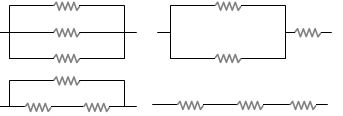
Given three equal resistors, how many different combination of all the three resistors can be made
Answerc
(c)
View full question & answer→MCQ 1431 Mark
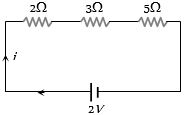
A cell of negligible resistance and $e.m.f.$ $2$ $volts$ is connected to series combination of $2$, $3$ and $5\, ohm$. The potential difference in volts between the terminals of $3\, ohm$ resistance will be
Answera
Current supplied by cell $i = \frac{2}{{2 + 3 + 5}} = \frac{1}{5}\,A$
So potential difference across $3$ will be $V = \frac{{3 \times 1}}{5} = 0.6\,V$
View full question & answer→MCQ 1441 Mark
Two resistors are connected $(a)$ in series $(b)$ in parallel. The equivalent resistance in the two cases are $9$ $ohm$ and $2$ $ohm$ respectively. Then the resistances of the component resistors are
- A
$2$ $ohm$ and $7$ $ohm$
- ✓
$3$ $ohm$ and $6$ $ohm$
- C
$3$ $ohm$ and $9$ $ohm$
- D
$5$ $ohm$ and $4$ $ohm$
AnswerCorrect option: B. $3$ $ohm$ and $6$ $ohm$
b
(b) ${R_1} + {R_2} = 9$ and $\frac{{{R_1}{R_2}}}{{{R_1} + {R_2}}} = 2$ $ \Rightarrow $ ${R_1}{R_2} = 18$
${R_1} - {R_2} = \sqrt {{{({R_1} + {R_2})}^2} - 4{R_1}{R_2}} = \sqrt {81 - 72} = 3$
${R_1} = 6\,\Omega ,\,{R_2} = 3\,\Omega $
View full question & answer→MCQ 1451 Mark
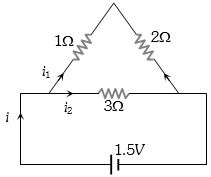
Resistors of $1$, $2$, $ohm$ are connected in the form of a triangle. If a $1.5\, volt$ cell of negligible internal resistance is connected across $3\, ohm$ resistor, the current flowing through this resistance will be ................ $amp$
Answerb
${i_1} + {i_2} = \frac{{1.5}}{{3/2}} = 1\,amp$
$\frac{{{i_1}}}{{{i_2}}} = \frac{3}{3}$ $ \Rightarrow $ ${i_1} = {i_2}$
${i_2} = 0.5\,A = {i_1}$
View full question & answer→MCQ 1461 Mark
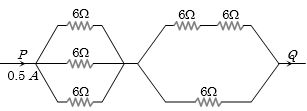
Resistances of $6\, ohm$ each are connected in the manner shown in adjoining figure. With the current $0.5\,ampere$ as shown in figure, the potential difference ${V_P} - {V_Q}$ is .............. $V$
Answerc
${V_p} - {V_q} = \left( {\frac{6}{3} + \frac{{12 \times 6}}{{12 + 6}}} \right)\,(0.5) = (2 + 4)\,(0.5) = 3\,V$
View full question & answer→MCQ 1471 Mark
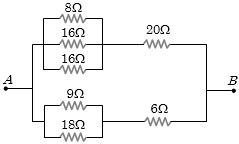
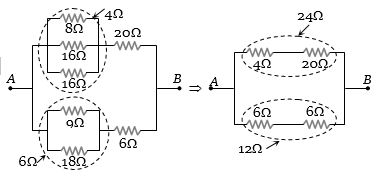
The equivalent resistance of the arrangement of resistances shown in adjoining figure between the points $A$ and $B$ is ............... $ohm$
Answerb
(b) ${R_{AB}} = \frac{{24 \times 12}}{{(24 + 12)}} = 8\,\Omega $
View full question & answer→MCQ 1481 Mark
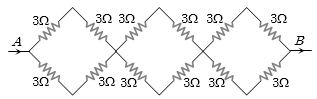
In the network of resistors shown in the adjoining figure, the equivalent resistance between $A$ and $B$ is ............ $ohm$
Answerd
The network can be redrawn as follows
$ \Rightarrow $ ${R_{eq}} = 9\,\Omega $

View full question & answer→MCQ 1491 Mark
A wire is broken in four equal parts. A packet is formed by keeping the four wires together. The resistance of the packet in comparison to the resistance of the wire will be
AnswerCorrect option: D. $\frac{1}{{16}}th$
d
Let the resistance of the wire be $R$, then we know that resistance is proportional to the length of the wire. So each of the four wires will have $R/4$ resistance and they are connected in parallel. So the effective resistance will be
$\frac{1}{{{R_1}}} = \left( {\frac{4}{R}} \right)4 \Rightarrow {R_1} = \frac{R}{{16}}$
View full question & answer→MCQ 1501 Mark
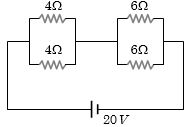
Four resistances are connected in a circuit in the given figure. The electric current flowing through $4\, ohm$ and $6\, ohm$ resistance is respectively
- A
$2\, amp$ and $4\, amp$
- B
$1\, amp$ and $2\, amp$
- C
$1\, amp$ and $1\, amp$
- ✓
$2\, amp$ and $2\, amp$
AnswerCorrect option: D. $2\, amp$ and $2\, amp$
d
Equivalent resistance $ = \frac{{4 \times 4}}{{4 + 4}} + \frac{{6 \times 6}}{{6 + 6}} = 5\,ohm$
So the current in the circuit $ = \frac{{20}}{5} = 4\,ampere$
Hence the current flowing through each resistance $= 2\,ampere$.
View full question & answer→


