MCQ 11 Mark
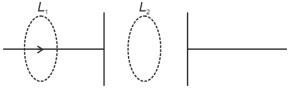
A parallel plate capacitor is charged by connecting it to a battery through a resistor. If $l$ is the current in the circuit, then in the gap between the plates:
AnswerCorrect option: A. Displacement current of magnitude equal to / flows in the same direction as /
a
According to modified Ampere's law
$\oint B \cdot d l=\mu_0\left(I_C+I_D\right)$
$\text { For Loop } L_1 \quad I_C \neq 0 \text { and } I_D=0$
$\text { For Loop } L_2 \quad I_C=0 \text { and } I_D \neq 0$
$\text { Due to KCL } \quad I_C=I_D$
View full question & answer→MCQ 21 Mark
The property which is not of an electromagnetic wave travelling in free space is that:
AnswerCorrect option: C. They originate from charges moving with uniform speed
c
The $EM$ waves originate from an accelerating charge. The charge moving with uniform velocity produces steady state magnetic field.
View full question & answer→MCQ 31 Mark
An ac source is connected to a capacitor $C$. Due to decrease in its operating frequency :
- A
capacitive reactance remains constant.
- B
capacitive reactance decreases.
- C
displacement current increases.
- ✓
displacement current decreases.
AnswerCorrect option: D. displacement current decreases.
d
$i _{ C }= i _{ D }=\frac{ V _{ O }}{ X _{ C }} \sin \omega t$
$i _{ C }= i _{ D }=\left( V _{ O } \omega C \right) \sin \omega t$
On decreasing frequency $i_C \downarrow$
View full question & answer→MCQ 41 Mark
In a plane electromagnetic wave travelling in free space, the electric field component oscillates sinusoidally at a frequency of $2.0 \times 10^{10}\,Hz$ and amplitude $48\,Vm ^{-1}$. Then the amplitude of oscillating magnetic field is : (Speed of light in free space $=3 \times 10^8\,m s ^{-1}$)
- A
$1.6 \times 10^{-6}\,T$
- B
$1.6 \times 10^{-9}\,T$
- C
$1.6 \times 10^{-8}\,T$
- ✓
$1.6 \times 10^{-7}\,T$
AnswerCorrect option: D. $1.6 \times 10^{-7}\,T$
d
$C =\frac{ E _0}{ B _0}$
$B _0=\frac{ E _0}{ C }$
$=\frac{48}{3 \times 10^8}$
$=1.6 \times 10^{-7}\,T$
View full question & answer→MCQ 51 Mark
The magnetic field of a plane electromagnetic wave is given by $\overrightarrow{ B }=3 \times 10^{-8} \cos \left(1.6 \times 10^3 x +48 \times 10^{10} t \right) \hat{ j }$, then the associated electric field will be :
- A
$3 \times 10^{-8} \cos \left(1.6 \times 10^3 x +48 \times 10^{10} t \right) \hat{ i }\,V / m$
- B
$3 \times 10^{-8} \sin \left(1.6 \times 10^3 x +48 \times 10^{10} t \right) \hat{ i }\,V / m$
- C
$9 \sin \left(1.6 \times 10^3 x -48 \times 10^{10} t \right) \hat{ k}\,V / m$
- ✓
$9 \cos \left(1.6 \times 10^3 x +48 \times 10^{10} t \right) \hat{ k }\, V / m$
AnswerCorrect option: D. $9 \cos \left(1.6 \times 10^3 x +48 \times 10^{10} t \right) \hat{ k }\, V / m$
d
$B=3 \times 10^{-8} \cos \left(1.6 \times 10^3 x +48 \times 10^{10} t \right)$ $C=\frac{\omega}{ k }=\frac{48 \times 10^{10}}{1.6 \times 10^3}=3 \times 10^8\,m / s$ $C=E_0 / B_0$
$E=3 \times 10^{-8} \times 3 \times 10^8=9\,N / C$
$\therefore E=9 \cos \left(1.6 \times 10^3 x +48 \times 10^{10} t \right)$
View full question & answer→MCQ 61 Mark
The ratio of the magnitude of the magnetic field and electric field intensity of a plane electromagnetic wave in free space of permeability $\mu_0$ and permittivity $\varepsilon_0$ is (Given that $c$ - velocity of light in free space)
AnswerCorrect option: B. $\frac{1}{c}$
b
$\frac{ B _0}{ E _0}=\frac{1}{ c }=\sqrt{\mu_0 \varepsilon_0}$
View full question & answer→MCQ 71 Mark
Match List $- I$ with List $- II:$
| List$-1$ (Electromagnetic waves) |
List$-2$ (Wavelength) |
| $(a)$ $AM$ radio waves |
$(i)$ $10^{-10}\,m$ |
| $(b)$ Microwaves |
$(ii)$ $10^{2}\,m$ |
| $(c)$ Infrared radiations |
$(iii)$ $10^{-2}\,m$ |
| $(d)$ $X-$rays |
$(iv)$ $10^{-4}\,m$ |
Choose the correct answer from the options given below:
- A
$(a) - (iii), (b) - (ii), (c) - (i), (d) - (iv)$
- B
$(a) - (iii), (b) - (iv), (c) - (ii), (d) - (i)$
- ✓
$(a) - (ii), (b) - (iii), (c) - (iv), (d) - (i)$
- D
$(a) - (iv), (b) - (iii), (c) - (ii), (d)-(i)$
AnswerCorrect option: C. $(a) - (ii), (b) - (iii), (c) - (iv), (d) - (i)$
c
$(a)$ Radio wave (ii) $\approx 10^{2} m$ (ii)
$(b)$ Microwave $\approx$ (iii) $10^{-2} m$ (iii)
$(c)$ Infrared radiations $\approx$ (iv) $10^{-4} m$ (iv)
$(d)$ $X-\operatorname{ray}( i ) \approx \mathring A \mathring A=10^{-10} m$ (i)
$(a) - (ii), (b) - (iii), (c) - (iv), (d) - (i)$
View full question & answer→MCQ 81 Mark
For a plane electromagnetic wave propagating in $x$-direction, which one of the following combination gives the correct possible directions for electric field $(E)$ and magnetic field $(B)$ respectively?
- A
$\hat{j}+\hat{k}, \hat{j}+\hat{k}$
- ✓
$-\hat{j}+\hat{k},-\hat{j}-\hat{k}$
- C
$\hat{j}+\hat{k},-\hat{j}-\hat{k}$
- D
$-\hat{j}+\hat{k},-\hat{j}+\hat{k}$
AnswerCorrect option: B. $-\hat{j}+\hat{k},-\hat{j}-\hat{k}$
b
Wave in $x$ direction
$C=\vec{E} \times \vec{B}$
$(-\hat{j}+\hat{k}) \times(-\hat{j}-\hat{k})$
$=\hat{i}+\hat{i}$
$=2 \hat{i}$
View full question & answer→MCQ 91 Mark
A capacitor of capacitance $C,$ is connected across an ac source of voltage $\mathrm{V}$, given by
$\mathrm{V}=\mathrm{V}_{0} \sin \omega \mathrm{t}$
The displacement current between the plates of the capacitor, would then be given by :
- ✓
$ {I}_{ {d}}={V}_{0} \omega {Ccos} \omega {t}$
- B
$I_{d}=\frac{V_{0}}{\omega C} \cos \omega t$
- C
$I_{d}=\frac{V_{0}}{\omega C} \sin \omega t$
- D
$I_{d}=V_{0} \omega C \sin \omega t$
AnswerCorrect option: A. $ {I}_{ {d}}={V}_{0} \omega {Ccos} \omega {t}$
a
$\mathrm{q}=\mathrm{CV}$
$\frac{\mathrm{dq}}{\mathrm{dt}}=\frac{\mathrm{CdV}}{\mathrm{dt}}$
$\mathrm{I}_{\mathrm{d}}=\mathrm{C}\left(\mathrm{V}_{0} \omega \mathrm{cos} \omega \mathrm{t}\right)$
$=\mathrm{V}_{0} \omega \mathrm{C} \cos \omega \mathrm{t}$
View full question & answer→MCQ 101 Mark
Light with an average flux of $20\, W / cm ^{2}$ falls on a non-reflecting surface at normal incidence having surface area $20\, cm ^{2} .$ The energy recelved by the surface during time span of $1$ minute is $............J$
- A
$48 \times 10^{3}$
- B
$10 \times 10^{3}$
- C
$12 \times 10^{3}$
- ✓
$24 \times 10^{3}$
AnswerCorrect option: D. $24 \times 10^{3}$
d
$I =\frac{ E }{ At }$
$E = IAt$
$=\frac{20}{10^{-4}} \times 20 \times 10^{-4} \times 60$
$=24 \times 10^{3}\, J$
View full question & answer→MCQ 111 Mark
The magnetic field in a plane electromagnetic wave is given by, $B_{y}=2 \times 10^{-7} \sin \left(\pi \times 10^{3} x+3 \pi \times 10^{11} t\right) \;T$ Calculate the wavelength.
- A
$\pi \times 10^{-3} \;m$
- B
$\pi \times 10^{3} \;m$
- ✓
$2 \times 10^{-3} \;m$
- D
$2 \times 10^{3} \;m$
AnswerCorrect option: C. $2 \times 10^{-3} \;m$
c
$B_{y}=2 \times 10^{-7} \sin \left(\pi \times 10^{3} x+3 \pi \times 10^{11} t \right) T$
General equation of magnetic field vector
$B = B _{0} \sin ( k x+\omega t ) T$
$k=\pi \times 10^{3}$
$\frac{2 \pi}{\lambda}=\pi \times 10^{3}$
$\lambda=2 \times 10^{-3} m$
View full question & answer→MCQ 121 Mark
The ratio of contributions made by the electric field and magnetic fleld components to the intensity of an electromagnetic wave is :
$(c=$ speed of electromagnetic waves)
- A
$1: c ^{2}$
- B
$c: 1$
- ✓
$1: 1$
- D
$1: c$
AnswerCorrect option: C. $1: 1$
c
In $EMW,$ electric field and magnetic field have same energy density and same intensities.
View full question & answer→MCQ 131 Mark
The E.M. wave with shortest wavelength among the following is,
Answerd
Gamma rays have wavelength about less than $10^{-10} m$ to $10^{-14} m$ which is shortest wavelength among all options.
View full question & answer→MCQ 141 Mark
A parallel plate capacitor of capacitance $20\; \mu \mathrm{F}$ is being charged by a voltage source whose potential is changing at therate of $3 \;\mathrm{V} / \mathrm{s}$. The conduction current through the connecting wires, and the displacement current through the plates of the capacitor, would be, respectively
- A
$0\; \mu \mathrm{A}, 60 \;\mu \mathrm{A}$
- ✓
$60\; \mu \mathrm{A}, 60\; \mu \mathrm{A}$
- C
$60\; \mu \mathrm{A}, 0\; \mu \mathrm{A}$
- D
$0\; \mu \mathrm{A}, 0\; \mu \mathrm{A}$
AnswerCorrect option: B. $60\; \mu \mathrm{A}, 60\; \mu \mathrm{A}$
b
$\mathrm{v}=\frac{\mathrm{Q}}{\mathrm{C}}$
$\mathrm{Q}=\mathrm{CV}$
$\therefore \mathrm{i}=\mathrm{C} \frac{\mathrm{dV}}{\mathrm{dt}}=20 \mu \mathrm{F} \times 3 \mathrm{V} / \mathrm{s}=60\; \mu \mathrm{A}$
Also, conduction current in wires is equal to displacement current between the plates of capacitor.
View full question & answer→MCQ 151 Mark
For a transparent medium relative permeablity and permittlivity, $\mu_{\mathrm{r}}$ and $\in_{\mathrm{r}}$ are $1.0$ and $1.44$ respectively. The velocity of light in this medium would be,
- ✓
$2.5 \times 10^{8} \;\mathrm{m} / \mathrm{s}$
- B
$3 \times 10^{8} \;\mathrm{m} / \mathrm{s}$
- C
$2.08 \times 10^{8} \;\mathrm{m} / \mathrm{s}$
- D
$4.32 \times 10^{8} \;\mathrm{m} / \mathrm{s}$
AnswerCorrect option: A. $2.5 \times 10^{8} \;\mathrm{m} / \mathrm{s}$
a
$v=\frac{1}{\sqrt{\mu} \in}=\frac{1}{\sqrt{\mu_{\mathrm{r}} \in_{\mathrm{r}} \mu_{0} \in_{0}}}$$=\frac{3 \times 10^{8}}{\sqrt{1.44}}=\frac{30}{12} \times 10^{8}$$=2.5 \times 10^{8} \;\mathrm{ms}^{-1}$
View full question & answer→MCQ 161 Mark
Which colour of the light has the longest wavelength ?
Answera
Longest wavelength is of red colour.
View full question & answer→MCQ 171 Mark
An em wave is propagating in a medium with a velocity $\vec v =v\hat i.$ The instantaneous oscillating electric field of this em wave is along $+y$ axis. Then the direction of oscillating magnetic field of the em wave will be along
- A
$- z$ direction
- ✓
$+ z $ direction
- C
$- x$ direction
- D
$- y$ direction
AnswerCorrect option: B. $+ z $ direction
b
Velocity of em wave in a medium is given by $\vec{v}=\vec{E} \times \vec{B}$
$\therefore \quad v \hat{i}=(E \hat{j}) \times(\vec{B})$
$[\because \vec{E}=E \hat{j}(\text { Given })]$
As $\hat{i}=\hat{j} \times \hat{k}$ so $\vec{B}=B \hat{k}$
Direction of oscillating magnetic field of the em wave will be along $+z$ direction.
View full question & answer→MCQ 181 Mark
In an electromagnetic wave in free space the root mean square value of the electric field is $E_{rms} = 6\, V m^{-1}$ The peak value of the magnetic field is
- A
$2.83 \times 10^{-9}\;T$
- B
$4.83 \times 10^{-8}\;T$
- C
$8.83 \times 10^{-8}\;T$
- ✓
$2.83 \times 10^{-8}\;T$
AnswerCorrect option: D. $2.83 \times 10^{-8}\;T$
d
$\text { Given: } E_{\mathrm{rms}}=6 \,\mathrm{Vm}^{-1}$
$\frac{E_{\mathrm{rms}}}{B_{\mathrm{rms}}}=c$ or $B_{\mathrm{rms}}=\frac{E_{\mathrm{rms}}}{c}$
$B_{\mathrm{rms}}=\frac{6}{3 \times 10^{8}}=2 \times 10^{-8}\, \mathrm{T}$
since, $B_{\mathrm{rms}}=\frac{B_{0}}{\sqrt{2}}$
where $B_{0}$ is the peak value of magnetic field
$\therefore B_{0} =B_{\mathrm{rms}} \sqrt{2}=2 \times 10^{-8} \times \sqrt{2} T $
$ B_{0} \approx 2.83 \times 10^{-8}\, \mathrm{T}$
View full question & answer→MCQ 191 Mark
A $100 \,\,\Omega$ resistance and a capacitor of $100 \,\,\Omega$ reactance are connected in series across a $220\,\ V$ source. When the capacitor is $50\%$ charged, the peak value of the displacement current is.....$A$
- A
$4.4 $
- B
$11$$\sqrt 2 $
- ✓
$2.2 $
- D
$11$
AnswerCorrect option: C. $2.2 $
c
$\text { Here, } R=100\, \Omega, X_{e}=100 \,\Omega$
Net impedance, $Z=\sqrt{R^{2}+X_{L}^{2}}=100 \sqrt{2}\, \Omega$
Peak value of displacement current
$=$ Maximum conduction current in the circuit
$=\frac{\varepsilon_{0}}{Z}=\frac{220 \sqrt{2}}{100 \sqrt{2}}=2.2 \,\mathrm{A}$
View full question & answer→MCQ 201 Mark
Out of the following options which one can be used to produce a propagating electromagnetic wave?
- A
- B
- ✓
- D
A charge moving at constant velocity
Answerc
An accelerating charge is used to produce oscillating electric and magnetic fields, hence the electromagnetic wave.
View full question & answer→MCQ 211 Mark
A parallel plate capacitor of plate separation $2\, mm$ is connected in an electric circuit having source voltage $400\, V$. if the plate area is $60$ $cm^2$, then the value of displacement current for ${10^{ - 6}}\,\sec $ will be
- A
$1.062\, amp$
- ✓
$1.062 \times {10^{ - 2}}$$amp$
- C
$1.062 \times {10^{ - 3}}$$amp$
- D
$1.062 \times {10^{ - 4}}$$amp$
AnswerCorrect option: B. $1.062 \times {10^{ - 2}}$$amp$
b
(b)${I_D} = {\varepsilon _0}\frac{{d{\varphi _E}}}{{dt}} = {\varepsilon _0}\frac{{EA}}{t} = {\varepsilon _0}\left( {\frac{V}{d}} \right).\frac{A}{t}.$
$ = \frac{{8.85 \times {{10}^{ - 12}} \times 400 \times 60 \times {{10}^{ - 4}}}}{{{{10}^{ - 3}} \times {{10}^{ - 6}}}} = 1.602 \times {10^{ - 2}}amp$
View full question & answer→MCQ 221 Mark
A parallel plate capacitor with plate are $A$ and seperation between the plates $d$, is charged by a constant current $i$, consider a plane surface of area $A/2$ parallel to the plates and drawn symmetrically between the plates, the displacement current through this area, will be.
- A
$i$
- ✓
$\frac{i}{2}$
- C
$\frac{i}{4}$
- D
AnswerCorrect option: B. $\frac{i}{2}$
b
(b) Suppose the charge on the capacitor at time $t$ is $Q$, the electric field between the plates of the capacitor is $E = \frac{Q}{{{\varepsilon _0}A}}.$ The flux through the area considered is ${\phi _E} = \frac{Q}{{{\varepsilon _0}A}}.\frac{A}{2} = \frac{Q}{{2{\varepsilon _0}}}$
$\therefore$ The displacement current
${i_d} = {\varepsilon _0}\frac{{d{\phi _E}}}{{dt}} = {\varepsilon _0}\left( {\frac{1}{{2{\varepsilon _0}}}} \right)\frac{{dQ}}{{dt}} = \frac{i}{2}.$
View full question & answer→MCQ 231 Mark
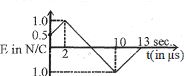
The electric filed through an area of $2\ m^2$ varies with time as shown in the graph. The greatest displacement current through the area is at.....$t=.....sec$
Answerd
${\rm{i}} = { \in _0}{\rm{A}}\frac{{{\rm{dE}}}}{{{\rm{dt}}}}$
View full question & answer→MCQ 241 Mark
The potential difference between the plates of a parallel plate capacitor is changing at the rate of $10^6\, V/s$. If the capacitance is $2\,\mu F$, the displacement current in the dielectric of the capacitor will be......$A$
Answerb
$i_{d}=i_{c}=\frac{d q}{d t}=\frac{d}{d t}(C V)$
$=\mathrm{C} \frac{\mathrm{dv}}{\mathrm{dt}}$
$=2 \times 10^{-6} \times 10^{6}$
$=2 \mathrm{\,A}$
View full question & answer→MCQ 251 Mark
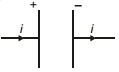
A parallel plate capacitor with circular plates of radius $R$ is being charged as shown. At the instant shown, the displacement current in the region between the plates enclosed between $\frac{R}{2}$ and $R$ is given by
- ✓
$\frac{3}{4} i$
- B
$\frac{1}{4} i$
- C
$3 i$
- D
$\frac{4}{3} i$
AnswerCorrect option: A. $\frac{3}{4} i$
a
(a)
$I_d=\varepsilon_0 A \frac{d E}{d t}=\varepsilon_0\left(\pi R^2\right) \frac{d E}{d t}=i$
$I_d^{\prime}=\varepsilon_0\left(\pi R^2-\frac{\pi R^2}{4}\right) \frac{d E}{d t}$
$=\frac{3}{4} \varepsilon_0 \pi R^2 \frac{d E}{d t}$
$I_d=\frac{3}{4} i$
View full question & answer→MCQ 261 Mark
To establish an instantaneous displacement current of $I$ ampere in the space between the plates of a parallel plate capacitor of $\frac{1}{2}$ farad, the value of $\frac{d V}{d t}$ is .......
- ✓
$2I$
- B
$\frac{I}{2}$
- C
$\frac{1}{2 I}$
- D
$I$
Answera
(a)
$I_d=\frac{A \varepsilon_0}{d} \frac{d E}{d t} \times d$
$I=\frac{1}{2} \frac{d E}{d t} \times d$
$I=\frac{1}{2} \frac{d V}{d t} \times \frac{1}{d} \cdot d$
$\frac{d V}{d t}=2 I$
View full question & answer→MCQ 271 Mark
The kinetic energy possessed by a body of mass $m$ moving with a velocity $ v$ is equal to $\frac{1}{2}m{v^2}$, provided
- A
The body moves with velocities comparable to that of light
- ✓
The body moves with velocities negligible compared to the speed of light
- C
The body moves with velocities greater than that of light
- D
None of the above statement is correcst
AnswerCorrect option: B. The body moves with velocities negligible compared to the speed of light
b
(b)Due to theory of relativity.
View full question & answer→MCQ 281 Mark
In an electromagnetic wave, the electric and magnetising fields are $100\,V\,{m^{ - 1}}$ and $0.265\,A\,{m^{ - 1}}$. The maximum energy flow is.......$W/{m^2}$
- ✓
$26.5$
- B
$36.5$
- C
$46.7$
- D
$765$
AnswerCorrect option: A. $26.5$
a
(a) Here ${E_0} = 100\;V/m,$${B_0} = 0.265\;A/m.$
Maximum rate of energy flow $S =$ ${E_0} \times {B_0}$
= $100 \times .265 = 26.5\frac{W}{{{m^2}}}$
View full question & answer→MCQ 291 Mark
An electromagnetic wave travels along $z-$axis. Which of the following pairs of space and time varying fields would generate such a wave
- ✓
${E_x},\,{B_y}$
- B
${E_y},\,{B_x}$
- C
${E_z},\,{B_x}$
- D
${E_y},\,{B_z}$
AnswerCorrect option: A. ${E_x},\,{B_y}$
a
(a)${E_x}$ and ${B_y}$ would generate a plane EM wave travelling in $z$-direction. $\vec E$, $\vec B$ and $\vec k$ form a right handed system $\vec k$ is along $z$-axis. As $\hat i \times \hat j = \hat k$
==> ${E_x}\hat i \times {B_y}\hat j = C\hat k$ i.e. $E$ is along $x$-axis and $B$ is along $y-$ axis.
View full question & answer→MCQ 301 Mark
An electromagnetic wave, going through vacuum is described by $E = {E_0}\sin (kx - \omega \,t)$. Which of the following is independent of wavelength
- A
$k$
- B
$\omega$
- ✓
$k/ \omega$
- D
$k \omega$
AnswerCorrect option: C. $k/ \omega$
c
(c)The angular wave number $k = \frac{{2\pi }}{\lambda };$ where $ \lambda$ is the wave length. The angular frequency is $w = 2\pi \nu .$
The ratio $\frac{k}{\omega } = \frac{{2\pi /\lambda }}{{2\pi \nu }} = \frac{1}{{\nu \pi }} = \frac{1}{c}$= constant
View full question & answer→MCQ 311 Mark
An electromagnetic wave going through vacuum is described by $E = {E_0}\sin (kx - \omega \,t)$; $B = {B_0}\sin (kx - \omega \,t)$. Which of the following equation is true
- ✓
${E_0}k = {B_0}\omega $
- B
${E_0}\omega = {B_0}k$
- C
${E_0}{B_0} = \omega k$
- D
AnswerCorrect option: A. ${E_0}k = {B_0}\omega $
a
(a) $\frac{{{E_0}}}{{{B_0}}} = C.$ also $k = \frac{{2\pi }}{\lambda }$ and $\omega = 2\pi \nu $
These relation gives ${E_0}K = {B_0}\omega $
View full question & answer→MCQ 321 Mark
A radio receiver antenna that is $2 \,m$ long is oriented along the direction of the electromagnetic wave and receives a signal of intensity $5 \times {10^{ - 16}}W/{m^2}$. The maximum instantaneous potential difference across the two ends of the antenna is
- ✓
$1.23 \mu \,V$
- B
$1.23 \mu V$
- C
$1.23 \,V$
- D
$12.3 \,mV$
AnswerCorrect option: A. $1.23 \mu \,V$
a
(a)$I = \frac{1}{2}{\varepsilon _0}CE_0^2$
==> ${E_0} = \sqrt {\frac{{2I}}{{{\varepsilon _0}C}}} = \sqrt {\frac{{2 \times 5 \times {{10}^{ - 16}}}}{{8.85}}} = 0.61 \times {10^{ - 6}}\frac{V}{m}$
Also ${E_0} = \frac{{{V_0}}}{d}$ ==> ${V_0} = {E_0}d = 0.61 \times {10^{ - 6}} \times 2 = 1.23\mu V$
View full question & answer→MCQ 331 Mark
The pressure exerted by an electromagnetic wave of intensity $I (watts/m^2)$ on a nonreflecting surface is [$c$ is the velocity of light]
- A
$Ic$
- B
$I{c^2}$
- ✓
$I/c$
- D
$I/{c^2}$
Answerc
(c) Momentum of a photon
$=\frac{h}{\lambda}=\frac{h}{c / v}=\frac{h v}{c}=\frac{E}{c}$
Momentum over unit area
$=\frac{E}{A c}=\frac{I}{c}\left[I=\frac{E}{A} \text { for wave }\right]$
since surface is non reflecting, final momentum of photon $= 0,$ change in momentum $=\frac{I}{c}$
So, force per unit area $=\frac{I}{c}$
Pressure of radiation $=\frac{I}{c}$
View full question & answer→MCQ 341 Mark
If $c $ is the speed of electromagnetic waves in vacuum, its speed in a medium of dielectric constant $K$ and relative permeability ${\mu _r}$ is
- A
$v = \frac{1}{{\sqrt {{\mu _r}K} }}$
- B
$v = c\sqrt {{\mu _r}K} $
- ✓
$v = \frac{c}{{\sqrt {{\mu _r}K} }}$
- D
$v = \frac{K}{{\sqrt {{\mu _r}C} }}$
AnswerCorrect option: C. $v = \frac{c}{{\sqrt {{\mu _r}K} }}$
c
(c)Speed of light of vacuum $c = \frac{1}{{\sqrt {{\mu _0}{\varepsilon _0}} }}$ and in another medium $v = \frac{1}{{\sqrt {\mu \varepsilon } }}$
$\frac{c}{v} = \sqrt {\frac{{\mu \varepsilon }}{{{\mu _0}{\varepsilon _0}}}} = \sqrt {{\mu _r}K} $ ==> $v = \frac{c}{{\sqrt {{\mu _r}K} }}$
View full question & answer→MCQ 351 Mark
In an electromagnetic wave, the amplitude of electric field is $1 V/m.$ the frequency of wave is $5 \times {10^{14}}\,Hz$. The wave is propagating along $z-$ axis. The average energy density of electric field, in $Joule/m^3$, will be
- A
$1.1 \times {10^{ - 11}}$
- ✓
$2.2 \times {10^{ - 12}}$
- C
$3.3 \times {10^{ - 13}}$
- D
$4.4 \times {10^{ - 14}}$
AnswerCorrect option: B. $2.2 \times {10^{ - 12}}$
b
(b)Average energy density of electric field is given by
${u_e} = \frac{1}{2}{\varepsilon _0}{E^2} = \frac{1}{2}{\varepsilon _0}{\left( {\frac{{{E_0}}}{{\sqrt 2 }}} \right)^2} = \frac{1}{4}{\varepsilon _0}E_0^2$
$ = \frac{1}{4} \times 8.85 \times {10^{ - 12}}{(1)^2} = 2.2 \times {10^{ - 12}}J/{m^3}.$
View full question & answer→MCQ 361 Mark
A laser beam can be focussed on an area equal to the square of its wavelength A $He-Ne$ laser radiates energy at the rate of $1\,mW$ and its wavelength is $632.8 \,nm$. The intensity of focussed beam will be
- A
$1.5 \times {10^{13}}\,W/{m^2}$
- ✓
$2.5 \times {10^9}\,W/{m^2}$
- C
$3.5 \times {10^{17}}\,W/{m^2}$
- D
AnswerCorrect option: B. $2.5 \times {10^9}\,W/{m^2}$
b
(b) Area through which the energy of beam passes
$ = \,(6.328 \times {10^{ - 7}}) = 4 \times {10^{ - 13}}{m^2}$
$I = \frac{P}{A} = \frac{{{{10}^{ - 3}}}}{{4 \times {{10}^{ - 13}}}} = 2.5 \times {10^9}\,W/{m^2}$
View full question & answer→MCQ 371 Mark
A lamp emits monochromatic green light uniformly in all directions. The lamp is $3%$ efficient in converting electrical power to electromagnetic waves and consumes $100\,W $ of power. The amplitude of the electric field associated with the electromagnetic radiation at a distance of $10m$ from the lamp will be........$V/m$
- ✓
$1.34$
- B
$2.68$
- C
$5.36$
- D
$9.37$
AnswerCorrect option: A. $1.34$
a
(a)${S_{av}} = \frac{1}{2}{\varepsilon _0}cE_0^2 = \frac{P}{{4\pi {R^2}}}$
==> ${E_0} = \sqrt {\frac{P}{{2\pi {R^2}{\varepsilon _0}C}}} $
$ = \sqrt {\frac{3}{{2 \times 3.14 \times 100 \times 8.85 \times {{10}^{ - 12}} \times 3 \times {{10}^8}}}} $
$= 1.34\, V/m$
View full question & answer→MCQ 381 Mark
A point source of electromagnetic radiation has an average power output of $800\, W.$ The maximum value of electric field at a distance $4.0 \,m$ from the source is....$V/m$
- A
$64.7$
- B
$57.8 $
- C
$56.72 $
- ✓
$54.77$
AnswerCorrect option: D. $54.77$
d
(d)Intensity of $EM$ wave is given by
$I = \frac{P}{{4\pi {R^2}}} = {v_{av}}.c = \frac{1}{2}{\varepsilon _0}E_0^2 \times c$
==> ${E_0} = \sqrt {\frac{P}{{2\pi {R^2}{\varepsilon _0}c}}} $
$ = \sqrt {\frac{{800}}{{2 \times 3.14 \times {{(4)}^2} \times 8.85 \times {{10}^{ - 12}} \times 3 \times {{10}^8}}}} $
$= 54.77 \frac{V}{m}$
View full question & answer→MCQ 391 Mark
A wave is propagating in a medium of electric dielectric constant $2$ and relative magnetic permeability $50$. The wave impedance of such a medium is.....$ \Omega$
- A
$5$
- B
$376.6 $
- ✓
$1883 $
- D
$3776$
AnswerCorrect option: C. $1883 $
c
(c)Wave impedance $Z = \sqrt {\frac{{{\mu _r}}}{{{\varepsilon _r}}}} \times \sqrt {\frac{{{\mu _0}}}{{{\varepsilon _0}}}} $
$ = \sqrt {\frac{{50}}{2}} \times 376.6 = 1883\,\Omega $
View full question & answer→MCQ 401 Mark
A plane electromagnetic wave of wave intensity $6\, W/ m^2$ strikes a small mirror area $40 cm^2$, held perpendicular to the approaching wave. The momentum transferred by the wave to the mirror each second will be
- A
$6.4 \times {10^{ - 7}}kg - m/{s^2}$
- B
$4.8 \times {10^{ - 8}}kg - m/{s^2}$
- C
$3.2 \times {10^{ - 9}}kg - m/{s^2}$
- ✓
$1.6 \times {10^{ - 10}}kg - m/{s^2}$
AnswerCorrect option: D. $1.6 \times {10^{ - 10}}kg - m/{s^2}$
d
(d)Momentum transferred in one second
$p = \frac{{2U}}{c} = \frac{{2{S_{av}}A}}{c} = \frac{{2 \times 6 \times 40 \times {{10}^{ - 4}}}}{{3 \times {{10}^8}}}$
$=$$1.6 \times {10^{ - 10}}kg - m/{s^2}$
View full question & answer→MCQ 411 Mark
A plane electromagnetic wave of angular frequency $\omega$ propagates in a poorly conducting medium of conductivity $\sigma$ and relative permittivity $\varepsilon$. Find the ratio of conduction current density and displacement current density in the medium.
- A
$\frac{\varepsilon \varepsilon_0 \omega}{\sigma}$
- ✓
$\frac{\sigma}{\varepsilon \varepsilon_0 \omega}$
- C
$\frac{\omega}{\sigma \varepsilon \varepsilon_0 }$
- D
$\frac{\omega \sigma}{ \varepsilon \varepsilon_0 }$
AnswerCorrect option: B. $\frac{\sigma}{\varepsilon \varepsilon_0 \omega}$
b
$J_{c}=\sigma E_{0} \sin (\omega t-k x)$
${{\text{i}}_{\text{d}}} = \in { \in _0}\frac{{{\text{d}}{\phi _{\text{E}}}}}{{{\text{dt}}}} = \in { \in _0}{\text{A}}\frac{{{\text{dE}}}}{{{\text{dt}}}}$
$ = \in { \in _0} \times {\text{A}}{{\text{E}}_0}\omega \cos (\omega {\text{t}} - kx)$
${\rm{Jd}} = \in { \in _0}{{\rm{E}}_0}\omega $
$\frac{{{{\rm{J}}_{\rm{e}}}}}{{{{\rm{J}}_{\rm{d}}}}} = \frac{\sigma }{{ \in { \in _0}\omega }}$
View full question & answer→MCQ 421 Mark
A mathematical representation of electromagnetic wave is given by the two equations $E = E_{max}\,\, cos (kx -\omega\,t)$ and $B = B_{max} cos\, (kx -\omega\,t),$ where $E_{max}$ is the amplitude of the electric field and $B_{max}$ is the amplitude of the magnetic field. What is the intensity in terms of $E_{max}$ and universal constants $μ_0, \in_0.$
- A
$I=\frac{1}{2}\sqrt {\frac{\mu_0}{\in_0}E^2_{max}}$
- ✓
$I=\frac{1}{2}\sqrt {\frac{\in_0}{\mu_0}E^2_{max}}$
- C
$I=2\sqrt {\frac{\mu_0}{\in_0}E^2_{max}}$
- D
$I=2\sqrt {\frac{\in_0}{\mu_0}E^2_{max}}$
AnswerCorrect option: B. $I=\frac{1}{2}\sqrt {\frac{\in_0}{\mu_0}E^2_{max}}$
View full question & answer→MCQ 431 Mark
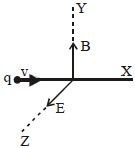
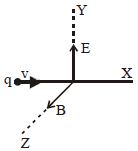
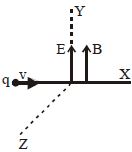
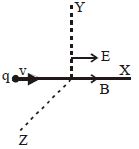
A particle of charge $q$ and mass $m$ is moving along the $x-$ axis with a velocity $v,$ and enters a region of electric field $E$ and magnetic field $B$ as shown in figures below. For which figure the net force on the charge may be zero :-
Answerb
The charge will not experience any force if $|\vec{F} e|=|\vec{F} m| .$ This condition is satisfied in option
View full question & answer→MCQ 441 Mark
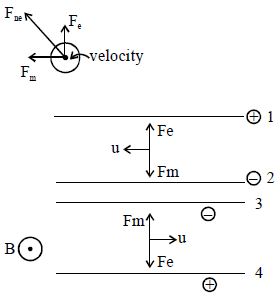
Figure given shows the face of a cathode-ray oscilloscope tube, as viewed from in front. $i.e.$ the electron beam is coming out normally from the plane of the paper. The electron beam passes through a region where there are electric and magnetic fields directed as shown. The deflections of the spot from the center of the screen produced by the electric field $E$ and the magnetic field $B$ separately are equal in magnitude. Which one of the diagrams below shows a possible position of the spot on the screen when both fields are operating?

Answerd
View full question & answer→MCQ 451 Mark
In a certain region uniform electric field $E$ and magnetic field $B$ are present in the opposite direction. At the instant $t = 0,$ a particle of mass $m$ carrying a charge $q$ is given velocity $v_o$ at an angle $\theta ,$ with the $y$ axis, in the $yz$ plane. The time after which the speed of the particle would be minimum is equal to
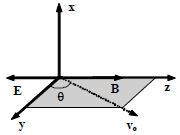
AnswerCorrect option: B. $\frac{{m{v_o}\sin \theta }}{{qE}}$
b
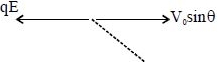
Impulse of $'qE'$ will remove its momentum along $\mathrm{x}$
$\mathrm{q} \mathrm{E} \cdot \mathrm{t}=\mathrm{mv}_{0} \sin \theta$
View full question & answer→MCQ 461 Mark
A plane electromagnetic wave is travelling in the positive $X-$axis. At the instant shown electric field at the extremely narrow dashed rectangle is in the $-ve$ $z$ direction and its magnitude is increasing. Which diagram correctly shows the direction and relative magnitudes of magnetic field at the edges of rectangle :-
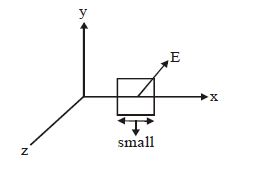
Answera
Wave is propagating along $+ve$ $X-$axis
View full question & answer→MCQ 471 Mark
A plane electromagnetic wave travelling along the $X$-direction has a wavelength of $3\ mm$ . The variation in the electric field occurs in the $Y$-direction with an amplitude $66\ Vm^{-1}$. The equations for the electric and magnetic fields as a function of $x$ and $t$ are respectively :-
- A
$E_y = 33\ cos\ \pi \times 10^{11} \left( {t - \frac{x}{c}} \right)$
$B_z = 1.1 \times 10^{-7}\ cos \pi \times 10^{11}\left( {t - \frac{x}{c}} \right)$
- B
$E_y = 11\ cos\ 2\pi \times 10^{11} \left( {t - \frac{x}{c}} \right)$
$B_z = 11 \times 10^{-7}\ cos 2\pi \times 10^{11}\left( {t - \frac{x}{c}} \right)$
- C
$E_y = 33\ cos\ \pi \times 10^{11} \left( {t - \frac{x}{c}} \right)$
$B_z = 11 \times 10^{-7}\ cos \pi \times 10^{11}\left( {t - \frac{x}{c}} \right)$
- ✓
$E_y = 66\ cos\ 2\pi \times 10^{11} \left( {t - \frac{x}{c}} \right)$
$B_z = 2.2 \times 10^{-7}\ cos 2\pi \times 10^{11}\left( {t - \frac{x}{c}} \right)$
AnswerCorrect option: D. $E_y = 66\ cos\ 2\pi \times 10^{11} \left( {t - \frac{x}{c}} \right)$
$B_z = 2.2 \times 10^{-7}\ cos 2\pi \times 10^{11}\left( {t - \frac{x}{c}} \right)$
d
The equation of electric field occurring in $Y$ - direction
$E_{y}=66 \cos 2 \pi \times 10^{11}\left(t-\frac{x}{c}\right)$
Therefore, for the magnetic field in $Z$ - direction
$\mathrm{B}_{\mathrm{z}}=\frac{\mathrm{E}_{\mathrm{y}}}{\mathrm{c}}$
$=\left(\frac{66}{3 \times 10^{8}}\right) \cos 2 \pi \times 10^{11}\left(\mathrm{t}-\frac{\mathrm{x}}{\mathrm{c}}\right)$
$=22 \times 10^{-8} \cos 2 \pi \times 10^{11}\left(t-\frac{x}{c}\right)$
$=2.2 \times 10^{-7} \cos 2 \pi \times 10^{11}\left(\mathrm{t}-\frac{\mathrm{x}}{\mathrm{c}}\right)$
View full question & answer→MCQ 481 Mark
The intensity of light from a source is $\left( {\frac{{500}}{\pi }} \right)W/{m^2}$ . Find the amplitude of electric field in this wave
- A
$\sqrt 3 \times {10^{2\,}}\,N/C$
- ✓
$2\sqrt 3 \times {10^{2\,}}\,N/C$
- C
$\frac{{\sqrt 3 }}{2} \times {10^{2\,}}\,N/C$
- D
$2\sqrt 3 \times {10^{1\,}}\,N/C$
AnswerCorrect option: B. $2\sqrt 3 \times {10^{2\,}}\,N/C$
b
$I=\frac{I}{2} \in_{o} c E_{0}^{2}$
$\mathrm{E}_{0}=\sqrt{\frac{2 \mathrm{I}}{\in_{0} \mathrm{c}}}$ or $\sqrt{\frac{2 \times 500 \times 10^{9} \times 36 \pi}{\pi \times 3 \times 10^{8}}}$
$\mathrm{E}_{0}=2 \sqrt{3} \times 10^{2} \mathrm{\,N} / \mathrm{C}$
View full question & answer→MCQ 491 Mark
A point source of $e. m.$ radiation has an average power output of $800\,W$ . The maximum value of electric field at a distance $4.0\,m$ from the source is...$V/m$
- A
$68.20$
- ✓
$54.77$
- C
$50.32$
- D
$48.10$
AnswerCorrect option: B. $54.77$
b
Intensity, $I=\frac{P}{4 \pi R^{2}}=\frac{1}{2} \varepsilon_{0} E_{0}^{2} c$
${E_{0}=\sqrt{\frac{P}{2 \pi R^{2} \varepsilon_{0} c}}} $
$ {=\sqrt{\frac{800}{2 \times 3.14 \times(4)^{2} \times 8.86 \times 10^{-12} \times 3 \times 10^{8}}}}$
$ {=54.77 \mathrm{\,V} / \mathrm{m}}$
View full question & answer→MCQ 501 Mark
The monoenergetic beam of electrons moving along $+ y$ direction enters a region of uniform electric and magnetic fields. If the beam goes straight undeflected, then fields $B$ and $E$ are directed respectively along
- A
$- y$ axis and $- z$ axis
- B
$+ z$ axis and $+ x$ axis
- ✓
$+ x$ axis and $+ z$ axis
- D
$- x$ axis and $- y$ axis
AnswerCorrect option: C. $+ x$ axis and $+ z$ axis
c
The total Lorentz force on the electron is
$\overrightarrow{\mathrm{F}}=-e(\overrightarrow{\mathrm{E}}+\vec{v} \times \overrightarrow{\mathrm{B}})$
The electron will be undeflected if $\mathrm{v} \perp \mathrm{B}.$
If $\mathrm{E}$ is along $+\mathrm{z}$ -direction, the force $-\mathrm{e}$ $\mathrm{E}$ will be along $\mathrm{z}$ -direction. If $\mathrm{B}$ is along $+\mathrm{x}$ direction, force
$-\mathrm{e}(\mathrm{v} \times \mathrm{B})$ will be along $+\mathrm{z}$ divection. When $\mathrm{eE}$ $=$ $\mathrm{evB}.$ the electron moves along $+\mathrm{y}$ -direction undeflected. Hence the correct choice is $(3).$
Thus, for an electron moving along $+$ $\mathrm{y}$ direction. the electric field should be along $+\mathrm{z}$ direction and magnetic field along $+\mathrm{x}$ direction, then the electron will be undeflected.
View full question & answer→