MCQ 511 Mark
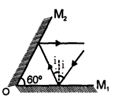
Two plane mirror are inclined to one another at an angle of $60^o$ . A ray is incident on mirror $M_1$ at an angle $i$. The reflected ray from mirror $M_1$ is shown in figure. The angle of incidence $i$ is
Answerc
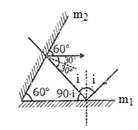
$60° + 60° + 90 - i = 180 $
$⇒ i = 30°$
View full question & answer→MCQ 521 Mark
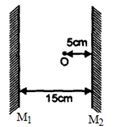
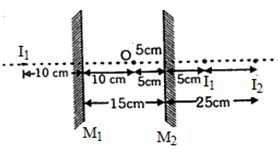
Two plane mirrors are parallel to each other and an object $O$ is placed between them. Then the distance of the first three images from the mirror $M_2$ will be (in $cm$)
- A
$5, 10,15$
- B
$5, 15, 30$
- ✓
$5, 25, 35$
- D
$5, 15, 25$
AnswerCorrect option: C. $5, 25, 35$
c
View full question & answer→MCQ 531 Mark
In the image given below, the total number of reflections of the light ray before it exits the system will be
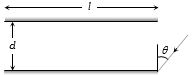
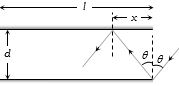
AnswerCorrect option: A. $\frac{l}{{d\tan \theta }}$
a
$nx = l$
$\tan \theta = \frac{x}{d}$
$ \Rightarrow \,\,\,\,\,\,n = \frac{l}{{d\tan \theta }}$
View full question & answer→MCQ 541 Mark
A ray reflected successively from two plane mirrors inclined at a certain angle undergoes a deviation of $300^o$. The number of observable image is :
Answerb
$\delta = (360 - 2\theta )\,\,\,\, \Rightarrow \,\,\,300 = 360 - 2\theta $
$ \Rightarrow \,\,\,\theta = {30^o}$.
પ્રતિબિંબની સંખ્યા $ = \frac{{360}}{{30}} - 1 = 11$
View full question & answer→MCQ 551 Mark
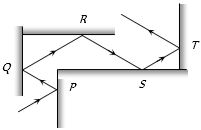
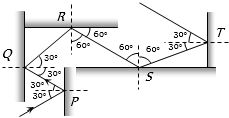
Following figure shows the multiple reflections of a light ray along a glass corridor where the walls are either parallel or perpendicular to one another. If the angle of incidence at point $P$ is $30^o $, what are the angles of reflection of the light ray at points $Q, R, S$ and $T$ respectively
- A
$30^o , 30^o , 30^o , 30^o $
- B
$30^o , 60^o , 30^o , 60^o $
- ✓
$30^o , 60^o , 60^o , 30^o $
- D
$60^o , 60^o , 60^o , 60^o $
AnswerCorrect option: C. $30^o , 60^o , 60^o , 30^o $
c
View full question & answer→MCQ 561 Mark
A point object is placed mid-way between two plane mirrors distance $'a'$ apart. The plane mirror forms an infinite number of images due to multiple reflection. The distance between the nth order image formed in the two mirrors is
- A
$na$
- ✓
$2na$
- C
$na/2$
- D
$n^2\, a$
Answerb
(b) From above figure it can be proved that separation between nth order image formed in the two mirrors $= 2na$
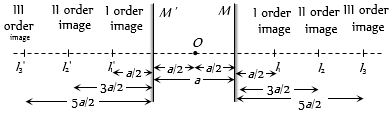
View full question & answer→MCQ 571 Mark
There are two plane mirror with reflecting surfaces facing each other. The mirrors are moving with speed $v$ away from each other.$A$ point object is placed between the mirrors. The velocity of the $n$ -th image will be
Answerb
With respect to mirror$1$ the object is going array from mirror. So first image will also more away w.r.t mirror $1$ with same speed $v.$ So with respect to object $O$ the image speed is
$v_{\text {image1 }}=v_{\text {image1, mirror } 1}+V_{\text {mirror } 1, \mathrm{obj}}$
$=v+v=2 v$
Now this image becomes object for mirror $2 .$ With respect to mirror $2$ the image is going away towards left with speed $3v.$ So its second image will more away towards right with speed $3v$ w.r.t mirror $2.$ Hence speed w.r.t $O$ will be $3v + v =$$4 \mathrm{v}$
Hence for nth image $v_{\text {image }}=2 n v$
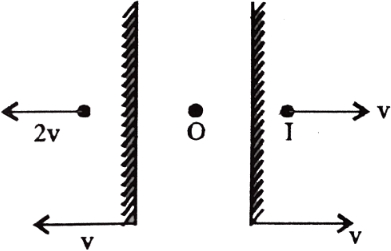
View full question & answer→MCQ 581 Mark
Two mirrors, labeled $LM$ for left mirror and $RM$ for right mirror in the adjacent figure, are parallel to each other and $3.0\, m$ apart. $A$ person standing $1.0\, m$ from the right mirror $(RM)$ looks into this mirror and sees a series of images. How far from the person is the second closest image seen in the right mirror $(RM)$?......$m$
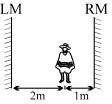
Answerc
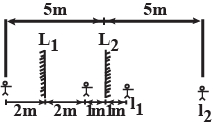
The nearest image in the right mirror forms with the man as the object.
The second nearest image in the right mirror forms with the nearest image of the man in the left mirror as the object as shown in the figure.
So the distance of the second nearest image from the man is:
$1+5=6 m$
View full question & answer→MCQ 591 Mark
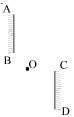
Two mirrors $AB$ and $CD$ are arranged along two parallel lines. The maximum number of images of object $O$ that can be seen by any observer is
View full question & answer→MCQ 601 Mark
$A$ straight line joining the object point and image point is always perpendicular to the mirror
- A
- B
if mirror is concave only
- C
- ✓
irrespective of the type of mirror.
AnswerCorrect option: D. irrespective of the type of mirror.
d
Any line joining the object point and the image point always passes through the centre of curvature of the mirror. This, is because of the law, that any ray passing through the centre of curvature of the mirror will retrace its path back.
Thus, any ray passing through the centre of curvature will be perpendicular to the mirror irrespective of the type of the mirror used.
View full question & answer→MCQ 611 Mark
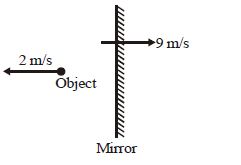
An object is moving in front of mirror as shown in figure
| Column $-I$ |
Column $-II$ |
| $(i)$ Velocity of image |
$(a) \;2\;m/s$ |
| $(ii)$ Velocity of image with respect to mirror |
$(b)\; 20\; m/s$ |
| $(iii)$ Velocity of image with respect to object |
$(c) \;11 \;m/s$ |
| $(iv)$ Velocity of image if mirror is stoped |
$(d)\; 22\; m/s$ |
- ✓
$(i-b), (ii-c), (iii-d), (iv-a)$
- B
$(i-a), (ii-b), (iii-c), (iv-c)$
- C
$(i-d), (ii-a), (iii-c), (iv-c)$
- D
AnswerCorrect option: A. $(i-b), (ii-c), (iii-d), (iv-a)$
a
Formula ${\bar V_I} = 2{\bar V_m} - {\bar V_0}$
where ${\bar V_I}=$ velocity of image
${\bar V_0}=$ velocity of object
${\bar V_m}=$ velocity of mirror
View full question & answer→MCQ 621 Mark
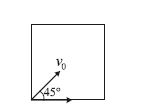
A cubical room is formed with $6$ plane mirrors. An insect moves along the diagonal of the floor with uniform speed. The speed of its image in two adjacent walls parallel to the walls is $20\sqrt2\ cm/s$ . Then the speed of the image formed on the roof with respect to ground is ......$cm/s$
- A
$20$
- ✓
$40$
- C
$20\sqrt2$
- D
$10\sqrt2$
Answerb
$ v_{0} \cos 45 =20 \sqrt{2} $
$v_{0} =40 \mathrm{\,cm} / \mathrm{s} $
View full question & answer→MCQ 631 Mark
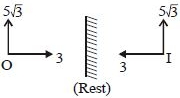
Find the velocity of image with respect to mirror.
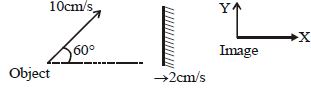
AnswerCorrect option: B. $ - 3i + 5\sqrt 3 \hat j$
b
${\overrightarrow {\rm{v}} _{{\rm{om}}}} = + 3\widehat {\rm{i}} + 5\sqrt {3\widehat j} $
w.r.t. mirror
${\overrightarrow {\rm{v}} _{{\rm{Im}}}} = - 3\widehat {\rm{i}} + 5\sqrt {3\widehat {\rm{j}}} $
View full question & answer→MCQ 641 Mark
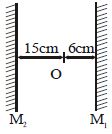
The position of $4^{th}$ image right to mirror $M_1$ is
- A
$69\,cm$ from $M_1$
- B
$48\,cm$ from $M_1$
- ✓
$78\,cm$ from $M_1$
- D
$57\,cm$ from $M_1$
AnswerCorrect option: C. $78\,cm$ from $M_1$
c
| ${M_2}$ |
${M_1}$ |
| $15$ |
$6$ |
| $27$ |
$36$ |
| $57$ |
$48$ |
| |
$78$ |
$78\,cm$ from ${M_1}$
View full question & answer→MCQ 651 Mark
A boy of height $1.5\,m$ with his eye level at $1.4\, m$ stands before a plane mirror of length $0.75$ fixed on the wall. The height of the lower edge of the mirror above the floor is $0.8\,m$, then
- A
The boy will see his full image
- B
The boy cannot see his head
- ✓
The boy cannot see his feet
- D
The boy cannot see neither his head nor his feet
AnswerCorrect option: C. The boy cannot see his feet
c
To see the full image height of mirror must be $70\,cm$ but height is $80\, cm$ in question so the boy cannot see the image of his feet.
View full question & answer→MCQ 661 Mark
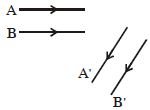
Figure shows two rays $A$ and $B$ being reflected by a mirror and going as $A'$ and $B'$. The mirror
- ✓
- B
- C
- D
may be any spherical mirror
Answera
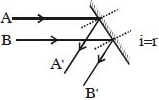
Here initially $A $ and $ B$ is parallel to each other after reflection by the plane mirror $A^{\prime} $ and $ B^{\prime}$ goes parallel to each other.
View full question & answer→MCQ 671 Mark
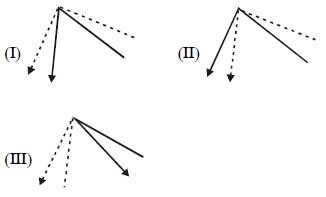
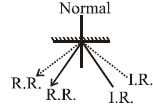
Each of these diagrams is supposed to show two different rays being reflected from the same point on the same plane mirror. Which one of the following is correct ?
- ✓
Only $I$
- B
Only $II$
- C
Only $III$
- D
AnswerCorrect option: A. Only $I$
a
View full question & answer→MCQ 681 Mark
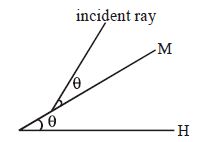
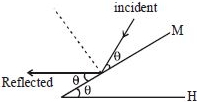
A mirror is inclined at an angle of ${{\theta ^o}}$ with the horizontal. If a ray of light is inclined at an angle of incidence ${{\theta ^o}}$ then the reflected ray makes the following angle with the horizontal
Answerd
Reflected ray make $0^{\circ}$ with horizontal
View full question & answer→MCQ 691 Mark
Image formed by an object placed between two plane mirrors whose reflecting surfaces makes an angle of $90^o$ with one another lie on
Answerb
The number of images formed by two mutually perpendicular mirror $(\theta = 90^o)$ will be $3$ all these three images will lie on circle with centre the point of intersection of two mirror.
View full question & answer→MCQ 701 Mark
Two long plane mirrors $M_1$ and $M_2$ are kept inclined to each other. The angle between reflecting surfaces is $40^o$. The maximum number of reflections , the ray will undergo is
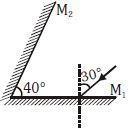
Answerb
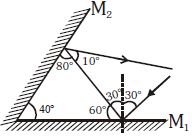
View full question & answer→MCQ 711 Mark
Two plane mirrors are placed parallel to each other at a distance $L$ apart. A point object $O$ placed between them at a distance $L/3$ from one mirror both mirrors form multiple images. The distance between any two images can not be
- ✓
$\frac {3\,L}{2}$
- B
$\frac {2\,L}{3}$
- C
$2\,L$
- D
AnswerCorrect option: A. $\frac {3\,L}{2}$
a
Distance between image
$\frac{2 \mathrm{L}}{3}+\mathrm{L}+\frac{\mathrm{L}}{3}=2 \mathrm{L}$
surface between ${2^{nd}}$ inte
$\frac{4 \mathrm{L}}{3}+\mathrm{L}+\frac{5 \mathrm{L}}{3}=4 \mathrm{L}$
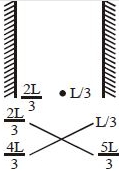
View full question & answer→MCQ 721 Mark
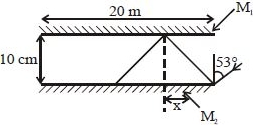
Two plane mirrors $M_1$ and $M_2$ have a length of $20\,m$ each and are $10\,cm$ apart. A ray of light is incident on one end of mirror $M_2$ at an angle of $53^o$. The number of reflections light undergoes before reaching the other end is
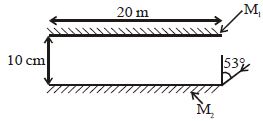
Answerc
After each reflection it covers a distance $\mathrm{x}$ along the mirror
$\frac{\mathrm{x}}{\mathrm{d}} =\tan 53^{\circ} $
$\Rightarrow \quad \mathrm{x} =\mathrm{d} \tan 53^{\circ} $
$=10 \times \frac{4}{3} \mathrm{\,cm}$
Total no. of reflections
$=\frac{20}{10 \times \frac{4}{3}} \times 100$ $=150$
View full question & answer→MCQ 731 Mark
There are certain material developed in laboratories which have a negative refractive index. A ray incident from air (medium $1$) into such a medium (medium $2$) shall follow a path given by
Answera
$sin\, i = msin\, r$
$r$ is negative
View full question & answer→MCQ 741 Mark
A plane mirror is placed along the $x-$ axis facing negative $y-$ axis. The mirror is fixed. A point object is moving with velocity $3\hat i + 4\hat j$ in front of plane mirror. The relative velocity of image with respect of its object

- ✓
$-8j$
- B
$8j$
- C
$3i -4j$
- D
$-6i$
Answera
${\overrightarrow v _{obj}} = 3\hat i + 4\hat j,\quad {\overrightarrow v _{im}} = 3\hat i - 4\hat j$
${\overrightarrow v _{rel}} = {\overrightarrow v _{in}} - {\overrightarrow v _{obj}} = 3\hat i - 4\hat j - 3\hat i - 4\hat j = - 8\hat j$
View full question & answer→MCQ 751 Mark
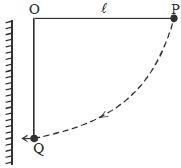
$Bob$ of a pendulum is left from position $P$, velocity of image on mirror $M$ of $ bob$ at position $Qwr$ to $bob$ is
- ✓
$2\sqrt {2gl} $
- B
$\sqrt {2gl} $
- C
$\sqrt {3gl} $
- D
$4\sqrt {gl} $
AnswerCorrect option: A. $2\sqrt {2gl} $
a
At position $Q$ veloicty of $bob$ is $\sqrt {2gl} $ so Ans is velocity of image wr to $bob$ is
$\sqrt {2gl} + \sqrt {2gl} = 2\sqrt {2gl} $
View full question & answer→MCQ 761 Mark
A man $160\,cm$ high stands in front of a plane mirror. His eyes are at a height of $150\,cm$ from the floor. Then the minimum length of the plane mirror for him to see his full length image is......$cm$
Answerc
The minimum length of the mirror is half the length of the man. This can be proved from the fact that $\angle i\, = \,\angle r$.
View full question & answer→MCQ 771 Mark
A ball is projected from top of the table with initial speed $u$ at an angle of inclination $q$, motion of image of ball w.r.t ball
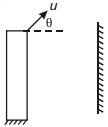
AnswerCorrect option: C. Must be straight line and horizontal
c
(c)
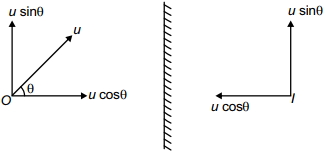
$\vec{V}_{l_0}=\vec{V}_l-\bar{V}_0$
$\vec{V}_{l_0}=-u \cos \theta \hat{i}+u \sin \hat{j}-(u \cos \theta \hat{i}+u \sin \theta \hat{j})$
$\vec{V}_{l_0}=-2 u \cos \theta \hat{i}$
Straight line and horizontal
View full question & answer→MCQ 781 Mark
$\hat{n}_1$ is the unit vector along incident ray, $\hat{n}_2$ along normal and $\hat{n}_3$ is the unit vector along reflected ray, then which of the following must be true?
- A
$\hat{n}_1 \cdot \hat{n}_2=0$
- B
$\hat{n}_1 \cdot \hat{n}_3=0$
- ✓
$\left(\hat{n}_1 \times \hat{n}_2\right) \cdot \hat{n}_3=0$
- D
$\left(\hat{n}_1 \times \hat{n}_2\right) \times \hat{n}_3=0$
AnswerCorrect option: C. $\left(\hat{n}_1 \times \hat{n}_2\right) \cdot \hat{n}_3=0$
c
(c)
The reflected ray, refracted ray a incident ray and normal all lie on the same plane
View full question & answer→MCQ 791 Mark
A small plane mirror placed at the centre of a spherical screen of radius $R$. A beam of light is falling on the mirror. If the mirror makes $n$ revolution. per second, the speed of light on the screen after reflection from the mirror will be
- ✓
$4\pi nR$
- B
$2\pi nR$
- C
$\frac{{nR}}{{2\pi }}$
- D
$\frac{{nR}}{{4\pi }}$
AnswerCorrect option: A. $4\pi nR$
a
(a) When plane mirror rotates through an angle $\theta$, the reflected ray rotates through an angle $2\theta$.
So spot on the screen will make $2n$ revolution per second.
View full question & answer→MCQ 801 Mark
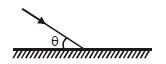
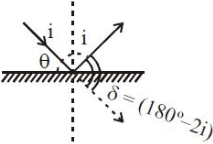
Find the angle of deviation (given diagram)
- A
$180 - 2\theta$
- B
$90 - \theta$
- ✓
$ 2\theta$
- D
$360 - 2\theta$
AnswerCorrect option: C. $ 2\theta$
c
Deviation $(s)$
$=180^{\circ}-2 \mathrm{i}$
$=180^{\circ}-2\left(90^{\circ}-\theta\right)$
$=2 \theta$
View full question & answer→MCQ 811 Mark
A ray reflected successively from two plane mirrors inclined at a certain angle undergoes a deviation of $270^o$ after total two reflections. The number of images observable are
Answerc
$\delta=360-2 \theta \Rightarrow \theta=45$
Angle between the mirror $\theta=45$
no. of Imager $=\frac{360}{45}-1=7$
View full question & answer→MCQ 821 Mark
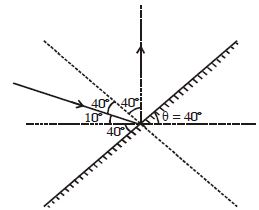
A ray of light making an angle $10^o$ with the horizontal is incident on a plane mirror making a angle $\theta $ with the horizontal. What should be the value of $\theta $ so that the reflected ray goes vertically upwards....$^o$
Answerc
View full question & answer→MCQ 831 Mark
A convex mirror of focal length $f$ forms an image which is $\frac{1}{n}$ times the object. The distance of the object from the mirror is
AnswerCorrect option: A. $(n - 1)f$
a
(a) $m = + \frac{1}{n} = - \frac{v}{u} \Rightarrow v = - \frac{u}{n}$
By using mirror formula $\frac{1}{f} = \frac{1}{{ - \frac{u}{n}}} + \frac{1}{u}$
$ \Rightarrow u = - (n - 1)f$
View full question & answer→MCQ 841 Mark
Which of the following could not produce a virtual image
- A
- B
- C
- ✓
All the above can produce a virtual image
AnswerCorrect option: D. All the above can produce a virtual image
d
(d) $Convex\, mirrors$ always produce a virtual, erect and diminished image and the decrease in size of image depends on the position of the object in front of the mirror.
$Plane\, Mirrors$ always produce a virtual and erect image having the same size as that of the object irrespective of the position of object.
$Concave\, mirrors$ produce real and virtual, erect and inverted, diminished, samesized and magnified image depending upon the position of the object on the principal axis. The concave mirror forms a virtual and erect image only when the object is placed between the Focus and the pole of the mirror.
Thus, a virtual image can be formed by all the three mirrors.
Hence, the correct answer is OPTION $D.$
View full question & answer→MCQ 851 Mark
The focal length of a concave mirror is $50 \,cm.$ Where an object be placed so that its image is two times and inverted.......$cm$
Answera
(a) For real image $m = -2$, so by using $m = \frac{f}{{f - u}}$
$ \Rightarrow - \;2 = \frac{{ - \,50}}{{ - 50 - u}} \Rightarrow u = - \;75\;cm$
View full question & answer→MCQ 861 Mark
An object of size $7.5cm$ is placed in front of a convex mirror of radius of curvature $25cm$ at a distance of $40cm.$The size of the image should be........$cm$
AnswerCorrect option: B. $1.78$
b
(b) By using $\frac{I}{O} = \frac{f}{{f - u}}$
$ \Rightarrow \frac{I}{{ + (7.5)}} = \frac{{(25/2)}}{{\left( {\frac{{25}}{2}} \right) - ( - 40)}} \Rightarrow I = 1.78\;cm$
View full question & answer→MCQ 871 Mark
The focal length of a concave mirror is $f$ and the distance from the object to the principle focus is $x$. The ratio of the size of the image to the size of the object is
AnswerCorrect option: B. $\frac{f}{x}$
b
(b) $\frac{I}{O} = \frac{f}{{f - u}};$ where $u = f + x $ $\therefore \;\frac{I}{O} = - \frac{f}{x}$
View full question & answer→MCQ 881 Mark
In a concave mirror experiment, an object is placed at a distance ${x_1}$ from the focus and the image is formed at a distance ${x_2}$ from the focus. The focal length of the mirror would be
AnswerCorrect option: B. $\sqrt {{x_1}{x_2}} $
b
(b) Given $u = (f + {x_1})$ and $v = (f + {x_2})$
The focal length $f = \frac{{uv}}{{u + v}} = \frac{{(f + {x_1})(f + {x_2})}}{{(f + {x_1}) + (f + {x_2})}}$
On solving, we get ${f^2} = {x_1}{x_2}$ or $f = \sqrt {{x_1}{x_2}} $
View full question & answer→MCQ 891 Mark
The image formed by a convex mirror of focal length $30cm$ is a quarter of the size of the object. The distance of the object from the mirror is......$cm$
Answerb
(b) $m = \frac{f}{{(f - u)}} \Rightarrow \left( { + \frac{1}{4}} \right) = \frac{{( + 30)}}{{( + 30) - u}} \Rightarrow u = - \;90\;cm$
View full question & answer→MCQ 901 Mark
The relation between the linear magnification $m,$ the object distance $u$ and the focal length $f$ is
- A
$m = \frac{{f - u}}{f}$
- ✓
$m = \frac{f}{{f - u}}$
- C
$m = \frac{{f + u}}{f}$
- D
$m = \frac{f}{{f + u}}$
AnswerCorrect option: B. $m = \frac{f}{{f - u}}$
b
(b) $m = - \frac{v}{u}$ also $\frac{1}{f} = \frac{1}{v} + \frac{1}{u}$
==> $\frac{u}{f} = \frac{u}{v} + 1$
==> $ - \frac{u}{v} = 1 - \frac{u}{f}$
$ \Rightarrow \frac{{ - v}}{u} = \frac{f}{{f - u}}$ so $m = \frac{f}{{f - u}}$.
View full question & answer→MCQ 911 Mark
A concave mirror is used to focus the image of a flower on a nearby well $120cm$ from the flower. If a lateral magnification of $16$ is desired, the distance of the flower from the mirror should be.....$cm$
Answera
(a) Let distance $ = u.$ Now $\frac{v}{u} = 16$ and $v = u + 120$
$\therefore \,\,\frac{{120 + u}}{u} = 16 \Rightarrow 15u = 120 \Rightarrow u = 8\,cm$.
View full question & answer→MCQ 921 Mark
A virtual image three times the size of the object is obtained with a concave mirror of radius of curvature $36cm.$The distance of the object from the mirror is........$cm$
Answerb
(b) Image is virtual so $m = + 3.$ and $f = \frac{R}{2} = 18\;cm$
So from $m = \frac{f}{{f - u}} \Rightarrow 3 = \frac{{( - 18)}}{{( - 18) - u}}$$ \Rightarrow u = - \;12\;cm.$
View full question & answer→MCQ 931 Mark
Radius of curvature of concave mirror is $40cm$ and the size of image is twice as that of object, then the object distance is....$cm$
Answerd
(d) $f = \frac{R}{2} = 20\,cm,$ $m = 2$ For real image; $m = - 2,$
By using $m = \frac{f}{{f - u}}$, $ - 2 = \frac{{ - 20}}{{ - 20 - u}} \Rightarrow u = - 30\,cm$
For virtual image; $m = + 2$
So, $ + 2 = \frac{{ - \,20}}{{ - 20 - u}} \Rightarrow u = - 10\,cm$
View full question & answer→MCQ 941 Mark
All of the following statements are correct except
- A
The magnification produced by a convex mirror is always less than one
- B
A virtual, erect, same-sized image can be obtained using a plane mirror
- C
A virtual, erect, magnified image can be formed using a concave mirror
- ✓
A real, inverted, same-sized image can be formed using a convex mirror
AnswerCorrect option: D. A real, inverted, same-sized image can be formed using a convex mirror
d
(d) Convex mirror always forms, virtual, erect and smaller image.
View full question & answer→MCQ 951 Mark
A convex mirror has a focal length$f.$ A real object is placed at a distance $f$ in front of it from the pole produces an image at
Answerc
( c)Here focal length $ = f$ and $u = - f$
On putting these values in $\frac{1}{f} = \frac{1}{u} + \frac{1}{v}$
$ \Rightarrow \frac{1}{f} = - \frac{1}{f} + \frac{1}{v} \Rightarrow v = \frac{f}{2}$
View full question & answer→MCQ 961 Mark
An object $1\;cm$ tall is placed $4\;cm$ infront of a mirror. In order to produce an upright image of $3\;cm$ height one needs a
- A
Convex mirror of radius of curvature $12\;cm$
- ✓
Concave mirror of radius of curvature $12\;cm$
- C
Concave mirror of radius of curvature $4\;cm$
- D
Plane mirror of height $12\;cm$
AnswerCorrect option: B. Concave mirror of radius of curvature $12\;cm$
b
(b) Erect and enlarged image can produced by concave mirror.
$\frac{I}{O} = \frac{f}{{f - u}} \Rightarrow \frac{{ + \;3}}{{ + 1}} = \frac{f}{{f - ( - \;4)}} \Rightarrow f = - \;6\,cm$
$ \Rightarrow R = 2f = - \,12\,cm$
View full question & answer→MCQ 971 Mark
A concave mirror gives an image three times as large as the object placed at a distance of $20cm$ from it. For the image to be real, the focal length should be......$cm$
Answerb
( b)$m = \frac{f}{{f - u}}$$ \Rightarrow - \;3 = \frac{f}{{f - ( - 20)}}$$ \Rightarrow f = - \,15\,cm$
View full question & answer→MCQ 981 Mark
An object is placed at $20cm$ from a convex mirror of focal length $10\,cm.$ The image formed by the mirror is
- A
Real and at $20\,cm$ from the mirror
- B
Virtual and at $20\,cm$ from the mirror
- ✓
Virtual and at $\frac{{20}}{3}$ from the mirror
- D
Real and at $\frac{{20}}{3}$ from the mirror
AnswerCorrect option: C. Virtual and at $\frac{{20}}{3}$ from the mirror
c
( c)$u = - 20\,cm,$ $f = + 10\,cm$ also $\frac{1}{f} = \frac{1}{v} + \frac{1}{u}$
$ \Rightarrow \frac{1}{{ + 10}} = \frac{1}{v} + \frac{1}{{( - 20)}} \Rightarrow v = \frac{{20}}{3}\,\,cm;$ virtual image.
View full question & answer→MCQ 991 Mark
A point object is placed at a distance of $10\,cm$ and its real image is formed at a distance of $20\,cm$ from a concave mirror. If the object is moved by $0.1cm$ towards the mirror, the image will shift by about
- ✓
$0.4cm$ away from the mirror
- B
$0.4cm$ towards the mirror
- C
$0.8cm$ away from the mirror
- D
$0.8cm$ towards the mirror
AnswerCorrect option: A. $0.4cm$ away from the mirror
a
(a)Mirror formula
$\frac{1}{f} = \frac{1}{v} + \frac{1}{u} \Rightarrow \frac{1}{f} = \frac{1}{{ - 20}} + \frac{1}{{( - 10)}} \Rightarrow f = \frac{{20}}{3}\,\,cm.$
If object moves towards the mirror by $0.1\,cm$ then.
$u = (10 - 0.1) = 9.9\,cm.$ Hence again from mirror formula
$\frac{1}{{ - 20/3}} = \frac{1}{{v'}} + \frac{1}{{ - 9.9}} \Rightarrow v' = 20.4\,cm$ i.e. image shifts away from the mirror by $0.4\,cm.$
View full question & answer→MCQ 1001 Mark
A concave mirror of focal length $15\, cm$ forms an image having twice the linear dimensions of the object. The position of the object when the image is virtual will be........$cm$
- A
$22.5 $
- ✓
$7.5$
- C
$30 $
- D
$45$
Answerb
(b) $f = - 15\,cm,$ $m = + 2$ (Positive because image is virtual)
$\because \,m = - \frac{v}{u} \Rightarrow v = - 2u$. By using mirror formula
$\frac{1}{{ - 15}} = \frac{1}{{( - 2u)}} + \frac{1}{u} \Rightarrow u = - 7.5\,cm$
View full question & answer→


