MCQ 1011 Mark
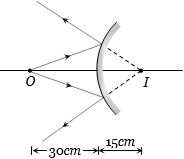
A point object is placed at a distance of $30 cm$ from a convex mirror of focal length $30cm$. The image will form at
AnswerCorrect option: D. $15 cm$ behind the mirror
d
(d) $u = - 30\,cm,$ $f = + 30\,cm,$ by using mirror formula
$\frac{1}{f} = \frac{1}{v} + \frac{1}{u} \Rightarrow \frac{1}{{ + 30}} = \frac{1}{v} + \frac{1}{{( - 30)}}$
$v = 15\,cm,$ behind the mirror
View full question & answer→MCQ 1021 Mark
An object $2.5 \,cm$ high is placed at a distance of $10\, cm$ from a concave mirror of radius of curvature $30 \,cm$ The size of the image is........$cm$
- A
$9.2$
- B
$10.5$
- C
$5.6$
- ✓
$7.5$
Answerd
(d)$R = - 30\,cm \Rightarrow f = - 15\,cm$
$O = + 2.5\,cm,$ $u = - 10\,cm$
By mirror formula $\frac{1}{{ - 15}} = \frac{1}{v} + \frac{1}{{( - 10)}} \Rightarrow v = 30\,cm.$
Also $\frac{I}{O} = - \frac{v}{u} \Rightarrow \frac{I}{{( + 2.5)}} = - \frac{{30}}{{( - 10)}}$$ \Rightarrow I = + 7.5\,cm.$
View full question & answer→MCQ 1031 Mark
An object of length $6 cm$ is placed on the principle axis of a concave mirror of focal length $f$ at a distance of $4f.$ The length of the image will be......$cm$
Answera
(a) $\frac{I}{O} = \frac{f}{{f - u}}$
$ \Rightarrow \frac{I}{{ + 6}} = \frac{{ - f}}{{ - f - ( - 4f)}}$$ \Rightarrow I = - \,2\,cm.$
View full question & answer→MCQ 1041 Mark
What ........$mm$ will be the height of image when an object of $2 \,mm$ is placed on the axis of a convex mirror at a distance $20 \,cm$ of radius of curvature $40 cm$
Answerd
( d)$\frac{I}{O} = \frac{f}{{f - u}} \Rightarrow \frac{I}{2} = \frac{{20}}{{20 + 20}} = \frac{1}{2}$==> $I = 1\,mm$
View full question & answer→MCQ 1051 Mark
Image formed by a concave mirror of focal length $6 \,cm$, is $3$ times of the object, then the distance of object from mirror is......$cm$
Answera
(a) $m = \pm 3\, and\, f = -6 cm$
Now $m = \frac{f}{{f - u}}\,\,\, \Rightarrow \,\, \pm 3 = \frac{{ - \,6}}{{ - 6 - u}}$
For real image $ - \,3 = \frac{{ - \,6}}{{ - 6 - u}}$ ==> $u = - \,8\,cm$
For virtual image $3 = \frac{{ - \,6}}{{ - 6 - u}}$ ==> $u = - \,4\,cm$
View full question & answer→MCQ 1061 Mark
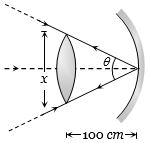
A concave mirror of focal length $100\,cm$ is used to obtain the image of the sun which subtends an angle of $30^\circ .$ The diameter of the image of the sun will be.....$cm$
- A
$1.74$
- ✓
$0.87$
- C
$0.435$
- D
$100$
AnswerCorrect option: B. $0.87$
b
( b) The angle subtended by the image of the sun at the mirror
$ = 30' = {\left( {\frac{1}{2}} \right)^o} = \frac{\pi }{{360}}\,\,rad$
If $x$ be the diameter of the image of the sun, then
$\frac{{{\rm{Arc}}}}{{{\rm{Radius}}}} = \frac{x}{{100}} = \frac{1}{2}.\frac{{2\pi }}{{360}} = \frac{\pi }{{360}}$
$ \Rightarrow \,\,x = \frac{{100\pi }}{{360}} = 0.87\,cm$
View full question & answer→MCQ 1071 Mark
A square of side $3\;cm$ is placed at a distance of $25\;cm$ from a concave mirror of focal length $10\;cm.$ The centre of the square is at the axis of the mirror and the plane is normal to the axis. The area enclosed by the image of the square is......$c{m^2}$
Answera
(a) $m = \frac{I}{O} = \frac{f}{{u - f}} = \frac{{10}}{{25 - 10}} = \frac{{10}}{{15}} = \frac{2}{3}$${m^2} = \frac{{{A_i}}}{{{A_o}}} \Rightarrow {A_i} = {m^2} \times {A_o}$$ = {\left( {\frac{2}{3}} \right)^2} \times {(3)^2} = 4\,c{m^2}$
View full question & answer→MCQ 1081 Mark
A point object is moving on the principal axis of a concave mirror of focal length $24\;cm$ towards the mirror. When it is at a distance of $60\;cm$ from the mirror, its velocity is $9 \, cm/sec$. What is the velocity of the image at that instant
- A
$5cm/sec$ towards the mirror
- B
$4cm/sec$ towards the mirror
- ✓
$4cm/sec$ away from the mirror
- D
$9cm/\sec $ away from the mirror
AnswerCorrect option: C. $4cm/sec$ away from the mirror
c
( c)${v_i} = - {\left( {\frac{f}{{f - u}}} \right)^2}.\,{v_o}$$ = - \,{\left( {\frac{{ - 24}}{{ - 24 - ( - 60)}}} \right)^2} \times 9= 4 cm/sec.$
View full question & answer→MCQ 1091 Mark
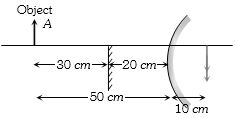
An object is placed infront of a convex mirror at a distance of $50\, cm$. A plane mirror is introduced covering the lower half of the convex mirror. If the distance between the object and plane mirror is $30\, cm$, it is found that there is no parallax between the images formed by two mirrors. Radius of curvature of mirror will be......$cm$
- A
$12.5$
- ✓
$25$
- C
$\frac{{50}}{3}$
- D
$18$
Answerb
(b) Since there is no parallex, it means that both images (By plane mirror and convex mirror) coinciding each other.
According to property of plane mirror it will form image at a distance of $30 cm$ behind it. Hence for convex mirror $u = -50 cm, \,\,v = + 10 cm$
By using $\frac{1}{f} = \frac{1}{v} + \frac{1}{u}$
$ \Rightarrow \,\,\,\frac{1}{f} = \frac{1}{{ + 10}} + \frac{1}{{ - 50}} = \frac{4}{{50}}$
$ \Rightarrow $ $f = \frac{{25}}{2}cm$
$ \Rightarrow \,\,\,R = 2f = 25cm.$
View full question & answer→MCQ 1101 Mark
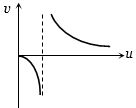
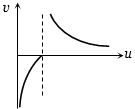
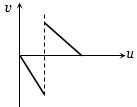
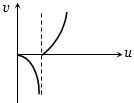
As the position of an object $(u)$ reflected from a concave mirror is varied, the position of the image $(v)$ also varies. By letting the u changes from $0$ to $ + \infty $ the graph between $v$ versus $u$ will be
Answera
( a)At $u = f, v =\infty$
At $u = 0, v = 0$ (i.e. object and image both lies at pole)
Satisfying these two conditions, only option ($a$) is correct.
View full question & answer→MCQ 1111 Mark
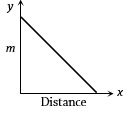
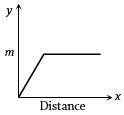
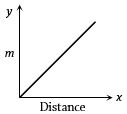
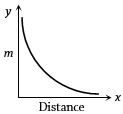
Which of the following graphs is the magnification of a real image against the distance from the focus of a concave mirror
Answerd
$(d)$ For concave mirror $m = \frac{f}{{f - u}}$
For real image $m$ $ = - \frac{f}{{(u - f)}}$$ = - \frac{f}{x}$
$ = - \frac{f}{{{\rm{(Distance\, of \,object\, from\, focus}})}}$
==> $m \propto \frac{1}{x}$.
View full question & answer→MCQ 1121 Mark
A convex mirror and a concave mirror of radius $10\; cm$ each are placed $15\; cm$ apart facing each other. An object is placed midway between them. If the reflection first takes place in the concave mirror and then in convex mirror, the position of the final image is
AnswerCorrect option: A. On the pole of the convex mirror
a
for concave mirror $u =-7.5 ; f =-5$
$\frac{1}{ v }+\frac{1}{ u }=\frac{1}{ f }$
$\frac{1}{ v }-\frac{2}{15}=\frac{-1}{5}$
$v =-15$
i.e, image is formed at pole of convex mirror for convex mirror, $u=0 ; f=+5$
$\frac{1}{ v }+\frac{1}{ u }=\frac{1}{ f }$
$\frac{1}{ v }+\frac{1}{0}=\frac{1}{5}$
$v =0$
so final image is frormed at pole of convex mirror
View full question & answer→MCQ 1131 Mark
The focal length of a concave mirror is $12\; cm$. Where should an object of length $4 \;cm$ be placed, so that a real image of $1 \;cm$ length is formed?
Answerc
Focal length of a concave mirror $f =12 cm$
Object length $h=4$
Real image length $h ^{\prime}=1 cm$
We know that,
$m =-\frac{ v }{ u }=\frac{- f }{- f -( u )}$
$-\frac{1}{ u }=\frac{-12}{-12- u }$
$12+ u =-48$
$u =-48-12$
$u =-60 cm$
Hence, the object distance is $60\; cm$
View full question & answer→MCQ 1141 Mark
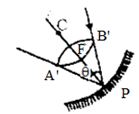
The sun (diameter $d$) subtends an angle $\theta$ radian at the pole of a concave mirror of focal length $f$ . What is the diameter of the image of the sun formed by the mirror ?
- A
$3f \theta$
- B
$f ^{2} \theta$
- C
$2f \theta$
- ✓
$f \theta$
AnswerCorrect option: D. $f \theta$
d
$\frac{1}{v}+\frac{1}{u}=\frac{1}{f}$
$\frac{1}{v}+\frac{1}{\infty}=\frac{1}{f}$
$v=f$
image is formed at the focus $F$ of concave mirror. If $A^{\prime} B^{\prime}$ is the size/diameter of the image of the sun, then from
$\theta=\frac{A^{\prime} B^{\prime}}{P F}=\frac{d}{f}$
$d=\theta f$
View full question & answer→MCQ 1151 Mark
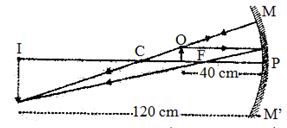
At what distance in front of a concave mirror of focal length $30\; cm$, an object be placed (in $cm$) so that its real image of size three times that of the object is obtained?
Answerb
$m=\frac{{{f}}}{{{{f}} - u}}$
$\Rightarrow- 3=\frac{{ - 30}}{{ - 30 - u}}$
$\Rightarrow u= - 40\,cm$
View full question & answer→MCQ 1161 Mark
The speed at which the image of the luminous point object is moving, if the luminous point object is moving at speed $v_0$ towards a spherical mirror, along its axis is (Given, $r =$ radius of curvature $u =$ object distance)
- A
$v_1 = -v_0$
- B
${v_1} = \,\, - {v_0}\,\,\left( {\frac{r}{{2u - r}}} \right)$
- C
${v_1} = \,\, - {v_0}\,\,\left( {\frac{{2u - r}}{r}} \right)$
- ✓
${v_1} = \,\, - {v_0}\,\,{\left( {\frac{r}{{2u - r}}} \right)^2}$
AnswerCorrect option: D. ${v_1} = \,\, - {v_0}\,\,{\left( {\frac{r}{{2u - r}}} \right)^2}$
d
$\frac{1}{v}+\frac{1}{u}=\frac{1}{f}$
Differentiating both sides $-\frac{1}{v^2} \frac{d v}{d t}=\frac{1}{u^2} \frac{d u}{d t}$
$\frac{d v}{d t}=v_l=-\left(\frac{v}{u}\right)^2 \frac{d u}{d t}=-\left(\frac{v}{u}\right)^2 v_0$
Again $\frac{1}{v}=\frac{1}{f}-\frac{1}{u}=\frac{2}{r}-\frac{1}{u}=\frac{2 u-r}{r u}$
$v=\frac{u r}{2 u-r}$
$v_i=-\left(\frac{v}{u}\right)^2 v_o=-v_o\left(\frac{r}{2u-r}\right)^2$
View full question & answer→MCQ 1171 Mark
A spherical mirror forms an erect image three times the linear size of the object. If the distance between the object and the image is $80\,cm$, the focal length of the mirror is........
- A
$15\;cm$
- B
$- 15\;cm$
- ✓
$-30\;cm$
- D
$40\;cm$
AnswerCorrect option: C. $-30\;cm$
c
$\mathrm{u}=-\mathrm{x}$
$\mathrm{v}=3 \mathrm{x}$
$3 x+x+80$
$4 x=80 \Rightarrow x=20$
$\mathrm{u}=-20 \quad \mathrm{v}=60$
$\frac{1}{v}+\frac{1}{u}=\frac{1}{f}$
$\frac{1}{60}-\frac{1}{20}=\frac{1}{f}$
$f=-30 \mathrm{\,cm}$
View full question & answer→MCQ 1181 Mark
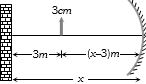
A candle flame of $3\, cm$ is placed at $3\, m$ from a wall. A concave mirror is kept at distance $x$ from the wall in such a way that image of the flame on the wall is $9\, cm$. Then $x$ is......$cm$
- A
$225$
- B
$300$
- ✓
$450$
- D
$650 $
Answerc
$\frac{I}{O} = \frac{{ - v}}{u}\,\,\, \Rightarrow \,\,\frac{{ - 9}}{{ + 3}} = \frac{{ - \left( { - x} \right)}}{{ - \left( {x - 3} \right)}}$
$ \Rightarrow \,\,\,x = - 4.5m\,\, = \,\, - 450cm.$
View full question & answer→MCQ 1191 Mark
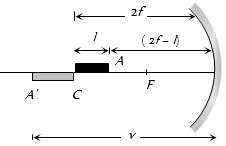
A thin rod of $5cm$ length is kept along the axis of a concave mirror of $10cm$ focal length such that its image is real and magnified and one end touches the rod. Its magnification will be
Answerb
(b) End $A$ of the rod acts as an object for mirror and $A$' will be its image so $u = 2f -l = 20 -5 = 15\, cm$
$\because$ $\frac{1}{f} = \frac{1}{v} + \frac{1}{u}$ ==> $\frac{1}{{ - 10}} = \frac{1}{v} - \frac{1}{{15}}$ ==> $v = -30\, cm$ .
Now $m = \frac{{{\rm{Length\, of}}\,{\rm{image}}}}{{{\rm{Length\, of\, object}}}} = \frac{{(30 - 20)}}{5} = 2$
View full question & answer→MCQ 1201 Mark
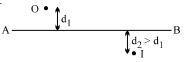
In the figure shown, the image of a real object is formed at point $I$. $AB$ is the principal axis of the mirror. The mirror must be :
- A
concave & placed towards right $I$
- ✓
concave & placed towards left of $I$
- C
convex and placed towards right of $I$
- D
convex & placed towards left of $I.$
AnswerCorrect option: B. concave & placed towards left of $I$
b
since image is magnified and inverted so mirrro in concave and placed also towards left of $I.$
View full question & answer→MCQ 1211 Mark
The distance of an object from the pole of a concave mirror is equal to its radius of curvature . The image must be :
Answera
If object is at centre then image forms on the centre, and real and if object is virtual then image forms at $V=-\frac{R}{3}$ (in both the cases image is real)
View full question & answer→MCQ 1221 Mark
$A$ concave mirror is used to form image of the Sun on a white screen. If the lower half of the mirror were covered with an opaque card, the effect on the image on the screen would be
- A
- ✓
to make the image less bright than before
- C
to make the upper half of the image disappear
- D
to make the lower half of the image disappear
AnswerCorrect option: B. to make the image less bright than before
b
The complete image is formed but intensity of image will decrease. intensity $\propto$ (area of mirror reflecting the light).
View full question & answer→MCQ 1231 Mark
$A$ point object is between the Pole and Focus of a concave mirror, and moving away from the mirror with a constant speed. Then, the velocity of the image is :
- ✓
away from mirror and increasing in magnitude
- B
towards mirror and increasing in magnitude
- C
away from mirror and decreasing in magnitude
- D
towards mirror and decreasing in magnitude
AnswerCorrect option: A. away from mirror and increasing in magnitude
View full question & answer→MCQ 1241 Mark
Choose the correct statement $(s)$ related to the motion of object and its image in the case of mirrors
AnswerCorrect option: A. Object and its image always move along normal $w.r.t.$ mirror in opposite directions
a
In all the types of mirror (i.e.plane mirror, convex mirror, concave mirror) object and its image always move along normal w.r.t mirror in opposite directions.
View full question & answer→MCQ 1251 Mark
Ram is looking at his face in a mirror kept $10\ cm$ away and he finds that his image is erect and magnified $(m = 1.8)$ . If he holds the mirror $50\ cm$ away
- A
He cannot see the image because reflected rays falling on his eyes are converging
- B
He sees a magnified and erect image
- ✓
He sees a diminished and inverted image
- D
He sees a magnified and inverted image.
AnswerCorrect option: C. He sees a diminished and inverted image
c
$1.8=\frac{f}{f+10}$
$1.8 f+18=f$
$18=-0.8 f$
$f=-22.5 \mathrm{\,cm}$
Tn second case, $u=-50$
$\Rightarrow$ object is beyond $C.$
$\Rightarrow$ image is inverted and diminished.
View full question & answer→MCQ 1261 Mark
If lateral magnification is $-2$ for virtual object for a spherical mirror then
- A
Convex mirror, Real image
- ✓
Convex mirror, Virtual image
- C
Concave mirror, Real image
- D
Concave mirror, Virtual image
AnswerCorrect option: B. Convex mirror, Virtual image
b
Sine magnification is $-2$ so virtual object have virtual image.
virtual object to virtual image then mirror is convex.
View full question & answer→MCQ 1271 Mark
A point object on the principal axis at a distance $15\,\, cm$ in front of a concave mirror of radius of curvature $20\,\, cm$ has velocity $2\,\, mm/s$ perpendicular to the principal axis. The velocity of image at that instant will be.......$mm/s$
Answerb
$m =\, -2$
Therefore velocity of image (perpendicular to principal axis)
= $|m|$ (object speed)
= $4\,\, mm/s$
View full question & answer→MCQ 1281 Mark
The image of an extented object, placed perpendicular to the principal axis of a mirror, will be erect if
$(a)$ The object and image both are real
$(b)$ The object and image both are virtual
$(c)$ The object is real but the image is virtual
$(d)$ The object is virtual but the image is real
- A
$(a)$ and $(b)$
- ✓
$(c)$ and $(d)$
- C
$(a)$ and $(c)$
- D
AnswerCorrect option: B. $(c)$ and $(d)$
b
$\left. \begin{array}{l}
R.O. \to R.I.\\
V.O. \to V.I.
\end{array} \right\}always\,\,inverted$
$\left. \begin{array}{l}
R.O. \to V.I.\\
V.O. \to R.I.
\end{array} \right\}always\,\,erect$
View full question & answer→MCQ 1291 Mark
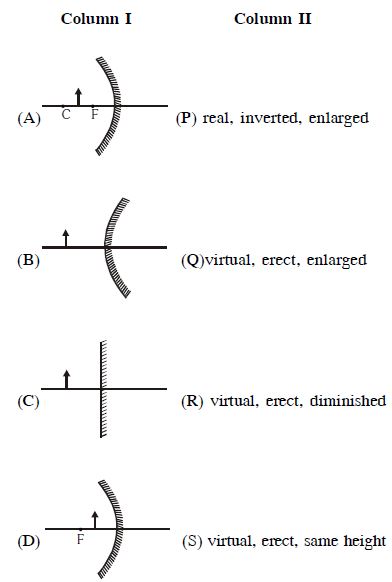
Column $-I$ contains a list of mirrors and position of object. Match this with Column $-II$ describing the nature of image
- A
$A \to P, B \to R, C \to Q, D \to S$
- ✓
$A \to P, B \to R, C \to S, D \to Q$
- C
$A \to R, B \to P, C \to Q, D \to S$
- D
$A \to P, B \to Q, C \to R, D \to S$
AnswerCorrect option: B. $A \to P, B \to R, C \to S, D \to Q$
View full question & answer→MCQ 1301 Mark
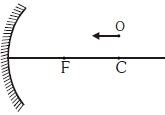
A point object $O$ is going towards concave mirror as shown in the figure. Choose the correct option representing direction of velocity of the image ($F$ is the focus and $C$ is the centre of curvature)
Answera
Image will go from $C$ to $\infty $ and ordinate will increase in reverse order.
View full question & answer→MCQ 1311 Mark
A square object of area $100\,sq.\,cm$ is placed perpendicular to the principle axis of a concave mirror. If the lateral magnification of the mirror, for the above object position, is $0.4,$ then the area of the image will be......$\,sq.\,cm$
View full question & answer→MCQ 1321 Mark
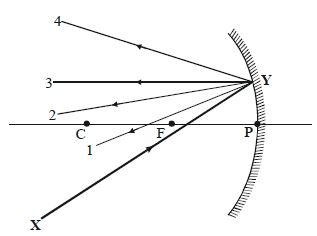
Figure shows a small concave mirror with $CP$ as its principal axis. A ray $XY$ is incident on the mirror. Which of the four rays can be the reflected ray.
Answerd
Obj $\to$ between $F -P$
Image $\to$ Virtual (Only ray $4$ is diverging)
View full question & answer→MCQ 1331 Mark
A concave mirror has a focal length $20\,cm$. The distance between the two positions of the object for which the image size is double of the object size is......$cm$
Answera
use $1/u +1/v = 1/f$ and $m = v/u.$
View full question & answer→MCQ 1341 Mark
A concave shaving mirror has a radius of curvature of $35.0\, cm$. It is positioned so that the (up right) image of man's face is $2.5\, times$ the size of the face. How far is the mirror from the face ?......$cm$
AnswerCorrect option: C. $10.5$
c
$\mathrm{f}=\mathrm{R} / 2$ by formula
$\mathrm{u}=\mathrm{f}\left(1-\frac{1}{\mathrm{m}}\right)=17.5\left(1-\frac{1}{2.5}\right)=10.5 \mathrm{\,cm}$
View full question & answer→MCQ 1351 Mark
A concave mirror of focal length $f$ produces an image $n$ times the size of the object. If the image is real then the distance of the object from the mirror is
AnswerCorrect option: C. $\left\{\frac{(n+1)}{n}\right\} f$
c
(c)
(magnification) $m=\frac{f}{f-u}$
Focal real image $m=-n$
$-n=\frac{-f}{-f-u}$
$\Rightarrow u=-\frac{f(n+1)}{u}$
View full question & answer→MCQ 1361 Mark
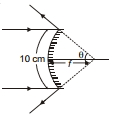
A driving mirror consists of a cylindrical mirror of radius of curvature $10 \,cm$ and the length over the curved surface is $10 \,cm$. If the eye of the driver be assumed to be at a great distance from the mirror, then field of view in radian is
Answera
(a)
$f=\frac{R}{2}=5 \,cm$
$\theta=\frac{10}{5}=2 \,rad$
View full question & answer→MCQ 1371 Mark
A point source S is placed at distance of $15 \;cm$ from a converging lens of focal length 10 cm . Where should a concave mirror of focal length $12\; cm$ be placed so that real image is formed on object itself.
Answerb
$u=- 15\,\,cm\,,\,\,{{f}}= +10\,\,cm$
$\frac{1}{v} - \frac{1}{u}=\frac{1}{{{f}}}$
$\Rightarrow \,\,\frac{1}{v}-\frac{1}{{( - 15)}}=\frac{1}{{10}}$
$\Rightarrow v=30\,cm$
$x=v+2 f \Rightarrow 30+3 \times 12=54 \;cm$
View full question & answer→MCQ 1381 Mark
In the figure shown if the object $‘O’$ moves towards the plane mirror, then the image $I$ (which is formed after successive reflections from $M_1$ & $M_2$ respectively) willmove:
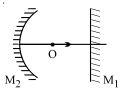
Answera
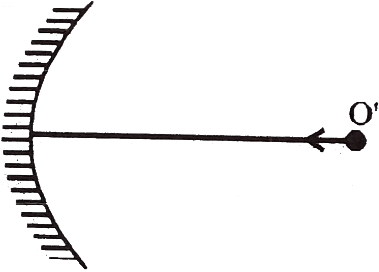
image $(O')$ of object in plane mirror will act as object for convave mirror.
$\left(V_{I / M}\right)=-m_{T}^{2} .\left(V_{O / M}\right)_{\mathrm{M}}$
so image $I$ in concave mirror will move towards right.
View full question & answer→MCQ 1391 Mark
A luminous object is placed $20\, cm$ from the surface of convex mirror and a plane mirror is adjusted in such a way that virtual images formed by two mirrors coincides. If focal length of convex mirror is $5\, cm$, then distance between plane mirror and object will be......$cm$
Answerb
$\mathrm{u}=-20 \mathrm{\,cm}$
$\mathrm{f}=+5 \mathrm{\,cm}$
$\frac{1}{f}=\frac{1}{v}+\frac{1}{u}$
$\mathrm{v}=+4 \mathrm{\,cm}$
Distance between object and image is $24 \mathrm{\,cm} .$ So plane mirror must be placed in between i.e. at $12 \mathrm{\,cm}$ from object.
View full question & answer→MCQ 1401 Mark
How much water should be filled in a container $21 cm$ in height, so that it appears half filled when viewed from the top of the container......$cm$ (given that $_a{\mu _\omega } = 4/3$)
Answerc
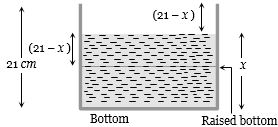
(c) To see the container half-filled from top, water should be filled up to height $x$
so that bottom of the container should appear to be raised upto height $(21-x).$
As shown in figure apparent depth $h' = (21 - x)$
Real depth $h = x$
$\therefore $$\mu = \frac{h}{{h'}} \Rightarrow \frac{4}{3} = \frac{x}{{21 - x}} \Rightarrow x = 12 cm$
View full question & answer→MCQ 1411 Mark
A vessel of depth $2d\, cm$ is half filled with a liquid of refractive index ${\mu _1}$ and the upper half with a liquid of refractive index ${\mu _2}$. The apparent depth of the vessel seen perpendicularly is
- A
$d\,\left( {\frac{{{\mu _1}{\mu _2}}}{{{\mu _1} + {\mu _2}}}} \right)$
- ✓
$d\,\left( {\frac{1}{{{\mu _1}}} + \frac{1}{{{\mu _2}}}} \right)$
- C
$2d\,\left( {\frac{1}{{{\mu _1}}} + \frac{1}{{{\mu _2}}}} \right)$
- D
$2d\,\left( {\frac{1}{{{\mu _1}{\mu _2}}}} \right)$
AnswerCorrect option: B. $d\,\left( {\frac{1}{{{\mu _1}}} + \frac{1}{{{\mu _2}}}} \right)$
b
( b)$h' = \frac{{{d_1}}}{{{\mu _1}}} + \frac{{{d_2}}}{{{\mu _2}}} = d\left( {\frac{1}{{{\mu _1}}} + \frac{1}{{{\mu _2}}}} \right)$
View full question & answer→MCQ 1421 Mark
The refractive indices of glass and water w.r.t. air are $3/2$ and $4/3$ respectively. The refractive index of glass w.r.t. water will be
Answerb
(b) $_a{\mu _g} = \frac{3}{2},{\,_a}{\mu _w} = \frac{4}{3}$
$\therefore $ $_w{\mu _g} = \frac{{_a{\mu _g}}}{{_a{\mu _w}}} = \frac{{3/2}}{{4/3}} = \frac{9}{8}$
View full question & answer→MCQ 1431 Mark
For a colour of light the wavelength for air is $6000 Å$ and in water the wavelength is $4500 Å.$ Then the speed of light in water will be
AnswerCorrect option: B. $2.25 \times {10^8} m/s$
b
( b)$v \propto \lambda \Rightarrow \frac{{{v_1}}}{{{v_2}}} = \frac{{{\lambda _1}}}{{{\lambda _2}}}$
$\therefore $ ${v_2} = \frac{{{v_1}}}{{{\lambda _1}}} \times {\lambda _2} = 3 \times {10^8} \times \frac{{4500}}{{6000}} = 2.25 \times {10^8}$ $m/s$
View full question & answer→MCQ 1441 Mark
A ray of light is incident on the surface of separation of a medium at an angle $45^o $ and is refracted in the medium at an angle $30^o .$ What will be the velocity of light in the medium
- A
$1.96 \times {10^8} m/s$
- ✓
$2.12 \times {10^8}$ $m/s$
- C
$3.18 \times {10^8}$$m/s$
- D
$3.33 \times {18^8}$$m/s$
AnswerCorrect option: B. $2.12 \times {10^8}$ $m/s$
b
(b) $\mu = \frac{c}{v} = \frac{{\sin i}}{{\sin r}} = \frac{{\sin {{45}^o}}}{{\sin {{30}^o}}}$
$ \Rightarrow $ $v = \frac{{3 \times {{10}^8}}}{{\sqrt 2 }} = 2.12 \times {10^8}$$m/s$
View full question & answer→MCQ 1451 Mark
Each quarter of a vessel of depth $H$ is filled with liquids of the refractive indices $n_1, n_2, n_3$ and $n_4$ from the bottom respectively. The apparent depth of the vessel when looked normally is
- A
$\frac{{H({n_1} + {n_2} + {n_3} + {n_4})}}{4}$
- ✓
$\frac{{H\left( {\frac{1}{{{n_1}}} + \frac{1}{{{n_2}}} + \frac{1}{{{n_3}}} + \frac{1}{{{n_4}}}} \right)}}{4}$
- C
$\frac{{({n_1} + {n_2} + {n_3} + {n_4})}}{{4H}}$
- D
$\frac{{H\left( {\frac{1}{{{n_1}}} + \frac{1}{{{n_2}}} + \frac{1}{{{n_3}}} + \frac{1}{{{n_4}}}} \right)}}{2}$
AnswerCorrect option: B. $\frac{{H\left( {\frac{1}{{{n_1}}} + \frac{1}{{{n_2}}} + \frac{1}{{{n_3}}} + \frac{1}{{{n_4}}}} \right)}}{4}$
b
(b) Apparent depth of bottom
= $\frac{{H/4}}{{{\mu _1}}} + \frac{{H/4}}{{{\mu _2}}} + \frac{{H/4}}{{{\mu _3}}} + \frac{{H/4}}{{{\mu _4}}}$
$ = \frac{H}{4}\left( {\frac{1}{{{\mu _1}}} + \frac{1}{{{\mu _2}}} + \frac{1}{{{\mu _3}}} + \frac{1}{{{\mu _4}}}} \right)$
View full question & answer→MCQ 1461 Mark
Refractive index of air is $1.0003$. The correct thickness of air column which will have one more wavelength of yellow light ($6000 Å$) than in the same thickness in vacuum is
- ✓
$2\, mm$
- B
$2\, cm$
- C
$2 \,m$
- D
$2\, km$
AnswerCorrect option: A. $2\, mm$
a
(a) For vacuum $t = n\,{\lambda _o}$.....$(i)$
For air $t = (n + 1)\,{\lambda _a}$.....$(ii)$
From equation $(i)$ and $(ii)$
$t = \frac{\lambda }{{\mu - 1}} = \frac{{6 \times {{10}^{ - 7}}}}{{1.0003 - 1}}$ $\left( {\mu = \frac{{{\lambda _o}}}{{{\lambda _a}}}} \right)$
$ = 2 \times {10^{ - 3}}m$
$= 2\,mm.$
View full question & answer→MCQ 1471 Mark
A fish at a depth of $12 \,cm$ in water is viewed by an observer on the bank of a lake. To what height the image of the fish is raised.......$cm$
Answerd
(d) Apparent rise $ = d\left( {1 - \frac{1}{{_a{\mu _w}}}} \right)$
$ = 12 \times \left( {1 - \frac{3}{4}} \right)$$= 3\, cm.$
View full question & answer→MCQ 1481 Mark
A ray of light falls on the surface of a spherical glass paper weight making an angle $\alpha $ with the normal and is refracted in the medium at an angle $\beta $. The angle of deviation of the emergent ray from the direction of the incident ray
- A
$(\alpha - \beta )$
- ✓
$2(\alpha - \beta )$
- C
$(\alpha - \beta )/2$
- D
$(\beta - \alpha )$
AnswerCorrect option: B. $2(\alpha - \beta )$
b
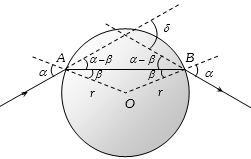
(b) From the following ray diagram it is clear that
$\delta = (\alpha - \beta ) + (\alpha - \beta )$$ = 2(\alpha - \beta )$
View full question & answer→MCQ 1491 Mark
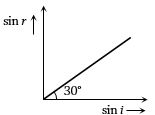
A medium shows relation between $i $ and $r$ as shown. If speed of light in the medium is $nc$ then value of $n $ is
- A
$1.5$
- B
$2$
- C
$2^{-1}$
- ✓
$3^{-1/2}$
AnswerCorrect option: D. $3^{-1/2}$
d
$(d)$ From graph it is clear that $\tan {30^o} = \frac{{\sin r}}{{\sin i}}$
==> $\frac{1}{{\sqrt 3 }} = \frac{{\sin r}}{{\sin i}} = \frac{1}{\mu }$ ==> $\mu = \sqrt 3 $
Also $v = \frac{c}{\mu } = nc$
==> $n = \frac{1}{\mu } = \frac{1}{{\sqrt 3 }} = {(3)^{ - 1/2}}$
View full question & answer→MCQ 1501 Mark
${V_o}$and ${V_E}$ represent the velocities,${\mu _o}$and${\mu _E}$the refractive indices of ordinary and extraordinary rays for a doubly refracting crystal. Then
- A
${V_o} \ge {V_E},\;\;{\mu _o} \le {\mu _E}$if the crystal is calcite
- B
${V_o} \le {V_E},\;\;{\mu _o} \le {\mu _E}$if the crystal is quartz
- ✓
${V_o} \le {V_E},\;\;{\mu _o} \ge {\mu _E}$if the crystal is calcite
- D
${V_o} \ge {V_E},\;\;{\mu _o} \ge {\mu _E}$if the crystal is quartz
AnswerCorrect option: C. ${V_o} \le {V_E},\;\;{\mu _o} \ge {\mu _E}$if the crystal is calcite
c
(c)In double refraction light rays always splits into two rays ($O-$ ray & $E-$ ray). $O-$ ray has same velocity in all direction but $E-ray$ has different velocity in different direction.
For calcite $\mu_e < \mu_0 ==> v_e > v_0$
For quartz $\mu_e > \mu_0 ==> v_0 > v_e$
View full question & answer→