Questions · Page 5 of 11

M.C.Q (1 Marks)

MCQ 2011 Mark
A potentiometer is an ideal device of measuring potential difference because
  • A
    It uses a sensitive galvanometer
  • It does not disturb the potential difference it measures
  • C
    It is an elaborate arrangement
  • D
    It has a long wire hence heat developed is quickly radiated
Answer
Correct option: B.
It does not disturb the potential difference it measures
View full question & answer
MCQ 2021 Mark
A Daniel cell is balanced on 125 cm length of a potentiometer wire. Now the cell is short-circuited by a resistance 2 ohm and the balance is obtained at 100 cm. The internal resistance of the Daniel cell is
  • 0.5 ohm
  • B
    1.5 ohm
  • C
    1.25 ohm
  • D
    4/5 ohm
Answer
Correct option: A.
0.5 ohm
0.5 ohm
View full question & answer
MCQ 2031 Mark
In Wheatstone's bridge P = 9 ohm, Q = 11 ohm, R = 4 ohm and S = 6 ohm. How much resistance must be put in parallel to the resistance S to balance the bridge
  • A
    24 ohm
  • B
    $\frac{44}{9}$ ohm
  • 26.4 ohm
  • D
    18.7 ohm
Answer
Correct option: C.
26.4 ohm
(c) 26.4 ohm
View full question & answer
MCQ 2041 Mark
The tangent galvanometer, when connected in series with a standard resistance can be used as
  • A
    An ammeter
  • A voltmeter
  • C
    A wattmeter
  • D
    Both an ammeter and a voltmeter
Answer
Correct option: B.
A voltmeter
A voltmeter
View full question & answer
MCQ 2051 Mark
A galvanometer can be used as a voltmeter by connecting a
  • High resistance in series
  • B
    Low resistance in series
  • C
    High resistance in parallel
  • D
    Low resistance in parallel
Answer
Correct option: A.
High resistance in series
View full question & answer
MCQ 2061 Mark
When a 12 Ω resistor is connected with a moving coil galvanometer then its deflection reduces from 50 divisions to 10 divisions. The resistance of the galvanometer is
  • A
    24 Ω
  • B
    36 Ω
  • 48 Ω
  • D
    60 Ω
Answer
Correct option: C.
48 Ω
48 Ω
View full question & answer
MCQ 2071 Mark
A galvanometer can be converted into an ammeter by connecting
  • A
    Low resistance in series
  • B
    High resistance in parallel
  • Low resistance in parallel
  • D
    High resistance in series
Answer
Correct option: C.
Low resistance in parallel
View full question & answer
MCQ 2081 Mark
A cell of internal resistance 1.5Ω and of e.m.f. 1.5 volt balances 500 cm on a potentiometer wire. If a wire of 15 Ω is connected between the balance point and the cell, then the balance point will shift
  • A
    To zero
  • B
    By 500 cm
  • C
    By 750 cm
  • None of the above
Answer
Correct option: D.
None of the above
None of the above
View full question & answer
MCQ 2091 Mark
$10^{-3}$ amp is flowing through a resistance of 1000Ω. To measure the correct potential difference, the voltmeter is to be used of which the resistance should be
  • A
    0 Ω
  • B
    500 Ω
  • C
    1000 Ω
  • >> 1000 Ω
Answer
Correct option: D.
>> 1000 Ω
(d) >> 1000 Ω
View full question & answer
MCQ 2101 Mark
A galvanometer of 100 Ω resistance gives full scale deflection when 10 mA of current is passed. To convert it into 10 A range ammeter, the resistance of the shunt required will be
  • A
    -10 Ω
  • B
    1 Ω
  • 0.1 Ω
  • D
    0.01 Ω
Answer
Correct option: C.
0.1 Ω
(c) 0.1 Ω
View full question & answer
MCQ 2111 Mark
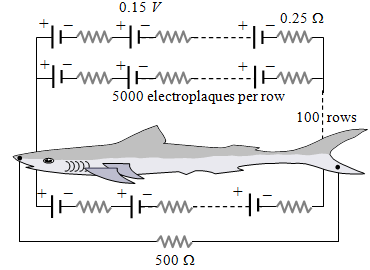
Eels are able to generate current with biological cells called electroplaques. The electroplaques in an eel are arranged in 100 rows, each row stretching horizontally along the body of the fish containing 5000 electroplaques. The arrangement is suggestively shown below. Each electroplaques has an emf of 0.15 V and internal resistance of 0.25 W


The water surrounding the eel completes a circuit between the head and its tail. If the water surrounding it has a resistance of 500 W, the current an eel can produce in water is about
  • 1.5 A
  • B
    3.0 A
  • C
    15 A
  • D
    30 A
Answer
Correct option: A.
1.5 A
(a) 1.5 A
View full question & answer
MCQ 2121 Mark
An ammeter gives full scale deflection when current of 1.0 A is passed in it. To convert it into 10 A range ammeter, the ratio of its resistance and the shunt resistance will be
  • A
    1 : 9
  • B
    1 : 10
  • C
    1 : 11
  • 9 : 1
Answer
Correct option: D.
9 : 1
9 : 1
View full question & answer
MCQ 2131 Mark
By ammeter, which of the following can be measured
  • A
    Electric potential
  • B
    Potential difference
  • Current
  • D
    Resistance
Answer
Correct option: C.
Current
Current
View full question & answer
MCQ 2141 Mark
The resistance of 1 A ammeter is 0.018 Ω . To convert it into 10 A ammeter, the shunt resistance required will be
  • A
    0.18 Ω
  • B
    0.0018 Ω
  • 0.002 Ω
  • D
    0.12 Ω
Answer
Correct option: C.
0.002 Ω
0.002 Ω
View full question & answer
MCQ 2151 Mark
For measurement of potential difference, potentiometer is preferred in comparison to voltmeter because
  • A
    Potentiometer is more sensitive than voltmeter
  • B
    The resistance of potentiometer is less than voltmeter
  • C
    Potentiometer is cheaper than voltmeter
  • Potentiometer does not take current from the circuit
Answer
Correct option: D.
Potentiometer does not take current from the circuit
View full question & answer
MCQ 2161 Mark
In order to pass 10% of main current through a moving coil galvanometer of 99 ohm, the resistance of the required shunt is
  • A
    9.9 Ω
  • B
    10 Ω
  • 11 Ω
  • D
    9 Ω
Answer
Correct option: C.
11 Ω
11 Ω
View full question & answer
MCQ 2171 Mark
For measurement of potential difference, potentiometer is preferred in comparison to voltmeter because
  • A
    Potentiometer is more sensitive than voltmeter
  • B
    The resistance of potentiometer is less than voltmeter
  • C
    Potentiometer is cheaper than voltmeter
  • Potentiometer does not take current from the circuit
Answer
Correct option: D.
Potentiometer does not take current from the circuit
(d) Potentiometer does not take current from the circuit
View full question & answer
MCQ 2181 Mark
In order to pass 10% of main current through a moving coil galvanometer of 99 ohm, the resistance of the required shunt is
  • A
    9.9 Ω
  • B
    10 Ω
  • 11 Ω
  • D
    9 Ω
Answer
Correct option: C.
11 Ω
(c) 11 Ω
View full question & answer
MCQ 2191 Mark
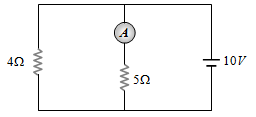
In the circuit, the reading of the ammeter is (assume internal resistance of the battery be zero)

  • A
    $\frac{40}{29}A$
  • B
    $\frac{10}{9}A$
  • C
    $\frac{5}{3}A$
  • 2 A
Answer
Correct option: D.
2 A
(d) 2 A
View full question & answer
MCQ 2201 Mark
An ammeter of 5 ohm resistance can read 5 mA. If it is to be used to read 100 volts, how much resistance is to be connected in series
  • A
    19.9995 Ω
  • B
    199.995 Ω
  • C
    1999.95 Ω
  • 19995 Ω
Answer
Correct option: D.
19995 Ω
(d) 19995 Ω
View full question & answer
MCQ 2211 Mark
The potential gradient along the length of a uniform wire is 10 volt/metre. B and C are the two points at 30 cm and 60 cm point on a meter scale fitted along the wire. The potential difference between B and C will be
  • 3 volt
  • B
    0.4 volt
  • C
    7 volt
  • D
    4 volt
Answer
Correct option: A.
3 volt
(a) 3 volt
View full question & answer
MCQ 2221 Mark
100 mA current gives a full scale deflection in a galvanometer of 2Ω resistance. The resistance connected with the galvanometer to convert it into a voltmeter to measure 5V is
  • A
    98 Ω
  • B
    52 Ω
  • C
    50 Ω
  • 48 Ω
Answer
Correct option: D.
48 Ω
(d) 48 Ω
View full question & answer
MCQ 2231 Mark
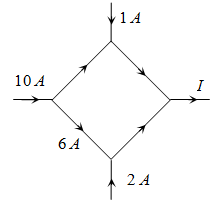
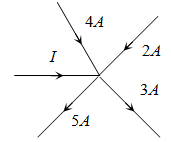
The figure shows a network of currents. The magnitude of currents is shown here. The current I will be
  • A
    3 A
  • B
    9 A
  • 13 A
  • D
    19 A
Answer
Correct option: C.
13 A
(c) 13 A
View full question & answer
MCQ 2241 Mark
To draw maximum current from a combination of cells, how should the cells be grouped
  • A
    Series
  • B
    Parallel
  • C
    Mixed
  • Depends upon the relative values of external and internal resistance
Answer
Correct option: D.
Depends upon the relative values of external and internal resistance
(d) Depends upon the relative values of external and internal resistance
View full question & answer
MCQ 2261 Mark
Two sources of equal emf are connected to an external resistance R. The internal resistances of the two sources are $R_1$  and $R_2\left(R_2>R_1\right)$ . If the potential difference across the source having internal resistance $R_2$ is zero, thenZ
  • A
    $\mathrm{R}=\mathrm{R}_1 \mathrm{R}_2 /\left(\mathrm{R}_1+\mathrm{R}_2\right)$
  • B
    $\mathrm{R}=\mathrm{R}_1 \mathrm{R}_2 /\left(\mathrm{R}_2-\mathrm{R}_1\right)$
  • C
    $\mathrm{R}=\mathrm{R}_2 \times\left(\mathrm{R}_1+\mathrm{R}_2\right) /\left(\mathrm{R}_2-\mathrm{R}_1\right)$
  • $\mathrm{R}=\mathrm{R}_2-\mathrm{R}_1$
Answer
Correct option: D.
$\mathrm{R}=\mathrm{R}_2-\mathrm{R}_1$
(d) $\mathrm{R}=\mathrm{R}_2-\mathrm{R}_1$
View full question & answer
MCQ 2271 Mark
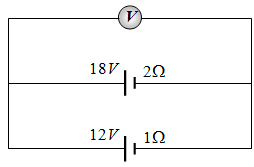
Two batteries, one of emf 18 volts and internal resistance 2Ω and the other of emf 12 volt and internal resistance 1 Ω, are connected as shown. The voltmeter V will record a reading of

  • A
    15 volt
  • B
    30 volt
  • 14 volt
  • D
    18 volt
Answer
Correct option: C.
14 volt
(c) 14 volt
View full question & answer
MCQ 2281 Mark
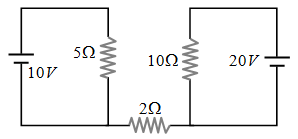
Find out the value of current through 2Ω resistance for the given circuit
  • A
    5 A
  • B
    2 A
  • Zero
  • D
    4 A
Answer
Correct option: C.
Zero
(c) Zero
View full question & answer
MCQ 2291 Mark
The maximum power drawn out of the cell from a source is given by (where r is internal resistance)
  • A
    $\mathrm{E}^2 / 2 \mathrm{r}$
  • $\mathrm{E}^2 / 4 \mathrm{r}$
  • C
    $\mathrm{E}^2 /  \mathrm{r}$
  • D
    $\mathrm{E}^2 / 3 \mathrm{r}$
Answer
Correct option: B.
$\mathrm{E}^2 / 4 \mathrm{r}$
(b) $\mathrm{E}^2 / 4 \mathrm{r}$
View full question & answer
MCQ 2301 Mark
When the resistance of 9 W is connected at the ends of a battery, its potential difference decreases from 40 volt to 30 volt. The internal resistance of the battery is
  • A
    6 W
  • 3 W
  • C
    9 W
  • D
    15 W
Answer
Correct option: B.
3 W
(b) 3 W
View full question & answer
MCQ 2321 Mark
A battery is charged at a potential of 15 V for 8 hours when the current flowing is 10 A. The battery on discharge supplies a current of 5 A for 15 hours. The mean terminal voltage during discharge is 14 V. The "Watt-hour" efficiency of the battery is
  • A
    82.5%
  • B
    80 %
  • C
    90%
  • 87.5%
Answer
Correct option: D.
87.5%
(d) 87.5%
View full question & answer
MCQ 2331 Mark
Current provided by a battery is maximum when
  • Internal resistance equal to external resistance
  • B
    Internal resistance is greater than external resistance
  • C
    Internal resistance is less than external resistance
  • D
    None of these
Answer
Correct option: A.
Internal resistance equal to external resistance
(a) Internal resistance equal to external resistance
View full question & answer
MCQ 2341 Mark
Electromotive force is the force, which is able to maintain a constant
  • A
    Current
  • B
    Resistance
  • C
    Power
  • Potential difference
Answer
Correct option: D.
Potential difference
(d) Potential difference
View full question & answer
MCQ 2351 Mark
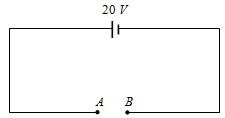
In the shown circuit, what is the potential difference across A and B

  • A
    50 V
  • B
    45 V
  • C
    30 V
  • 20 V
Answer
Correct option: D.
20 V
(d) 20 V
View full question & answer
MCQ 2361 Mark
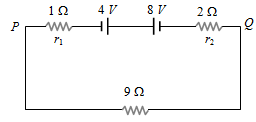
Two batteries of e.m.f. 4V and 8 V with internal resistances 1 W and 2 W are connected in a circuit with a resistance of 9 W as shown in figure. The current and potential difference between the points P and Q are

  • $\frac{1}{3}A$ and 3V
  • B
    $\frac{1}{6}A$ and 4V
  • C
    $\frac{1}{9}A$ and 9V
  • D
    $\frac{1}{2}A$ and 12 V
Answer
Correct option: A.
$\frac{1}{3}A$ and 3V
(a) $\frac{1}{3}A$ and 3V
View full question & answer
MCQ 2371 Mark
For driving a current of 2 A for 6 minutes in a circuit, 1000 J of work is to be done. The e.m.f. of the source in the circuit is
  • 1.38 V
  • B
    1.68 V
  • C
    2.04 V
  • D
    3.10 V
Answer
Correct option: A.
1.38 V
(a) 1.38 V
View full question & answer
MCQ 2381 Mark
Emf is most closely related to
  • A
    Mechanical force
  • Potential difference
  • C
    Electric field
  • D
    Magnetic field
Answer
Correct option: B.
Potential difference
(b) Potential difference
View full question & answer
MCQ 2391 Mark
The number of dry cells, each of e.m.f. 1.5 volt and internal resistance 0.5 ohm that must be joined in series with a resistance of 20 ohm so as to send a current of 0.6 ampere through the circuit is
  • A
    2
  • B
    8
  • 10
  • D
    12
Answer
Correct option: C.
10
(c) 10
View full question & answer
MCQ 2401 Mark
A storage battery has e.m.f. 15 volts and internal resistance 0.05 ohm. Its terminal voltage when it is delivering 10 ampere is
  • A
    30 volts
  • B
    1.00 volts
  • 14.5 volts
  • D
    15.5 volts
Answer
Correct option: C.
14.5 volts
(c) 14.5 volts
View full question & answer
MCQ 2411 Mark
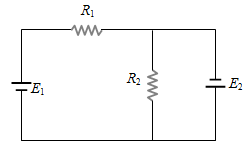
Two resistances $R_1$ and $R_2$  are joined as shown in the figure to two batteries of e.m.f. $E_1$  and $E_2$ . If $E_2$ is short-circuited, the current through $R_1$  is

  • $E_1/R_1$
  • B
    $E_2/R_1$
  • C
    $E_2/R_2$
  • D
    $E_1 /\left(R_2+R_1\right)$
Answer
Correct option: A.
$E_1/R_1$
(a) $E_1/R_1$
View full question & answer
MCQ 2421 Mark
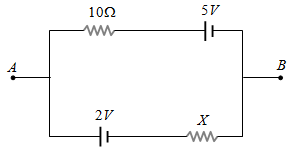
If $V_{A B}=4 \mathrm{~V}$ in the given figure, then resistance X will be
  • A
    5Ω
  • B
    10 Ω
  • C
    15 Ω
  • 20 Ω
Answer
Correct option: D.
20 Ω
(d) 20 Ω
View full question & answer
MCQ 2431 Mark
Kirchoff’s I law and II law of current, proves the
  • Conservation of charge and energy
  • B
    Conservation of current and energy
  • C
    Conservation of mass and charge
  • D
    None of these
Answer
Correct option: A.
Conservation of charge and energy
(a) Conservation of charge and energy
View full question & answer
MCQ 2441 Mark
The emf of a battery is 2 V and its internal resistance is 0.5 W. The maximum power which it can deliver to any external circuit will be
  • A
    8 Watt
  • B
    4 Watt
  • 2 Watt
  • D
    None of the above
Answer
Correct option: C.
2 Watt
(c) 2 Watt
View full question & answer
MCQ 2451 Mark
The n rows each containing m cells in series are joined in parallel. Maximum current is taken from this combination across an external resistance of 3W resistance. If the total number of cells used are 24 and internal resistance of each cell is 0.5 W then
  • A
    m = 8, n = 3
  • B
    m = 6, n = 4
  • m= 12, n = 2
  • D
    m = 2, n = 12
Answer
Correct option: C.
m= 12, n = 2
(c) m= 12, n = 2
View full question & answer
MCQ 2461 Mark
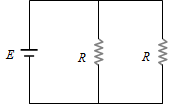
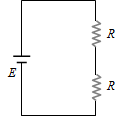
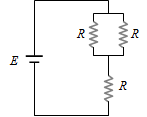
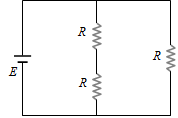
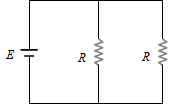
Consider four circuits shown in the figure below. In which circuit power dissipated is greatest (Neglect the internal resistance of the power supply)
  • B
  • C
  • D
Answer
Correct option: A.
(a)
View full question & answer
MCQ 2471 Mark
How much work is required to carry a 6 mC charge from the negative terminal to the positive terminal of a 9 V battery
  • A
    $54 \times 10^{-3} \mathrm{~J}$
  • $54 \times 10^{-6} \mathrm{~J}$
  • C
    $54 \times 10^{-9} \mathrm{~J}$
  • D
    $54 \times 10^{-12} \mathrm{~J}$
Answer
Correct option: B.
$54 \times 10^{-6} \mathrm{~J}$
(b) $54 \times 10^{-6} \mathrm{~J}$
View full question & answer
MCQ 2481 Mark
The internal resistance of a cell is the resistance of
  • A
    Electrodes of the cell
  • B
    Vessel of the cell
  • Electrolyte used in the cell
  • D
    Material used in the cell
Answer
Correct option: C.
Electrolyte used in the cell
(c) Electrolyte used in the cell
View full question & answer
MCQ 2491 Mark
When a resistor of 11 W is connected in series with an electric cell, the current flowing in it is 0.5 A. Instead, when a resistor of 5 W is connected to the same electric cell in series, the current increases by 0.4 A. The internal resistance of the cell is
  • A
    1.5 W
  • B
    2 W
  • 2.5 W
  • D
    3.5 W
Answer
Correct option: C.
2.5 W
(c) 2.5 W
View full question & answer
MCQ 2501 Mark
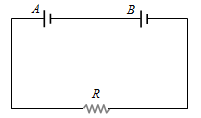
Two batteries A and B each of e.m.f. 2 V are connected in series to an external resistance R = 1 ohm. If the internal resistance of battery A is 1.9 ohms and that of B is 0.9 ohm, what is the potential difference between the terminals of battery A
  • A
    2 V
  • B
    3.8 V
  • Zero
  • D
    None of the above
Answer
Correct option: C.
Zero
(c) Zero
View full question & answer