Write the formula to determine the value of electric field intensity due to a uniformly charged thin spherical shell.
Answer
(i) Electric field outside shell: $E =\frac{q}{4 \pi \epsilon_0 r^2}$ Here, $q=4 \pi R^2 \sigma$ is the total charge on spherical shell Vector form $\vec{E}=\frac{q}{4 \pi \epsilon_0 r^2} \vec{r}$ (ii) Electric field inside the shell : Due to a uniformly charged thin spherical shell, the electric field at all points inside it is zero.
Can a metal sphere of radius 1 em be given a charge of IC?
Answer
No, electric field at the bottom of the sphere $E =\frac{1}{4 \pi \epsilon_0} \times \frac{q}{ R ^2}$ $=9 \times 10^9 \times \frac{1}{(0.01)^2}$ $=9 \times 10^{13} V / m$ If the electric field intensity in air is $3 \times 10^6 V / m$, air will be ionized and the charge of the sphere will be destroyed in air Therefore the sphere will not be able to hold a charge of 1 C.
If an electric dipole is placed at an angle of $30^{\circ}$ to an electric field of intensity $2 \times 10^5 N / C$, a torque of 4 Nm is applied on it. If the length of the dipole is 2 cm , then what will be charge?
A sample of $\ce{HCl}$ gas is placed in an electric field of $3 \times 10^4 N / C$. The dipole moment of each molecule of $\ce{HCl}$ is $6 \times 10^{-30} C \times m$. What will be the maximum torque acting on the molecule?
Answer
Torque on dipole $\tau= P \times E$
$ \tau=P E \sin \theta $
For maximum value, $\theta=90^{\circ}$
$ \tau_{\max }=6 \times 10^{-30} \times 3 \times 10^4 \sin 90^{\circ}$
$\tau_{\max }=18 \times 10^{-26} Nm $
(1) Charge can be zero, positive or negative but mass is always positive. (ii) Electric charge does not depend on the velocity of motion of the particle whereas mass also depends on the velocity of motion of the particle.
Two protons and two electrons are hanging freely at equal distances. Compare the repulsion force between proton and electron.
Answer
The repulsion forces between two protons and two electrons will be equal because the magnitude of charge on the proton and electron is equal and the distances between them are also equal.
If we walk barefoot on a nylon mat for some time and touch the metal handle of a door, we get an electric shock. Why does this happen?
Answer
While walking, our feet rub on the mat, due to which our body gets charged. When we touch the handle, electric charge from our body flows into it, due to which we
get a shock.
Two point charges are placed at a distance d from each other. Due to these, the electric field intensity at any point is zero. But the point is not in the middle of these charges although on the line connecting them, write two necessary conditions for this to happen.
Answer
(i) Both the charges should be of opposite nature.(ii) The magnitude of the charge located near that point should be less and the magnitude of the other charge should be greater.
There is a potential of 10V on the surface of a charged spherical shell of radius 10 cm. Write the value of potential at a distance of 5 cm from its centre.
Answer
The potential is the same at all points within the spherical surface and its value is the same as that on the surface of a spherical charge, that is, the value of the potential at a distance of 5 cm from its centre will be 10 Volt.
An electric dipole of charge $\pm 1 \mu C$ is located inside a spherical Gaussian surface of radius 1 cm . Write the value of electric flux emerging from the Gaussian surface.
Answer
Electric flux emerging out of Gaussian surface $\phi=\frac{q}{\epsilon_0} $Here, $\epsilon_0$ is the electrical conductivity of air or vacuumIn the given question the algebraic sum of charges is zero. Therefore the value of electric flux emmiting from the Gaussian surface will be zero.
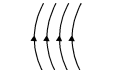
(i) The tangent drawn at any point to the line of electric force expresses the direction of the resultant electric field at that point. (ii) Electric lines of force run from positive charge and end at netative charge. Note: Students can also write other properties of electric field lines.
Can a metal sphere of radius one meter be given a charge of 1 coulomb?
Answer
No, because $\begin{aligned} E= \frac{k q}{R^2}=\frac{9 \times 10^9 \times 1}{1^2} \\ E=9 \times 10^9 \frac{\text { Volt }}{\text { meter }}\end{aligned}$ will occur on the surface of the sphere. If the electric field in the air exceods $3 \times 10^6$ Volt/ meter, the air will get ionized due to which the charge of the sphere will get destroyed in the air.
How does the electric field due to point charge and line charge change with distance?
Answer
Due to point charge $E =\frac{1}{4 \pi \epsilon_0}\left(\frac{q}{r^2}\right)$ $E \propto \frac{1}{r^2}$ And due to linear charge $E =\frac{\lambda}{2 \pi \epsilon_0 r} \Rightarrow E \propto \frac{1}{r}$
It is a region around a charge in which the electric field intensity is equal at all points and the electric flux is always perpendicular to the surface.
The total value of electric flux passing through a closed surface in free space is $\frac{1}{\epsilon_0}$ times the charge enclosed by the surface. Electric flux passing through a closed surface S $ \phi=\frac{q}{\epsilon_0} $ Here $q$, is the total charge enclosed bv the surface S .
What is the magnitude of the torque and also give its direction.
Answer
Magnitude of torque $=q E \cdot 2 a \sin \theta$ $=2 q a E \sin \theta$ The direction of $\vec{p}$ normal to the plane of $\overrightarrow{ E }$ is given by the right hand screw rule. But $p=2 a q$ $\therefore \quad$ Magnitude of torque $=p E \sin \theta$
A dipole of dipole moment $\vec{P}$ is placed in a uniform electric field $\vec{E}$. Write the value of the angle between $\vec{P}$ and $\vec{E}$ for which the torque experienced by the dipole is minimum.
Answer
$\theta=0^{\circ} \text { (because } t=P E \sin \theta \text { for } \tau_{\min } \left. \sin \theta=0, \theta=0^{\circ}\right)$
In which configuration will an electric dipole be in (i) permanent and (ii) temporary equilibrium when placed under a uniform electric field?
Answer
(i) When the electric dipole moment $\overrightarrow{ P }$ and the electric field intensity $\vec{E}$ have the same direction. (ii) When $\overrightarrow{ P }$ and $\overrightarrow{ E }$ are in opposite directions.
The electric flux $\overrightarrow{\Delta S}$ passing through an area element $\Delta \phi$ is detined as follows : $ \Delta \phi=\vec{E} \cdot \overrightarrow{\Delta S}=E \Delta S \cos \theta $ Here, $\theta$ is the angle between the area element $\overrightarrow{\Delta S}$ and $\overrightarrow{ E }$
Why can't two lines of electric force intersect each other?
Answer
Lines of force do not intersect each other, because if they intersect then two tangent lines at the intersection point will express two resultant fields, which is impossible.
Definition of electric field intensity at a point.
Answer
The electric force acting on a unit test positive charge at any point in the electric field is called the intensity of the electric field at that point. $E =\lim _{q_0 \rightarrow 0}\left(\frac{F}{q_0}\right)$
Two equal point charges are placed at a dis- tance of 1 meter from each other, experience a force of 8N. If these charges are kept in water at the same distance, then how much force will be felt between them?
Answer
We know$F_{m}=\frac{F_{a}}{m}=\frac{8 N}{80}=0.1 N$
The ratio of absolute permittivity of a medium and permittivity of air or vacuum is called dielectric constant (relative permittivity) of the medium. Therefore, $\epsilon_{ r }=\frac{\epsilon}{\epsilon_0}$ or $\epsilon=\epsilon_{ o } \epsilon_{ T }$
If two electric charges $q_1$ and $q_2$ are such that (i) $q_1 q_2>0$, (ii) $q_1 q_2<0$, then what will be the nature of the electric force between them?
Answer
(i) Repulsive (since in this case both the chargers will be of similar nature).
(ii) Attractive (since in this case both the charges will be of opposite nature).
The force of attraction or repulsion (F) between two point charges is proportional to the product of the magnitude of the charges $q_1$ and $q_2$ and inversely proportional to the square of the distance between the charges $\left(1 / r^2\right)$. That is $F \propto \frac{q_1 q_2}{r^2}$ or $F = K \frac{q_1 q_2}{r^2}$ or $F =\frac{1}{4 \pi \epsilon_o} \frac{q_1 q_2}{r^2}$ Here, $K \left(=\frac{1}{4 \pi \epsilon_{ o }}\right)=9 \times 10^9 Nm ^2 / C ^2$.