Sample QuestionsElectric Charges and Fields questions
One sample from each question group in this chapter. Select any group above to see the full set with answer keys.
The value of dielectric strength for air is:
- ✓
$3 \times 10^6 V / m$
- B
$3 \times 10^8 V / m$
- C
- D
Answer: A.
View full solution →The electric flux on a Gaussian spherical surface of radius 15 cm, drawn with a point charge as the centre, is ф. If the radius of this surface is tripled, then the electric flux passing through the surface will be:
Answer: D.
View full solution →The SI value of electrical conductivity of free space or vacuum is:
- A
$9 \times 10^{\circ} Nm ^2 / C ^2$
- B
$-9 \times 10^{\circ} Nm ^2 / C ^2$
- ✓
$8.854 \times 10^{-12} C ^2 N^{-1} m^{-2}$
- D
$8.854 \times 10^{12} C ^2 N^{-1} m^{-2}$
Answer: C.
View full solution →The SI unit of electric flux is:
- ✓
$NC ^{-1} m^2$
- B
$NC ^{-1} m^-2$
- C
$N ^{-1} C ^{-1} m^{-2}$
- D
$N ^{-1} C ^{1} m^{2}$
Answer: A.
View full solution →The magnitude of the electric field due to a point charge at a distance of 4.0 m is 9 N/C. Distance of this point charged substance due to electric field of magnitude 16 N/C will be:
Answer: C.
View full solution →Write the value of the electric field due to an electric dipole at a point situated on its axis.
Write the formula to determine the value of electric field intensity due to a uniformly charged thin spherical shell.
Draw lines of force due to point charges when
(i) $q<0$ and (ii) $q>0 . \quad$
View full solution →Can a metal sphere of radius 1 em be given a charge of IC?
If an electric dipole is placed at an angle of $30^{\circ}$ to an electric field of intensity $2 \times 10^5 N / C$, a torque of 4 Nm is applied on it. If the length of the dipole is 2 cm , then what will be charge?
View full solution →Electric charge is distributed in a small volume. The electric flux passing through a total charge enclosed by a spherical surface of radius 10 cm is 10 Vm . Then what will be the flux associated with a concentric sphere of radius 20 cm ?
The electric potential inside a charged spherical ball is given by $\phi=a r^2+b$. Where $r$ is the distance from the centre, $a$ and $b$ are constants. Calculate the charge density inside the ball.
View full solution →If an electric dipole is placed at an angle of $30^{\circ}$ to an electric field of intensity $2 \times 10^5 N / C$, a torque of 4 Nm is applied on it. If the length of the dipole is 2 cm , then what will be charge?
View full solution →A sample of $\ce{HCl}$ gas is placed in an electric field of $3 \times 10^4 N / C$. The dipole moment of each molecule of $\ce{HCl}$ is $6 \times 10^{-30} C \times m$. What will be the maximum torque acting on the molecule?
View full solution →Two electric dipoles whose dipole moments are $P$ and 64 P are placed on a line at a distance of 25 cm in opposite directions. If the electric field at any point between them is zero, then what will be the distance of this point from the electric potential $P$ ?
View full solution →Two electric charges $+Q$ and $-Q(x-y)$ are placed at the points $\left(-x_2, 0\right)$ and $\left(x_1, 0\right)$ respectively in the plane. Find the magnitude and direction of the resultant electric field at the origin $(0,0)$.
View full solution →By defining electric dipole and dipole moment, find the necessary formula for the field intensity at any point located on the neutral (equatorial plane) of the dipole.
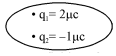
Write the statement of Gauss's law for electrostatics. Draw a diagram and derive an expression for the electric field due to a uniformly charged infinite plane sheet at a point near it.In the given figure, write the value of electric flux emerging from the surface :
Prove that due to a charged layer of infinite expansion, the value of the electric field at any point near it does not depend on the area of the surface and the distance from the layer . i.e., the electric field remains uniform at points near the layer.###Write Gauss'law.By applying this rule,find the value of the electric field due to a uniformly charged infinite plane sheet at any point near the sheet.
What is Gauss theorem? With its help, obtain an expression for the electric field intensity at any point near a uniformly charged linear conductor of infinite length.###Make the necessary diagram and with the help of Gauss law, calculate the electric field intensity at any point due to a charged wire of infinite length. Plot the change in intensity with distance.###Define Gauss' law. With its help, find the value of electric field intensity at a distance from a uniformly charged linear conductor of infinite extension. Make the necessary diagram and also make a graph of the change of electric field with distance.
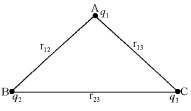
Write the definition of electrostatic at any point. Also write its S.I. units. As shown in the figure, three points charges $q_1$, $q _2$ and $q _3$ are placed at points $A, B$ and $C$ respectively. Drive an expression for the electrostatic potential energy of this system.
View full solution →The charge density of two uniformly charged parallel infinite plane sheets ' 1 ' and ' 2 ' are $+\sigma$ and $-2 \sigma$ respectively. Find the magnitude and direction of the net electric field (i) at any point between these two sheets and (ii) at any point outisde these two sheets but near sheet ' 1 '.
View full solution →A charge of $1.6 \times 10^{-7} C$ is uniformly distributed on the surface of a spherical conductor of radius 12 cm . What will be the electric field?(a) Inside the sphere(b) Just outside the sphere(c) At any point located 18 cm from the centre of the sphere.
View full solution →The radius of a thin hollow metal sphere (spherical shell) is 30 cm . And there is a charge of 500 $\mu C$ on that spherical shell. Find the electric field intensity at a distance.(i) 1 meter, (ii) 30 cm , (iii) 10 cm , from the centre of the cell.
View full solution →An electric charge of $17.7 \times 10^{-4}$ Coulomb is distributed uniformly on a large thin sheet of area $200 m^2$. Find the intensity of the electric field in air at a distance of 20 cm from it.
View full solution →An electron revolves around an infinite positive linear charge in a circular orbit of radius 0.5 m . If the line charge density is $18.2 \times 10^{-10}$ Coulomb/ meter, then find the speed of the electron (in $m / s$ ).
(Mass of electron $m=9.1 \times 10^{-31} kg$ )
View full solution →The field lines due single positive charge are radially $.................$
View full solution →The direction of the area vector is $...............$ to the region.
View full solution →If the electron and proton are kept in the same electric field, the acceleration of $...............$ will be greater.
View full solution →Electric dipole moment is a $...............$ quantity.
View full solution →If a dielectric material is placed between two positive charges placed in air, the repulsion force between them will be $...............$
View full solution →